
CompanyWatch Field Guide: How to Stress-Test ABLIC's Growth Story, Ultrasound Roadmap and Battery-less Sensor Bet
ABLIC grew straight through a stalled analog market — recording over 10% year-over-year sales growth in FY 2025 while the sector stayed flat from 2023 to 2025 — because it concentrates low-power analog know-how on five key sectors instead of chasing volume. For readers who track the company, the practical question is not whether it grew but which two lines make that growth repeatable: medical and high-voltage applications, and the CLEAN-Boost TM battery-less water leak sensor.
This CompanyWatch note converts the strategy statements made by Satoshi Hanazawa, ABLIC's Director, Senior Vice President and CPO (Chief Product Officer), into a working verification routine: what to read first, which claims can be checked against public records, where buyers and analysts commonly misjudge the technology, and which indicators to log over the next four quarters.
What does ABLIC actually sell, and why does its background matter?
Start with the unit of analysis: ABLIC is a specialized analog semiconductor manufacturer, not a diversified chip group. Hanazawa describes the business as organised around five key sectors — lithium-ion battery protection, power management ICs for automotive applications, medical and high-voltage applications, Hall effect ICs (magnetic sensor ICs), and battery-less water leak sensors built on CLEAN-Boost TM technology. Within that set, he identifies medical and high-voltage applications and the battery-less leak sensor as the highest-growth areas.
The company's differentiator is inherited, not purchased: a low-power-consumption approach cultivated over more than half a century, beginning with semiconductors for watches. Two structural facts sharpen how that heritage should be read. ABLIC became independent from the SEIKO Group in 2018, and it is now presented on its corporate pages as a member of the MinebeaMitsumi Group; a group investor briefing has argued that combining ABLIC with MinebeaMitsumi and excluding vendors focused solely on power semiconductors puts the pair third in analog. For an outside reader, the implication is operational: ABLIC scales by raising value per function, not by adding wafer volume, and it can lean on group resources for market access while keeping a narrow product identity.

How did growth continue while the analog market stood still?
The short answer, in Hanazawa's telling: product mix, not cycle luck. After the COVID-19 pandemic, the industry worked through excess inventory and a long adjustment period, leaving the analog semiconductor market flat from 2023 to 2025. ABLIC nonetheless kept expanding, with over 10% year-over-year sales growth in FY 2025, which he attributes to consistently supplying high-value-added products that make ABLIC the first choice for its customers.
Hanazawa also flags where competition is already intense: the AI sector draws major attention and rapid response to demand is critical, while the longer-term bets he names are humanoid robots, commercial drones and autonomous driving. Three tests make that claim checkable rather than rhetorical:
- Segment mix — has the growth come from the two designated high-growth areas, or from restocking in the older three sectors?
- Price per function — is the new-product share of total sales rising, as management says it is targeting?
- Design-win latency — how quickly do completed ICs convert into customer mass production, the metric that best reflects ABLIC's collaboration model with device makers?
What is the medical ultrasound plan, and what can be verified?
Conclusion: the medical story is a vertical integration play on ultrasound transmit and receive, and it is the most externally verifiable part of ABLIC's roadmap. Transmitter ICs for ultrasound diagnostic systems remain the strength. In December 2024 the company acquired Socionext's medical business, adding low-power, compact, lightweight receiver LSIs that deliver high diagnostic image quality, and giving ABLIC comprehensive transmitter-receiver solutions for ultrasound diagnostic systems.
Combining transmission and reception is what drives the viewphii series for handheld ultrasound devices. A third-generation model is under development, scheduled for mass production in 2027, and will raise transmission voltage to ±100V to improve deep-tissue diagnostic image quality. ABLIC's own newsroom, which styles the part viewphii-Gen 3 as "viewphii-Gen3", puts it on a sampling track ahead of that production date and describes a newly developed digital pulser IC lifting output from ±40V in the previous generation to the ±100V level (ABLIC product news, 22 October 2026). For readers, the useful inference is the ratio, not the label: roughly 2.5x transmit voltage is what converts a portable probe from a superficial-imaging tool into a deeper-diagnostic one, while size, weight and continuous-run time are held at earlier-generation levels.
Two dates anchor the near-term watch list. ABLIC plans to present the expanding handheld series at RSNA 2026 in Chicago, Illinois, this November; the society's own meeting page lists the RSNA annual session as Nov. 29 - Dec. 3 (RSNA). It will also share the lineup and roadmap for transmitter ICs and high-voltage switch ICs aimed at higher performance, functionality and reliability for conventional cart-based systems. ABLIC has long collaborated with medical device manufacturers so that buyers can evaluate ICs early in development and move swiftly to mass production after ICs are completed - the mechanism behind the fast growth of its medical-related business.
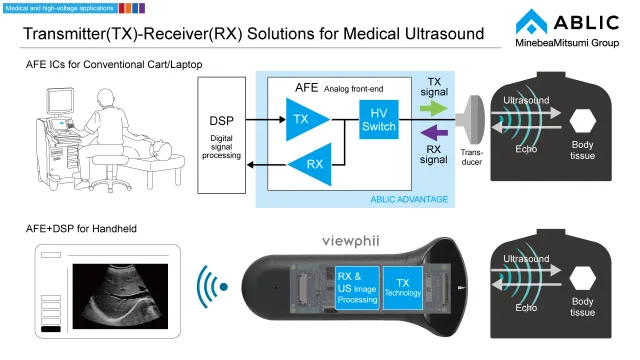
Transmitter(TX)-Receiver(RX) Solutions for Medical Ultrasound (Source: ABLIC)
Why is a battery-less water leak sensor a company-level growth driver?
Because the demand curve moved out of factories and into water-cooled AI data centers. The sensor uses CLEAN-Boost TM, a power storage and boost circuit technology: the wireless device harvests the tiny electrical charge generated when it contacts water, detects a few drops, and cuts false alarms. Such sensors were traditionally installed in factories and buildings, but growing water-cooled AI servers are lifting demand from data centers.
The technical distinction that matters in procurement is detection physics. Many water leak sensors rely on resistance changes between electrodes. ABLIC's battery-less water leak sensors instead identify leaks through the chemical reaction between water and metal, so they work even in pure water with low electrical conductivity - the condition inside many closed cooling loops. Because they need no power wiring or battery replacement, they can be retrofitted into existing infrastructure in large data centers and smart city developments in Europe.
Deployment status is uneven by region, and that is the honest way to read it. The sensors are already widely adopted in Japan, building a strong track record, with trial tests under way at several infrastructure facilities; ABLIC's own newsroom has reported verification results on an actual bridge presented at the JSCE Conference. In the US and EU markets, ABLIC obtained FCC certification, a communication and safety standard, and began sales last year. In June 2026 the company showcased the battery-less water leak sensor overseas for the first time at BOMA 2026, an international trade show in Los Angeles, California, generating great interest. Trade coverage of the export version points to a communication range extended to roughly twice that of the predecessor model (EDN, November 2025), consistent with product pages describing BLE beacon output and drip-level detection in under five minutes in tap water (ABLIC CLEAN-Boost product page).
Market context, to be treated as directional third-party estimation rather than company guidance: one research line sizes the global data center liquid cooling market at about US$5.7 billion in 2026 growing to US$29.2 billion by 2033 (Persistence Market Research), while another puts data center leak detection near US$640 million in 2025 rising toward US$1.39 billion by 2035 (OMR Global). Neither figure is an ABLIC forecast; they only indicate the pool the sensor competes for.
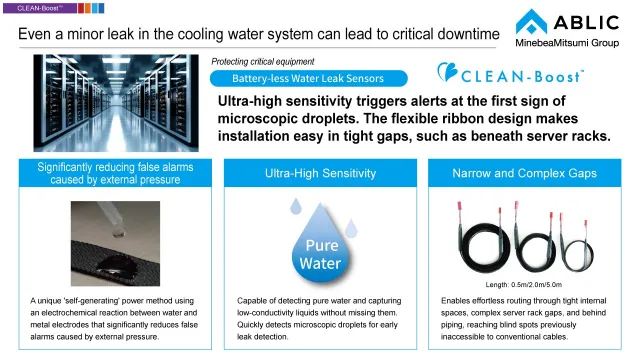
Characteristics and implementation overview of battery-less water leak sensors for data centers (Source: ABLIC)
Which assumptions about battery-less sensing are wrong? Common pitfalls
Five misconceptions recur in buyer memos and analyst notes, and GlobalBizSight's reading of the published material suggests each has a cheap counter-check.
- "Battery-free means maintenance-free." The tag needs no battery, but the reader, gateway or building network that collects the beacon signal usually does. Pilot scope should cover connectivity mapping and gateway power before any cost-per-point comparison.
- "Any leak sensor catches any leak." Electrode-resistance designs can under-report low-conductivity water; the metal-water chemical reaction approach is what enables pure-water detection. Specify loop chemistry, not just "water detection".
- "Detection equals location." A drip-level alarm without a unique tag ID mapped to a rack, pump or pipe segment still leaves crews searching. Confirm ID granularity and building-management integration paths.
- "One global SKU." Certification and radio specifications differ by market: FCC certification underpins the US and EU rollout, and the export variant changed range characteristics versus the Japan model. Re-read the datasheet for the region actually being deployed.
- "Better sensing replaces shutdown logic." Leak detection feeds alarm and isolation decisions; it does not replace loop-level valves, containment or emergency power design. Treat it as a layer, not a system.
How is ABLIC rebuilding the engine behind the products?
Two levers, both capital-light and both slow to show: development efficiency and adjacency expansion. Hanazawa says ABLIC aims to raise the share of new products in total sales and that the effort is progressing as planned, with continued investment in technology and talent, and M&A kept open as another route to high-value-added products. On AI, the company wants to improve development efficiency by training AI to acquire design expertise so it can eventually handle all stages of the process - while stressing that humans should make all final decisions, and consulting with EDA vendors on how to proceed given security concerns.
Adjacent demand is being pulled from the same low-power core. ABLIC intends to propose lithium-ion battery protection solutions for industrial equipment, including energy storage systems (ESS) and battery backup units (BBUs) that guard against momentary power interruptions in AI servers, and to expand the lineup with 48 V-compatible products so in-vehicle power supplies can serve a broad range of electric vehicles (EVs) and related applications. Beyond the five key sectors, including medical and high-voltage applications and CLEAN-Boost TM, the company plans to develop new fields that will become the sixth and seventh pillars of its business - the single most watchable item in this roadmap, because pillars six and seven will not appear in a flat market by accident.
Asked how ABLIC will use its strengths amid fierce global semiconductor competition, Hanazawa returned to a "Small Smart Simple" positioning: the company is committed to a vision of inspiring customers with Small, Smart, Simple analog semiconductor solutions. Its origin in watch semiconductors and its constant priority on low power consumption continue to shape the business, with new combinations of existing technologies intended to create products of still higher added value.
What should investors, analysts and BD teams do next? Action recommendations
Run a five-step routine each quarter; it separates a durable mix-driven grower from a cycle-driven one.
- Log the two high-growth lines separately. Track medical and high-voltage and battery-less leak sensing against the three legacy sectors; growth concentrated in legacy restocking weakens the mix argument.
- Follow the medical funnel, not the press release. Record RSNA 2026 exhibit content, then the interval between sampling, design win and customer mass production for the handheld and cart-based IC lines.
- Instrument the sensor rollout. Count announced data center or infrastructure installations outside Japan, retrofit versus new-build, and any certification expansion beyond FCC.
- Test the AI-efficiency claim on time-to-launch. New-product share of sales and shortened development cycles are the observable proxies; note that ABLIC says humans retain final design decisions.
- Watch for pillar six and seven. Treat M&A announcements, group capacity sharing and new application categories as the leading indicators of a sixth-sector move.
| Tracking indicator | Why it matters | First source to check |
|---|---|---|
| Year-over-year sales growth vs. analog market direction | Confirms whether growth is mix-driven (over 10% in FY 2025 against a flat 2023 to 2025 market) | ABLIC results and newsroom |
| New-product share of total sales | Management's stated efficiency target; progressing as planned | Company interviews, product launch cadence |
| Ultrasound transmit voltage roadmap (±40V to ±100V) | Defines which clinical use cases a handheld probe can serve | viewphii product news, RSNA 2026 |
| Export sensor certifications and range specs | Sets addressable markets and retrofit economics | FCC filings, ABLIC product pages, trade press |
| Named pillars beyond the five key sectors | Early signal of the sixth and seventh pillars | M&A disclosures, group investor briefings |
Frequently asked questions
Is ABLIC's growth in FY 2025 explained by the market recovering?
No. Hanazawa describes the analog semiconductor market as flat from 2023 to 2025 after pandemic-era excess inventory, while ABLIC still delivered over 10% year-over-year sales growth in FY 2025. The explanation offered is product mix: high-value-added parts that keep ABLIC as customers' first choice.
What did the Socionext deal change?
It closed a gap rather than opening a new market. Before December 2024 ABLIC was strong on transmitter ICs for ultrasound; acquiring Socionext's medical business added low-power, compact, lightweight receiver LSIs, enabling complete transmitter-receiver solutions.
Why do data centers need a battery-less sensor at all?
Because cabling and battery servicing are the costly parts of large-scale leak coverage. CLEAN-Boost TM lets the tag power itself from the water it detects, so drip-level alarms can be retrofitted into live facilities in Europe, Japan, the US and EU without new power runs.
What is the single best near-term event to watch?
RSNA 2026 in Chicago, Illinois this November, where ABLIC plans to present the expanding handheld line plus the roadmap for transmitter and high-voltage switch ICs for cart-based systems - the clearest public read on how quickly the third-generation model moves toward its 2027 mass production.
How should the leak-sensor opportunity be sized?
As exposure, not revenue. Third-party market studies put data center liquid cooling around US$5.7 billion in 2026 and leak detection nearer US$640 million in 2025; ABLIC's share is undisclosed, so track announced installations and certifications instead of inferring dollars.
Reference sources
- ABLIC corporate profile and group status - https://www.ablic.com/en/semicon/corp/
- MinebeaMitsumi Group FY3/2020 investor briefing (combined analog position) - https://www.minebeamitsumi.com/english/corp/investors/disclosure/financial/p2020/p2020_slide04/1198874_14199.html
- ABLIC viewphii-Gen3 sampling news release - https://www.ablic.com/en/semicon/news/2026-10-22/viewphii-gen3/
- RSNA annual meeting dates - https://www.rsna.org/annual-meeting
- ABLIC CLEAN-Boost battery-less water leak sensor product page - https://www.ablic.com/en/semicon/products/cb/wls/
- EDN on the upgraded battery-less leak detection sensor - https://www.edn.com/ablic-upgrades-battery-less-water-leak-detection-sensor/
- Persistence Market Research, data center liquid cooling - https://www.persistencemarketresearch.com/market-research/data-center-liquid-cooling-market.asp
- OMR Global, data center leak detection market - https://www.omrglobal.com/press-release/global-data-center-leak-detection-market
CompanyWatch observation report prepared by Marc Hale for GlobalBizSight. Corrections and tips: info@globalbizsight.com. Market-size figures are third-party estimates cited for context only and are not attributed to ABLIC.