
CompanyWatch: Amazon's GPU Order Purge Turns the Checkout Counter Into an AI Supply Signal
For once, the Amazon metric investors argued about this week was not AWS growth or fourth-quarter guidance; it was the cancellation notice inside a shopper's account. The episode surfaced on October 31, roughly 48 hours after the company reported third-quarter net sales of $201.9 billion and reaffirmed a 2026 capital-expenditure plan close to $220 billion. Buyers of high-end compute hardware say their orders were voided and, in at least one case, the profile itself was shut down. Read as a single-company event rather than a customer-service gripe, it reveals how Amazon manages scarcity at the edge of its retail business — and how little visible due process its risk systems currently offer.
Incident timeline: four DGX Spark orders, then a closed profile
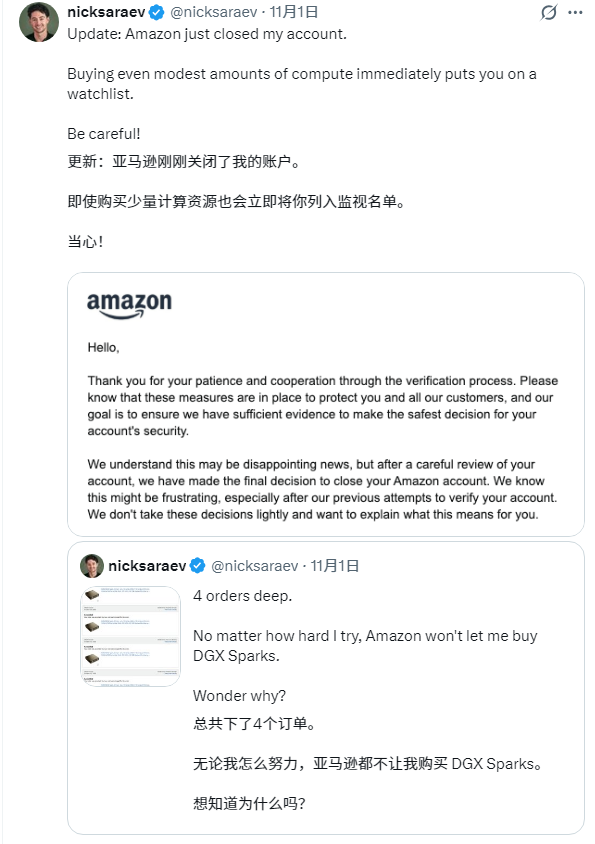
A shopper posting as @nicksaraev reports placing four separate orders for the NVIDIA DGX Spark on October 31, all of which were cancelled. Retry attempts failed as well; when Amazon's internal verification routine ran to completion, he says the company closed the account instead of releasing the units. The email he shared frames the decision as one taken after careful review.
The operational detail that turns this into a governance question is the collateral freeze. He reports no clear statement of what rule was broken, no appeal channel, and no further access to his Prime membership, gift-card balances or order history. Amazon's own help pages describe the mechanics bluntly: once an account is closed, the remaining balance is no longer available to the customer, and breaches of the gift-card rules can trigger account actions including balance revocation or closure. Enforcement is immediate; the explanation standard is not.
The second data point: one GPU purchase poisoning unrelated orders
Tim Sweeney, chief executive of Epic Games, describes a lighter but structurally identical outcome. His account remained open, yet after he ordered two NVIDIA GPUs, ordinary baskets began dying in the dispatch queue — submitted normally, then cut shortly before shipment. Sweeney notes that his routine purchasing had behaved normally before those graphics-card buys.
That sequence points to a control that is account-level rather than line-level: a flagged purchase appears to attach a persistent risk attribute to the profile, and the attribute then bleeds into unrelated items. If so, the design flaw is wider than GPU rationing — one scarce product category can degrade a customer's entire relationship with the store. Because Amazon has published no criteria for the flag, the incident stays unresolved as a governance issue instead of a mere availability issue.
Why now: three pressures meeting on one retail shelf
Device scarcity and a rising price path. The DGX Spark is NVIDIA's desktop Grace Blackwell machine built for local AI development, and its recent repricing signals supply pressure rather than fading demand. A 64 GB tier arrived at $4,999 in October 2026 while the 128 GB configuration was quoted near $6,950, after the original model had already been moved from $3,999 to $4,699 as memory shortages worked through the bill of materials (nvidia.com; wccftech.com). Hardware carrying a four-figure street premium invites arbitrage, and marketplaces answer by throttling quantities.
Instrument design differs across channels. Rival sellers have taken the opposite route: publish the rule instead of hiding it. Micro Center requires photo identification and a signed no-export pledge from buyers of flagship cards, and limits purchase to one GPU per customer per 30 days (tomshardware.com, October 2026). Explicit limits inconvenience fewer legitimate buyers; statistical risk scoring catches more false positives.
Amazon's own inventory paradox. Reporting during October 2026 described billions of dollars of NVIDIA racks bought for AWS sitting idle in transit warehouses because several data-centre sites lack the electricity to switch them on — the so-called dark GPUs (businessinsider.com). A consumer basket and an enterprise backlog run through different systems, but the incentive rhymes: when hardware is scarce and depreciation begins the day a rack is invoiced, management treats leakage anywhere in the chain as expensive.
Three ways to buy the same box, compared
| Dimension | Amazon retail (as reported) | Micro Center | Authorised NVIDIA channels |
|---|---|---|---|
| Rule visibility | No published criteria for cancellation or closure | Stated quantity limit per customer, per period | Waitlists and partner-level allocation disclosed |
| Identity check | Automated verification after the order is placed | Government photo ID at checkout | Account and business details at order intake |
| Quantity control | Implicit: repeated orders cancelled | Explicit: one GPU per 30 days | Explicit caps tied to channel stock |
| Failure mode | Whole account, benefits and stored balances frozen | Single transaction refused | Order parked on a queue |
| Buyer takeaway | Unpredictable for urgent professional needs | Friction is visible and plannable | Best audit trail for procurement records |
Materiality check: a trust problem, not a profit-and-loss problem
Set against Amazon's reported numbers, first-party GPU sales are a rounding error: third-quarter net sales of $201.9 billion, AWS revenue of roughly $46 billion growing 39% year on year, capital expenditure held near $220 billion for 2026, and fourth-quarter sales guidance of $240–247 billion (ir.aboutamazon.com; cnbc.com). Still, the two stories share a spine: cloud growth is the demand curve that makes a five-thousand-dollar desktop machine unbuyable. The real exposure is reputational and legal. The forfeited value in Prime benefits, stored balances and purchase records — extinguished without a stated reason — is exactly the fact pattern that consumer agencies and press scrutiny notice first.
Five misconceptions worth retiring
- A cancelled order proves the buyer did something wrong. Cancellation is a model output, not a finding of fact; the absence of a stated reason is itself the evidence problem.
- Account closure only costs the hardware. It also removes membership benefits, prepaid balances and the order archive that serves as receipts and warranty proof.
- Tim Sweeney was banned too. The reports say his account stayed open; what changed was whether individual orders survived to dispatch.
- Rationing proves AI demand is overheating. On Amazon's own infrastructure side, the binding constraint reported in October 2026 was power availability, not purchase orders.
- This is a glitch that will quietly disappear. Random faults do not typically complete a verification workflow and then execute an account-closure notification.
Follow-up checklist: what to watch next
- Any official Amazon statement defining the trigger for hardware-order cancellations, or a published per-SKU quantity cap.
- Whether an appeal path appears for closed accounts holding gift-card balances and Prime benefits.
- NVIDIA's next move on DGX Spark pricing and the mix between the 64 GB and 128 GB tiers, which tracks memory cost pass-through.
- Commentary on the fourth-quarter call about power interconnection queues and whether the $220 billion capex plan is adjusted or pulled forward.
- Street-price spreads on resale marketplaces: narrowing gaps suggest supply relief; widening gaps predict a tougher round of platform controls.
- Whether other large marketplaces copy the identity-verification model instead of the risk-flag model.
Action recommendations
- For procurement and IT teams: treat high-end AI workstations as a multi-channel problem. Buy one unit per account per order, prefer authorised partners or invoiced business channels with written terms, and export order history and receipts before any dispute begins.
- For buyers holding prepaid value: keep gift-card and promotional balances low. Stored credit converts a lost order into a lost asset.
- For industry analysts: use retail rationing of a flagship AI SKU as a leading indicator of allocation pressure upstream, and cross-check it against cloud capacity disclosures rather than reading it as demand proof.
- For Amazon watchers: the decisive question is not whether limits exist but whether they are documented. A published rule can be complied with; a hidden score can only be guessed at.
CompanyWatch verdict
The economics here are small and the information content is large. Amazon's retail GPU line moves no needle in a quarter defined by $201.9 billion of sales, yet the way that line is being policed exposes a strategic tension: the company is simultaneously the most aggressive bidder for scarce AI hardware and the least transparent about who may buy it. Until the criteria, the notice standard and the remedy path are made public, professional readers should treat these cancellations less as anti-resale enforcement than as supply management dressed in compliance language — and should price the trust cost, not the hardware cost, into their view of the platform.