
GlobalBizSight CompanyWatch: A Practical Guide to Reading AMD’s Data-Center-First Pivot After Q3 2026
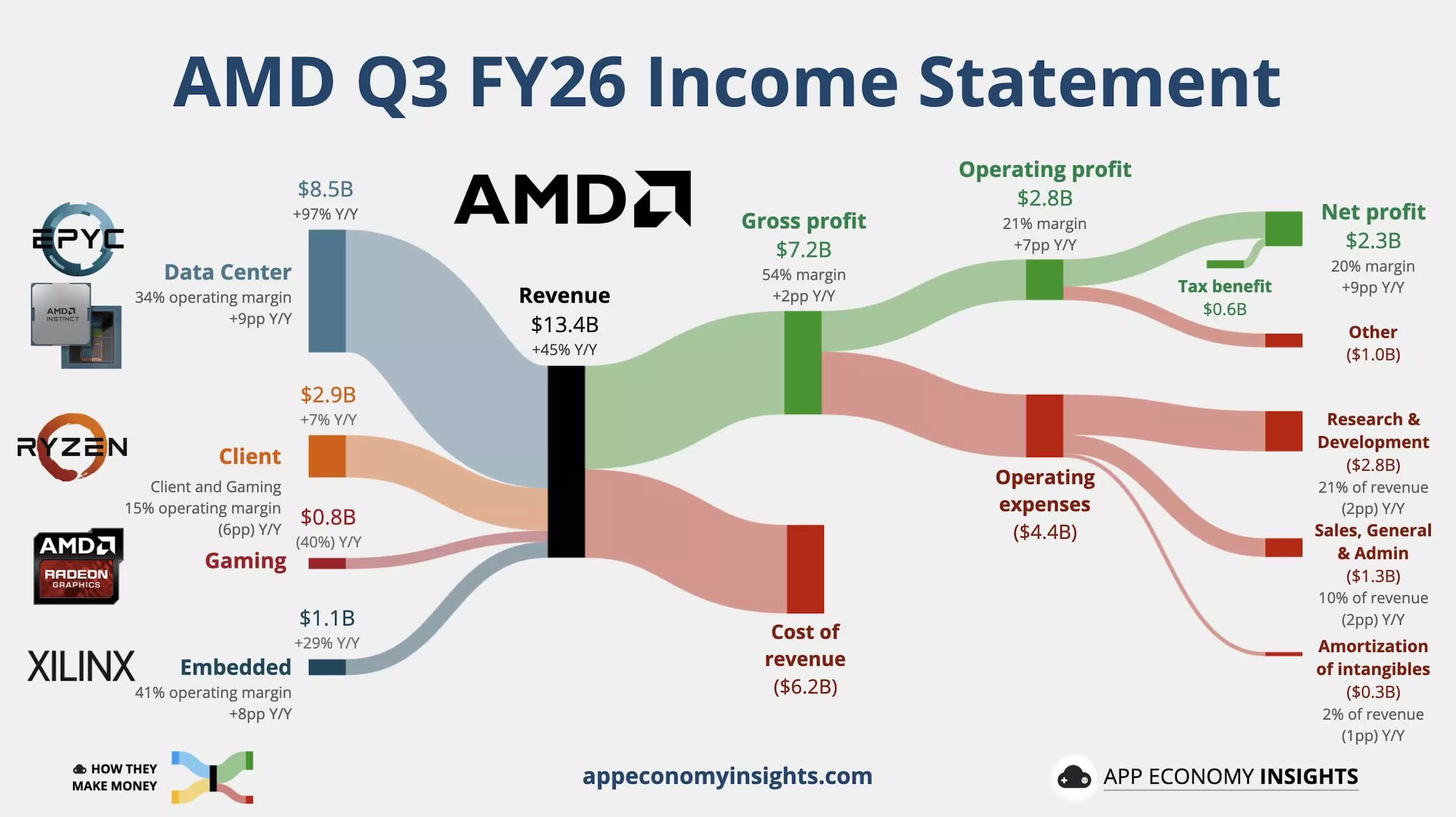
AMD’s Q3 2026 quarter points to a clearer identity: the company wants to be judged as a data-center-first semiconductor platform, not mainly a PC and gaming supplier. The mix is stark: record revenue of $13.4 billion, up 97% year over year, versus gaming revenue of $773 million, down 40% year over year. The practical task now is to track segment share, guidance follow-through, supply constraints and margin durability.
What did AMD report, and why does it change the investment lens?
Conclusion first: the quarter is more a resource-allocation disclosure than a simple earnings beat. AMD said revenue reached $13.4 billion for Q3 2026, up 97% year over year, while gaming revenue declined 40% year over year to $773 million. The difference tells readers where AMD believes future returns are concentrated.
Lisa Su told Yahoo Finance: “We are a data-center-first company; that is our positioning. People need more compute power to support a wide range of applications.” That wording is meant to reframe the company for analysts who may still compare AMD mainly with Intel on Ryzen shipments or with Nvidia on Radeon gaming cards. AMD now wants the board evaluated first on server and AI compute.
That is where Instinct and EPYC matter. Instinct targets AI model training and inference; EPYC supplies CPU capacity for cloud and enterprise data centers. The practical implication is that third-quarter performance should be assessed less by consumer GPU launch noise and more by design wins, shipment cadence, platform attach and the ability to keep margins stable while supplying large compute customers.
What data points should a company-focused reader cite?
For a CompanyWatch note, the core anchor data should be separated from interpretation. AMD’s financial-results release gives the headline revenue and segment direction. The investor-relations release also cited third-quarter gross margin of 54%, operating income of $2.8 billion and net income of $2.4 billion.
External coverage adds two useful forward checks. Reuters reported that AMD guided fourth-quarter revenue to about $17 billion, plus or minus 3%, after the data-center surge. In the same earnings discussion, Su stated that AMD’s data-center business is expected to grow 50% sequentially in the fourth quarter, and that AMD wants the business to be more than twice its current scale after 2027, with planning carried out over a three to five year horizon.
How to turn the report into a tracking checklist
Step 1: measure mix, not just growth. If data center continues to rise, AMD’s sensitivity to gaming and PC cycles declines. In Q3 2026, data center was about 63% of total revenue, the threshold to watch.
Step 2: test guidance follow-through. The fourth-quarter target and 50% sequential data-center expectation are not passive statements; they imply that management believes supply and demand remain visible.
Step 3: inspect supply constraints. A gaming decline can be demand-driven, component-cost-driven or allocation-driven. TechSpot’s reporting on VRAM and entry-level GPU shortages suggests supply pressure can explain part of the consumer weakness without treating Radeon as a product failure.
Step 4: compare strategic choices with rivals. Nvidia has moved farther than AMD in concentration. For fiscal Q2 2027, Nvidia reported data-center revenue of $89.02 billion, equal to 92.5% of total revenue. Nvidia Newsroom also reported total quarterly revenue of $96.2 billion for that quarter.
Step 5: look for margin stress. Fast scaling can pressure gross margin if AMD gives pricing to secure large customers, if advanced packaging remains tight, or if memory costs stay elevated. AMD’s reported 54% gross margin is a useful starting point for the next quarters.
Step 6: separate long-term demand from short-term sentiment. Su’s answer on AI investment concerns is a risk-disclosure signal: if some investors focus on short payback periods, AMD is planning around future compute demand. That does not guarantee demand, but it defines how management will defend capital allocation.
Watchlist metrics
| Metric | Latest anchor | What it reveals | Watch trigger |
|---|---|---|---|
| Total revenue | $13.4 billion, up 97% year over year in Q3 2026 | Scale and cycle position | Whether growth becomes lumpy after a record quarter |
| Gaming revenue | $773 million, down 40% year over year | Consumer hardware demand and allocation | Whether decline is seasonal or structural |
| Data-center share | about 63% of Q3 2026 revenue | Dependence on AI infrastructure customers | Rise toward Nvidia-like concentration |
| Fourth-quarter guidance | data center up 50% sequentially; Reuters reported total revenue guide about $17 billion | Management confidence in supply chain | Miss, delay or margin erosion |
| 2027 ambition | more than twice current data-center scale after 2027 | Execution horizon | Need for new customers and long-term capacity |
Common misconceptions in AMD company notes
- Misconception 1: “data-center-first” means AMD is exiting gaming. It does not. AMD has not said Ryzen and Radeon will stop; it has said where priority resources are going.
- Misconception 2: gaming weakness is only a PC-market problem. It can also reflect AI-driven memory, packaging and cost pressure across consumer hardware.
- Misconception 3: one record quarter proves AI demand is self-evidently durable. The practical check is whether AMD converts guidance into shipments without eroding margin.
- Misconception 4: AMD is simply imitating Nvidia. AMD still has a more balanced portfolio today, with gaming and client businesses still visible in reported results.
Practical action recommendations by reader type
For investors: treat the fourth quarter as proof-of-execution, not proof-of-narrative. Track whether the 50% sequential data-center expectation is met, whether the total guide is revised upward or downward, and whether gross margin remains close to 54%.
For industry analysts: build a simple three-line model. Line 1: data-center revenue share. Line 2: gaming revenue trajectory. Line 3: supply-cost sensitivity from memory and advanced packaging.
For enterprise buyers and partners: evaluate AMD first on EPYC and Instinct readiness, then ask whether consumer GPU roadmaps receive enough long-term allocation. If you need Radeon supply, test the practical question: can AMD commit memory and wafers at the needed volume?
For strategy teams: benchmark AMD against Nvidia, but avoid a single comparison. Nvidia’s concentration is higher, while AMD’s remaining breadth may be an asset if AI demand cools or if PC and gaming recover. The real strategic question is whether AMD can fund both without weakening its data-center-first promise.
Risk checklist: where the company story can break
- Customer concentration: large cloud providers may dictate pricing or timing.
- Supply chain: AI data-center demand can continue to squeeze memory and packaging resources.
- Margin: rapid revenue growth may not translate into sustained profit if component costs rise.
- Competition: Intel and Nvidia are not static; both can respond with platform, pricing and software advantages.
- AI sentiment: if public companies slow capital expenditure, AMD’s longer three to five year plan may look expensive to short-term investors.
Frequently asked questions
Is AMD becoming a pure AI data-center company?
Not yet, and not according to the company’s own reporting. AMD remains a broader semiconductor supplier because Ryzen and Radeon are still part of the business. The management message is one of priority: AMD is positioning itself as a data-center-first company.
Why is gaming revenue falling?
The decline can reflect several forces: softer consumer hardware demand, higher component costs, memory supply pressure and reduced priority in product allocation. TechSpot’s VRAM shortage coverage is useful because it links AI infrastructure demand to consumer GPU supply constraints.
How large is AMD’s data-center exposure today?
In Q3 2026, the data-center business accounted for about 63% of AMD’s total revenue, based on the company’s reported mix. That is materially lower than Nvidia’s fiscal Q2 2027 data-center share of 92.5%, but it is high enough to change the company’s valuation lens.
What should readers watch next?
Watch whether the fourth-quarter data-center growth target of 50% sequentially holds, whether total revenue tracks near the reported guidance, and whether AMD can keep gross margin stable while expanding capacity.
Reference sources
- AMD investor relations: Q3 2026 financial results
- Yahoo Finance video: Lisa Su on AMD as a data-center-first company
- Reuters: AMD forecasts quarterly revenue above estimates as data-center growth accelerates
- TechSpot: entry-level GPU shortages warning tied to VRAM supply
- Nvidia Newsroom: second-quarter fiscal 2027 results