
Anthropic's Claude Reads Your Bank Data: What Personal Finance Really Changes, and Who Should Opt In
Short answer: Anthropic has turned Claude into a read-only viewer of your real accounts. Rolling out this week in the United States, the Personal Finance feature connects bank and credit card data through Plaid for Claude Pro, Max and Ultra subscribers in beta, and it cannot move money. The tell for investors is not the feature itself but the distribution bet underneath it: consumer subscription revenue, a single-vendor open-banking pipe, and a level of bank tolerance Anthropic does not control.
Until now Claude answered money questions only from what a user typed. With this release it answers from actual balances and transaction history, which moves the company from chatbot vendor to financial-information intermediary — a category where economics, regulators and banks all behave differently. This CompanyWatch note works through the questions readers and analysts are actually asking, in short form, with a decision at the end.
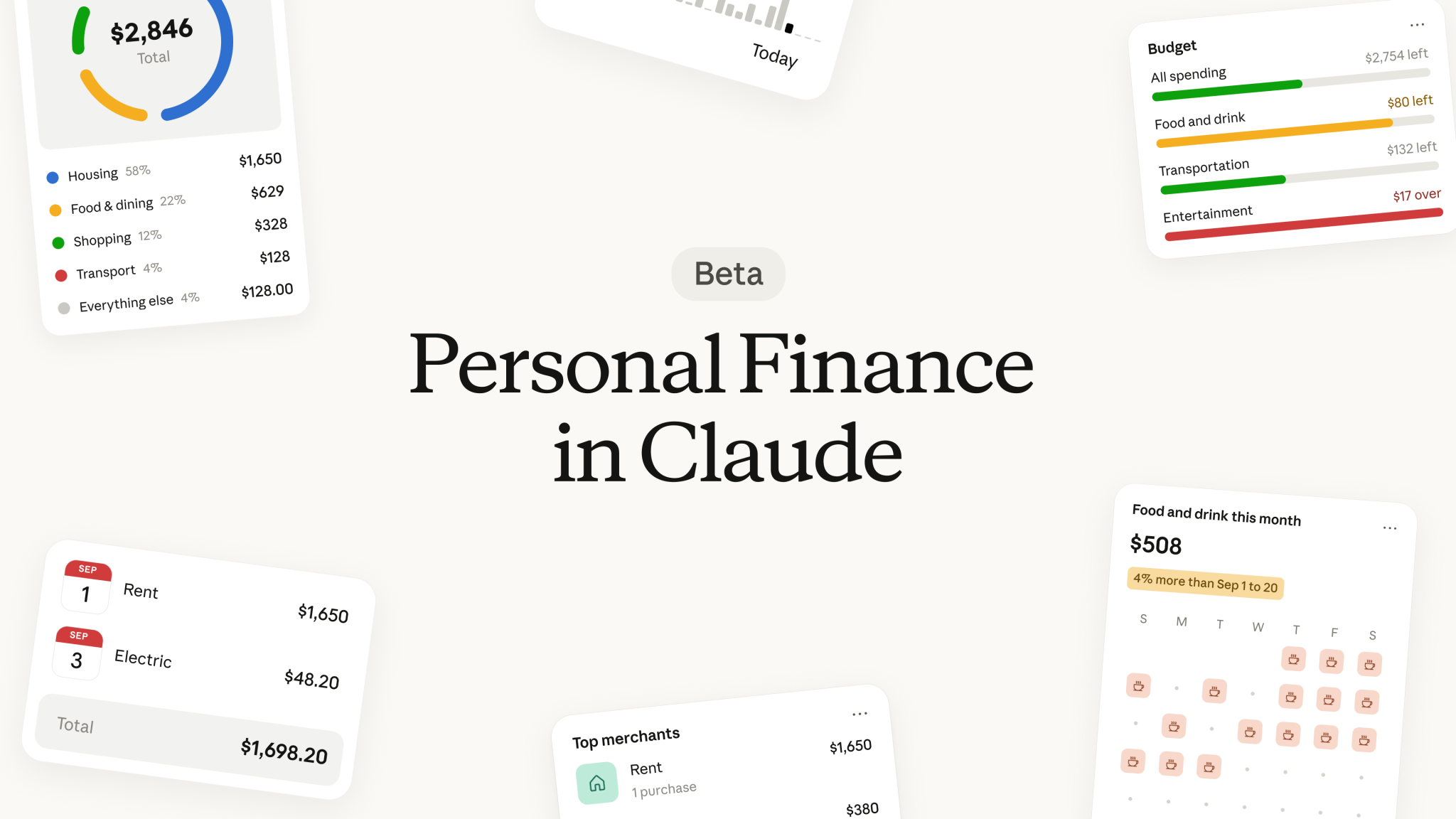
What exactly has Anthropic shipped?
Conclusion first: an analytics layer, not a banking product. Claude gains visibility into a user's finances and the language to explain it, but every action path is deliberately cut off.
| Dimension | What Anthropic states | Why it matters commercially |
|---|---|---|
| Access level | Read-only; Claude cannot transfer, manage or invest funds, and cannot execute any transaction for the user | Removes the licensing and custody problem, and removes the revenue line that comes with payments |
| Connection route | Account linking is handled by Plaid, the financial data connection platform, with user authorisation | Anthropic inherits coverage instead of building it — and inherits someone else's outage and policy risk |
| Data in scope | Bank name, account name and type, the last four digits of account numbers, balances, credit limits and up to two years of transaction history; no full account numbers, no bank passwords | Enough for behavioural analysis, not enough for identity theft — a defensible minimum set |
| Commercials inside the feature | No advertising and no sponsored recommendations; Anthropic sells no credit card, loan or savings product, so answers are not steered | Honest answers, but also zero take-rate: the feature must pay for itself through plan retention |
| Training use | Conversations inside the Personal Finance area are not used to train AI models | The single most important sentence for regulator and enterprise adoption |
| Availability | Beta, staged from this week, United States, for paying Claude Pro, Max and Ultra subscribers | Deliberately narrow: premium plans only, so usage data comes from users who already pay |
What can a user actually ask it?
Conclusion first: the value is aggregation plus translation, not advice. The interesting test is the end-of-month cash question.
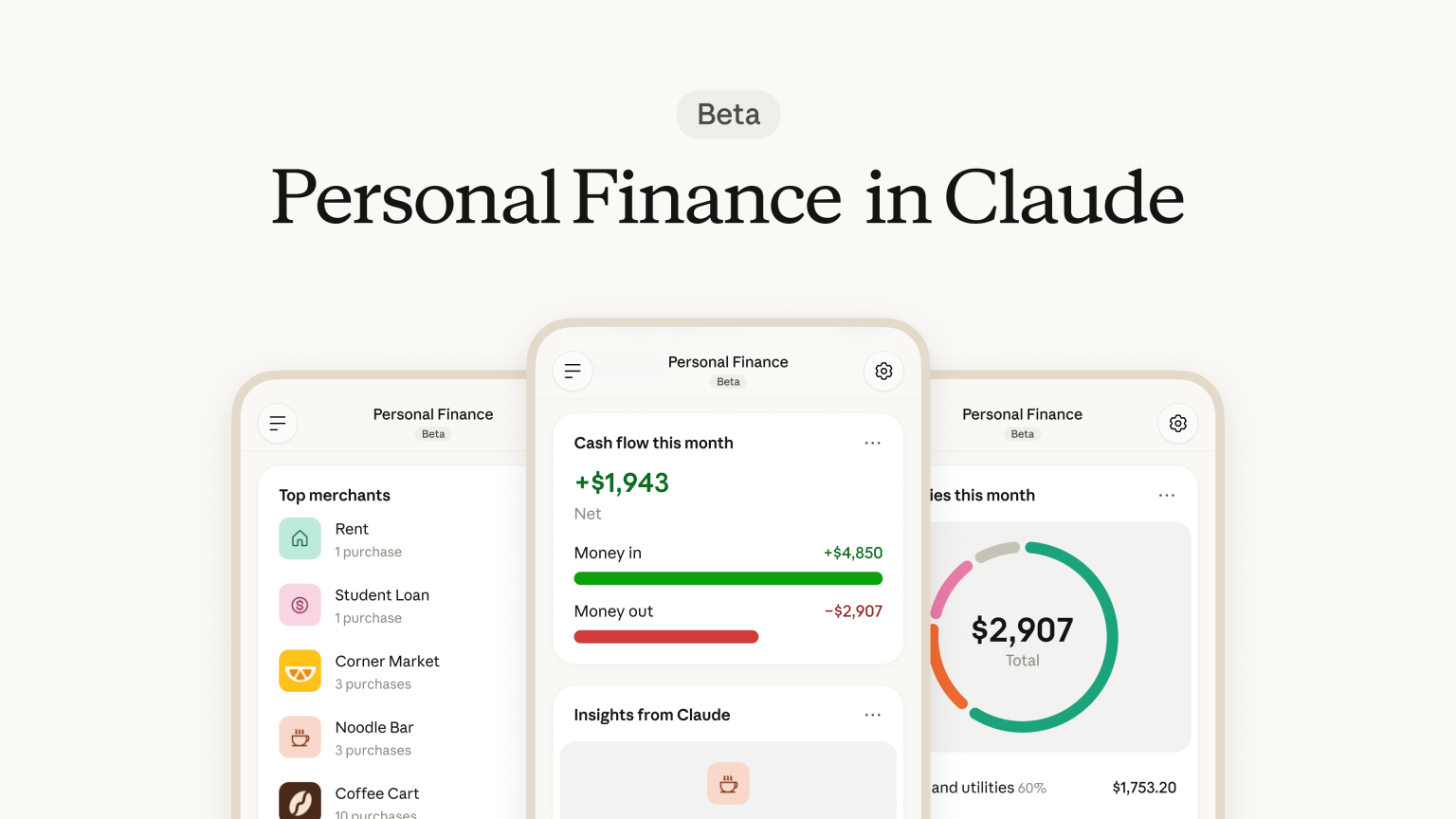
The scenario Anthropic describes is the last week of the month, pay day still ahead. A user asks "Where did my money go this month?", and Claude consolidates spending across every linked account and sorts it into buckets such as rent and utilities, dining out and shopping. Follow-ups are the point: "Is this higher than my usual level?" and "Which other spending is worth watching?" turn a static categorised list into a comparison against the user's own history. At the macro level, a user can ask the blunt version — whether spending exceeds income — and get an answer computed from real flows rather than a self-reported budget.
The second half of the pitch is education. Claude explains terms such as annual percentage rate (APR) in ordinary language and then applies the concept to the user's own numbers, including how much interest was paid over the past year. It also flags anomalies proactively: duplicate charges, unexpected fees, bills that keep climbing and subscriptions still billing in the background, with charts, calendar views and dashboards generated on request.
Why is an enterprise-first AI lab chasing consumer money tools?
Conclusion first: because consumer subscriptions are the only channel where a feature like this is a retention asset rather than a support cost.
Anthropic's growth has been reported in run-rate terms. Reuters reported on 17 August 2026 that its annualised revenue run rate had topped US$65 billion by the end of July, up from roughly US$47 billion in May; CNBC reported in the same cycle that full-year 2025 revenue was around US$10 billion. Those are company-disclosed figures filtered through media reporting, so treat the trajectory as reliable and the exact level as approximate.
Read against that curve, Personal Finance looks cheap and strategic: it consumes inference capacity but is bundled into plans that already exist, gives Pro, Max and Ultra subscribers a reason to stay, and produces high-frequency, emotionally loaded usage that pure chat does not. It is also the clearest public statement that Anthropic will not monetise financial answers through lead generation. In a category where comparison tables and affiliate referrals fund most personal-finance content, promising neutrality is a positioning asset — and a cap on the company's own monetisation of the feature.
How does this differ from what OpenAI did?
Conclusion first: OpenAI bought its way in; Anthropic plugged in.
| OpenAI / ChatGPT | Anthropic / Claude | |
|---|---|---|
| Method | Acquired the personal finance startup Hiro Finance, announced 13 April 2026, with founder Ethan Bloch confirming the deal and the standalone app winding down (TechCrunch) | Built a read-only view layer on top of Plaid's existing connection network; no acquisition disclosed |
| Timing | Personal finance in ChatGPT arrived this May, initially for US Pro subscribers | Beta opens this week for Claude Pro, Max and Ultra in the United States |
| Data starting point | Buys an app with purpose-built budgeting, debt and planning logic | Buys nothing; relies on model reasoning over transaction history |
| Shared dependency | Plaid | Plaid |
That last row is the one worth tracking. Plaid says its technology connects to more than 12,000 banks and credit unions worldwide, and the company said its 2024 revenue exceeded US$300 million with growth above 25 per cent year on year, while research firm Sacra estimated Plaid's annual recurring revenue at roughly US$546 million in 2025. The two figures do not reconcile cleanly, which says less about Plaid than about how opaque aggregator economics remain. Either way, both flagship AI assistants now hang their personal-finance capability on the same connection layer and, beyond it, on the same institutions.
What should you price in before linking an account?
Conclusion first: the binding constraint is not Claude's code, it is the banks' consent.
- Bank gating risk. On 13 October 2026, CNBC reported that JPMorgan Chase CEO Jamie Dimon said the bank would not allow outside AI agents to access customer accounts and act on their behalf; within days USA Today reported Citi, Wells Fargo, Bank of America and JPMorgan Chase taking steps to limit third-party agents. Anthropic's design is compliant with the settlement emerging from that fight — view-only data through an authorised aggregator, no money movement — but it also inherits its ceiling. If banks tighten aggregator consent, coverage shrinks without any change to Claude.
- Beta accuracy risk. Categorisation is inference. A merchant coded as "dining" can be a school cafeteria contract or a subscription streaming bill. Acting on a mis-tagged category — cutting a service, restructuring a payment — is a user-side error, not a bank error. Verify against the statement before you act.
- Scope risk. A tool that explains interest costs is not a licensed adviser and owes no fiduciary duty. Nothing in this launch changes that.
- Regulatory backdrop. The consumer's right to move their own financial data rests on Section 1033 of the Dodd-Frank Act; the CFPB's implementing open banking rule has been contested and re-opened for review, as summarised by the Congressional Research Service. Rules still being rewritten make today's data-access conventions provisional.
Common misconceptions
- "Read-only means nothing can go wrong." Read-only stops Claude from moving money; it does not stop sensitive behavioural inference, nor stop a confident wrong summary of your spending.
- "Anthropic now has my bank login." It does not. Credentials and authorisation sit with Plaid; Claude receives account metadata, balances, credit limits and up to two years of transactions, never full account numbers.
- "Bills will get paid automatically next." There is no disclosed roadmap for money movement, and the largest US banks have publicly refused it. Assume the read-only wall is the design, not phase one.
- "No ads means no commercial angle." No ads means the commercial angle shifts to plan retention and upgrade pressure — a subtler monetisation, not an absent one.
- "It replaces budgeting apps." Aggregation and explanation are one job; execution, alerts and savings automation are another, and Claude explicitly cannot do the second.
Which plan makes sense if you want it?
Conclusion first: entry is a paid consumer plan, and the tier you pick should reflect how often you query, not how much data you have.
- Any Personal Finance use requires Claude Pro, Max or Ultra — the beta is not open to non-paying users, and no other plan is named.
- Claude Pro is the rational test seat: it is the cheapest named plan, priced by Anthropic and tracked by third-party reviewers at about US$20 a month on web, or roughly US$17 with annual billing.
- Max (around US$100 a month) only makes sense if Claude is already your main working assistant; a monthly budget review does not need its capacity.
- Ultra is documented at US$200 a month in Anthropic's own help centre — bought for heavy agentic and developer workloads, not for account checking. Anthropic notes web pricing may differ on mobile stores.
FAQ: the questions analysts keep asking
Is Claude Personal Finance live now?
Partially. It began rolling out as a beta this week to Claude Pro, Max and Ultra subscribers in the United States. Staged rollout means availability arrives account by account, not on a fixed date.
Can Claude transfer money, pay a bill or invest?
No. Access is read-only, and the feature cannot transfer, manage or invest a user's money, or execute any financial transaction.
How much of my history does it see?
Up to two years of transactions, plus bank name, account name and type, the last four digits of account numbers, balances and credit limits.
Will my financial chats train the model?
Anthropic says conversations inside the Personal Finance area are not used to train AI models. Data retention periods beyond that training exclusion are not specified in the launch material, so treat them as an open item.
Should I link every account at once?
Not on day one. Link one checking account and one card, check whether categories and anomaly flags match your own statement, and expand only after that test passes. Two accounts is enough to validate the whole premise.
What would make this feature fail commercially?
Three things, in order of likelihood: banks narrowing authorised aggregator access, category and analytics errors reaching a level where users stop trusting the summary, and a rival bundling the same read-only view into a cheaper plan.
Action list: what GlobalBizSight will track next
- Rollout breadth. Whether the beta extends beyond the United States and whether it ever reaches non-paying tiers — a widening to lower plans would signal a user-growth priority over margin.
- Bank consent signals. Any change in how JPMorgan Chase, Citi, Wells Fargo or Bank of America treat read-only aggregator connections, since coverage, not capability, is the limiting factor.
- Usage disclosure. Whether Anthropic publishes adoption or query-volume numbers; a company that keeps reporting run rate but never feature-level usage is not yet monetising this directly.
- Vendor concentration. Whether Claude adds a second connection provider alongside Plaid, or an institution-direct route. Diversification here is the clearest tell that Anthropic sees the dependency risk itself.
- OpenAI's counter-move. Whether ChatGPT's finance experience, seeded by the Hiro acquisition and launched this May, moves from view-only to execution — the first mover to cross that line will force a regulatory conversation on everyone.
- Rulemaking. Progress on the CFPB's Section 1033 open banking rule, which defines who pays for and who controls consumer data sharing.
The practical read for a professional audience: treat Claude Personal Finance as a serious aggregation and explanation tool worth a low-risk test on a Pro plan, and as a company-level signal that Anthropic is willing to sell neutrality in a market where its rivals monetise recommendations. Anyone who needs money actually moved should look elsewhere — as of this week, nobody in this category is permitted to do it.
Filed by Marc Hale for GlobalBizSight CompanyWatch. Queries: info@globalbizsight.com
Reference sources
- Reuters, 17 August 2026 — Anthropic revenue run rate tops US$65 billion: https://www.reuters.com/technology/anthropic-revenue-run-rate-tops-65-billion-source-says-2026-08-17/
- CNBC, 13 October 2026 — JPMorgan blocks outside AI agents from customer accounts (Jamie Dimon statement): https://www.cnbc.com/2026/10/13/jpmorgan-ai-agents-account-access.html
- TechCrunch, 13 April 2026 — OpenAI acquires personal finance startup Hiro Finance: https://techcrunch.com/2026/04/13/openai-has-bought-ai-personal-finance-startup-hiro/
- OpenAI — A new personal finance experience in ChatGPT: https://openai.com/index/personal-finance-chatgpt/
- Claude Help Center — What is the Ultra plan: https://support.claude.com/en/articles/17728952-what-is-the-ultra-plan
- Congressional Research Service — Open Banking and the CFPB's Section 1033 Rule: https://www.congress.gov/crs-product/IF13117
- Forbes — Plaid profile, Fintech 50 2025: https://www.forbes.com/sites/martinacastellanos/2025/02/18/the-future-of-payments-fintech-50-2025/
- USA Today, 23 October 2026 — Banks move to limit AI agent access: https://www.usatoday.com/story/money/2026/10/23/banks-move-to-limit-ai-agent-access/92385119007/