
CompanyWatch | ASML's Order Book Now Runs to 2030: What 120 EUV Tools in 2028 Still Cannot Deliver
GlobalBizSight's answer in one line: the binding constraint on advanced AI chip capacity is no longer customer appetite but ASML's own factory output. Even the lithography maker's published 2027 and 2028 supply plans leave orders unfilled, which is why several buyers have skipped ahead to negotiating 2029 and 2030 tool slots.
That is the signal carried by the company's 2026 third-quarter accounts, as first flagged by Digitimes. President and CEO Christophe Fouquet has framed the situation plainly: planned capacity for 2027 and 2028 still cannot fully cover customer demand, and the shortage is expected to persist at least into 2028. For an AI build-out measured in gigawatts and fab cleanrooms, ASML has become the single chokepoint through which advanced logic and memory expansion must pass. This CompanyWatch report reads the filing, the supply chain and the pricing shift, and sets out what to track next.
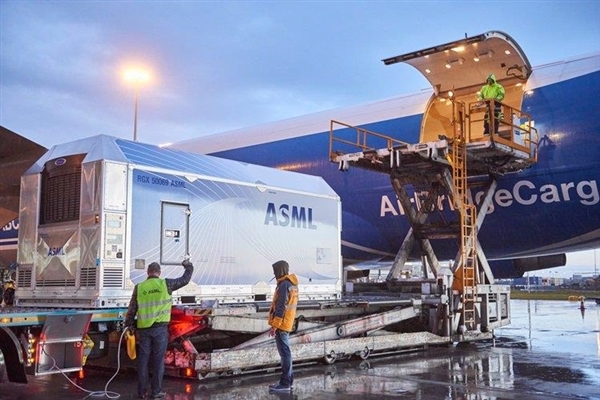
What has ASML actually committed to for 2028?
Conclusion first: a plan, not a guarantee. ASML had already mapped an approximately 30% uplift for both low numerical aperture EUV scanners and immersion DUV tools in 2027; because demand kept accelerating, management is now studying a further expansion of more than 30% in 2028.
The commercial backdrop is unusually supportive. Net sales in the third quarter of 2026 reached 11.662 billion euros, or EUR 11,662 million, up 55.2% year on year and a quarterly record — a conversion noted by the Chinese tech outlet Kuaikeji (MyDrivers) at roughly RMB 87.7 billion. The company has lifted its full-year 2026 guidance three times within the year, now pointing to 44 billion to 45 billion euros of net sales (Kuaikeji converts that to about RMB 331.1 billion to RMB 338.6 billion). Bank of America's model goes further: it expects EUV shipments of 120 tools in 2028 together with an average selling price roughly 5% higher, which feeds straight into earnings per share.
Two things follow. First, the 120 tools figure is a sell-side estimate layered on top of a capacity study that management has not yet approved — a demand-side scenario, not a booked production plan. Second, the guidance revisions show how fast the planning assumption itself is moving; a target set for 2028 in 2026 is a forecast that will be re-cut again before it is met.
Why can't ASML simply build more machines?
Because the arithmetic starts from a narrow base and the constraint has moved outside ASML's walls. Reporting around the July plan puts the 2026 low-NA EUV baseline at roughly 65 systems, with about 130 immersion shipments expected in the same year. A 30% uplift therefore lands 2027 output somewhere in the mid-80s — a range consistent with supply-chain analyst Ming-Kuo Kuo's survey, which projects 80 to 85 EUV and 380 to 400 DUV systems shipping in 2027 on the back of Carl Zeiss SMT's expansion.
EE Times reported in mid-October 2026 that ASML's EUV ramp runs through Zeiss, whose qualified precision projection optics remain effectively non-substitutable. Interviews with equipment-sector specialists summarised in the same cycle put the pinch differently from the usual story: component shortages have eased, and the gating items are now assembly bays, cleanroom floor space and trained technicians — inputs that cannot be bought, only grown.
SemiAnalysis founder Dylan Patel argued earlier in 2026 that supplier limits could hold EUV shipments near 100 units a year until 2030. That view predates the latest capacity study and is now contested by the 120 tools scenario — but the disagreement is useful. It marks the outer edge of what the physical supply chain appears able to deliver, and it explains why customers are willing to open 2029 and 2030 conversations: they are queuing for scarce assembly capacity, not shopping for price.
Where the money is being made: upgrades, mix and a pricing pivot
Conclusion first: the margin story is increasingly about the installed base, not about new fabs. ASML's CFO Roger Dassen has disclosed that value-based pricing conversations with major customers are complete and that price increases have been applied to certain lithography products. In a seller's market, that converts scarcity into contracted economics rather than spot leverage.
The numbers support the read. Q3 gross margin came in at 57.5%, above the 55 to 57% guidance band, with full-year 2026 margin guided at about 56% and fourth-quarter net sales guided at 14.2 to 15.2 billion euros — all disclosed in the company's own quarterly results package. The bigger surprise sits in service: installed base management revenue reached about 3.29 billion euros, up 19.1% quarter on quarter and some 400 million euros ahead of plan, because customers are paying to upgrade throughput on tools already in their fabs instead of waiting two years for new ones.
That substitution behaviour matters for anyone modelling the cycle. Upgrades are cheaper for the buyer, faster to deploy and, per the margin disclosure, more profitable for ASML than a scanner sale. A part of "AI capacity growth" is therefore being funded through the service line, which softens the volume assumption behind the 120 tools headline while firming the revenue line.
Is the demand durable? Logic, memory and the China question
The demand mix is broadening rather than narrowing. A breakdown of the quarter compiled by 199IT shows 121 lithography units shipped — 17 EUV, 40 immersion ArF, 35 KrF and 19 i-line — with EUV at about 49% of net system sales, ArF immersion at 39%, and end-demand split 54% logic to 46% memory. Regionally, Taiwan led at 32%, Korea followed at 31%, the United States took 13%, and China rebounded from 14% to 23% in a single quarter.
That rebound is the item to interrogate. Coverage of the same filing links Chinese buyers, including memory makers CXMT and YMTC, to front-loaded purchases of DUV tools covering several years of expansion, ahead of possible tightening from Washington. Reuters has reported China forecast at up to 20% of ASML sales for 2026, with the company denying that its most advanced EUV tools are shipped there. Pull-forward of this kind supports near-term revenue while raising the risk of a hole later, and pending US legislation on deep-UV exports remains the sharpest downside swing factor.
A second wildcard comes from ASML's own next generation. High-NA EUV tools cost roughly USD 400 million each, and at SEMICON Taiwan 2026 ASML senior vice-president Greet Storms disclosed that ten High-NA systems were in operation with about 1.35 million wafers exposed and 84% uptime. Samsung has targeted 2028 for High-NA DRAM volume production and TSMC 2030 for logic, while Intel reports the largest processing volume to date. If High-NA replaces multiple passes of conventional EUV, it changes both the per-wafer cost equation and the tool count implied by AI demand.
Four misconceptions about the shortage story
- "120 EUV tools in 2028 is ASML's plan." It is Bank of America's estimate; ASML has only said it is studying a further expansion of more than 30% that year.
- "Record sales mean record tool volume." The Q3 gross margin beat was driven mainly by upgrades and service on the installed base, not by additional scanners shipped.
- "Pricing power is unlimited in a seller's market." Value-based pricing is negotiated with a handful of customers whose own capex is cyclical; a doubling of their return thresholds invites substitution and over-ordering.
- "The only risk is AI capex cooling." There are two ASML-specific risks: a pull-forward air pocket in China DUV, and non-operating items in the earnings line. Chinese media summaries of the Q3 call attributed roughly 500 million euros of the approximately 5.0 billion euro net income to a revaluation linked to the company's stake in AI firm Mistral — worth stripping out before extrapolating EPS.
Action guidance: what to watch, and what it changes
CompanyWatch tracks single-company events against pre-set indicators. For ASML, five signals decide whether the 2028 bottleneck thesis strengthens or breaks.
| Indicator to track | Current read | Why it moves the thesis |
|---|---|---|
| Backlog and net bookings | 38.8 billion euros of backlog at end-2025, per filings summaries | 2029 and 2030 talks convert into backlog only if deposits are placed; watch whether bookings extend beyond 2028 |
| Quarterly EUV units shipped | 17 in Q3 2026 | Only 121 systems shipped in total; the ramp shows up as annualised units, not press releases |
| Installed base management revenue | about 3.29 billion euros, roughly 400 million above plan | Sustained outperformance here means customers are substituting upgrades for new tools |
| China share of sales | 14% to 23% in one quarter | A rapid fade signals a pull-forward air pocket and export-control risk |
| Zeiss SMT and assembly capacity disclosures | Bottleneck now assembly, cleanroom space and technicians | Supplier-led capacity is the ceiling that validates or kills the 120 tools scenario |
For investors, the practical translation is to price the pricing, not the unit count: a ~5% ASP lift plus a service mix shift can hold margins near 56% even if tool shipments disappoint. For strategy and business-development teams, the read is that access to lithography — slot timing, upgrade packages and High-NA qualification windows — is now a scheduling problem that must be managed years ahead of fab need.
Frequently asked questions
Is ASML's capacity the real bottleneck for AI chips?
On the evidence in the Q3 2026 filing, lithography is the most visible single point of failure: the company says its own 2027 and 2028 plans will not fully satisfy demand. Packaging, HBM yield and power availability also constrain build-outs, but ASML is the only supplier at this step.
How many EUV machines could ASML ship in 2028?
Bank of America forecasts 120 units with average selling prices about 5% higher. A 2026 baseline of roughly 65 low-NA systems, an approximately 30% step-up planned for 2027 and a studied expansion of more than 30% for 2028 define the plausible path; supply-chain views from analysts such as Dylan Patel suggest a ceiling nearer 100 units a year, so treat 120 as the optimistic bound.
Why are customers negotiating orders for 2029 and 2030?
Because reservation cost is now lower than the cost of waiting. With assembly bays and optics output fixed for several years, buyers lock slots to protect their own node timelines, and they hedge against export-control surprises on the DUV side.
What would break the bullish case?
Three things: a sharp deceleration in AI infrastructure spending once backlog converts; a China revenue collapse if DUV restrictions tighten; and High-NA adoption arriving faster than expected, letting chipmakers get the same wafer output from fewer scanners.
Sources
- ASML investor relations, quarterly results package and Q3 2026 press release (investor.asml.com, 14 October 2026)
- Digitimes and Kuaikeji (MyDrivers) reporting on ASML's 2026 third-quarter earnings and RMB conversions
- EE Times, "ASML's EUV Expansion Runs Through Zeiss" (14 October 2026)
- CNBC, on TSMC, Samsung and High-NA EUV adoption at roughly USD 400 million per tool (8 September 2026)
- Reuters, on capacity, China share and export-control questions (13 July 2026)
- 199IT compilation of ASML Q3 2026 shipment, technology and regional mix
- StockTitan summaries of ASML filings covering backlog and booking history
CompanyWatch by Marc Hale, GlobalBizSight. Corrections and confidential tips: info@globalbizsight.com.