
GlobalBizSight CompanyWatch: Inside BDG's ECHO — Why a 30% AI Visibility Lift Is Not a Revenue Line
A publisher can now sell a 30% lift in AI visibility and still book no incremental sale. That is the odd economics at the center of BDG's ECHO program: the product being priced is a chance to shape an answer, not a transaction. For readers tracking the shift from page visits to machine-generated recommendations, the distinction decides whether this is a new revenue line or a well-packaged metric.
What is BDG actually selling?
Conclusion first: BDG is productizing its editorial staff as a service for AI discovery, priced on the chance that an assistant cites its work — not on clicks or conversions.
Internally, the offer is called ECHO. It draws on analytics from Profound's AI citation-tracking platform to find questions where a brand is missing or weakly represented. BDG then creates content for its publisher properties and watches whether systems such as ChatGPT, Gemini and Google AI Overviews cite those pages. The difference is central: the program sells a measurable chance to shape an answer, not a guaranteed sale.
BDG runs lifestyle and parenting publications including Bustle, Nylon and Scary Mommy. Advertisers already buy branded content to sit near relevant editorial audiences. Its newer proposal carries that distribution logic into AI assistants, where an answer may draw on a publisher's material without sending a consumer to the publisher's website.
Why does a citation matter when nobody clicks?
Conclusion: An AI citation can deliver brand exposure without a visit — which is exactly why it breaks the publisher's old unit of account.
The commercial role of content shifts. A useful explainer can reach a buyer indirectly through a machine-generated answer, even when nobody clicks the original story. For years publishers treated a visit as the way to deliver an ad impression; a citation instead delivers exposure without the visit. That opens room for a different product — and a measurement problem, because visibility in an answer cannot be treated as equivalent to traffic or purchase intent.
For marketers, the notable point is not that BDG found another location for sponsored content. It is that the publisher is packaging its editorial capabilities as a service for shaping which information appears in AI discovery.
Context matters: Daily Mail was testing publisher-led GEO with brands before a 2027 product, with up to 15 GEO tests noted by ContentGrip.

How does a prompt become a sponsored article?
Conclusion: The workflow starts from a brand's business questions, then lets analytics choose the prompts — while human editors keep the pen.
BDG says the process starts with the advertiser's business questions, not a fixed article template. In a research phase, BDG and Profound identify the subjects and prompts a brand wants to influence, then review competitor mentions and the sources AI tools already cite.
The workflow combines Profound analytics with BDG's internal AI agents trained on material from its publishing brands. Those tools shape an editorial strategy and content briefs; human creative staff then prepare the finished articles, with formats and explanatory details matched to the questions being tracked.
BDG's Graham Howes, senior vice president of distribution and AI intelligence, said the company keeps creative development with its own editors rather than the advertiser. That matters because a plainly promotional ad is not necessarily a useful answer to a consumer's product question.
The publisher also pushes live content on Reddit through paid media. In that sense, the program joins source development with audience distribution instead of relying only on technical changes to a webpage.
Profound's Josh Blyskal framed the operating challenge: "You've got to be able to connect analytics into action." The test for an advertiser is whether a monitoring dashboard produces a different, more useful article — not just a favorable figure.
What do the Pampers and Innisfree cases actually show?
Conclusion: Both cases show a publisher tying a product detail to a real information need; neither proves the content caused the change or led to a purchase.
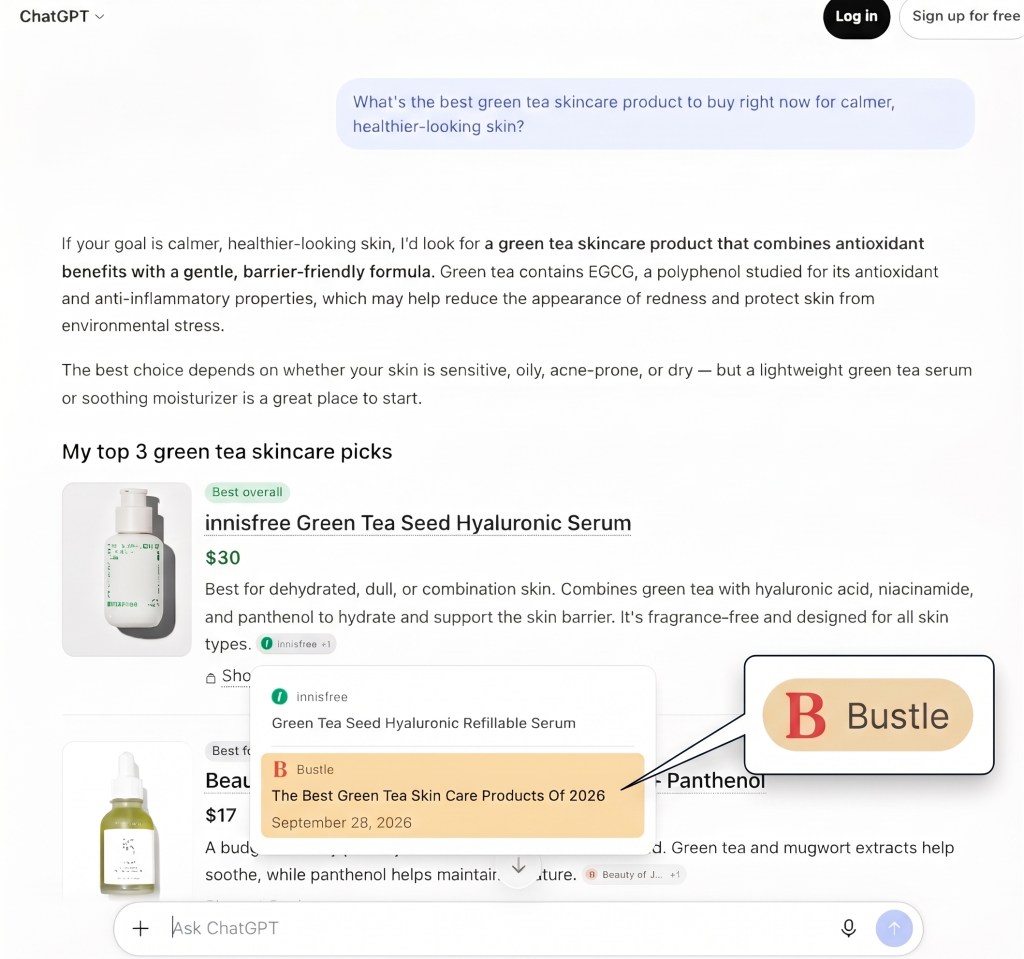
Innisfree offers an illustration. BDG used Bustle's beauty coverage to address questions around green tea skin care, including a September 2026 product guide that recommended the brand's serum. The marketer tracked AI-generated responses to a defined group of product questions during the campaign.
For Innisfree, a BDG and Profound case study described by the companies reported 30% higher AI visibility across 200 tracked skincare prompts for August 11 to September 30. The same case study said Bustle's citation rank improved from 709 to 12 within the monitored set. That is a shift in the vendor's AI-citation ranking — not the publisher's Google search position, and not evidence of product purchases.
Pampers took a different subject. A Scary Mommy explainer addressed the shift to fragrance-free Swaddlers, answering a product question parents might put to an AI search tool. For fragrance-free diaper questions, BDG said the brand moved from second to first in tracked AI visibility after the campaign.
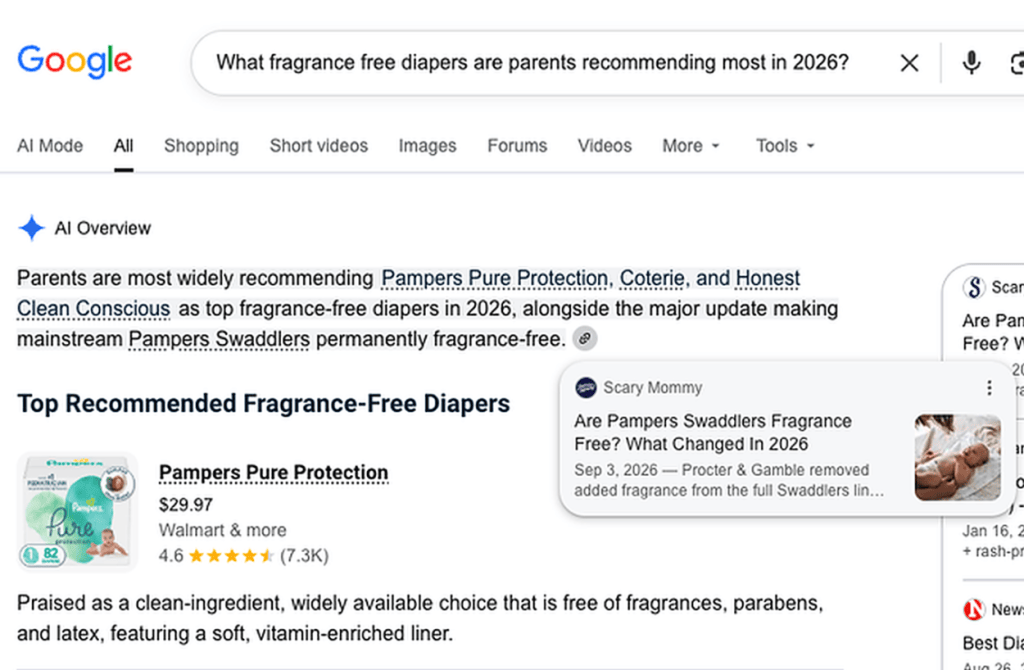
Both examples show how a publisher can tie a brand's product detail to a real information need. Neither proves the content alone caused the ranking change, nor that an AI recommendation led to a transaction. The measurements are vendor-reported and depend on which prompts, platforms and periods were sampled — a point the Digiday report also leaves open.
Can a 30% visibility lift be booked as sales?
Conclusion: No. Visibility is an upper-funnel signal — exposure early in the consideration process — and should not be reported as revenue created.
BDG's offer sits beside a wider set of software tools that measure brand presence in AI answers. Adobe Brand Visibility, previously LLM Optimizer, and Semrush's AI Visibility Toolkit also evaluate visibility, mentions and citations; Adobe's own KPI guidance treats citations, mentions, sentiment and AI referral traffic as separate signals. BDG's distinct commercial pitch is the addition of content creation and distribution through its own publishing properties.
Those approaches address related problems, but not identical ones. Marketers should not combine every metric into a single return-on-investment claim.
| Measurement | What it can establish | What it cannot establish alone |
|---|---|---|
| Brand visibility | How often a brand appears in selected AI answers | Incremental consumer demand |
| Publisher citation share | Whether monitored answers reference a publisher's pages | That readers visited or trusted those pages |
| Sales and conversions | Downstream customer action where tracked | Which AI answer caused it without attribution evidence |
BDG tracks citation share and rank across AI platforms and supplies campaign reporting to advertisers. Yet Profound has acknowledged a gap between finding a brand through an AI answer and showing how that discovery affects a later sale. That gap should guide budget decisions: a brand can reasonably test AI-answer visibility as an upper-funnel outcome, but it should not automatically report a rise in tracked mentions as revenue created.
Where does publisher-led GEO measurement break down?
Conclusion: Two blind spots matter more than the headline percentage — whether the AI gets the facts right, and whether the number is stable across reruns.
Presence is not accuracy. A brand can be mentioned in an answer while its founding story, product capability or service scope is described incorrectly — which can mislead a prospective buyer more than no mention at all. A fuller scorecard tracks both how often core facts appear and how often they appear correctly. Profound itself lists verify the accuracy of AI claims alongside tracking and benchmarking, yet the BDG case studies report visibility and rank, not factual correctness.
A screenshot is not a distribution. Generative answers vary with the run, the phrasing and the time; a single capture cannot stand in for the real chance a buyer sees a brand. Profound's own GEO guide recommends roughly 20–30 unique prompts per core topic, run daily, precisely because the useful measure is longitudinal. Academic work is formalizing the same split: a 2026 measurement framework separates citation selection from the answer-generation stage, so a vendor "citation rank" captures only part of the chain.
Platforms move the baseline. When a platform relabels how its AI-driven interactions are counted — as with Google's AI Max click label, which effectively lets the platform define growth — any cross-period comparison has to be re-based. That is a measurement risk rather than a campaign failure, but it lands on the same report.
What should marketers ask before paying for publisher-led GEO?
Conclusion: Judge the process, not the screenshot — the useful questions concern the consumer query, the source's clarity, and the boundary between visibility and business impact.
BDG's cases provide a practical way to evaluate generative engine optimization without assuming it works like traditional search or display advertising.
- Start with the consumer question. Pampers centered on a specific concern about fragrance-free diapers; Innisfree on questions about green tea skin care. That is more informative than tracking only the brand name.
- Audit the source, not just the answer. If a publisher's material is cited, examine whether the original article answers the question clearly and transparently. Source credibility remains part of the brand experience.
- Separate visibility from business impact. Set targets for sampled mentions or citations, but report them alongside referral data, engagement and sales where reliable connections exist. A favorable citation screenshot is not a conversion study.
- Check how the content is made. BDG describes agents assisting with strategy and briefs while human staff produce the work. Understand the publisher's editorial controls and the limits of your own influence.
Common misreadings to avoid: treating a citation as a click; treating a mention as a correct mention; and treating a single report as a trend. Each converts a fragile signal into a confident budget decision.
FAQ: publisher-led GEO, answered
Is AI visibility the same as a search ranking?
No. An AI answer has no fixed position like a results page, and the same question phrased differently can produce a different set of cited sources. Treat visibility as mention and citation frequency across a defined prompt set, not a rank to defend.
Does a citation in ChatGPT or Gemini drive traffic?
Not necessarily. The answer can cite a publisher's material without sending a click. That is exactly why BDG's model prices exposure rather than referral sessions.
What should I ask before funding an ECHO-style program?
Ask which prompts are tracked, on which platforms, over what window; whether facts — not just mentions — are checked; and how editorial judgment is kept separate from advertiser influence.
Should AI visibility share a budget with paid media?
Keep them separate. Ads buy a time-bound placement that stops when spend stops; GEO builds an information asset that needs ongoing maintenance. Blending them into one ROI table tends to obscure both.
What does this mean for investors?
The broader change is a redefinition of what a publisher can sell. A publication's value may increasingly lie in its ability to provide trustworthy, retrievable explanations to systems that summarize information for consumers. That could put editorial clarity and measurement at greater commercial importance while leaving simplistic impressions-based models looking incomplete. BDG's experiment is worth watching for that reason: it tests whether a publisher can create value even when the consumer's next destination is an AI answer rather than a website.
The reminder for investors: when a vendor reports a visibility win, ask which number would have to move before it reaches revenue — and whether anyone is actually measuring that one.