
CompanyWatch Case Review: How Boston Dynamics Rebuilt Stretch Gen 2 Around Downtime, and What It Signals
Case answer, stated up front: the machine unveiled by Boston Dynamics is not principally a speed story. Its rate ceiling is again expressed as 1,000 cases per hour; what changed is everything that keeps the robot running — cabling, connectors, joints, panels, service access and diagnostics. For anyone tracking how a robotics supplier converts pilots into fleets, that re-ordering of priorities is the actual commercial event.
The release is dated 3 November 2026 and, unusually for the sector, the company describes the design brief as a subtraction exercise rather than an addition one: engineers mined telemetry from the installed base, found the failure modes, then removed the parts that caused them. GlobalBizSight's CompanyWatch desk reads this as a shift in the firm's centre of gravity — from proving a technology to industrialising a product line.
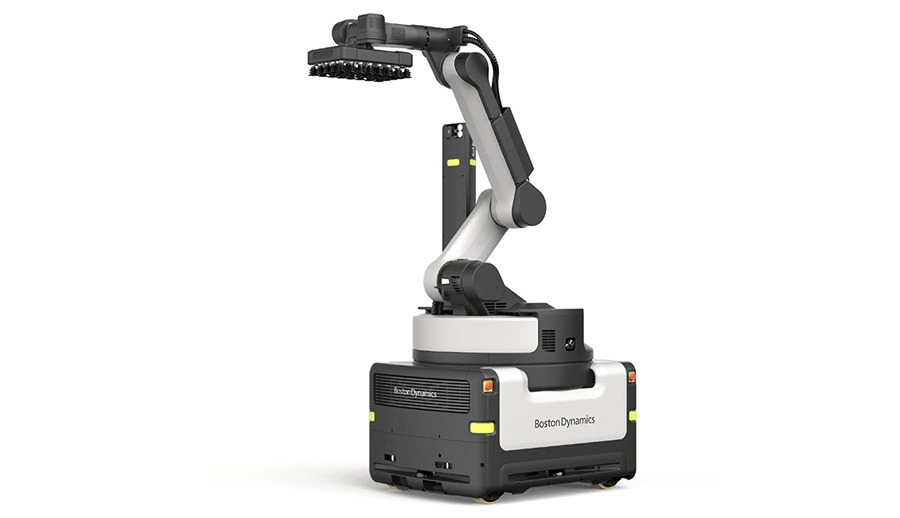
Stretch Gen 2.
What evidence produced the redesign brief?
Conclusion: the specification was written by operating history, not by a roadmap sketch. The team worked through data covering more than 100,000 operating hours and tens of millions of boxes handled by Stretch in the field, isolating the causes of unplanned stoppages before touching the design.
That method is the reusable part of the case. As the first mover in robotic trailer unloading, Stretch already holds more deployments than any competing logistics product, which means the company is competing on an information advantage as much as on hardware: each additional installed unit sharpens the next build. Rivals without a comparable installed base must guess at failure modes; this firm could measure them.
Which hardware changes carry the reliability argument?
Conclusion: the company attacked electrical and mechanical wear points, then handed routine servicing to the customer. The specific items named in the release are:
- Cabling removal. Internal wiring was cut by 81 percent — about a half-mile’s worth of cable — which the company identifies as the largest source of intermittent electrical faults and insulation wear.
- Connectors. Heavy-duty automotive-grade connectors are specified to survive vibration from high-torque case handling and travel over uneven dock floors.
- Joint travel. Continuous-rotation joints now operate beyond 360°, removing hard stops that previously concentrated mechanical stress.
- Gripper and sensing. A revised gripper with new valve systems and finer sensing improves pick and placement accuracy at pace.
- Safety hardware and skin. The emergency stop sits lower and recessed; exterior panels use new materials so a dropped case is far less likely to trigger a stoppage or crack a panel.
Two of those items deserve emphasis for a corporate-watch reader. Cabling and connector wear are exactly the "boring" failure classes that show up in uptime reporting long after a launch keynote is forgotten; and the recessed e-stop plus tougher panels address false-trip downtime, which is invisible on a spec sheet but expensive on a live dock.
Why repair time matters more than the headline rate
Conclusion: throughput only counts when the robot is available, and this redesign compresses the two costs that erode availability — service-call frequency and mean time to repair. A complete swerve drive swap is now quoted at about one hour instead of a full day. Modular, plug and play part swaps plus standardised high-strength fasteners reduce tool changes, and new onboard diagnostics move routine maintenance onto the customer's own staff instead of a vendor dispatch queue.
The operational philosophy is blunt. Robert Playter, the company's chief executive, told Business Insider in a January 2026 interview that staff shifted roles rather than leaving: "Some of the people who used to unload trailers now operate Stretch. They just got upskilled." Maintenance ownership shifting in-house is the same logic applied to the technical side — the vendor supplies the machine and the diagnostic layer, the site keeps it running.
What the customer cases say about the design choices
Conclusion: the two best-documented deployments explain why Gen 2 is a fleet product, not a demo. DHL Supply Chain took the first commercial deployment of Stretch in North America and has been working with the robotics maker since 2018; on 13 May 2025, DHL Group signed a memorandum of understanding with Boston Dynamics covering more than 1,000 additional Stretch units for global rollout. Volume commitments of that size are only credible if service burden per unit falls, because a thousand-machine fleet multiplies every hour of downtime.
On the retail-apparel side, Gap Inc. has reported reduced workplace injuries and lower turnover at sites running the robot, according to the supplier's published case study — a labour-availability argument rather than a productivity one, and a reminder that trailer unloading is typically the hardest, least desirable job on a distribution centre floor.
Trade coverage of the earlier generation put Stretch's unloading rate at up to 700 cases per hour (dcvelocity, May 2025). Against that reference point, the new model's stated 1,000 cases per hour is a 40 percent nominal step — yet the company itself stresses that realised rates hinge on case weight and how orderly or messy the stack is, with multipick doing much of the work at the top end.
How to read the specification sheet as unit economics
Conclusion: every number below is conditional, and the columns buyers should test are the ones vendors rarely publish. The table is CompanyWatch's reading framework rather than company data where marked "verify".
| Stated capability | Company figure | What to verify on site |
|---|---|---|
| Sustained availability | Serviceable via plug and play part swaps; drive swap about one hour | Spares holding on site; technician training hours; dispatch SLA in contract |
| Endurance | Battery rated for two shifts | Duty-cycle reality across mixed case weights; opportunity-charging windows |
| Recharge | Fast charger to 90 percent charge in about 75 minutes | Available dock-side power; charger count per fleet |
| Throughput | Up to 1,000 cases per hour | Average, not peak, rate on the buyer's own SKUs and floor condition |
| Commissioning effort | Pre-trained vision recognises most packages from day one, no programming | Long-tail packaging mix; damaged or crushed cases; WMS and dock-scheduling integration |
Five ways readers commonly misread this launch
- Peak rate mistaken for contracted rate. A "up to" figure is a scenario ceiling, not a service level; stacking discipline dominates.
- Assuming the generation gap is where growth comes from. The vendor states that case detection, motion planning, pick strategies and world modelling continue to improve through regular software releases across the whole fleet, with no hardware change — so much of the future value curve is software margin, not new capex.
- Treating in-house maintenance as pure savings. It transfers cost and responsibility to the customer, and rewards sites with stable technical staffing.
- Ignoring the ownership file. Hyundai Motor Group completed its takeover of the robotics company in June 2021 with an 80 percent stake; in July 2026 Reuters reported the group moving to buy the roughly 10 percent stake still held by SoftBank Group for about $325 million, taking it to full ownership — a change that affects how long capital can wait for logistics automation to scale.
- Framing it purely as labour substitution. The documented pattern at customer sites is reassignment of the hardest role, plus safety and retention benefits, not a straight headcount deduction.
What CompanyWatch will track next on this company file
- Named lead adopters of the Gen 2 configuration and the gap between order announcement and shipped units.
- Any published uptime, mean-time-to-repair or service-call frequency data — the metrics this redesign exists to improve.
- Commercial model: outright purchase, leasing or robot-as-a-service, which determines revenue quality per installed unit.
- Manufacturing capacity and site footprint at Boston-area facilities as fleet volumes rise.
- Response from rival unloaders and from customers' own in-house automation programmes.
- Post-full-ownership capital plans under Hyundai Motor Group, including how humanoid work feeds back into mobile manipulator components.
Action suggestions for professionals evaluating this case: benchmark the peak rate against your own inbound mix before any payback model; price the service contract and spares plan into total cost, not into a footnote; and treat the installed-base learning loop as the moat to be assessed — a competitor can copy a gripper faster than it can copy hundreds of thousands of documented operating hours.
Questions readers ask about this case
Is Stretch Gen 2 mainly about unloading speed?
No. The peak rate is again stated as 1,000 cases per hour; the redesign concentrates on durability, fault removal and repair time, which is what determines whether that rate is available shift after shift.
Who benefits most from the maintenance changes?
High-volume docks with their own technical staff. Onboard diagnostics plus about one hour for a swerve drive swap, versus a full day previously, reduce dependence on vendor dispatch.
Why does a hardware revision matter to investors and analysts?
Because fleet economics, not demonstration capability, decide whether the robotics business scales. A lower service burden per unit makes thousand-unit commitments such as DHL Group's 2025 memorandum financially realistic.
Does the case prove robots replace unloading crews?
No. Customer reporting points to injury and turnover reduction, with former unloading staff moved to operating and supervising the machine.
Reference sources consulted
- Boston Dynamics press release on Stretch Gen 2, 3 November 2026 — https://bostondynamics.com/news/boston-dynamics-launches-next-generation-stretch-robot/
- DHL Group press release on the 1,000-unit memorandum, 13 May 2025 — https://group.dhl.com/en/media-relations/press-releases/2025/dhl-group-signs-mou-with-boston-dynamics-and-accelerates-cross-business-automation-strategy.html
- Boston Dynamics customer case study on Gap Inc. — https://bostondynamics.com/case-studies/stretch-helps-gap-inc-deliver-for-its-customers/
- Reuters on Hyundai Motor Group's purchase of SoftBank's remaining stake, 16 July 2026 — https://www.reuters.com/world/hyundai-motor-group-make-boston-dynamics-wholly-owned-with-purchase-softbank-2026-07-16/
- Business Insider interview with Robert Playter, January 2026 — https://www.businessinsider.com/boston-dynamics-ceo-humanoid-robot-factory-workers-hyundai-atlas-2026-1
- DC Velocity reporting on first-generation Stretch rates, May 2025 — https://www.dcvelocity.com/material-handling/robotics/dhl-to-buy-1000-container-unloading-robots
Prepared for GlobalBizSight CompanyWatch by Marc Hale. Editorial and reader queries: info@globalbizsight.com.