
GigaDevice's GD32H7 in Munich, Germany: One Die, Three Industrial Jobs and a Read on the Control Layer
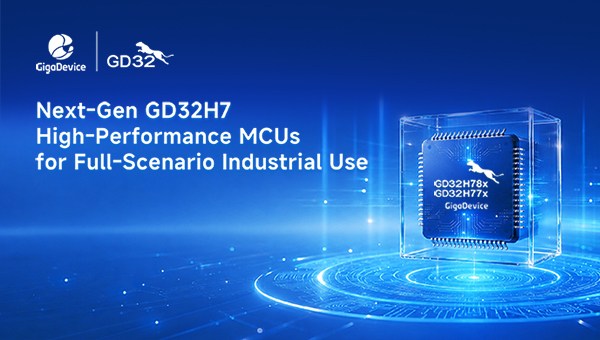
The durable question is not clock speed. It is whether one supplier's design base can quietly become the default control layer of European machinery. On November 10, 2026, in Munich, Germany, GigaDevice answered with hardware: the new-generation GD32H7 microcontroller portfolio, cut from a single homologous die on a unified chip architecture and re-tuned through IP selection, peripheral sets and scenario tuning to cover three industrial jobs — human-machine panels, general factory automation, and robotic servo joint control.
Why a launch event in Munich says more than a datasheet line
Trend first, because the frame changes what you notice. Equipment makers do not buy a microcontroller; they buy a maintenance cost curve — one toolchain, one safety argument, one supplier statement of work spread across every node in the machine. Viewed that way, this is a company decision to convert silicon reuse into account-level stickiness rather than part-number substitution.
The staging matched that intent. In the same window, the company's own event note described a six-axis collaborative robotic arm running on the GD32H77R at Electronica in Munich, which makes the reveal a live design-in pitch to European systems houses instead of a specification memo for distributors.
What sits inside the shared hardware core?
Conclusion first: the compute story is deliberately ordinary, and the memory-plus-compliance story is where the family is actually differentiated.
Every GD32H7 device carries an Arm® Cortex®-M7 core at either 600 MHz(GD32H77x series) or 750 MHz(GD32H78x series), with a peak CoreMark® score of 3,736. Around that core the memory map is held constant across the family: 640 KB of tightly coupled memory running in step with the CPU for zero-wait instruction and data execution, 2 MB of executable high-speed Flash, 8 MB of storage Flash and 1.2 MB of high-speed SRAM. Dual OSPI interfaces on a 200 MHz clock with double data rate (DTR) mode carry external memory expansion for graphics buffering, fast logging and larger program images, and a dedicated math engine offloads trigonometric, FFT and FIR workloads.
Compliance baked into silicon is the heavier block. The family holds IEC 61508 SC3 (SIL 2/SIL 3) functional safety certification issued by TÜV Rheinland, backed by safety manuals, an FMEDA report and purpose-built self-test libraries. On the security side the parts ship hardware AES encryption, SHA-256 hashing, a true random number generator, unique chip UID, secure boot, authenticated firmware upgrade and anti-rollback. That combination is aimed squarely at a legal calendar the industry is already living through: the EU Cyber Resilience Act (CRA), Regulation (EU) 2024/2847, entered into force on 10 December 2024, with vulnerability and incident reporting duties applicable since 11 September 2026 and full application from 11 December 2027, as recorded in the official text on EUR-Lex.
Industrial plumbing is standardised as well: multiple U(S)ART, I²C, SPI and I²S ports, two 10/100 Mbps Ethernet MACs and 3 CAN-FD buses, multi-channel high-precision ADC/DAC with comparators and high-speed digital filters, plus USB HS/FS and SDIO, across a 1.71 V to 3.6 V supply range with several configurable low-power modes.
How do the three scenario lines split one core?
The split follows the interface, not the pipeline. Read the table as three different cost models: joint drives economise board area and bus latency, panels economise display and audio pipelines, automation controllers economise analog fidelity and axis synchronisation.
| Product line | Job it is tuned for | Interface that decides the design | Shape of the variant |
|---|---|---|---|
| GD32H7xR Series (GD32H77R) | Collaborative and humanoid robot joints, miniature servo drives, high-precision CNC | EtherCAT® slave controller plus two on-chip 100 Mbps Ethernet PHYs, transmission latency under 50 ns, FSoE safety protocol, mainstream position-feedback protocol compatibility | 9mm×9mm BGA169 to shrink the joint drive PCB |
| GD32H7xD Series (GD32H78D/77D) | Industrial touch panels, embedded display terminals, control consoles, portable medical and premium home HMIs | Native 2-Lane MIPI DSI output driving HD screens from QCIF to XVGA at full resolution, image processing accelerator, 4 SAI channels, 4 I²S channels and S/PDIF audio, with LVGL, emWin, Embedded Wizard and ThreadX GUIX support | 750 MHz (GD32H78D) and 600 MHz (GD32H77D) performance steps |
| GD32H7xE/7×9 Series (GD32H78E/77E, GD32H789/779) | Real-time motion control (GD32H7xE series) versus general-purpose control, variable-frequency drives, digital power, industrial gateways and multi-axis linkage (GD32H7x9 series) | Hardware EtherCAT slave with DC synchronisation down to 62.5 μs; native EnDat, BiSS-C, Tamagawa and HIPERFACE DSL plus an on-die resolver-to-digital converter on the real-time parts; 14-bit ADC and HPDF high-speed digital filter on the general-purpose parts | Universal compute and safety set retained; analog and communication blocks diverge |
Two consequences follow for engineering budgets. The real-time variants delete external signal-conditioning circuits, which pulls cost and failure points out of the servo front end. And because hardware platform, software ecosystem, toolchain and safety documentation stay identical across the three lines, the familiar industrial pains — cross-platform porting, fragmented sourcing, per-project certification expense, slow iteration — are answered with one qualification narrative instead of three.
What does the launch date reveal about the balance sheet?
Here the reading is about money, not marketing. GigaDevice completed its second listing on the Hong Kong Exchange Main Board on January 13, 2026 (H shares 3986.HK alongside A shares 603986.SH), pricing at HK$162 per share to raise HK$4.68 billion, about US$600 million, with retail demand reportedly subscribed 542 times and the stock closing its debut roughly 37% higher, per Reuters and SCMP coverage of the listing.
Why that matters for a chip family: a fabless firm converts cash into capacity reservations and IP breadth, not into fabs. A one-die, many-variant plan is how you buy wafer volume with fewer mask sets, fewer qualification campaigns and one ecosystem budget. The Munich reveal, ten months after that capital event, is the first large-scale attempt to spend the money on European design desks rather than on domestic substitution alone — our analysis, not a company statement.
Who else is selling reuse, and where do the bets differ?
Reuse is now the industry's standard argument, so positioning is what distinguishes suppliers. STMicroelectronics is stretching STM32 outward into a platform story that spans STM32A, STM32G5, STM32H7P, Cube tooling and agentic-AI hooks, a path we assessed in our case review of the STM32 reuse bet. GigaDevice inverts the sequence: it leads with the deterministic control boundary — servo joints, DC synchronisation, functional safety certificates — and only then reaches for graphics and edge intelligence. The opposite failure mode is splitting a family so hard that customers inherit two firmware baselines, the risk we tracked in our file on the Renesas RL78 split.
Demand backdrop for scale: the International Federation of Robotics reported in its September 2026 update that new collaborative robot installations reached 66,000 units, around 11% of all industrial robot installations, with factory robot stocks passing 5 million units worldwide. On the bus side, Fortune Business Insights sizes the global EtherCAT market at about USD 3.1 billion in 2026 and points to USD 7.23 billion by 2034, an 11.16% CAGR. Both are third-party estimates, not company disclosures.
Which judgments do readers most often get wrong?
- Frequency mistaken for performance. A 750 MHz core is useless if instructions stall on external memory; the zero-wait 640 KB tightly coupled memory and fixed Flash/SRAM map are the parts that change control-loop jitter.
- Certification mistaken for transferred liability. The SIL rating is a device-level claim plus documentation. The machine maker still owns the system safety case; what the certificate buys is amortised qualification work per project.
- Sample dates mistaken for supply. Full sample availability is targeted for January 2027 and mass production for April 2027, so early design-ins commit to a device that has not yet been through volume burn-in or long-term field thermal cycling.
- One architecture mistaken for one code base. Variant peripherals still fork drivers and boot flows. Watch how far third-party toolchains and evaluation boards cover the whole matrix — the vendor's ecosystem pages at gd32mcu.com list compiler support and partner boards as part of the rollout, which is a fair proxy for whether reuse is real or marketing.
What should buyers and analysts track over the next four quarters?
- Calendar fit. Put the April 2027 production date against CRA full application on 11 December 2027. A machine family started on GD32H7 in mid-2027 lands almost exactly on the compliance wall, which is either a tailwind or a crowded queue at assessment bodies.
- Documentation before samples. Request the FMEDA report, safety manual and self-test library as a pre-sample condition, and quantify the certification delta against your incumbent part.
- BOM arithmetic. Re-run joint-drive cost and board area with and without external PHYs, then stress-test the 9mm×9mm claim against your thermal envelope.
- Capital disclosures. Track HKEX filings for foundry and assembly prepayments, capacity commitments, and whether industrial revenue mix moves after the family ships.
- Second-source discipline. Map which functions exist on a qualified alternate part today; treat single-die convenience as a sourcing risk until dual-sourced equivalents appear.
- Design-win cadence. Count European machinery OEM announcements referencing GD32H7 after the Munich showing, quarter by quarter, rather than accepting launch-week enthusiasm as evidence.
FAQ: what the design desk asks first
Is this an industrial-only family or a general high-performance line?
Both readings are defensible. The silicon is a general-purpose Arm® Cortex®-M7 device with high clocks and large on-chip memory, but the certification package, real-time buses, position-feedback interfaces and CRA-oriented security features are industrial commitments; consumer designs get the compute without paying for the paperwork.
When can an OEM realistically build volume equipment on it?
Samples across the line are targeted for January 2027, with production scheduled for April 2027. That implies prototype boards in the first half of 2027 and volume ramps no earlier than the second half — with the safety documentation stream, not the silicon, likely the pacing item.
What is the weakest point in this plan?
Execution density. Three scenario lines, a full toolchain, GUI stacks, motor and joint reference projects and a certification suite all have to stay synchronised from one vendor. If any leg lags, customers experience a fragmented family regardless of the unified die.
Company snapshot
GigaDevice Semiconductor Inc., founded in April 2005, operates as a global fabless supplier and placed its global headquarters in Singapore in 2025, running branch offices across numerous countries and regions for local support. Core product lines cover Flash memory, 32-bit microcontrollers (MCUs), sensors and analog products serving industrial, automotive, computing, consumer electronics, IoT, mobile, networking and communications markets. Its qualification record includes ISO26262:2018 automotive functional safety at ASIL D, IEC 61508 product certification under the 61508 standard, and ISO9001, ISO14001, ISO45001 and Duns. Supply continuity rests on long-term alliances with foundries and assembly and test houses. GigaDevice and GD32 are trademarks or registered trademarks of GigaDevice Semiconductor Inc.
For decision-makers, one line: the launch is not a faster MCU, it is a bid to make re-qualification, not performance, the reason European machine makers stay.
Reference sources
- GigaDevice event note on its Intelligent Embedded Solutions showcase at Electronica 2026 — https://www.gigadevice.com/about/news-and-event/news/gigadevice-at-electronica-2026
- GigaDevice announcement of its Hong Kong Main Board listing — https://www.gigadevice.com/about/news-and-event/news/gigadevice-listed-on-hkex
- Reuters coverage of the HK$4.68 billion offering and debut move — https://www.reuters.com/world/asia-pacific/chinas-gigadevice-semiconductor-jumps-54-hong-kong-debut-2026-01-13/
- International Federation of Robotics, collaborative robot installation figures — https://ifr.org/ifr-press-releases/news/presidents-report-by-jane-heffner-3-2026
- Regulation (EU) 2024/2847 (Cyber Resilience Act), official text and application dates — https://eur-lex.europa.eu/eli/reg/2024/2847/oj
- Fortune Business Insights, EtherCAT market sizing — https://www.fortunebusinessinsights.com/ethercat-market-114613
- GD32 ecosystem and toolchain support pages — https://www.gd32mcu.com/