
GlobalBizSight CompanyWatch: Why GE Vernova's 6 GW PGCIL HVDC Order Is an India Grid Stress Test
GE Vernova's selection by PowerGrid Corporation of India Limited (PGCIL) turns a planned 6 GW ±800 kV corridor into a company-level execution test: it must move renewable output from Barmer, Rajasthan, to South Kalamb while proving India-based manufacturing, grid automation and full delivery can scale. PGCIL's award was recorded in the fourth quarter of 2026, and the official scope describes a 6,000 MW bipolar system with two poles rated as 2×3000 MW.
What exactly was booked?
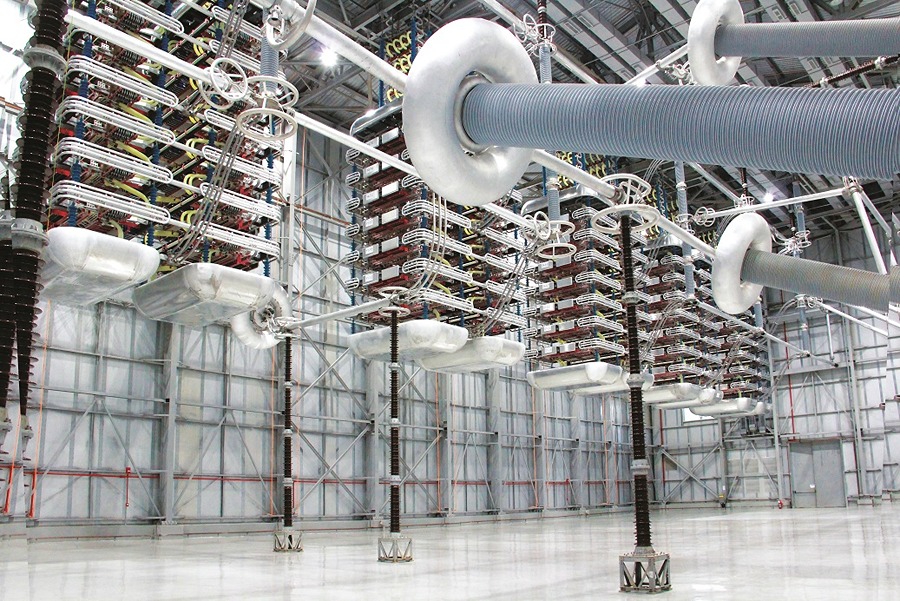
The transaction is better read as a full system-integration order than as a component sale. GE Vernova will deliver the complete design for the ±800 kV, 6,000 MW (2×3000 MW) bipolar HVDC link between Barmer II and South Kalamb. The delivery chain also includes new converter stations, major equipment supply, site erection, testing and commissioning, which means the company is accountable for several interfaces that normally sit between vendors.
In practical terms, the project has three layers: a high-voltage electrical layer that moves power at 800 kV, a civil and industrial layer that builds converter sites and associated infrastructure, and a digital control layer that keeps flows stable. That structure also explains why the order is a useful CompanyWatch signal: it tests manufacturing, execution and software integration at the same time.
- Client: PowerGrid Corporation of India Limited (PGCIL).
- Contractor: GE Vernova.
- Core specification: ±800 kV, 6,000 MW bipolar HVDC link.
- Pole structure referenced in the master scope: 2×3000 MW.
- Key geography: Barmer II, Barmer, Rajasthan, and South Kalamb in India.
- Timing anchor: fourth quarter of 2026.
Why Barmer and South Kalamb matter for PGCIL?
The Barmer area sits inside Rajasthan's renewable-rich zone. Official Indian power-sector communication has highlighted Rajasthan's installed renewable capacity at 29.98 GW, while the country's broader target remains 500 GW of non-fossil capacity by 2030. That context gives the PGCIL corridor strategic weight: it is not simply a transmission line, but a mechanism to move energy from surplus generation zones to demand centers without creating congestion or instability.
“The Barmer–South Kalamb HVDC corridor is a strategic project for PGCIL, designed to efficiently integrate large-scale renewable capacity from Rajasthan ...” — GE Vernova announcement.
The load-side endpoint at South Kalamb makes the route more than a local Rajasthan project. It creates an evacuation channel that can support large industrial and urban demand elsewhere in India. When renewable resources are remote, the real bottleneck is not generation alone; it is whether the grid can absorb variability, maintain voltage and dispatch power reliably over long distances.
A useful comparison comes from India's wider HVDC pipeline. Hitachi Energy has previously been selected for a 950-km, 6 GW HVDC connection from Bhadla in Rajasthan to Fatehpur in Uttar Pradesh, showing that PGCIL's use of high-capacity corridors is part of a broader renewable integration model rather than an isolated purchase. That parallel also sharpens the vendor race: GE Vernova now has to show that its order-book momentum can convert into on-time commissioning.
How does the technology and local manufacturing change the risk map?
The master announcement points to GE Vernova's most advanced LCC valve being supplied for the project, with manufacture taking place at Pallavaram in India. For investors and analysts, that is a meaningful signal because HVDC equipment is not a commodity purchase. Converter valves, control systems and testing capacity are long-cycle assets, so local manufacturing can reduce logistics uncertainty and strengthen the company's positioning in India's grid-equipment market.
The digital element matters too. The eLumina control system is intended to manage complex power flows and provide the intelligence needed for dynamic grid conditions. In an HVDC corridor carrying 6 GW of renewable-linked capacity, control software becomes part of the physical safety envelope. A converter station is only as reliable as the system that coordinates commutation, power direction, fault response and operator interface.
Still, local manufacturing and advanced controls do not eliminate execution risk. They shift it into a different place: factory-to-site sequencing, site acceptance testing, interface approvals, and the ability to finish commissioning without schedule slippage. For a supplier, a 6 GW order may improve visibility immediately, but revenue realization and customer value depend on execution milestones.
What should investors and industry analysts watch next?
| Watch point | Why it matters | What would count as confirmation |
|---|---|---|
| Contract value and financial disclosure | A 6 GW HVDC award changes the order book, but analysts need a clear value range, margin assumption and revenue-recognition timeline. | Company disclosure with project value, milestone billing and expected delivery period. |
| Transmission economics on the client side | Project finance for interstate transmission often depends on tariff recovery and commissioning date. | Indian market coverage reports that POWERGRID quoted annual transmission charges of about ₹3,244.33 crore, while project capex has been estimated near ₹24,974 crore by financial media. |
| Execution speed | HVDC corridors typically take years to complete, so backlog quality depends on how quickly equipment reaches sites. | Regular updates on converter-station construction, valve shipment, site erection and commissioning tests. |
| Competitive follow-on | PGCIL's program is not limited to one corridor, and rival vendors are already active in India's renewable evacuation tenders. | Subsequent HVDC awards, bid wins or losses, and commentary from GE Vernova on capacity availability. |
For a professional reader, the best near-term signal is not the headline capacity number alone, but the chain of confirmations that follows: order value, delivery schedule, site readiness and commissioning evidence. If those items stay aligned, the PGCIL project can improve GE Vernova's position in a market where transmission vendors are competing for visibility over several years.
Common misreadings to avoid
- It is only an equipment sale. The scope includes complete design, converter stations, site erection, testing and commissioning. That makes it a system-integration commitment with interface risk.
- 6 GW means immediate renewable power delivery. The corridor can support renewable evacuation, but physical delivery depends on generation availability, construction progress, grid code approvals and system testing.
- Manufacturing at Pallavaram removes execution risk. Local production helps supply-chain positioning, yet factory output is still only one step before site work, energization and regulatory acceptance.
- One order proves permanent market leadership. The HVDC pipeline in India is large, but competitors are present and PGCIL's project pipeline will keep being re-opened through future tenders.
Action suggestions for a deeper CompanyWatch view
- Track quarterly order-book disclosures for HVDC backlog and execution timing, not only headline awards.
- Monitor site milestones in Rajasthan and at the South Kalamb destination, because permitting and land interfaces often shape transmission schedules.
- Compare GE Vernova's delivery model with rival HVDC projects in India, including Bhadla-linked corridors, to understand whether PGCIL's demand is project-specific or a structural shift.
- Use tariff-recovery reporting as a proxy for project bankability; transmission projects often depend on the client's ability to earn regulated returns after commissioning.
- Follow control-system evidence as much as hardware evidence, because eLumina and other digital tools will determine how well the grid handles renewable variability.
FAQ: questions likely to follow the GE Vernova 6 GW HVDC order
What does the 6 GW rating mean in this project?
The 6 GW rating describes the corridor's transmission capability: it is designed to move large blocks of power efficiently across distance. In India's renewable context, that matters because generation zones can be far from load centers. The project is also framed as a ±800 kV system, with the scope including 6,000 MW and the bipolar arrangement expressed as 2×3000 MW.
Why is PGCIL important here?
PGCIL is the client and system planner behind the corridor. Its role is to create transmission infrastructure that supports renewable integration, demand growth and grid resilience. For vendors, winning a PGCIL project is not just a single sale; it signals a position in a long pipeline of interstate transmission development.
Does Pallavaram manufacturing make the project less risky?
It improves one dimension of the risk map. Local manufacturing can shorten some logistics paths and support policy preferences around Indian production. But HVDC projects still face civil works, equipment integration, site testing and regulatory approvals. The net effect is stronger supply-chain visibility, not automatic schedule certainty.
What is the role of eLumina in this order?
eLumina is the control-system layer mentioned in the master scope. It supports the digital management of power flow, which is essential when an HVDC link moves variable renewable-linked energy through a large interconnected system. In practical terms, the software and control architecture become part of the stability case for the corridor.
References
- GE Vernova press release on the 6 GW HVDC transmission project — official announcement on scope, technology and India execution.
- Business Standard — market coverage of GE Vernova's position in the POWERGRID Barmer II–South Kalamb tender process.
- CNBCTV18 — reporting on annual transmission charges associated with the project economics.
- Press Information Bureau — renewable capacity context, including Rajasthan's installed renewable capacity and India's 500 GW non-fossil target.
- Hitachi Energy — comparison project for India's renewable evacuation model.