
CompanyWatch Case File: How Videostrong Monetized Certified Android TV Boxes — and What the XCPE Takedown Changes for OEMs | GlobalBizSight
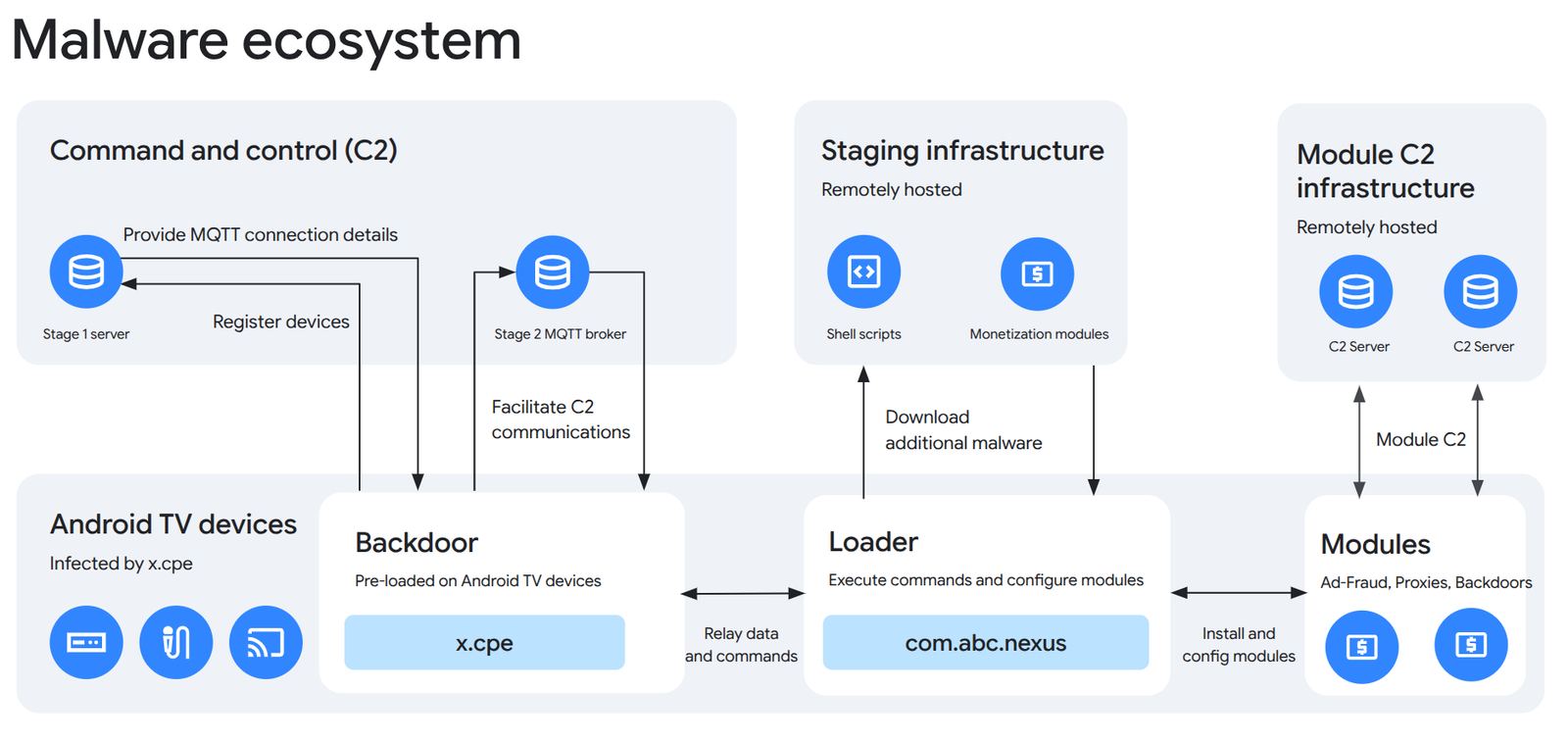
A streaming box parked behind a television is not how anyone pictures network-crime infrastructure, yet that is exactly the role a Shenzhen hardware maker assigned to its own firmware. In findings published a few days ago, Google laid out a years-long operation in which a manufacturer of officially approved devices built a remote-control channel into production firmware and then rented that channel to paying criminal customers. The CompanyWatch angle here is not the malware itself; it is the business model wrapped around it. The following review reconstructs the sequence — how the code entered the supply chain, how it cleared an official gate, how it was sold, what Google's response actually removed, and which risks remain open for buyers, resellers and competitors.
Case file at a glance
| Dimension | What the record shows |
|---|---|
| Company at the center | Videostrong, a China-based manufacturer headquartered in Shenzhen, supplying devices under its own name and as an OEM/ODM for other brands |
| Platform implicated | Android TV and Google TV certified hardware, plus other Android device classes |
| Mechanism | XCPE — a pre-installed, remotely controllable backdoor plus supporting server network |
| Commercial logic | Access sold to criminal affiliates, whose malware modules were then loaded onto infected devices |
| Scale disclosed | Google estimated the response cut communication channels for at least 10 million additional affected devices beyond those already confirmed compromised |
| Vendor outcome | All cooperation terminated; Videostrong and affiliated entities barred from producing certified Android devices with preinstalled Google apps or supplying software to other certified-device makers |
| Platform outcome | Google acknowledged a gap in its review flow and said it is upgrading certification and firmware-behavior verification |
Stage one: the payload was written in at the factory
The first structural lesson from this case is where the malicious code entered. It was not downloaded by a careless user, sideloaded from a website, or shipped inside a third-party application. Google's investigation concluded that the components were embedded during manufacturing, spanning multiple models and multiple brand labels. The company further stated that the pattern was neither the work of a rogue employee nor a development accident: the system ran for years, carried dedicated infrastructure and continuously refreshed evasion mechanisms, and was used to manage downstream partners and their modules. For analysts tracking a hardware business, that detail matters. It converts the incident from a quality defect into an operating practice, and a practice can be replicated across product lines — which is precisely what the device-type spread suggests.
Stage two: clearing the gate by deferring the payload
The second lesson concerns how approved status was obtained at all. Reported technical write-ups, including Google's own threat-intelligence account of XCPE, describe a staging trick: hidden code was seeded at production, protected by obfuscation, and only downloaded or activated after a buyer's first boot. That sequencing let the hardware pass compatibility and security review because the incriminating behavior was not resident when the reviewers looked.
Google's admission is unusually direct. The company said the vendor exploited a blank area in the review flow by loading malicious code onto the end-user device later, and that it is now strengthening verification of both firmware and subsequent software behavior. In CompanyWatch terms, a platform's certification badge was functioning as a marketing asset whose guarantee was enforced at a single moment in time rather than continuously. Anyone sourcing certified hardware from an emerging market — hospitality integrators, IPTV operators, sports-bar chains — has just learned that the badge is a compliance snapshot, not a lifecycle warranty.
Stage three: the monetization layer
The commercially revealing part is that the backdoor was treated as a product feature with customers. Reported descriptions of the scheme say access to the infected fleet was sold to criminal affiliates and that those affiliates' malware modules were pushed onto devices. Documented uses of the compromised hardware include:
- installing additional malicious software on demand, effectively turning each unit into a delivery point;
- generating fraudulent advertising traffic through hidden page loads and fake clicks;
- building residential proxy networks that route other parties' traffic through ordinary home broadband;
- supplying high-privilege execution capability so devices could be pooled into a large botnet without owners noticing;
- other general-purpose network crime activity, given the elevated system permissions involved.
This is why the takedown had to be aimed at infrastructure rather than at one binary. Google said it took legal action against the domains and servers used to command the XCPE network and succeeded in severing the control chain, thereby stripping the operator of remote control over a large number of devices.
The company behind it: an established OEM profile, not a garage brand
Videostrong's position in the industry explains the blast radius. Trade listings and device guides describe it as a long-running Shenzhen manufacturer of OTT and IPTV Android TV and AOSP boxes, working as an OEM/ODM for other sellers and also shipping its own-branded units; reporting tied to this case notes its portfolio reaching home TV boxes and projectors. That is the profile of a supplier embedded in operator procurement chains, where a single board design can be rebranded dozens of times across regional markets. Coverage of the takedown flagged products under the Mecool brand among the most affected, and Google's disclosure extended the impact list well beyond living rooms — the same malicious components were found on parts of digital signage estates, karaoke equipment and telehealth terminals. A backdoor that survives a hardware rebrand is a supply-chain liability, and it lands hardest on business customers who bought the device as a piece of infrastructure and never thought of it as a computer.
Scale check: how 10 million devices sits against the platform base
Put the numbers in proportion, because Google's estimate is easy to misread. The at-least-10-million figure describes additional devices whose channel to the attackers was closed by the infrastructure action — on top of units already confirmed compromised, which independent reporting on the case put at over 1.3 million. Against the total footprint, industry coverage following Google's platform announcements estimated the combined active Google TV and Android TV device base at around 300 million as of mid-2026, so the population touched by this operation sits in the low single-digit percentages of the installed base while representing a far larger share of the white-label, entry-price segment. The asymmetry is the story: exposure was concentrated in exactly the price tier where buyers lean hardest on certification as a proxy for trust.
Not the first box scandal — but the first to hit approved hardware
A comparison makes the shift visible. Earlier large-scale infections of low-cost Android boxes, most notably the BadBox line of operations disrupted through Google's 2025 civil action against 25 unnamed defendants said to be based in China, centered on uncertified, open-source-project devices; reporting on that lawsuit described a botnet of more than 10 million units used for proxy traffic and ad fraud. The current case repeats the same economic playbook on a different tier of the market.
| Comparison dimension | Earlier uncertified-box operations | Videostrong / XCPE |
|---|---|---|
| Who inserted the malware | Factories or firmware modders outside the platform's approval system | An approved manufacturer inside the system |
| Buyer's expectation | Bargain hardware, trust placed in the price | Trust placed in official approval and safety review |
| Gate that failed | Marketplace moderation and detection at retail | Certification review, defeated by post-boot loading |
| Distribution logic | Access rented out at the criminal-commodity layer | Access rented out at the criminal-commodity layer |
| Platform consequence | Reputational pressure on open Android devices | Reputational pressure on the vendor's own approval program |
The constant across both waves is monetization through rented access rather than through selling devices cheaply, which tells us the incentive has not disappeared — only the tier of hardware it was applied to.
Four misconceptions this case should retire
- Approved equals audited over its life. Certification verified the software image at review time. Reported findings show behavior that only materialized on the user's first boot, which a snapshot test cannot see.
- Resetting the box removes the threat. Because the components were baked into the device's own system partition, ordinary recovery steps that users rely on do not reach the embedded code; Google's own guidance in this case leaned toward assessing device source and, for users of affected products, considering replacement with higher-reputation brands.
- It is one bad model. Google described the malicious code as present across many models and brands over several years, and the affected device classes included signage, karaoke and telehealth terminals — so per-model blocklists will not close the exposure.
- The risk ended when the servers went dark. Risk has been materially reduced because the control path was severed, but the residual state is not clean, and the affiliate modules had their own distribution channels outside this one backdoor.
Action recommendations by audience
For households operating an Android TV or Google TV box bought at an entry price:
- Inventory what is in the living room — brand, model and where it was purchased — before assuming an authorized retailer equals authorized hardware.
- Watch for the classic misuse symptoms of a rented device: unexplained bandwidth, a warm box under idle load, sluggish performance.
- Treat isolation or replacement as the conservative option; putting the unit behind a separate network segment limits what a high-privilege foothold can reach.
For resellers, IPTV and hospitality integrators:
- Add firmware lineage and post-deployment update behavior to vendor due diligence, not just certification paperwork.
- Ask suppliers for signed build provenance and for a stated policy on third-party software services delivered to fielded units.
- Plan for segmentation on signage, karaoke and telehealth fleets, where devices are numerous, unmetered and physically untouched.
For platform and strategy analysts watching Videostrong's peers:
- Expect demand to rotate toward manufacturers that can document continuous attestation, and expect certification thresholds to rise as Google upgrades review — a cost line that squeezes thin-margin white-label suppliers first.
- Treat vendor concentration as the risk metric: a board design shared across many brands means one ban can strand several storefronts at once.
Watchlist for the next two quarters
- Whether Google's revised review process explicitly covers post-boot payload loading, and whether any second vendor is caught inside the tightened gate.
- Which OEMs publicly distance themselves from the banned supplier network, and whether affiliates migrate to new host firmware — Google barred Videostrong and related entities from supplying software services to other certified-device makers, so rebranding via software is the route to watch.
- Regulatory follow-through: the EU's Cyber Resilience Act brings vulnerability and incident reporting duties for products with digital elements into force from 11 September 2026, with the main obligations applying from 11 December 2027, meaning a pre-installed backdoor sold into Europe increasingly becomes a disclosure event as well as a security one.
- Residual fleet data: how quickly the disconnected devices stop showing abnormal traffic, which will indicate whether the affiliate modules persisted through other channels.
The durable reading of this case is that a certification label was monetized by the very party it was supposed to constrain, and that the platform's correction is a process change rather than a prosecution. For investors and procurement teams, the practical implication is a repricing of trust in the entry-level smart-display segment: the cheapest device in the category is now known to carry a hidden cost, and the vendors who survive the tightened review will be the ones able to prove behavior across a product's whole service life, not just on the day it is approved. That is the line to hold when the next supply-chain incident is attributed — and, given the economics of rented access documented here, the assumption that one is coming is the more defensible position.