
Gemini Omni 1.2 Flash by the Numbers: What Google's $0.07-a-Second Video Model Really Changes
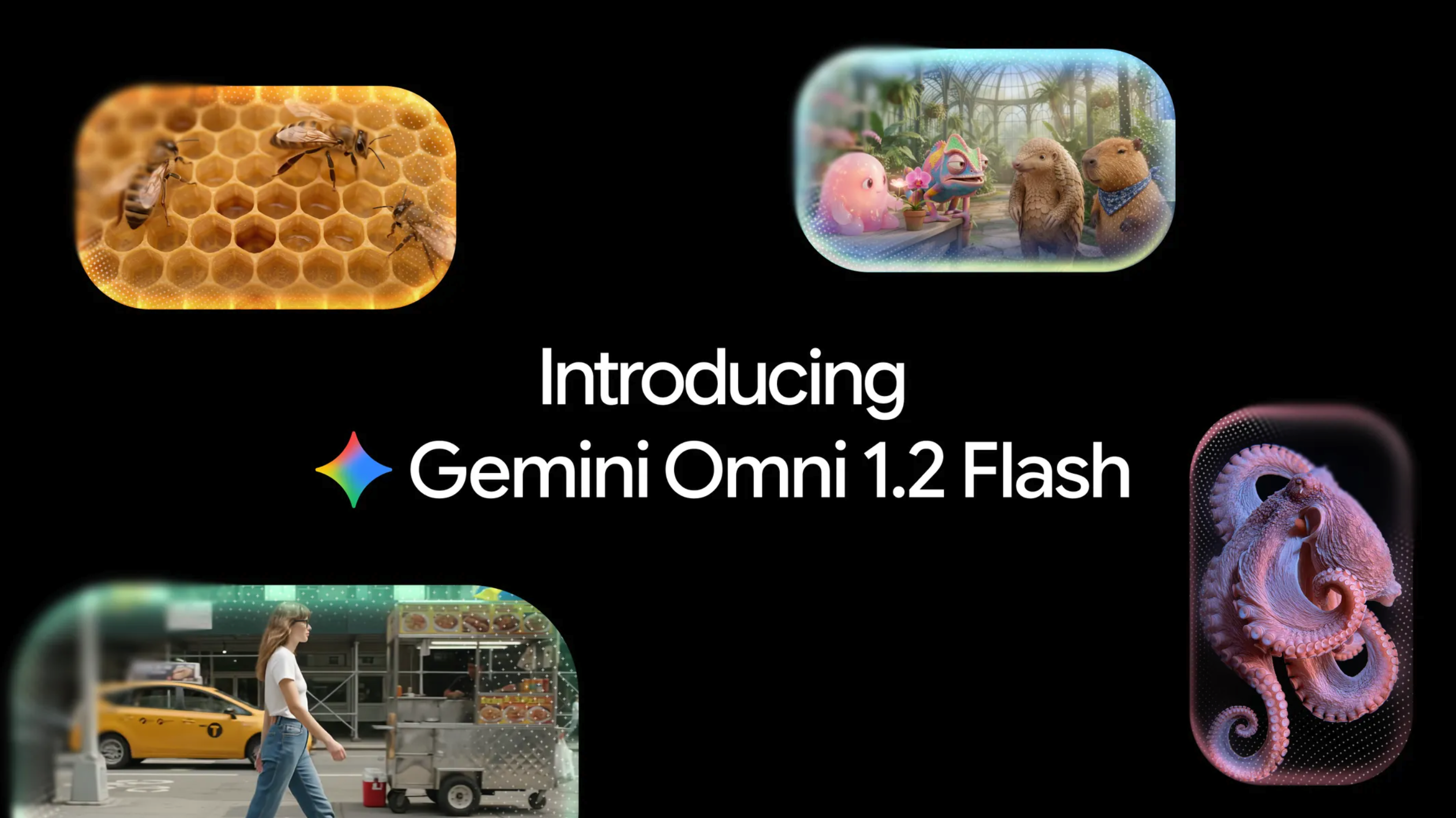
On November 6 — a Thursday — Google pushed its video model Gemini Omni 1.2 Flash out to market, stretching native output from a previous ceiling of 10 seconds to clips of 3 to 15 seconds while cutting 720p generation by 30%, to $0.07 per second. The extra footage grabs the headlines. The commercially decisive variable is a unit-cost curve Google can now attach to its own ads, cloud and workspace surfaces.
GlobalBizSight CompanyWatch — a company-level read on one event. By Marc Hale; reach the desk at info@globalbizsight.com.
What moved, and what only got better
Conclusion first: two numbers changed and one interaction pattern changed. Everything else in Google's announcement is quality improvement rather than a new capability class — which matters when you are pricing how fast this erodes a competitor's position.
| Variable | Previous generation | Gemini Omni 1.2 Flash | Commercial reading |
|---|---|---|---|
| Native clip length | 10 seconds maximum | Settable from 3 to 15 seconds | Crosses the threshold where one render can carry a full ad beat instead of needing stitching |
| 720p price | — | $0.07 per second, down 30% | A price cut, not a feature; it is the lever competitors must answer |
| Revision method | Re-render from scratch | Conversational Editing, multi-turn, across the full 15 seconds | Largest hidden cost saving: iteration, not first-pass generation |
| Resolution path | Single-tier | Draft at 360p or 720p, then upscale only the approved cut to 1080p or 4K | Turns video production into a budget line you can stage-gate |
| Reference inputs | Basic | Character images, product photos, video clips up to 3 seconds, audio prompts | Brand-safe continuity across camera angles |
| Provenance | SynthID | SynthID embedded in every generated video | Compliance-ready by default |
| Distribution | Developer previews | Rolling out via the Gemini API, Google AI Studio, Google Cloud Console, Flow, Google Vids, the Gemini app for Google AI Ultra subscribers, and Google Ads | One model, seven routes to spend |
How cheap is "cheap"? Running the arithmetic
The headline rate is only useful once you convert it into the cost of finished work. At $0.07 per second, one 15-second clip costs roughly $1.05 to render. Google's own developer pricing documentation reaches a comparable figure: under Standard pricing of $12.00 per 1M tokens, output works out to about $0.07 per second — approximately $0.70 for a 10-second clip and about $1.04 for a 15-second clip.
Google Cloud's published rate card exposes why the tiered workflow is the real cost lever rather than a presentation trick: the Omni Flash family bills around 1,931 tokens per second of 360p video, rising to 5,792 tokens per second at higher resolutions. Drafting cheap and reserving the upscale for the one cut that survives review can therefore swing campaign-level spend far more than the 30% list-price reduction does.
Against outside options, the positioning is aggressive but not unrivalled. A widely cited third-party API cost tracker from July 2026 listed Sora 2 base at $0.10 per second and Veo 3.1 Standard as high as $0.75 per second, with per-second rates across the market spanning roughly $0.05 to $0.75. Those are third-party snapshots, they mix resolutions and audio terms that are not apples-to-apples, and they go stale quickly — but they place Gemini Omni 1.2 Flash at the value end of the field rather than at the top of it.
Rough working assumption for planning, not a Google figure: a 200-variant creative test at 15 seconds each costs about $210 in raw 720p generation. If half the variants need two revision passes and only 20% are ever upscaled to 1080p or 4K, the workflow structure — not the per-second rate — decides whether that number doubles or triples.
Where the model plugs into Google's money machine
The launch is best read as a distribution event, not a research event. Google is making the same weights available to developers (Gemini API, Google AI Studio), enterprise buyers (Google Cloud Console), creators (Flow, Google Vids), subscribers (the Gemini app, opening to Google AI Ultra tiers) and advertisers (Google Ads) simultaneously — and the pricing sheet is published on both the developer and cloud sides of the house.
Timing sharpens the reading. Alphabet reported third-quarter 2026 revenue of $127.6 billion, up 25% year on year, with Google Cloud expanding 103% to $30.71 billion and its operating margin moving from 23.7% to 36.2%. Chief executive Sundar Pichai framed the quarter around a "deep full-stack" strategy, and the company disclosed that its first-party model API was processing close to 32 billion tokens per minute, up more than fourfold year on year, while the Gemini app passed one billion monthly users.
That context cuts both ways. The same quarter showed capital expenditure at roughly $51.4 billion and free cash flow turning negative, and the shares fell in post-earnings trading as investors questioned the payback schedule. A 30% price cut on a media model is therefore a deliberate bet: Google is trading margin per second for volume per second, on the theory that usage growth on TPU-backed inference outruns the rate reduction. The observable test is whether the next earnings cycle shows media-model volume large enough to matter against those numbers.
What the demo evidence shows — and what it does not
Google's strongest claim is reference adherence, and it is stated in testable terms: feed the model a character image, a product photo, a short clip of up to 3 seconds, plus audio prompts, and it should hold a face, a garment, packaging lettering and brand colour steady as the camera angle changes.
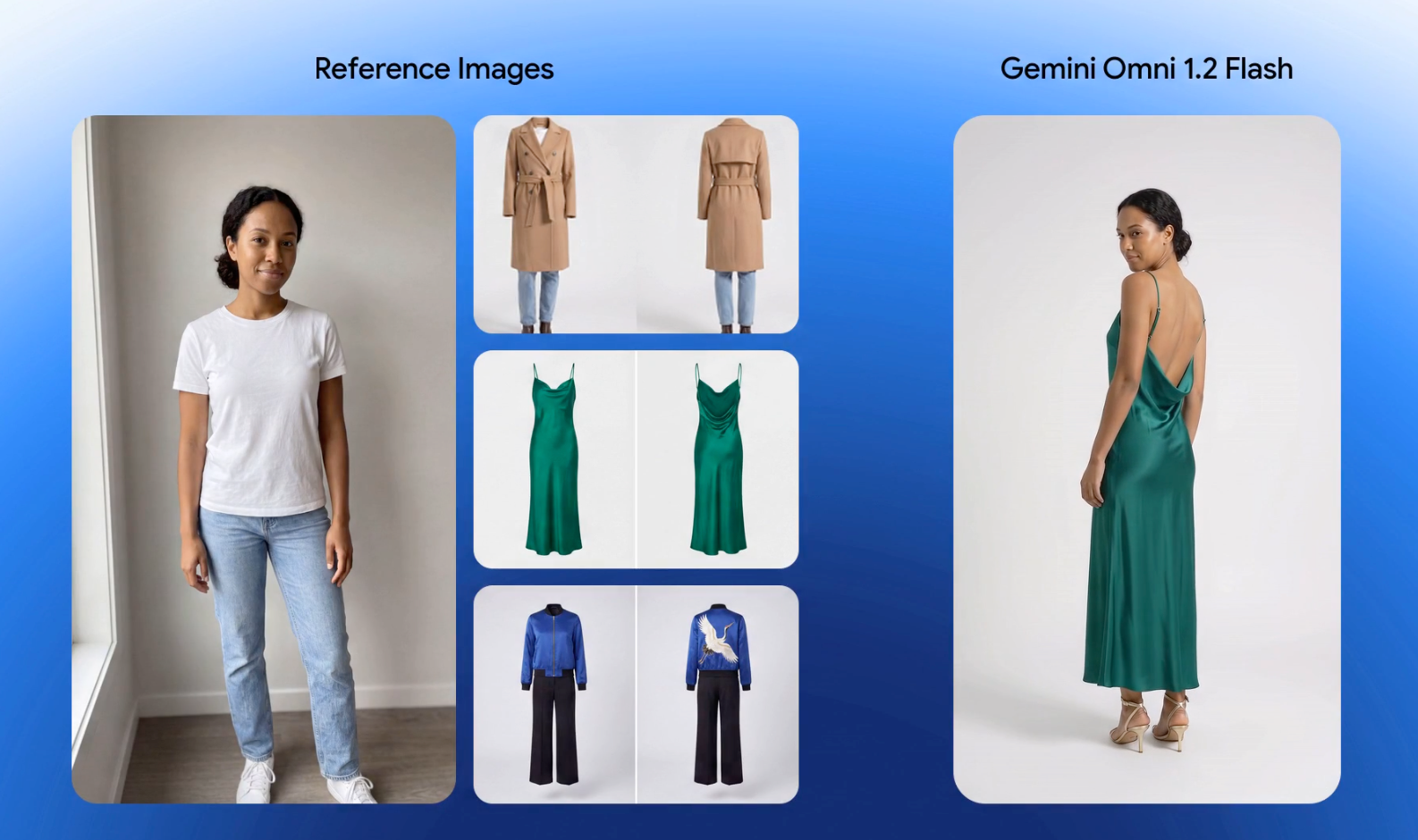
The worked example Google published is a virtual try-on: from one model photograph and product shots of three outfits, the model produced a single 15-second sequence containing a 360-degree turn, with the model's identity and each garment's cut and drape held constant. For retail and marketplace advertisers, that is the closest thing yet to a drop-in replacement for a low-budget shoot.
Two further craft improvements were claimed: less visual drift and deformation during motion and shot transitions than the previous generation, and smoother conversational speech with tighter lip sync that can distinguish multiple speakers. Camera handling also improved on complex continuous moves — first-person drone-style fly-throughs, fast pull-back shots — with far fewer unwanted jump cuts.
What is missing is independent verification. No third-party benchmark, blind quality comparison or per-resolution failure rate was published with the release; every consistency statement above is a vendor claim. Treat it as directional until an external evaluation exists.
Release cadence: May 19 to November 6
The Omni line is moving on a roughly five-month clock. The first model of the family, Gemini Omni Flash, was introduced at Google I/O on May 19 by Pichai and DeepMind chief Demis Hassabis, with clip length capped at 10 seconds in the platform documentation that followed. General availability of Gemini Omni 1.2 Flash on November 6 doubles usable duration to 15 seconds and lowers price in the same step.
Two signals sit inside that cadence. First, shipping under the Google DeepMind banner means model and product surfaces are being sequenced together rather than handed off — the seven-route rollout on day one supports that reading. Second, the pace implies that today's per-second rate is a waypoint, not a floor: on this schedule, a further cut or a longer ceiling is a within-two-quarters event, not a within-two-years one.
Five common misreadings of this launch
- Reading $0.07 per second as the cost of an advertisement. It is the cost of one render of one clip. Revisions, failed takes and upscaling stack on top; Conversational Editing is what changes the total, not the list rate.
- Assuming day-one availability. Google says the model is "rolling out" across the seven surfaces, and the consumer route opens to Google AI Ultra subscribers first. Procurement teams have repeatedly been caught by launch-day access language.
- Confusing the visible watermark with provenance. Turning off a visible mark does not remove provenance: SynthID is an imperceptible embedded layer, and metadata standards such as C2PA operate separately. The two are different controls, and enterprise buyers increasingly ask for both.
- Comparing per-second prices across vendors directly. Published rates bundle different resolutions, audio terms and length caps; one vendor's cheap second is another's silent surcharge.
- Treating brand consistency as commercial clearance. Holding packaging text and brand colour stable is a technical property. It says nothing about likeness, music or product-rights permissions, which remain the buyer's problem.
What to watch next: a tracking checklist
- Price and length, quarterly. Log the 720p per-second rate and the maximum native clip length at each point release. A move from 15 seconds toward half-minute output, or another double-digit percentage cut, is the single best leading indicator of Google's media-model strategy.
- Published upscale economics. Ask for, or wait for, explicit pricing on 360p and 720p drafts and on final 1080p and 4K upscaling. Without it, the tiered workflow is unfalsifiable and budgets are guesswork.
- Advertiser-side evidence. Watch Google Ads and Google Vids for productised multi-variant workflows and any disclosed lift in creative throughput or advertiser adoption — that is where the volume bet either pays or does not.
- Cloud disclosure linkage. In the next earnings cycle, listen for management connecting media-model inference volume to TPU demand or backlog conversion. Alphabet carried roughly $561 billion of backlog after Q3, with most of it expected to be recognised within 24 months.
- Competitor response. Track whether outside models reprice or extend length within one quarter. On this cadence, a silent market means the price cut is absorbing share.
- Provenance and compliance. Mid-2026 saw rival labs commit to embedding SynthID alongside C2PA metadata, and EU transparency obligations for machine-readable marking of synthetic content apply from August 2, 2026. Build provenance capture into asset pipelines now rather than retrofitting it into contracts later.
For buyers: pilot a draft-at-360p, finish-at-1080p-or-4K workflow with a hard cap of two revision passes, and measure cost per approved creative rather than cost per generation. For analysts: the number to interrogate is not the 30% discount but the elasticity it buys. For operators: verify SynthID provenance handling and likeness rights before scaling anything that resembles a person.
Frequently asked questions
How long a video can Gemini Omni 1.2 Flash generate?
Between 3 and 15 seconds, selectable per clip. The previous ceiling was 10 seconds.
What does the price reduction mean in cash terms?
Google cut 720p pricing by 30% to $0.07 per second, which arithmetic puts at roughly $1.05 for a full 15-second render; Google's developer pricing documentation cites about $1.04 for a 15-second clip under Standard token rates.
Can you change part of a finished clip without regenerating it?
Yes. That is Google's Conversational Editing feature: multi-turn instructions — swap the background, change the lighting, alter the aspect ratio — applied across the complete 15-second video while the untouched elements persist.
Are the outputs labelled?
Every video generated by the model carries an imperceptible SynthID watermark identifying its origin.
Which assets can be used as references?
Character images, product photographs, video clips of up to 3 seconds and audio prompts. Google's demonstration built a 15-second, 360-degree try-on from one model photo and three outfit shots.
Reference material
- Google, "Gemini Omni 1.2 Flash: 15-second video and lower pricing" — https://blog.google/innovation-and-ai/technology/developers-tools/introducing-gemini-omni-1-2-flash/
- Gemini Developer API pricing documentation — https://aistudio.google.com/docs/pricing
- Google Cloud Model Garden / Agent Platform rate card — https://cloud.google.com/model-garden/pricing
- Alphabet third-quarter 2026 results — https://abc.xyz/investor/
- Third-party AI video API cost tracker, July 2026 — https://www.buildmvpfast.com/api-costs/ai-video
- OpenAI on content provenance and SynthID adoption — https://openai.com/index/advancing-content-provenance/
- EU AI Act Article 50 transparency obligations — https://artificialintelligenceact.eu/