
GlobalBizSight Company Watch: Google’s K-12 AI Policy Turns Search Access Into a Bundled Choice
Google’s new K-12 administration rules make AI permissions and search access inseparable: schools that switch off all artificial-intelligence tools also lose Google Search, according to the company’s policy statement. That coupling has revived debate over platform control in United States classrooms, and it has given DuckDuckGo a concrete opening to pitch opt-out search to districts, teachers and administrators.
What changed inside Google’s K-12 education controls?
The core change is a default-off, opt-in model for managed student accounts, but with one asymmetric exception: Google Search is not offered as a standalone, fully AI-free product in this setting. As covered by CNBC, Google said Gemini, Gemini Notebook and search would be off by default for K-12 student accounts, and schools could choose to enable one, two or all three services. The controversy arises because enabling search also enables AI modes and AI Overviews in that environment.
For administrators, the practical consequence is a governance trade-off. They are no longer only deciding whether students may use a chatbot. They are also deciding whether students retain one of the most widely used research utilities in school: conventional web search. Google’s position is that search and AI capabilities are deeply integrated, so a completely AI-stripped search version cannot be supplied.
Why the policy spread beyond product settings
This is not only an interface question. It touches procurement, instructional design, student privacy and local autonomy. Teachers who want pupils to compare sources, identify weak links and learn keyword techniques still need a blue-link results page. Administrators worried about prompt leakage or inappropriate AI outputs may prefer to restrict chat-style tools while preserving search. The policy forces both groups into the same decision.
The backlash also landed in a more cautious policy environment. In early September 2026, the country’s two largest public school systems tightened rules for student AI use: New York City moved to pause student-facing generative AI in elementary and middle grades, while Los Angeles Unified restricted such use on district-issued devices, as reported by Tech Policy Press. Against that backdrop, Google’s choice to bundle search with AI looks less like a small default change and more like a platform-level constraint on school districts that are already testing the limits of classroom AI.
How DuckDuckGo is converting the dispute into a campus wedge
DuckDuckGo is framing itself as the opt-out alternative. The company’s founder and chief executive, Gabriel Weinberg, publicly told schools that DuckDuckGo lets users choose whether AI is included, and he highlighted the possibility of making the engine the default search option. Camille Bazbaz, the company’s chief public affairs officer, was sharper, arguing that forcing AI features on students reflects market dominance and urging schools to demonstrate that choice still exists.
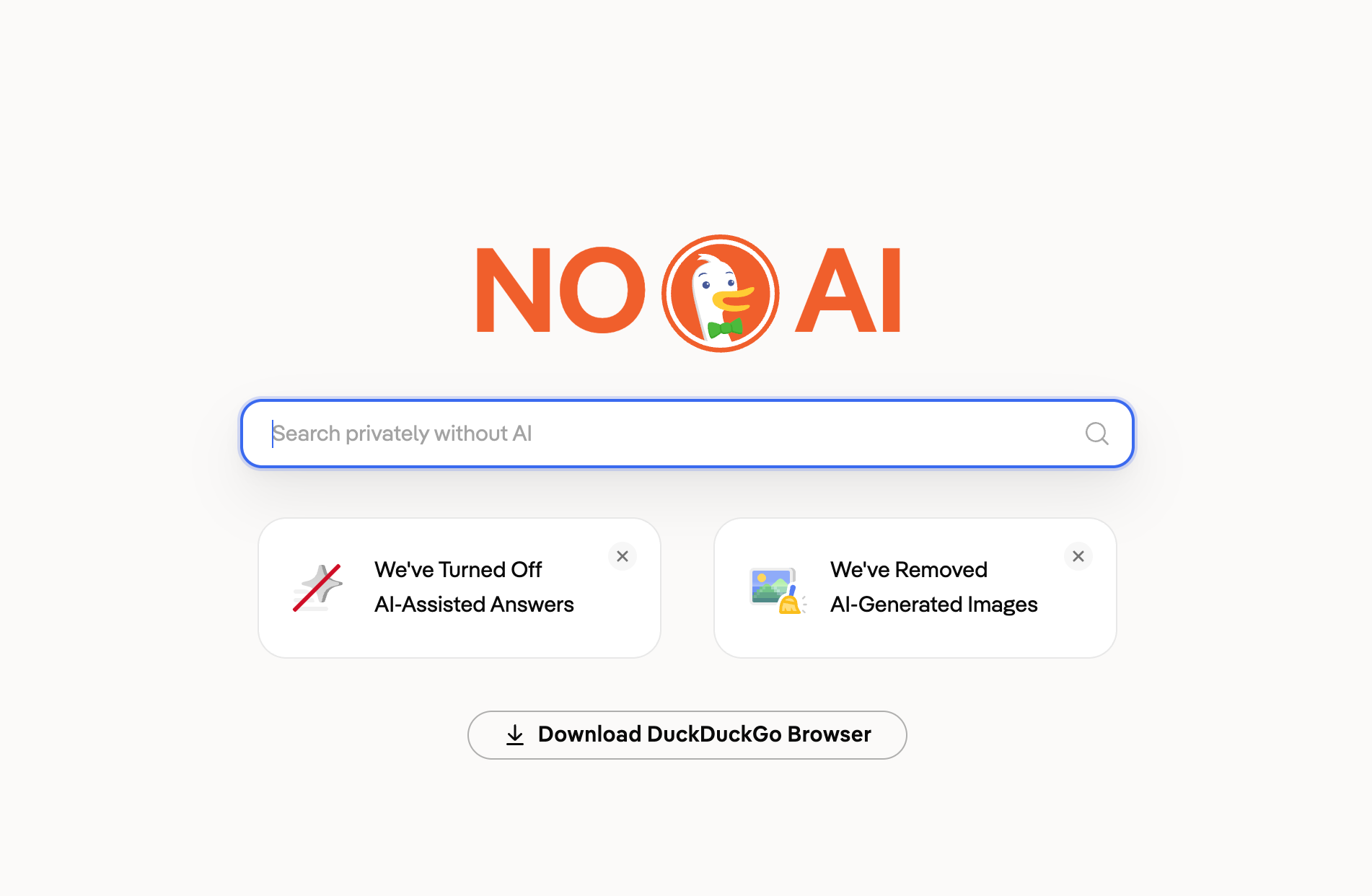
The pitch is simple enough to execute with limited IT resources. DuckDuckGo’s official help pages describe noai.duckduckgo.com as a search experience where AI features are disabled and AI-generated images are filtered from results. The company has also pointed schools toward basic browser and device configuration methods, while offering assistance with migration and deployment. Its message is not that AI is useless; it is that AI should remain a selectable feature, not the gateway to retrieval.
- Students can use traditional blue-link results without an AI summary.
- Administrators can avoid bundling chatbot or AI assistant access with search access.
- AI-related experiences can remain optional rather than mandatory.
- The company positions itself as a privacy-oriented fallback for districts uncomfortable with Google’s default.
Competitive interpretation: platform lock, product design and switching friction
From a company-watch perspective, the case reveals three commercial tensions.
| Dimension | Google’s position | DuckDuckGo’s position | What it implies |
|---|---|---|---|
| Product architecture | Search and AI are deeply merged. | Search and AI are separable modules. | Google treats AI as infrastructure; DuckDuckGo treats it as preference. |
| School control | Admins opt in to AI-enabled services. | Admins can point search to an AI-free endpoint. | Districts with strong AI skepticism get a lower-friction escape hatch. |
| Competitive strategy | Uses AI integration to strengthen its default education stack. | Uses choice and privacy to attack Google’s default. | The fight is less about ranking quality than about who controls the classroom entry point. |
Google’s education position remains structurally strong: classroom accounts, Chromebook workflows, Workspace collaboration and district contracts create significant inertia. A switch is rarely just a browser setting. It can affect assignment creation, sign-in policies, device management, lesson links, teacher expectations and technical support capacity. Yet the policy gives challengers a rare emotional and operational narrative: “keep search, remove AI.” That narrative is easy to sell to school boards and may be easier to pilot in individual classrooms than in district-wide systems.
Common misconceptions
- Misconception 1: The dispute is only about chatbots. The more difficult point is access to search itself. If AI settings determine whether search is available, the issue becomes basic information retrieval.
- Misconception 2: DuckDuckGo’s offer is a fully enterprise-grade replacement. It may function well as a default search endpoint, but schools still need to test sign-in, device policies, content filtering, analytics and support workflows.
- Misconception 3: Turning off AI automatically solves educational risk. A traditional search page still returns low-quality sites, misleading images and SEO spam; instruction in source evaluation remains essential.
- Misconception 4: Google’s opt-in controls are meaningless. They are meaningful for administrators who want controlled AI use; they are controversial for administrators who want controlled non-AI use.
Action checklist for school and platform leaders
- Separate the governance questions: chatbot use, search AI summaries, general web retrieval, and student data handling.
- Map every classroom workflow that depends on Google Search, including assignment links, library databases, browser profiles and district support tools.
- Run a pilot in one school or one grade band before changing the district default search engine.
- Document why a district chooses an AI-on, AI-off or mixed model so parents and teachers understand the instructional rationale.
- Review whether the chosen search endpoint logs queries, stores history, filters images and permits administrative controls.
- Track complaints and teacher workarounds after rollout; migration friction often appears through support tickets, not board debates.
What to watch next
The next signal is not whether Google repeats that AI and search are integrated, but whether it offers any school-facing toggle that disables AI Overviews and AI chat while keeping blue-link search. Another signal is whether districts formally set DuckDuckGo as default in managed devices, and whether that causes a measurable increase in support load. For analysts, the case is a reminder that education technology is now a control-plane business: the product is not only the tool students use, but the permission structure that determines which tools can coexist.
Google’s earlier attempt to soften the debate, including its Guided Learning direction, sought to make AI guide students step by step rather than hand them answers. DuckDuckGo’s move shows the remaining gap: some schools are not looking for a better pedagogy of AI; they are asking for an environment where AI is not required.
Frequently asked questions
Does Google’s K-12 policy ban AI for all students?
No. The policy makes AI-related products, including Gemini and Gemini Notebook, default off for managed K-12 student accounts. Schools can choose to enable them. The disputed point is that fully rejecting AI can also remove access to Google Search.
Why would disabling AI affect search?
Google argues that its search product now contains AI functionality so closely that a completely AI-free version cannot be separated. Critics counter that search results and AI summaries are distinct modules and can be controlled independently.
What is DuckDuckGo offering schools?
DuckDuckGo is promoting a search option that does not require AI summaries or chatbot-style tools, including noai.duckduckgo.com. Gabriel Weinberg and Camille Bazbaz have publicly positioned the company as a way for schools to retain traditional search while opting out of AI features.
Is this mainly a privacy dispute or a platform-power dispute?
Both. DuckDuckGo emphasizes privacy and choice, while the broader criticism concerns default control: when one platform combines account management, browser deployment, search, classroom software and AI features, switching decisions become high-stakes infrastructure decisions.
What metric would show the controversy is changing behavior?
Useful metrics include district-wide default search engine changes, device management profiles pointing to non-Google search, support tickets related to lost search access, enrollment in pilot schools, and requests for AI-off search endpoints.
Reference sources
- CNBC, “Google responds to outrage over removing search in schools that ban AI”
- Tech Policy Press, “America’s Two Largest School Districts Impose AI Moratoriums”
- TechCrunch, “DuckDuckGo pitches itself to schools amid backlash over Google’s AI policy”
- DuckDuckGo Help Pages, “About noai.duckduckgo.com”