
CompanyWatch: Intel Weighs an End for Arc B580 as Battlemage Silicon Is Redirected Toward Arc Pro AI GPUs
For anyone tracking Intel as a company rather than as a stock ticker, the clearest read on its next twelve months may come from a mid-range gaming card that nobody can any longer buy at its shelf price. Intel's third-quarter 2026 results, published in late October 2026, showed revenue of $16.5 billion, up 21% year over year, with data-centre and AI revenue surging 78% to $7.3 billion while the client computing segment slipped to roughly $8.1 billion. That mix shift is the operating backdrop to a report that circulated on November 3, 2026 and was first carried by Wccftech: the chipmaker is weighing the retirement of its fastest-selling consumer GPU in years, and handing the underlying silicon to products with richer margins.
Separating the claim from the record: what is alleged, and what is confirmed
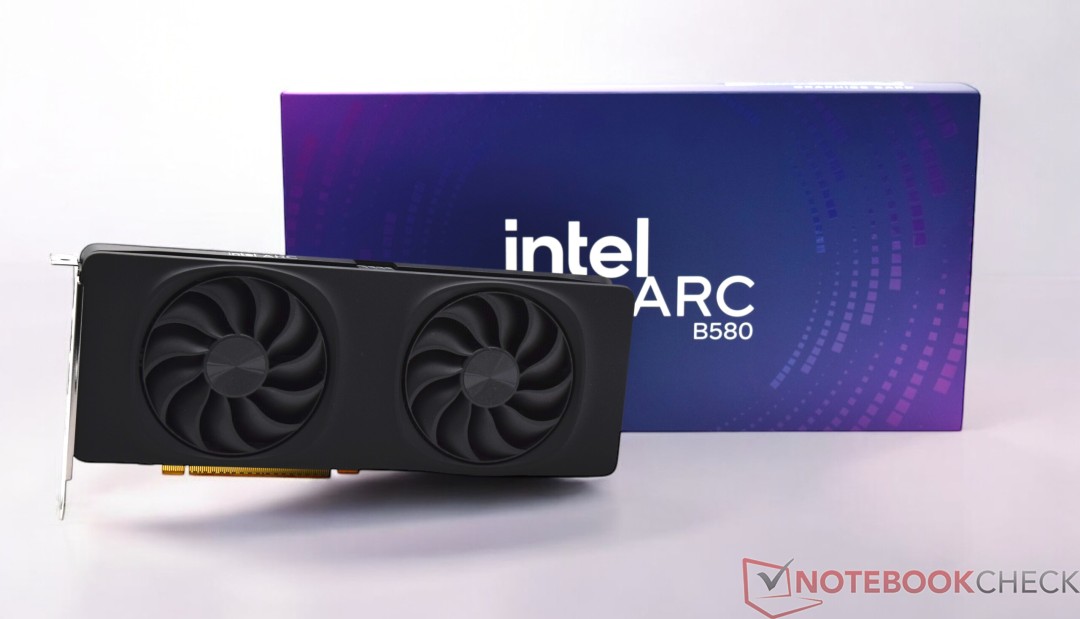
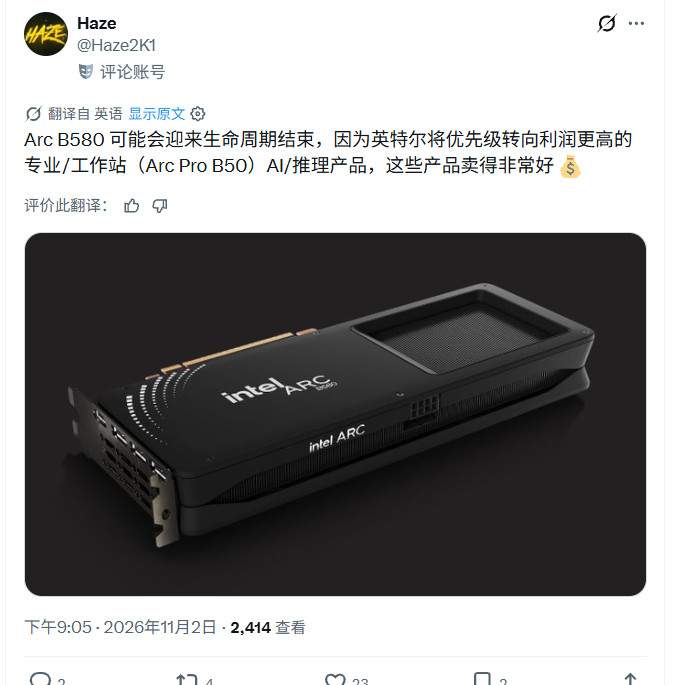
The rumour originates with leaker Haze (@Haze2K1), who alleges that Intel may place the Arc B580 on an end-of-life list and move capacity behind the Arc Pro series. The tip singles out the Arc Pro B50 and claims that Intel's professional-grade GPUs are seeing strong pull from artificial-intelligence inference workloads. The mechanism is straightforward: the Arc B580 is built on Intel's BMG-G21 chip, and that same chip also serves the Arc Pro B50 and the B60. On paper the two ends of the family are near relatives — the consumer card carries 20 Xe cores with 12GB GDDR6 memory, while the B60 uses 20 Xe cores with 24GB memory, and partners such as Maxsun and Sparkle go further, offering boards with up to 48GB memory.
What is not on the record matters just as much. Intel has issued no end-of-life bulletin, no product change notification and no public statement about the Arc B580's production status; the two companies referenced in these supply-side reports — Intel and Nvidia — have both left the claims unconfirmed. Treat the story as a channel signal, not a decision.
The margin arithmetic: one die, two very different price tags
Reading the price history of the Battlemage family makes the logic of a reallocation almost self-evident. The same BMG-G21 silicon has already been proven to command close to double the average selling price once it is wrapped in a workstation box with more memory attached.
| SKU | Silicon | Memory | Launch price | Segment |
|---|---|---|---|---|
| Arc B580 (December 2024) | BMG-G21 | 12GB GDDR6 | launch price of $249 | Consumer gaming |
| Arc Pro B50 (September 5, 2025) | BMG-G21 family | 16GB | $349 at retail launch, after a $299 pre-launch target | Small-form-factor workstation |
| Arc Pro B60 (September 5, 2025) | BMG-G21 | 24GB | c. $499 (TechPowerUp GPU database) | AI inference / pro workstation |
| Arc Pro B70 (announced March 2026) | BMG-G31 | 32GB ECC GDDR6 | c. $949 suggested starting price (Phoronix) | Workstation only |
Three commercial effects compound here. First, revenue per wafer start rises simply because the pro SKUs sell for roughly twice as much off the same die bank. Second, workstation buyers purchase through OEM and integrator channels with certified drivers and ISV validation attached, which dampens the discounting that erodes gross margin in consumer retail. Third, memory configuration becomes a differentiator instead of a liability: the 24GB and 48GB pro boards convert an input-cost problem into a premium feature. Intel's gaming SKU, by contrast, has the least pricing headroom of the four.
The Nvidia mirror image
The Intel story is easier to credit because the same pattern is visible across the competitive set. Multiple reports have alleged that Nvidia is pushing GB202 silicon away from the GeForce RTX 5090 and toward higher-margin RTX Pro professional cards, and one account held that a board partner could not even pre-order RTX 5090 kits. The RTX 5090 itself was cited as the consumer flagship caught in that reallocation. Nvidia's public position differs from Intel's silence: the company insists the RTX 5090 has not been discontinued and will continue shipping. The parallel does not prove Intel's intentions, but it shows a shared industry behaviour — when a die is scarce and AI demand is inelastic, the same silicon is steered toward the buyer with the larger budget line.
Street price is the leading indicator
Pricing has already moved ahead of any official notice. The Arc B580 reached the market in December 2024 with a launch price of $249, yet listings on Newegg recently climbed to about $330, and some models in the United Kingdom have reached around £500. Intel originally framed the card as a sub-$300 product — priced under $300 — whose performance rivalled Nvidia's RTX xx60-xx70 tier, making it one of the few genuine value options on the shelf. What is telling is that supply was already tight well before the AI memory squeeze hit the market; scarcity is not new to this product, which is precisely why an allocation decision now looks like a continuation rather than a shock.
Why the economics flipped: a memory shock, not a demand collapse
Wccftech's report tied the possible pivot explicitly to strong demand for AI-oriented variants and to elevated VRAM pricing, and that framing matches the wider component market. TechPowerUp reported that AMD was exploring graphics card price increases as memory costs spiked, and distributor commentary through 2026 described lengthening lead times across data-centre-class boards. The relevant point for Intel's product planning is that graphics memory competes for the same wafer supply as server memory. A $249 gaming card carrying 12GB of GDDR6 has a far higher share of bill-of-materials exposed to that inflation than a $499 workstation card carrying 24GB, whose memory cost is passed through to a customer buying a machine for inference work rather than for frame rates.
Pattern, not accident: where Intel's graphics silicon has already gone
The B580 rumour fits a sequence that Intel has been following for more than a year, and that sequence is the strongest reason analysts are giving the leak a hearing:
- The larger BMG-G31 die surfaced in March 2026 on the Arc Pro B70 and B65 — workstations only, no consumer gaming launch, as documented by ServeTheHome and Phoronix.
- Intel's public messaging has repeatedly resisted the "exit" narrative: an Intel community support response in August 2026 stated that stock shortages do not necessarily mean the Arc B580 is discontinued, and a May 2026 Intel community post said there was no announcement or plan to abandon the Intel Arc lineup; at Computex 2026, client computing executive Alex Katouzian described the GPU business as a key part of Intel's PC portfolio.
- The most capable Battlemage gaming card long promised above the B580 has never appeared, and reporting that the next-generation gaming line was cut traces back to a leaker rather than to the company.
- Intel has confirmed that its Xe3P-based data-centre accelerator, code-named Crescent Island and shipping as the GPU D-Series with 160GB to 480GB of LPDDR5X, was slated for customer sampling in the second half of 2026 — its own newsroom announcement positioned it as an expansion of the AI accelerator portfolio.
Read together, these signals suggest a reallocation of scarce wafers inside the graphics organisation rather than a retreat from graphics itself.
How much would losing the B580 actually cost Intel?
In revenue terms, comparatively little. Intel's discrete gaming install base remains small — Steam's hardware survey still lists the Arc Graphics entry at roughly 0.3% of surveyed systems — so the B580's removal would barely move the reported top line, and the card was never a volume rival to the two large incumbents. The cost is strategic and reputational. Battlemage's gaming tier is the only evidence Intel has offered that it can sustain a consumer roadmap, and its credibility depends on two things hardware buyers watch closely: whether the current card keeps receiving drivers, and whether a successor arrives on schedule. If the B580 becomes a one-generation dead end, Intel's argument for competing in gaming GPUs rests entirely on products that have not yet shipped.
Common misconceptions
- Rumour equals decision. An end-of-life list is a formal channel document. None has been published for the Arc B580, and the source itself used conditional language.
- Shortage proves discontinuation. Allocation to pro SKUs, board-partner component constraints and memory inflation can all empty shelves without any product retirement.
- A pro card is just a rebadged gaming card. Shared BMG-G21 silicon does not mean identical products: memory capacity, ECC configurations, certified workstation drivers and OEM validation separate the Arc Pro line from the consumer line.
- Intel is leaving graphics. The same reports that question the B580 describe expanding professional and AI output; Nvidia's refusal to retire the RTX 5090 shows that flagship consumer SKUs and AI-driven allocation can coexist.
- End-of-life means end of support. Retirement from manufacturing and retirement of driver updates are separate decisions, though for a small player the former usually precedes the latter.
Action recommendations
If you are an integrator or end buyer. Do not pay above the original $249 tier for a card you intend to deploy in fleet quantities; the Arc Pro B50 and B60 exist precisely because the same silicon is available with more memory through channels that support longer lifecycle commitments, and a workstation SKU is the safer bet if you need procurement continuity beyond twelve months.
If you are an investor. Judge the story by mix, not by sentiment. Watch reported revenue in the client segment against the 78% data-centre and AI growth rate from the third quarter, and treat any confirmed wafer reallocation from consumer to professional graphics as a modest gross-margin tailwind rather than a revenue event.
If you cover competitive strategy. Track Nvidia's RTX Pro allocation in parallel. The two cases are the same trade-off — scarce die area sold into elastic versus inelastic demand — and whichever company is first to make it explicit will reset expectations for the whole discrete GPU market.
The watchlist: five things to verify next
- An Intel end-of-life bulletin or product change notification naming the Arc B580 — the single piece of evidence that would convert speculation into fact.
- Statements from board partners such as Maxsun and Sparkle, including whether their 48GB variants remain orderable.
- Street-price direction on Newegg and in the United Kingdom: sustained retreat toward the launch price would argue for supply recovery rather than retirement.
- Intel's fourth-quarter 2026 commentary on graphics capacity allocation inside the client and accelerated-computing businesses.
- Driver branch cadence for Battlemage gaming products and any confirmed appearance of the missing higher-end gaming SKU.
Nothing in this story has been settled, and the sensible posture is patient scepticism. What the B580 episode does reveal is a company making an early, quiet choice about which customers deserve scarce silicon first — and that choice, more than any single product retirement, is the item worth putting on Intel's watchlist.