
Apple's 27.3 iCloud Link Check: What It Signals for the Company's Services Business
Apple will start reading what users publish from its cloud. Beginning with iOS 27.3, iPadOS 27.3, macOS 27.3 and visionOS 27.3 — updates expected to reach all users this December — every photo or file shared through the "Anyone with the link" option in iCloud Photos or iCloud Drive becomes available to Apple's review for harmful content, and flagged material can be deleted while the linked Apple Account is restricted.
For a company watch, the interest is not the feature itself. It is why Apple Inc. has chosen the single sharing mode that already sits outside its own encryption guarantees, and what that choice reveals about how the group intends to govern a Services business that is now the most valuable recurring revenue engine it operates.
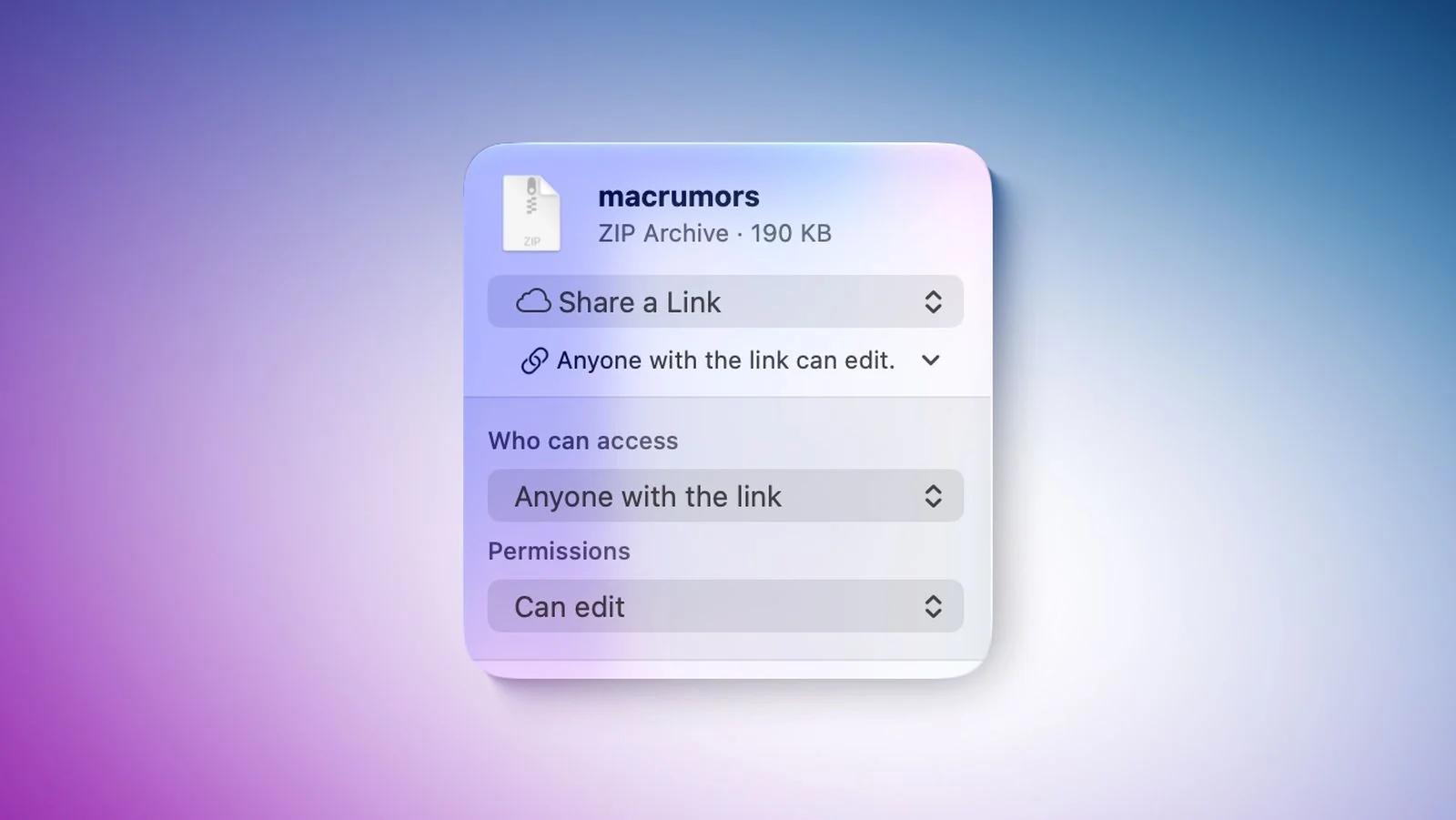
What exactly does the 27.3 release change?
The trigger is an access setting, not a file type or an app. Apple's revised wording says that when you share from iCloud Photos or iCloud Drive and choose "Anyone with the link", the picture or document involved is opened to Apple so that a content check can run.
iCloud today offers two ways to hand something to someone else. "Send a Copy" delivers the file itself to the recipient. "Share a Link" hands over a URL that the recipient uses to download from your storage — and inside that second mode you pick an audience: access limited to specific people, or access open to anyone holding the link. Apple states that the new review applies only to that last, fully public case.
| Sharing mode | Who can reach the item | In scope for the 27.3 check? |
|---|---|---|
| Send a Copy | Only the recipient you chose | No |
| Share a Link — access for specific people | Named Apple Accounts only | No |
| Share a Link — Anyone with the link | Anyone on the internet holding the URL | Yes |
Apple has not defined "harmful content" in the announcement. Judging from its published policies, the categories most plausibly in scope are malware, dangerous files and child sexual abuse material or other illegal content, and the company adds that it may cooperate with law enforcement where a case requires it.
What can Apple do to an account that fails the check?
Two tiers of consequences: content level and identity level.
- Apple reserves the right to move, refuse, alter, remove or delete material it judges harmful, at any time.
- It can take further measures against the related Apple Account, including restricting or deactivating it.
- It can stop the same email address or telephone number from being used to open a new Apple Account.
- In specific situations it can hand the matter to law enforcement.
The identity-level sanction is the commercially interesting detail. Free cloud storage is one of the cheapest assets abuse operations reuse; blocking an email address or phone number from re-registering raises the cost of getting back online, and it signals that Apple is treating public links as a policed surface rather than a dumb pipe.
Why is Apple moving now — and why on public links?
Because public links are the one part of iCloud the company can moderate without touching the privacy position it has defended since 2022.
The background matters. In August 2021 Apple announced a plan to scan photos uploaded to iCloud Photos for known child sexual abuse images. The proposal drew sustained criticism from cryptographers, digital-rights organisations such as the Electronic Frontier Foundation, lawmakers and even some staff, and in December 2022 Apple shelved it. Erik Neuenschwander, Apple's director of user privacy and child safety, put the objection plainly in a statement later reported by WIRED: "Scanning every user's privately stored iCloud data would create new threat vectors for data thieves to find and exploit."
The 27.3 design keeps that logic intact. Private storage stays unread; only items a user has already published to the whole internet are examined. It is a moderation move dressed as a platform update, and it lets Apple respond to child-safety and malware pressure while arguing that the user chose the exposure.
The timing is also concrete. Apple's developer portal lists the first 27.3 betas as released on November 3, 2026, with general availability expected this December. That leaves IT teams and creators a window of a few weeks, not months, to reclassify whatever they distribute by public link.
How does this sit with Advanced Data Protection?
The two features are linked by one rule: the sharing option, not the encryption setting, decides the outcome.
Apple's opt-in Advanced Data Protection raises the number of iCloud data categories under end-to-end encryption to 25, according to Apple's own iCloud data security overview. Yet the company states clearly that once content is shared as "Anyone with the link", it no longer benefits from end-to-end protection even when Advanced Data Protection is switched on. That loss of encryption is exactly what makes review technically possible.
What remains open is scope in time. Apple has not said whether public iCloud links created before iOS 27.3 and the other 27.3 updates ship are also examined, so the policy detail is still unresolved and should be treated as an assumption by anyone relying on old links.
How does Apple's approach compare with Google's and Microsoft's?
Read against its peers, Apple is aligning on the malware axis and going further on sanctions.
| Provider | Stated scanning practice | Stated consequence |
|---|---|---|
| Apple (from 27.3) | Checks items shared via "Anyone with the link" in iCloud Photos and iCloud Drive for harmful content | Content removal, Apple Account restriction or deactivation, blocking new accounts from the same email or phone, law-enforcement referral |
| Google Drive | Automatically assesses files shared with you by people outside your organisation for phishing and malware risk; scans cover files up to 100 MB and cannot read every format | Access blocked when a threat is detected; accounts that breach abuse limits can be suspended immediately |
| Microsoft OneDrive / SharePoint | Microsoft 365 runs its anti-malware engine over uploaded files asynchronously; Microsoft states not all files are automatically scanned | Infected files flagged and download restricted per tenant policy |
Sources for the comparison rows are the vendors' own documentation: Google's Drive security help page and Microsoft's Microsoft 365 anti-malware guidance. The difference in posture is worth noting. Google frames its checks as protecting the recipient; Microsoft frames them as tenant security hygiene. Apple frames the new check around the publisher and attaches identity-level penalties to it — the stricter of the three designs.
Where the disclosure gaps are
The following are gaps we identify in Apple's announcement rather than points the company has confirmed.
- No public definition of "harmful content", no classifier description, and no stated false-positive rate.
- No answer on retroactivity: are links created before the December release in scope?
- No described notice-and-appeal path for a file that is removed or an account that is restricted.
- Silent on whether shared albums, links generated from iCloud.com or Mail Drop attachments fall inside the same review.
- Unclear treatment of managed identities under Apple Business Manager, where the account belongs to an employer rather than the individual.
- No retention statement for content that has been read by reviewers or forwarded to authorities.
What it means for Apple's business picture
Services is the asset this policy touches. Apple's September-quarter Services revenue reached a record $31.57 billion, up 9.8% year on year, according to Variety's coverage of the results. iCloud storage tiers and iCloud+ bundles sit inside that line, together with advertising, payments and content.
Three consequences follow. First, moderation becomes a permanent operating cost attached to a product sold as private storage, which is a governance story Apple has not yet priced publicly. Second, workflow risk migrates to the customer: agencies, researchers, journalists and small firms that send deliverables by public iCloud link now depend on an undefined policy for reachability, so some of that traffic will drift to portals with contractual terms and audit logs. Third, the move is defensively smart — it gives Apple a documented child-safety measure on the only surface where it can hold one, strengthening its hand with regulators without reversing its refusal to read private data.
Which indicators should watchers track?
- Any update to Apple's legal and support pages before this December that defines "harmful content".
- Behaviour observed in the 27.3 developer beta cycle opened on November 3, 2026 — timing of checks, notifications shown to the sharer.
- Whether Apple answers the retroactivity question for links created earlier.
- Whether an appeal route appears, and whether restrictions are notified in-account or only discovered when a link breaks.
- Whether link moderation starts appearing in Apple's periodic transparency reporting alongside government content requests.
- Whether enterprise customers raise it on earnings calls or in Apple Business Manager documentation.
Common misconceptions
- "Apple will now scan my whole Photos library." No — the stated scope is the fully public sharing option.
- "I have Advanced Data Protection, so public links are exempt." No — public sharing is explicitly outside end-to-end encryption.
- "Only photos are affected." No — the announcement covers images and files, including iCloud Drive items.
- "This is the abandoned 2022 CSAM scanner returning." Different mechanism: the cancelled tool targeted private uploads; this one targets published links.
- "Deleting the link solves everything." Removing a link ends future access, but does not by itself answer what happened to material already reviewed.
- "Business accounts are handled the same way." Unconfirmed — managed Apple Accounts add an employer as a third party to any restriction.
What should teams do before the December rollout?
- Inventory live public iCloud links used for customer, media or partner delivery, and rank them by business value.
- Reclassify sensitive or revenue-critical items to access limited to specific people, or to "Send a Copy".
- Move regulated or contractual deliverables to storage with enforceable service terms, retention and audit trails.
- Put one named owner on each public link and set an expiry or review date.
- Brief staff that a broken public link may now indicate a policy action, not an outage, and define who checks account status.
- Confirm the recovery path for the Apple Account at the centre of a team's workflow: device trust, recovery contacts and two-factor setup.
- Re-test the flow on the 27.3 beta before the stable release, and record what notifications appear.
Frequently asked questions
Will Apple scan private iCloud files under 27.3?
Nothing in the announcement suggests that. The stated scope is items shared with "Anyone with the link"; "Send a Copy" and links restricted to specific people are described as outside the new check.
What happens if a shared file is flagged?
Apple says it can move, refuse, alter, remove or delete the content, and can restrict or deactivate the related Apple Account. It may also stop the same email address or phone number from registering a new account, and refer cases to law enforcement.
When does the rule take effect?
Betas of iOS 27.3, iPadOS 27.3, macOS 27.3 and visionOS 27.3 are already with developers; the public updates are expected this December.
Does this weaken end-to-end encryption?
It does not change Advanced Data Protection, which still covers 25 iCloud data categories. It confirms the existing exception: anything published to everyone is, by definition, not end-to-end encrypted.
Are links created before the release affected?
Apple has not said. Until it does, treat pre-existing public links as an open risk.
References
- Apple, iCloud data security overview — https://support.apple.com/en-us/102651
- Apple Developer news and release downloads, 27.3 beta cycle — https://developer.apple.com/news/
- The Verge, "Apple will check shared iCloud links for 'harmful content'" — https://www.theverge.com/tech/1026604/apple-icloud-links-harmful-content-27-3
- MacRumors, Apple to check public iCloud links starting in iOS 27.3 — https://www.macrumors.com/2026/11/04/ios-27-3-icloud-link-check/
- WIRED on Apple's abandoned iCloud scanning plan and Erik Neuenschwander's statement — https://www.wired.com/story/apple-csam-scanning-heat-initiative-letter/
- Google, Drive security help (external sharing checks, 100 MB scan limit) — https://support.google.com/drive/answer/141702
- Microsoft, built-in virus protection for SharePoint and OneDrive — https://learn.microsoft.com/en-us/microsoft-365/security/office-365-security/anti-malware-protection-for-spo-odfb-teams-about
- Variety, Apple Services revenue record for the September quarter — https://variety.com/2026/digital/news/apple-september-2026-earnings-services-revenue-hits-new-record-1236937903/
By Marc Hale, GlobalBizSight CompanyWatch — enterprise-level tracking of single-company moves: strategy, governance, financial exposure and the indicators that tell you whether the change is real.