
GlobalBizSight CompanyWatch: A Practical Guide to the 164,000-Signature Petition and Jensen Huang's Nvidia Return
Over the past decade, the decisive layer of the AI economy has shifted from chips to the infrastructure that makes those chips indispensable — and that is why the petition demanding Jensen Huang's return cannot, by itself, decide who runs Nvidia. As of November 16 at 9:15 a.m. Beijing time, the campaign had 164,000 signatures. For investors, the operative question is not the count but what the board does with it.
The scale is real; scale is not governance. Of those 164,000 signatures, more than 9,000 came from current and former Nvidia employees, nearly 90,000 from shareholders, and more than 60,000 from other supporters. Against a workforce of about 42,000, the signed employee tally equals 19.3% of staff — a meaningful signal of internal unease, but not a board resolution.
What does the 164,000-signature petition actually prove?
Conclusion: it proves that Huang still commands a mobilizable constituency, not that he will be reinstated. The breakdown — more than 9,000 current and former employees, nearly 90,000 shareholders, more than 60,000 others — tells us where sentiment sits. A board's fiduciary duty, however, runs to the company rather than to a signature total. Reuters reported on November 15 that the United States Treasury Secretary, Scott Bessent, had publicly urged Nvidia to "go outside the company" for its next chief executive — a deliberate counterweight to the campaign.
Read that tension correctly: two legitimate claims are colliding. One says a founder who built the franchise deserves due process; the other says a public company exposed to United States export controls needs a governance reset. Neither is settled by volume.
Who is really running the process — and why does it matter more than the petition?
Conclusion: the independent investigation, not the petition, will define the terms of any return. Nvidia's board retained Joon H. Kim of Wachtell, Lipton, Rosen & Katz — a former acting federal prosecutor — to run what it describes as a thorough and independent inquiry. Our earlier CompanyWatch analysis of the Wachtell investigation into Jensen Huang set out the mandate. The practical point: "due process" here means a written finding and a documented timeline, not a social-media vote.
For analysts, this is the single most trackable variable. A transparent scope and schedule reduce the probability of a disorderly succession; a vague or extended process keeps the key-person discount on the stock alive.
Why did one engineer's departure become a market signal?
Case study — the human-capital channel. On November 16, Jiemian News reported that Nvidia robotics learning engineer Darrell Dai had posted yesterday that he would leave the company. In his account, Huang was not simply a CEO: he admired a leader willing to fund future technologies with no clear near-term payoff. Huang had invested in CUDA before deep learning became a craze and completed Nvidia's AI positioning before artificial intelligence drew universal attention — decisions that built the infrastructure now underpinning the entire AI industry. Dai concluded that with Huang's departure, his own chapter at Nvidia should close.
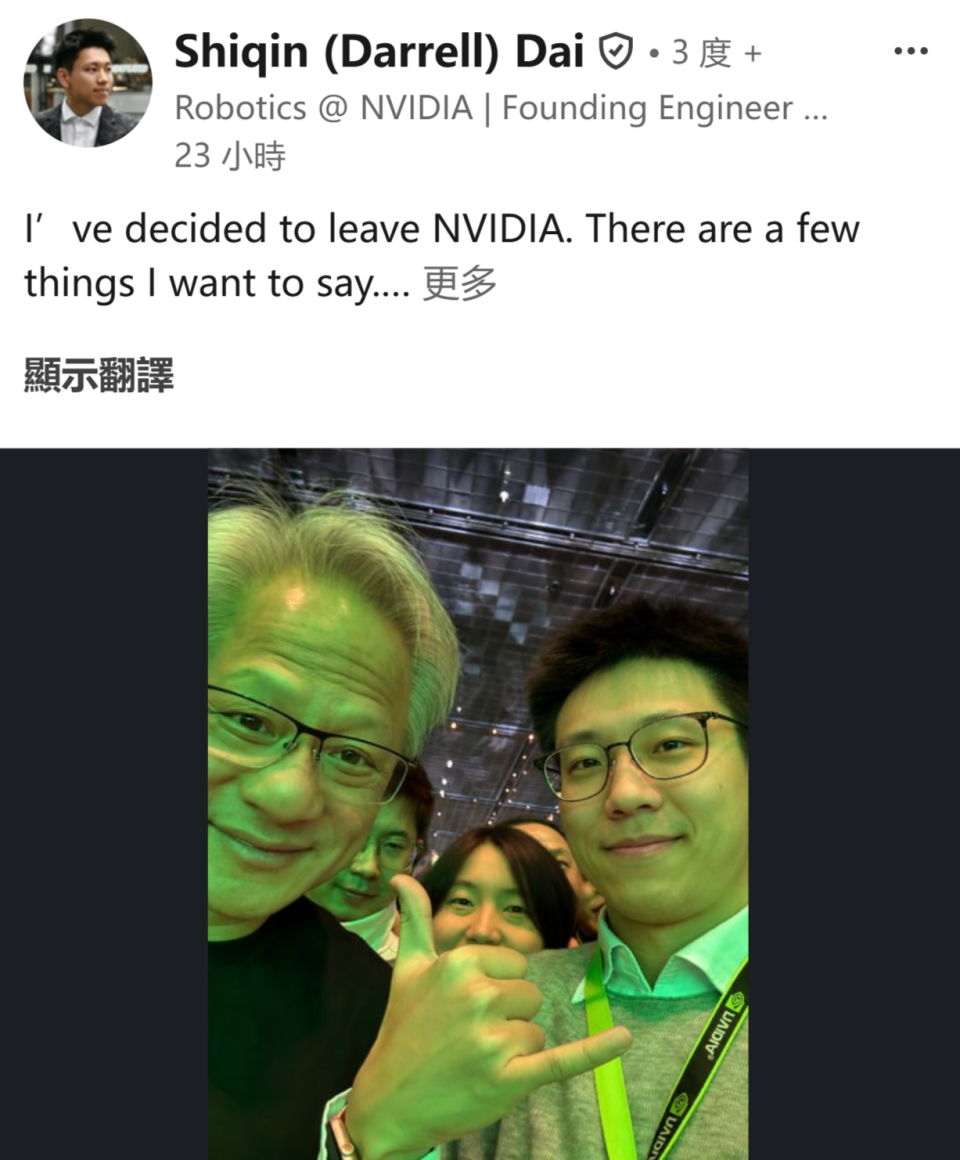
This is what key-person risk looks like in practice — key-person risk meaning the extent to which valuation depends on one individual's judgment and relationships. It travels through people before it travels through earnings.
Does the franchise still work without Huang? What the numbers say
Conclusion: the operating engine looks intact, but the market is pricing in founder dependence. Nvidia reports its fiscal 2027 third quarter on November 17 — the first results since Huang stepped down. Pre-release consensus tracked by CNBC clustered around $109 billion in revenue and roughly $2.48 in adjusted earnings per share. Morningstar, which assigns Nvidia a "wide economic moat" — its term for an advantage expected to persist for at least two decades — now describes the company as an "AI systems" business. Investors will listen closely to interim CEO Colette Kress for a strategy that reads as continuity rather than improvisation. Last week, the shares fell 12.75%, a direct gauge of confidence erosion.
A useful corrective came from Morgan Stanley, reported by Wallstreetcn on November 16: the debate about a collapsing CUDA moat "has attracted far more attention than it deserves," with Nvidia's revenue share still above 80% and most scarce-supply orders for the next 12 months already secured through prepayments. The near-term baseline is contractual, not charismatic. That distinction belongs in every valuation model here.
How should investors monitor the situation? A five-step checklist
- Separate sentiment from process. Log signature counts daily, but weight the board's investigation scope, timeline and written findings far more heavily.
- Treat the November 17 call as a governance event. Note whether Colette Kress frames the roadmap as continuity, and whether Q&A dodges questions about the succession mechanism.
- Quantify key-person dependency. Score five dimensions: direct-report span, decisions with no alternative path, concentration of final technical judgment, whether top-customer and government relationships sit with one person, and which processes stall if the chief executive is absent for six months.
- Verify demand lock-in. Prepayments and order-backlog disclosures matter more than headline sentiment when judging the next four quarters.
- Watch the talent channel. Departures of the Darrell Dai kind are a leading indicator; a cluster, not a single exit, is the signal.
What are the common pitfalls in reading this story?
- Pitfall 1 — treating a petition as a shareholder vote. It measures intensity, not authority.
- Pitfall 2 — assuming the CUDA moat has evaporated. With revenue share above 80% and a wide moat rating from Morningstar, that conclusion outruns the evidence.
- Pitfall 3 — extrapolating one engineer's exit into a talent collapse. Watch the pattern, not the individual.
- Pitfall 4 — ignoring the Treasury factor. Bessent's call for an outside chief executive is a real constraint on the board's options.
Korn Ferry's governance research puts the standard plainly: "Strong CEO succession planning is the ultimate test of board effectiveness." For a company whose product is now critical infrastructure, that test is being run in public.
Frequently asked questions
Will Jensen Huang return as Nvidia CEO?
Undecided as of this writing. The 164,000-signature petition and the push from Bessent point in opposite directions, and the board's independent investigation is the mechanism that will resolve the question.
How many people signed, and who were they?
By November 16 at 9:15 a.m. Beijing time: 164,000 signatures in total — more than 9,000 current and former Nvidia employees, nearly 90,000 shareholders, and more than 60,000 other supporters, with the employee figure equal to 19.3% of a roughly 42,000-person workforce.
When is the next earnings report, and why does it matter?
November 17, for the fiscal 2027 third quarter. It is the first release since the resignation and the first chance to hear interim CEO Colette Kress define the operating plan.
What should analysts watch after the report?
Three things: any change in the investigation's published scope, the tone of management's succession language, and whether the 12.75% weekly decline reverses as the prepayment-backed order book becomes visible.
For decision-makers, the closing judgment is simple: what ultimately separates a durable company from a fragile one is not whether a single person can hold it together, but whether the infrastructure that person built keeps compounding after they step away.
References
- Reuters — "Bessent says Nvidia must 'go outside the company' to find new CEO" — https://www.reuters.com/world/bessent-says-nvidia-must-go-outside-company-find-new-ceo-2026-11-15/
- CNBC — "Nvidia: Joon Kim leads Jensen Huang investigation" — https://www.cnbc.com/2026/11/12/nvidia-jensen-huang-joon-kim-wachtell-china-spy.html
- CNBC — "The tech world's calls for Jensen Huang to return to Nvidia are growing" — https://www.cnbc.com/2026/11/16/nvidia-jensen-huang-return-tech.html
- Morningstar — "What to Watch in Nvidia Earnings" — https://www.morningstar.com/stocks/what-watch-nvidia-earnings-spy-scandal-data-center-concerns-take-center-stage
- Wallstreetcn / Morgan Stanley — "CUDA moat and post-Huang outlook" — https://wallstreetcn.com/articles/3785982
- NACD — "CEO Succession Principles and Tools for Boards" — https://www.nacdonline.org/all-governance/governance-resources/governance-research/director-handbooks/success-at-the-top-ceo-evaluation-and-succession/
- GlobalBizSight CompanyWatch — "A Practical Guide to Nvidia's Wachtell Investigation of Jensen Huang" — https://globalbizsight.com/companywatch/nvidia-board-wachtell-investigation-jensen-huang