
How JSW Greentech Limited Turned a Siemens Xcelerator Selection Into an India EV Operating Model
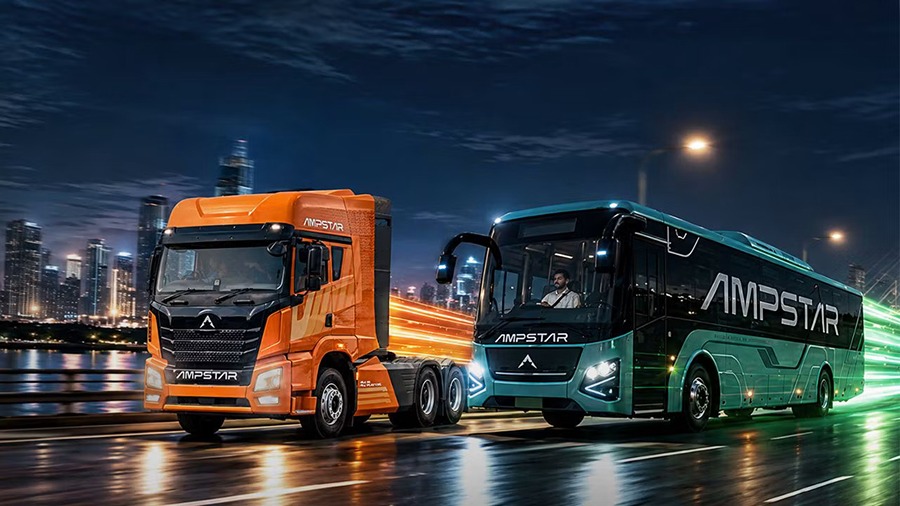
The case shows that Siemens Xcelerator, Teamcenter and Mendix were selected by JSW Greentech Limited as the control layer for AMPSTAR electric buses and trucks in India. The plan ties engineering, product development, factory planning and supplier coordination to one product-data spine across Pune and Chhatrapati Sambhajinagar. For GlobalBizSight CompanyWatch readers, the signal is concrete: EV expansion depends less on launch messaging than on traceable bills of materials, change records and supplier workflows before capacity is scaled.
This is a retrospective case view, not a product review. The value for investors, strategists and analysts is the sequence: a company first creates a controlled product-data spine, then extends it to suppliers and business functions before scaling a new vehicle brand.
What changed in the JSW Greentech Limited case
In its November 3, 2026 announcement, Siemens said JSW Greentech Limited selected Siemens Xcelerator software to create a unified digital base for commercial electric vehicle development. The work supports AMPSTAR, the company's electric bus and truck brand, and connects its R&D center in Pune with its greenfield manufacturing facility in Chhatrapati Sambhajinagar, India.
Independent reporting adds useful context. Indian business media said AMPSTAR vehicles are planned for a 90-acre integrated EV facility at AURIC in Chhatrapati Sambhajinagar, with an initial annual capacity target of 15,000 electric buses and trucks. That capacity target makes the software announcement more important than it would be for a single prototype: commercial EV scaling turns engineering data, change control and supplier alignment into throughput variables.
Why Teamcenter and Mendix were paired
The architecture is purposeful. Teamcenter is assigned the backbone role: it should hold the product and engineering records, support BOM and structure management, and let requirements, program plans and engineering changes move through a controlled process. The case specifically needs mechanical and electrical work to stay aligned.
Mendix is assigned the workflow layer: supplier users and internal teams get portal-style access and process apps, rather than seeing raw PLM screens. Siemens Xcelerator materials describe the platform as a low-code environment for building fit-for-purpose solutions around core products such as Teamcenter.
That division of labor matters because electric commercial vehicles are not assembled from one engineering silo. A change to a battery cooling route can affect harness routing, connector placement, supplier lead time, assembly sequence and cost. According to Siemens Teamcenter supply-chain collaboration materials, disconnected systems, inconsistent product data and delayed change communication are recurring manufacturing risks. The JSW Greentech implementation addresses the risk by keeping product truth in Teamcenter while letting Mendix make that truth usable in partner-facing and process-facing work.
Digital thread mapping: function, owner and observable signal
| Element | Function in the AMPSTAR program | Why CompanyWatch readers should track it |
|---|---|---|
| Teamcenter | Stores the digital thread for product structures, bills of materials, requirements, change management and cross-discipline collaboration. | It creates the audit trail needed to compare design intent with factory execution. |
| Mendix | Builds portal and workflow experiences, especially for supplier collaboration and business processes. | It reveals whether partner users are being onboarded into controlled digital processes, not email exchanges. |
| ERP integration | Aligns engineering records with commercial and planning data. | It is the test of whether product changes move procurement, cost and planning data at the same time. |
| Pune and Chhatrapati Sambhajinagar | Connects R&D with greenfield manufacturing operations. | The distance between concept and production is where many new EV programs fail or slow down. |
Case replay: the implementation logic investors should infer
- Single source of product truth. Before scaling AMPSTAR, JSW Greentech Limited needs a controlled repository for engineering and product data. Teamcenter is assigned that role.
- Cross-domain dependency control. Electric buses and trucks require mechanical, electrical and supplier data to stay synchronized. The program explicitly supports collaboration across mechanical and electrical engineering disciplines.
- Business data alignment. Integration between Teamcenter and the company's ERP system is meant to improve information flow between engineering and business functions. This is where digital transformation becomes measurable.
- Supplier extension. A Mendix-based portal pushes controlled processes beyond internal teams. For an Indian EV supply chain, this is often the hardest adoption problem because supplier digital maturity is uneven.
- Launch-to-manufacture handover. Pune's R&D center and Chhatrapati Sambhajinagar's greenfield plant are linked by the same thread, reducing the risk that prototype decisions become unusable at the factory gate.
Financial and strategic read-through
The announcement does not provide order backlog, unit economics, battery-pack sourcing terms or plant output rates. It should therefore be read as a capital-efficiency and risk-reduction signal rather than proof of commercial success. A 15,000-unit capacity target is an operating ambition; software implementation is the control mechanism that can turn that ambition into repeatable production planning.
For analysts, the most useful inference is the spending priority. The company is investing in product lifecycle management before the brand becomes a large-scale revenue engine. That is a rational sequence, but it also raises the bar for follow-on disclosure: stakeholders should look for evidence that the system has moved beyond configuration into daily use.
Common misconceptions
- This is not just an IT purchase. The case is a manufacturing-process redesign. If suppliers and engineers do not use the same data definitions, the software stack does not solve the problem.
- Mendix is not replacing Teamcenter. Siemens Xcelerator materials describe Mendix as a low-code application platform that can build fit-for-purpose solutions around Teamcenter. The portal approach complements the PLM backbone.
- Capacity is not the same as capability. A 90-acre plant and 15,000-unit target indicate ambition. Change control, supplier onboarding and ERP synchronization determine whether capacity becomes shipment.
- One announcement is not execution. The case should be judged by milestones: BOM release, supplier access, change-cycle time and engineering-to-plant data flow.
Action checklist for CompanyWatch readers
- Track implementation milestones rather than press-release language: supplier portal onboarding, Teamcenter-ERP synchronization, release management and BOM accuracy.
- Ask whether AMPSTAR's electric bus and truck programs use controlled change orders that connect design, procurement and manufacturing data.
- Monitor whether Pune R&D decisions move to Chhatrapati Sambhajinagar without parallel spreadsheets or email packets; that is the practical test of the digital thread.
- Watch for supply-chain transparency around battery, power electronics and body components, because supplier collaboration is where EV programs usually slow.
- Treat the Siemens Xcelerator selection as a governance signal: the company is building traceability before scaling, but traceability still needs measurable adoption.
Frequently asked questions
What did Siemens Xcelerator software aim to do for JSW Greentech Limited?
It aimed to create a unified digital base for commercial electric vehicle development, connecting engineering, product development, factory planning and supplier coordination under the AMPSTAR brand.
Why are Teamcenter and Mendix relevant together?
Teamcenter stores and manages the product lifecycle record, while Mendix extends that record into portal and workflow applications, including supplier collaboration.
Where are the main operations in the case?
The R&D center is in Pune, while the greenfield manufacturing site is in Chhatrapati Sambhajinagar, India. The program links the two through the digital thread.
What is the biggest execution risk?
The biggest risk is not the software selection; it is adoption across mechanical and electrical teams, supplier users and ERP owners. If change data remains fragmented, capacity targets may not translate into stable deliveries.
Reference sources
- Siemens news release, JSW Greentech scales EV development with Siemens: https://news.siemens.com/en-us/siemens-jsw-greentech/
- CNBC-TV18 report on AMPSTAR launch and capacity: https://www.cnbctv18.com/auto/jsw-greentech-launches-ampstar-ev-brand-eyes-15000-unit-manufacturing-capacity-19995683.htm
- Siemens Teamcenter supply-chain collaboration materials: https://blogs.sw.siemens.com/teamcenter/supply-chain-collaboration-leader/
- Mendix and Siemens Xcelerator portfolio materials: https://www.mendix.com/siemens/
This GlobalBizSight CompanyWatch analysis is prepared by Marc Hale. Follow-up questions may be sent to info@globalbizsight.com.