
818 Tequila Nothing Extra Review: Does Ingredient Proof Outrun Celebrity Pull?
Celebrity spirits have run one script for a decade: a famous name rents attention at launch, then the liquid must earn repeat purchase on its own. 818 Tequila's Nothing Extra, announced on November 9, inverts that order. The reveal is the bottle, and the claim is 3 ingredients backed by published laboratory work. For investors and brand teams the useful question is not whether the spot is memorable, but whether evidence plus Sazerac's US network can convert a joke into shelf velocity. That is the trade this review prices.
What does the Nothing Extra film actually reveal?
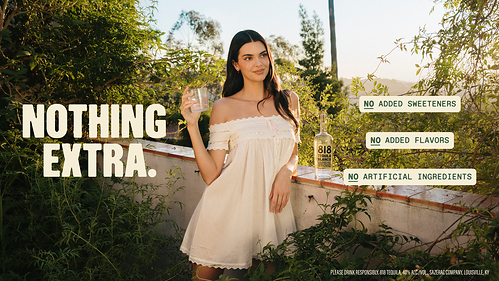
An ingredient list, delivered as misdirection. Kendall Jenner stays out of frame while the camera teases, Kendall remains fully clothed throughout, and the object finally laid bare is the product. The creative bets that one phrase travels from a joke to an aisle decision.
 Still from the Nothing Extra spot; image credit: Little Black Book.
Production choices are why the gag reads as product talk rather than gossip. The film was shot at Flamingo Estate in Los Angeles; agency Nice + Frank created the campaign, OBB Bolded produced it and Max Bartick directed. A Garden of Eden setting lets any viewer translate "bare" into "nothing added" without knowing how tequila is made. Jenner said the team "wanted to do something unexpected," and the unexpected element is that the punchline is a formula: 100% Agave Azul, water and yeast, with no added sweeteners, flavors, colorings or artificial ingredients.
How testable is the ingredient claim?
More testable than the category norm, and stated with limits. On its campaign page 818 publishes third-party laboratory results beside its ingredient statements, covering specific Blanco and Reposado lots rather than issuing a blanket guarantee. Two disclosures deserve a precise reading.
- Trace compounds. Trace propylene glycol was detected in the tested samples even though 818 says none was added during production; the brand treats detection and deliberate introduction as different facts.
- Date and lot scope. Tequila produced with the newer formula began rolling out in the United States in 2025, and lot numbers are printed so a buyer can check one bottle instead of the whole brand.
The part most coverage skips: under Mexican tequila rules, up to 1% of total liquid weight may come from caramel coloring, oak extract, glycerin or sugar-based syrup without appearing on the label, per Whisky Advocate's additive-free guidance. Against that legal default, "nothing extra" is a deviation requiring evidence, not a description of the category. The campaign's honest weakness is scope: results are published at lot level, and nothing in the ad tells a shopper what share of output those lots represent.
What does the Sazerac partnership change?
The route to market shifted earlier this year, in a direction that favours the balance sheet over the spotlight. In April 2026, 818 announced a strategic partnership and financial investment alongside an exclusive US sales and distribution agreement with Sazerac, dated April 28. The Wall Street Journal described the transaction as a minority investment, and The Spirits Business reported Sazerac declined to detail terms, so the founder keeps equity while renting a national network. Independent October reporting from Food Dive, whose deal coverage flagged wider shelf visibility and new bottle formats, framed the brand as entering a more aggressive growth phase.
Company-reported volume is the second driver. For the four weeks ending October 3, 2026, 818 says US volume sales rose 77% from a year earlier, compared with 6% for the US tequila category priced at $24 and above, citing NielsenIQ.
| Metric | 818 | US $24+ tequila segment |
|---|---|---|
| US volume sales growth, four weeks ending October 3, 2026 (company-reported, NielsenIQ) | 77% | 6% |
Two corrections belong here. First, that window closes before the November creative launched, so the print is the reason the campaign exists, not proof that it worked — treat campaign-attributed lift as unproven. Second, 6% is itself a firm number in a maturing category: IWSR reported in July 2026 that super-premium tequila volumes fell 6% across 2024-25, with a further -5% annual decline forecast to 2030. A founder-led label posting 77% inside that shape is a share-taking story, and share-taking invites both distribution support and competitive response. The measurement trap is familiar on this desk, where a promotion can appear to prove adoption while only certifying clicks.
Which playbook is 818 running: Casamigos, Beats, or its own?
| Dimension | 818 Tequila (Nothing Extra) | Casamigos (Diageo) | Beats (Jenner campaign) |
|---|---|---|---|
| Role of the famous name | Founder of a brand that began selling tequila in 2021; carries the setup, hands the payoff to the liquid | Co-founder shorthand for a lifestyle, then a seller of the company | Hired talent; several versions of Kendall make a customization feature legible |
| What the creative explains | Product composition: 3 ingredients, nothing added | Aspiration and social proof | A feature of someone else's hardware |
| Growth engine | Sazerac US distribution plus retail and delivery platforms | Diageo global scale after acquisition | Incumbent marketing budget and existing channel |
| Ownership signal | Equity retained, minority partner, terms undisclosed | Exit to Diageo in 2017, a deal reported at up to $1 billion | No equity link between talent and product |
| Dominant risk | The claim must survive lab scrutiny and shelf turnover | Identity fades once the founder is no longer the owner | Attention lands on the star, not on a buying habit |
The comparison is where the capital-allocation choice becomes visible. 818 is not selling the company and is not renting a face; it is putting its founder's own formula on the table while a larger distributor handles availability. Jenner remains the first look, the product is meant to earn the second.
Where the coverage goes wrong, and who should copy this
Four errors recur.
- Reading the growth figure as campaign output. The 77% covers the four weeks ending October 3, 2026; the film arrived in November. Attribution runs the other way.
- Treating "no additives" as the industry default. Regulation permits undisclosed additives inside a 1% limit, so the claim needs lot-level proof.
- Calling the Sazerac arrangement a sale. It is reported as a minority investment with exclusive US distribution; retained ownership is what makes the claim hers to defend.
- Assuming the joke does the work. The same suggestive framing that wins attention can swallow the claim if viewers keep the setup and lose the ingredients.
Fit check, on CompanyWatch's assessment rather than on published evidence:
- Copy it when the founder owns the product, the claim can be verified on a page the ad points to, and wider distribution is already contracted.
- Skip it when the range is broad and recently reformulated without dated lot codes, or when the brand sits below the $24+ tier, where shoppers are less primed to inspect evidence.
What CompanyWatch will track next
- Evidence coverage. Whether published testing expands from the named Blanco and Reposado lots to aged expressions, and whether 818 discloses what share of output is covered.
- Transition completion. How fast pre-2025 stock clears from US shelves; legacy bottles are the single largest threat to a formula claim.
- Distribution proof. Doors, facings and the new formats under the Sazerac agreement, matched against the campaign's run across social media, YouTube, connected television, out-of-home, shopper media and delivery and commerce platforms.
- Later sales prints. NielsenIQ windows after November 9 are the first honest read on whether the creative moved volume.
- Governance signals. Any disclosure of the stake size or option terms would show whether a Casamigos-style exit remains on the table.
Questions this campaign raises
Does Nothing Extra prove that no additive is in any bottle of 818?
No. It documents the tested lots, identified by lot number, as containing no added sweeteners, flavors or colorings, with trace propylene glycol detected despite no deliberate addition. Scope is lot-level and tied to the 2025-onward formula.
Did the campaign generate the 77% growth?
Unproven. The measured window, the four weeks ending October 3, 2026, closes before the November 9 launch, and NielsenIQ's own 2026 drinks outlook notes a category still growing but unevenly across price tiers.
Is a transparency angle enough to hold premium price?
Not alone. Transparency answers a shopper's objection; pricing is defended by availability, consistent liquid and repeat purchase, which is exactly where the Sazerac agreement matters.
What should a retail or brand buyer do with this?
Treat 818 Tequila as a high-velocity, scrutiny-prone item: plan facings for the supported formats and keep the evidence page reachable at shelf.
Sources referenced
- PR Newswire: Sazerac strategic partnership and financial investment in 818 Tequila — https://www.prnewswire.com/news-releases/sazerac-announces-strategic-partnership-and-financial-investment-in-818-tequila-302755626.html
- PR Newswire: 818 Tequila Nothing Extra campaign release — https://www.prnewswire.com/news-releases/818-tequila-bares-all-in-its-biggest-campaign-yet-nothing-extra-302932464.html
- 818 Tequila official site, ingredient and sustainability statements — https://drink818.com/
- The Wall Street Journal on the Sazerac investment — https://www.wsj.com/business/retail/kendall-jenners-818-tequila-gets-investment-from-fireball-maker-sazerac-898f9a84
- The Spirits Business on terms not disclosed — https://www.thespiritsbusiness.com/2026/04/sazerac-backs-kendall-jenners-818-tequila/
- IWSR on slowing super-premium tequila volumes — https://www.theiwsr.com/insight/tequilas-growth-story-enters-a-new-chapter/
- Whisky Advocate on additive-free tequila and label rules — https://whiskyadvocate.com/Additive-Free-Tequila
- Forbes on 2026 tequila industry trends — https://www.forbes.com/sites/joemicallef/2026-01-03/ten-major-trends-shaping-the-tequila-industry-in-2026/
Availability makes a brand visible; evidence makes it arguable; only a distributor makes it repeatable. If you are allocating facings, media budget or valuation to a founder-led label, underwrite the second and third, not the face.
Reviewed for GlobalBizSight CompanyWatch by Felix Campbell, who reads consumer brands as systems: attention in, infrastructure out. Corrections and data requests: info@globalbizsight.com.