
CompanyWatch: Kioxia's Record Quarter, a Flat Guide, and the Warning Hiding in NAND Prices
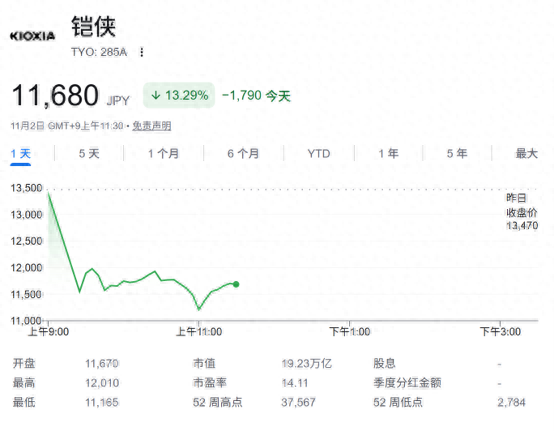
A single forward-looking line, rather than any disappointment in the reported numbers, is what turned Monday into a heavy session for the Tokyo-listed memory maker. Investors who had already been nervous about the durability of the AI storage cycle found in Kioxia's December-quarter profit guide the kind of data point that forces a re-rating: a forecast that, taken at face value, halts a profit ramp that had run steeply higher for the past several quarters. This CompanyWatch note separates what was actually reported last Friday from what the market chose to punish on Monday, and lays out the trackable signals for the next two quarters.
Event in brief: the numbers behind the sell-off
| Item | Reported figure | Why it mattered |
|---|---|---|
| Quarter reported | Fiscal second quarter of FY2026, ended September 30 | First print after the June peak of the storage rally |
| Revenue | ¥2.48 trillion, up 453.20% year on year | A single quarter above the full previous fiscal year total of about ¥2.34 trillion |
| Adjusted operating profit | Up 2181.10% year on year; ¥1.99 trillion for the September quarter | Confirms the scale of the upcycle, not its trajectory |
| December-quarter guide | ¥2 trillion (roughly US$12.7 billion) | Below the ¥2.35 trillion analysts had modelled |
| Sequential read | Essentially flat against the ¥1.99 trillion just delivered | Broke a multi-quarter upward slope |
| Price momentum | NAND average selling price up about 70% quarter on quarter in the second quarter of 2026, then an increase that narrowed sharply to about 20% in the third quarter | Read as a possible inflection in the cycle |
| Regional tape | Samsung Electronics fell more than 3% and SK hynix fell more than 1% in early trading; both reversed, with Samsung up 0.44% and hynix up 2.75% as of press time | Contagion was contained outside Japan |
What the September quarter actually proved
The reported quarter was exceptional by any standard. Revenue of ¥2.48 trillion for the fiscal second quarter of FY2026 represented growth of 453.20% year on year, and the total was larger than the roughly ¥2.34 trillion Kioxia had booked across the entire previous fiscal year. Adjusted operating profit rose 2181.10% on the same comparison. Just months earlier, in June this year, the same AI-driven storage supercycle had lifted the company to the position of the largest publicly listed company in Japan by market value.
In other words, the fundamentals disclosed last Friday were not the problem. The problem was the shape of the curve that management drew from that point forward.
Why the December guide rattled the market
Kioxia forecast December-quarter operating profit of ¥2 trillion, or about US$12.7 billion, against a consensus of ¥2.35 trillion. Set next to the ¥1.99 trillion recorded in the September quarter, the guide implies growth that all but stalls after quarters in which the profit line had been climbing steeply.
Management's own explanation is a mechanical one: shipment timing, not deteriorating demand. Three effects were described in the earnings call:
- Orders originally scheduled for the current quarter were pulled forward into the September quarter at customers' request, flattering the base period.
- Other orders slipped to the March quarter of the following year, because the mix is shifting toward enterprise storage products that require longer manufacturing and qualification cycles.
- Chief financial officer Yoshihiko Kawamura told investors last week that demand from AI data-centre operators remains strong and that the company expects to return to rapid growth in the March quarter next year.
The order-book colour offered at the same time is unusual for a commodity-adjacent industry: planned capacity for next year is already sold out, more than half of the output earmarked for the year after next has been allocated, and several major customers have begun negotiating contracts covering 2029 and beyond. If that is accurate, the December-quarter shortfall is a calendar artefact rather than a demand event.
The real signal investors traded: the slope of price
The harder question is whether the timing story survives contact with pricing data. In the second quarter of 2026, Kioxia's NAND average selling price rose about 70% quarter on quarter. In the third quarter, the increase narrowed sharply to about 20%. Memory equities are rarely valued on absolute price levels; they are valued on the rate of change, and a deceleration of that magnitude reads as a candidate cycle inflection even when unit demand is intact.
External context cuts both ways. Industry trackers have projected NAND contract prices to rise roughly 15-20% quarter on quarter into the final quarter of 2026, with enterprise SSD contract prices rising faster than the overall category as AI server build-outs absorb supply. On that read, price is still climbing, just no longer in the parabolic manner that funded this year's re-rating — a growth-deceleration-without-price-collapse scenario that is far more common in memory cycles than a genuine bust.
Competitive position: the single-product handicap
A structural disadvantage sits behind the numbers. Kioxia's exposure is concentrated in NAND flash, while its South Korean rivals sell both NAND and DRAM — the other critical component in AI compute systems, including high-bandwidth memory. That two-basket position gives Samsung Electronics and SK hynix more leverage in customer negotiations and more ways to compensate if one product line's pricing cools.
The Monday session illustrated the difference in how that plays out in markets. Kioxia was hit hardest, while Samsung Electronics and SK hynix recovered their opening losses to trade higher as of press time — evidence that global investors treated the episode as a company-specific repricing rather than a verdict on the whole memory sector.
Shareholder structure: the amplifier nobody priced
The second driver of Monday's decline was ownership plumbing rather than operations. Among all listed companies on the Tokyo Stock Exchange, Kioxia carries the highest concentration of leveraged long positions. When a negative catalyst lands, buyers financed with borrowed money face forced liquidation, and the resulting supply of shares pushes prices below what the fundamental gap alone would justify.
Broader disclosures from Japanese market watchers earlier this autumn pointed to record retail margin balances in the stock, which implies the same mechanism can amplify moves in either direction. For a company-level watch file, this is a valuation-irrelevant risk that is nevertheless decisive for entry points and position sizing.
Common misreadings of this episode
- Confusing a record revenue quarter with a record forward quarter. Pulled-forward September orders mathematically leave December lighter; the comparison base is not clean.
- Reading the flat guide as proof that AI storage demand has broken. Capacity sold out for next year and allocations covering the year after next point the other way, at least for the moment.
- Watching margin instead of price velocity. In this sector the speed of price change has historically moved share prices before reported profitability does.
- Treating the Korean peers' recovery as confirmation that nothing happened. Samsung Electronics and SK hynix sell DRAM as well as NAND; their portfolio breadth changes the read-across.
- Assuming the guide is management's most optimistic view. Conservative guidance during a period of elevated leverage and close price scrutiny is a recognised habit in memory names.
Action recommendations and tracking list
- Investors: verify the timing-not-demand claim against the December-quarter outcome. A catch-up in the March quarter next year — with revenue and profit resuming a steep slope — would validate management; a second soft guide would convert a mix story into a cycle story.
- Investors: treat the leveraged-long concentration on the Tokyo Stock Exchange as a volatility input. Position size, not direction, is the practical decision while margin balances remain elevated.
- Analysts: model three separate variables — blended NAND average selling price, enterprise-storage mix, and production lead times — rather than one aggregate price assumption; the deceleration from about 70% to about 20% quarter on quarter is the most important new datapoint.
- Enterprise strategics and procurement: with capacity for next year already sold out and more than half of the year after next allocated, lock volume and price through long-term agreements now; several hyperscale customers are already negotiating toward 2029 and beyond, and some suppliers are seeking cash prepayment on multi-year deals.
- Business development: weight the NAND-only constraint. Counterparties with DRAM and high-bandwidth memory can bundle, which shifts negotiating leverage in multi-product deals.
- Next checkpoints: December-quarter guidance updates, consensus revisions after last Friday's miss, South Korean peer earnings for a cross-read on pricing, and margin-debt statistics for signs of forced selling.
Bottom line
The Monday derating was not a verdict on a quarter that delivered ¥2.48 trillion of revenue and a 2181.10% jump in adjusted operating profit. It was a verdict on what comes immediately after it: a ¥2 trillion December guide below the ¥2.35 trillion consensus, an ASP ramp that has cooled from about 70% to about 20%, and a shareholder register loaded with borrowed money. The company's own narrative — timing shifts, sold-out next-year capacity, contracts stretching to 2029 and beyond — is testable and may yet prove right. What has changed is the burden of proof, and the next two quarterly prints are where that burden will be discharged.