
AMD's Data-Center-First Playbook: A CompanyWatch Guide to Telling Priority From Retreat
No — AMD has not walked away from consumer hardware. Take Lisa Su's third-quarter 2026 numbers literally and the story is a reallocation of capacity toward AI compute, not an exit: data center revenue reached $8.55 billion, or 64% of $13.38 billion in total revenue, while gaming fell 40% year on year to $773 million. "Priority" and "retreat" read identically in a headline. The checks, metrics and traps below let you tell them apart before the next earnings call.
What AMD actually said — and what it did not say
Su's claim is narrower than the coverage built around it. Her premise is adoption speed: AI is landing inside enterprises faster than many of them planned for, so some customers have stopped treating compute budgets as an annual exercise and now re-cut them more often as demand rises. AMD's answer is to expand supply and pursue larger deployments, while stating plainly that real demand still has to be re-tested quarter by quarter. Two boundaries define the statement.
- Said: AMD invests on a three-to-five-year view and expects AI compute demand to keep growing.
- Scoped: the growth target applies to the data center business only — it is not a promise that AMD will double total revenue.
- Not said: any withdrawal from consumer hardware. There is no announced end to client CPUs or Radeon graphics, and "data center first" is a resourcing statement, not a product-discontinuation notice.
The last point is verifiable rather than inferred. At CES 2026 in January, AMD broadened its client line-up with Ryzen AI 400, Ryzen AI PRO 400 and Ryzen AI Max+ processors; at Computex 2026 in May it marked ten years of AM4, extended AM5 socket support through 2029 and added RDNA 4 gaming parts. Companies do not commit to socket longevity on a shelf they are clearing.
Which Q3 2026 numbers turned this into a mix-shift story
Conclusion first: the lines that shrank are not the lines AMD is funding, and they are shrinking fastest where AI demand does not reach. That is the arithmetic behind Su's argument.
| Business line | Q3 2026 | Year on year | What it actually signals |
|---|---|---|---|
| Total revenue | $13.38 billion | up roughly 45% | Record quarter; AI demand absorbing incremental capacity |
| Data center | $8.55 billion (64% of total) | nearly doubled (reported as up 97%) | EPYC plus the first Instinct MI455X shipments |
| Client and Gaming combined | $3.72 billion | down 8% | Mix deteriorating even as revenue holds up |
| Gaming alone | $773 million | down 40% | AMD attributes the fall to weaker semi-custom and graphics revenue |
| PC outlook | planning for a double-digit decline in PC shipments next year | — | Input-cost shock as much as an AMD execution problem |
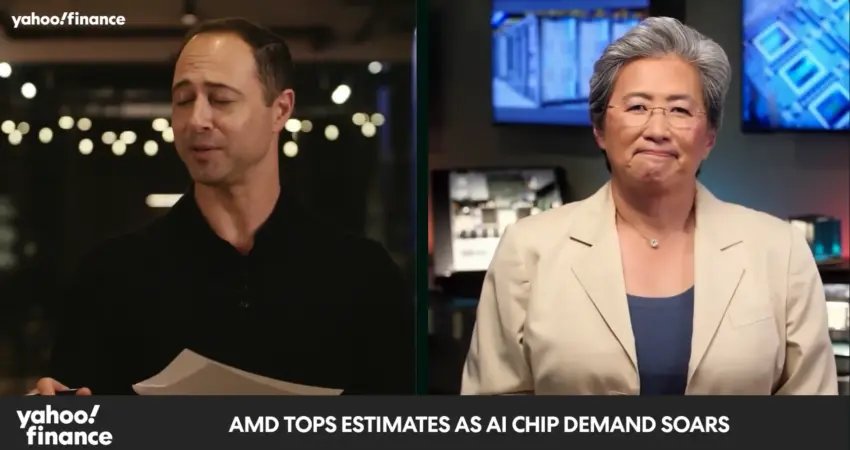
Two forward data points sharpen the picture. On November 3, 2026, AMD guided the fourth quarter to about $17 billion of revenue, plus or minus 3%, according to Reuters; and the framing Su carried into the call — relayed by Yahoo Finance and Seeking Alpha on November 4, 2026 — is that data center should clear 80% of revenue in 2027, against 64% in the September quarter. The mix is expected to keep tilting even if consumer dollars merely flatten, which is precisely why the "exit" reading spreads.
Why the pull toward the data center keeps getting stronger
Agentic workloads, not chatbots, moved AMD's own market math. Speaking at Open Compute Project 2026 in October, Su called 2026 the "year of inference," putting inference at roughly 60% of AI compute demand, and lifted AMD's forecast for the server CPU market to more than $200 billion by 2030, growing about 50% a year (TrendForce). That is a step up from the "AI data center market beyond $1 trillion by 2030" framing she gave in November 2025. Inference and agent stacks keep general-purpose CPUs busy orchestrating tools, memory and storage, which is why the silicon class AMD also sells into PCs is back at the centre of the growth case.
The rack business is where the resourcing decision becomes concrete. Helios bundles 72 Instinct MI455X GPUs with 18 sixth-generation EPYC "Venice" CPUs, networking and ROCm software into one rack-scale platform. MI455X entered volume shipment in the September quarter, and Su told the OCP audience: "Today, initial systems are installed and running at OpenAI, Meta, Microsoft and Oracle." Deployments are expected to widen through the fourth quarter as HPE, Dell, Lenovo and Supermicro begin shipping systems of their own.
Five checks that separate a priority shift from an exit
- Split share from absolute revenue. Compute the segment's dollars and its share of the total in parallel. Falling share with flat or rising dollars is reallocation; falling dollars for several consecutive quarters alongside withdrawn guidance is retreat. Q3 2026 gaming, at $773 million and down 40%, is the pattern to watch rather than to condemn on one print.
- Audit roadmap cadence, not roadmap language. Count new SKUs, socket or platform support commitments and design-win announcements in the consumer lines over four quarters. AMD's CES 2026 client launches and its AM5-through-2029 commitment are the counter-evidence to the exit thesis.
- Trace scarce inputs. In a supply-constrained cycle, priority is visible in who gets advanced packaging, high-bandwidth memory and wafer allocation. Look for explicit commentary that capacity is being steered to rack-level AI systems — exactly what Helios ramp commentary implies.
- Read the hedging verbs. "Expect," "plan for," "assess quarter by quarter" and "three-to-five-year view" describe conditional capacity, not fixed commitments. Su's doubling language is scoped to data center only; anything broader is the reader's addition.
- Test customer concentration. A pivot to a handful of AI buyers changes risk even while it flatters growth. Note which systems are running at which hyperscalers and whether OEM channels beyond them are actually shipping.
Four misreadings that inflate "AMD is quitting consumers"
- Share confusion. Treating data center rising to 64% of revenue as though the client and gaming business of $3.72 billion, down 8%, were being written off. Mix shift and shutdown are different events.
- Mistaking TAM for guidance. AMD's forecast of a server CPU market above $200 billion by 2030 is an industry size estimate, not a company revenue promise, and it is not a promise of double total revenue either.
- Reading an input-cost shock as an AMD retreat. Gartner reported worldwide PC shipments of 55.4 million units in the third quarter of 2026, down 22.4%, with DRAM costs up roughly five times year on year; in February 2026 it had already forecast a 10.4% full-year decline on memory costs. When AMD plans for a double-digit decline in PC shipments next year, the whole category is the cause.
- Assuming priority costs nothing. Concentrating on a few AI buyers, ramping a brand-new rack platform, and running consumer lines down 40% each carry execution and margin risk that a "growth story" framing hides.
What to watch next: metric, source, threshold
| Watch item | Where it shows up | Threshold that would change the read |
|---|---|---|
| Data center share of revenue | Quarterly segment tables | Above 80% in 2027 confirms the pivot; a stall below 64% weakens it |
| Gaming trajectory | Client and Gaming breakdown | Three more quarters near -40% points to structural, not cyclical, decline |
| PC shipment planning | Management commentary | Any cut to the client SKU count or socket-support commitments |
| Helios ramp | Supply chain and OEM announcements | Volume shipping through the channel versus single-customer installations |
| Capacity allocation | Foundry, memory and packaging disclosures | Explicit reservation of capacity for AI racks at the expense of client parts |
Action advice: what to do this quarter, reader by reader
- Investors: underwrite the mix shift, not the TAM headline. Model client and gaming at their declining run rate and test how much of the 2027 revenue shape depends on Helios shipping in volume through HPE, Dell, Lenovo and Supermicro.
- Industry analysts: benchmark AMD against the category, not its own guidance — a 22.4% quarterly PC shipment decline industry-wide reframes the -8% client and gaming line entirely.
- Enterprise buyers and channel partners: treat a double-digit PC shipment decline and five-times memory inflation as lead-time risk. Lock pricing and quantities for endpoint refreshes early and price inference-heavy server orders as the scarcity good.
- Strategy and BD teams: assume AI compute absorbs the best supply for at least the three-to-five-year horizon AMD says it invests over, and plan consumer-facing roadmaps around that constraint rather than against it.
FAQ: AMD, AI demand and the consumer business
Is AMD leaving the consumer market?
No. Su describes a "data center first" allocation of capacity and investment on a three-to-five-year horizon. AMD continued to launch client and gaming products in 2026 and extended AM5 support through 2029, which is not the behaviour of a company exiting the segment.
Why is gaming down 40%?
AMD attributes the drop to lower semi-custom and graphics revenue in the quarter, at $773 million. Semi-custom console cycles and discrete GPU supply dynamics drive this line, and neither is a signal about data center priority.
Does AI demand really justify the pivot?
The evidence AMD points to is inference and agentic workloads: data center revenue of $8.55 billion, nearly doubled year on year and 64% of the total, plus the first volume shipments of MI455X and initial Helios racks running at OpenAI, Meta, Microsoft and Oracle. Su's own caveat is that demand still has to be assessed quarter by quarter.
What would make the "exit" reading legitimate?
A discontinued consumer platform or socket-support reversal, several consecutive quarters of falling gaming and client dollars with no new SKUs, and explicit capacity reservations for AI racks at the direct expense of client supply. None of these has been announced.
What is the biggest risk in AMD's story?
Concentration and execution. The growth case rests on a rack platform that only began shipping this year, sold into a small number of very large buyers, while the PC category that supplies the rest of the revenue faces a memory-cost shock forecast to persist into 2027.
Sources
- AMD, "AMD Reports Third Quarter 2026 Financial Results," November 3, 2026 — https://ir.amd.com/news-events/press-releases/detail/1303/amd-reports-third-quarter-2026-financial-results
- Reuters, "AMD forecast eases AI spending fears as data-center sales surge," November 3, 2026 — https://www.reuters.com/business/amd-forecasts-quarterly-revenue-above-estimates-data-center-growth-accelerates-2026-11-03/
- AMD Newsroom, "OCP 2026: AMD CEO Lisa Su Highlights Open Infrastructure for the Future of AI," October 2026 — https://newsroom.amd.com/news/ocp-2026-amd-ceo-lisa-su-keynote-takeaways/
- TrendForce, "[OCP in Focus] Lisa Su Calls 2026 'Year of Inference' as AMD Lifts 2030 CPU TAM Forecast to $200B," October 13, 2026 — https://www.trendforce.com/news/2026-10-13/ocp-in-focus-lisa-su-calls-2026-year-of-inference-as-amd-lifts-2030-cpu-tam-forecast-to-200b/
- Gartner, "Worldwide PC Shipments Declined 22.4% in the Third Quarter of 2026," October 12, 2026 — https://www.gartner.com/en/newsroom/press-releases/2026-10-12-gartner-says-worldwide-pc-shipments-declined-22-point-4-percent-in-third-quarter-of-2026-as-component-cost-inflation-raised-asps
- Gartner, "Surging Memory Costs Will Reduce Global PC and Smartphone Shipments in 2026," February 26, 2026 — https://www.gartner.com/en/newsroom/press-releases/2026-02-26-gartner-says-surging-memory-costs-will-reduce-global-pc-and-smartphone-shipments-in-2026
- AMD, "AMD Expands AI Leadership Across Client, Graphics and Software at CES 2026," January 5, 2026 — https://ir.amd.com/news-events/press-releases/detail/1270/amd-expands-ai-leadership-across-client-graphics-and-software-with-new-ryzen-ryzen-ai-and-amd-rocm-announcements-at-ces-2026
- AMD blog, "AMD Computex 2026: 10 Years of AM4, AM5 Support Through 2029," May 31, 2026 — https://www.amd.com/en/blogs/2026/amd-computex-2026-10-years-of-am4-am5-support-through.html
This CompanyWatch note was written by Marc Hale for GlobalBizSight. To suggest a correction or request a follow-up on AMD's fourth-quarter and 2027 mix disclosures, write to info@globalbizsight.com.