
OpenAI's GPT 6.2 Astra Gray-Release Trail: A 47% Benchmark Signal and What It Means for Hardware Teams
By Marc Hale | GlobalBizSight CompanyWatch
Recently, an identifier that should not yet be part of public usage gave CompanyWatch readers a concrete way to read OpenAI's next product move. Codex traffic reports show gpt-6.2-astra appearing for some accounts, while OpenAI separately published benchmark evidence that a newer internal model performed far better on mechanical and electronic design tasks. The company has not confirmed GPT 6.2 Astra, so the episode is best treated as a case study in separating gray-release signals, engineering metrics and verified product availability.
The OpenAI case in six evidence blocks
- TestingCatalog reported that, from October 31, some Codex users saw a separate usage record for GPT 6.2 Astra, while the model selector still displayed GPT 6 Astra.
- On the X platform, account Token Gremlin posted a screenshot in which about 19.8% of model calls on one account were attributed to GPT 6.2 Astra, while about 80% remained with GPT 6 Astra.
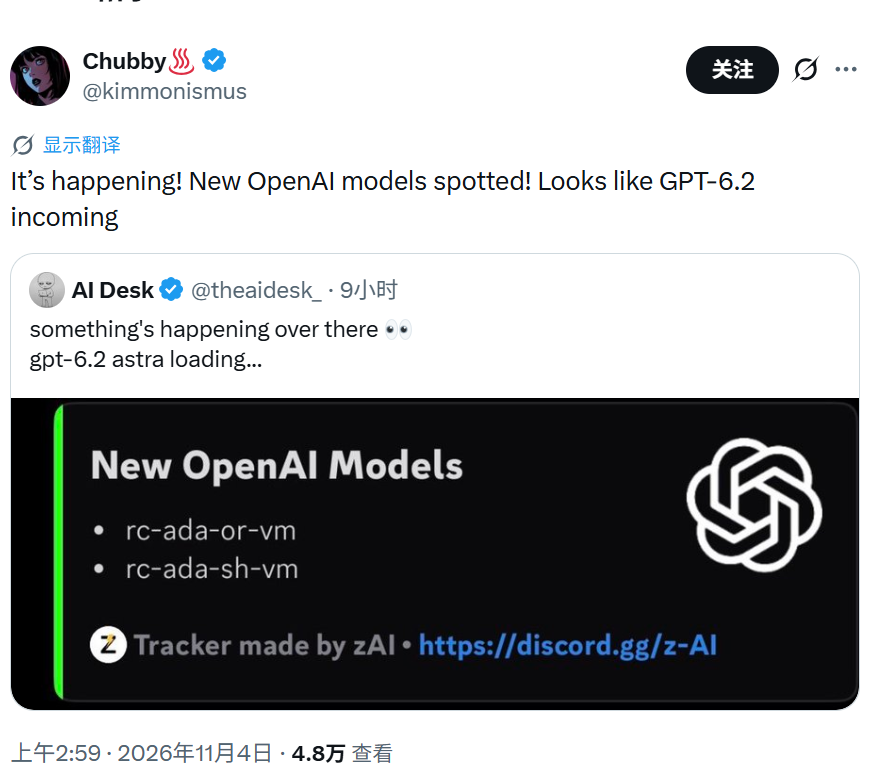
- On November 3, model tracker LuminaBench said the OpenAI API model list briefly showed two new labels, rc-ada-or-vm and rc-ada-sh-vm, before they disappeared; no evidence confirms that they belong to GPT 6.2 Astra.
- OpenAI said a newer internal model scored 0.875 on BenchCAD 2.0, compared with 0.594 for GPT 6 Astra at the highest reasoning setting, a lift described as 47% and more precisely about 47.3%.
- In a physical hardware example, two engineers used GPT 6 Astra to finish a portable AI device design in less than a week, and a factory built a small batch of prototypes in less than a month.
- OpenAI also said its hardware team's AI-token consumption has increased 23 times since this February, while Codex and ChatGPT are used for computer-aided design, manufacturing drawings, engineering simulation and design review.
Why the usage-data signal matters more than the label
A new string in an internal analytics page is not a product launch. It can be a logging change, a canary, a shadow request router or an experiment bucket. What made the Codex case harder to ignore was the pairing of two independent observations: a model identifier appearing in usage data, and OpenAI choosing to publish engineering benchmark numbers for a newer internal model without naming it. The latter gives the former a plausible business purpose.
The practical interpretation is narrower than the rumor ecosystem often assumes. If the about 19.8% and about 80% split reflects A/B testing, it suggests that some requests are being routed to a different backend while user-facing labels remain stable. This is not a guarantee that the new backend is GPT 6.2 Astra, but it is a signal that OpenAI may be validating performance, latency, safety behavior or request compatibility before a public rename.
Data citations used in this case review
| Signal | Reported figure or label | Use in the case | Limitation |
|---|---|---|---|
| Codex usage | gpt-6.2-astra; about 19.8%; about 80% to GPT 6 Astra | Suggests a possible background test bucket | Does not prove public availability or API terms |
| BenchCAD 2.0 | 0.594 for GPT 6 Astra; 0.875 for a newer internal model; 47%, about 47.3% | Shows the direction of engineering-capability investment | Not an end-to-end manufacturing success metric |
| Internal workflow use | 23 times token increase since this February | Indicates that hardware teams are already consuming AI output at larger scale | Does not reveal cost, quality or customer adoption |
BenchCAD's own project material describes 2.0 as a benchmark for programmatic computer-aided design on professional hardware tasks, including reconstructing parts and assemblies and working with circuit-board relationships. That context is available from BenchCAD's 2.0 introduction.
BenchCAD 2.0: the number, the benchmark and the missing context
The most quotable figure from OpenAI's November 3 engineering post is the jump from 0.594 to 0.875 on BenchCAD 2.0. The benchmark focuses on work that is closer to hardware reality than ordinary text generation: rebuilding 3D mechanical parts and assemblies, and identifying circuit-board connections. OpenAI's argument is that a higher score could improve iterative efficiency for professional engineering work.
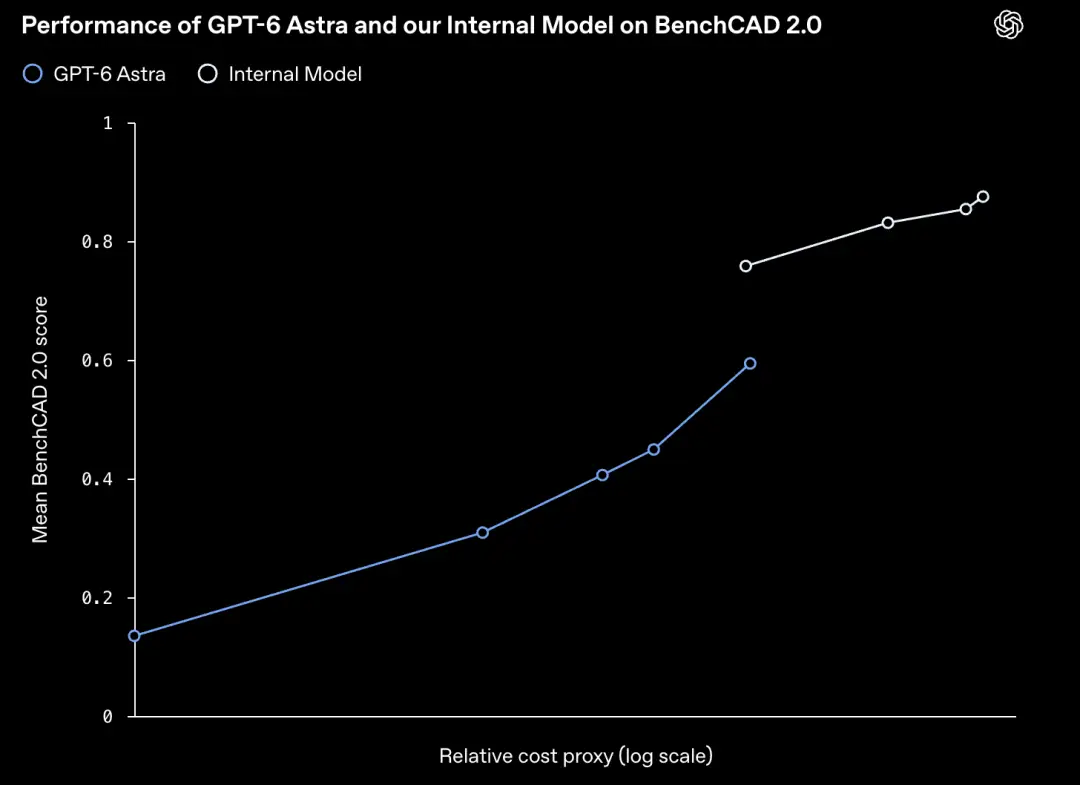
The 47% improvement is meaningful for one reason: it moves frontier-model evaluation away from generic chat quality and toward measurable engineering artifacts. For enterprise readers, that suggests OpenAI is optimizing for tasks where output must be checked against geometry, assembly constraints, board topology and manufacturability, not just fluent language.
Still, the limit is equally important. The score is not a production acceptance rate, not a proof that every generated CAD file can be machined, and not evidence that the benchmarked model is GPT 6.2 Astra. OpenAI did not disclose the newer internal model's formal name, nor did it confirm the release date.
The Mazda case shows where AI may actually be used first
OpenAI's research cooperation with Mazda is a useful business-process case. The work focuses on automotive aerodynamics and crash-safety design. GPT 6 Astra can generate different front-vehicle geometry options and combine those shapes with airflow simulation to help engineers compare design proposals.
Mazda chief engineer Nakata Akihiro said AI helps explore dozens of design variants, making it clearer which shape features affect aerodynamic performance and where designers have more freedom. That phrasing matters: the value is not replacing automotive engineers, but accelerating the search through variants that would otherwise be manually slow to compare.
Similarly, the expanded cooperation with IndyCar team Chip Ganassi Racing aims to convert 3D scans of existing components into editable CAD models and two-dimensional manufacturing drawings, reducing repetitive reverse-modelling work in prototype development. This is supply-chain-adjacent: fewer manual modelling hours may shorten the path from scan to drawing to supplier communication.
What the hardware prototype story proves — and does not prove
OpenAI's portable AI device example gives a compact sequence: two engineers, less than a week for design, then a factory produced a small batch of physical prototypes in less than a month. The model participated in enclosure structure, internal mechanical components, PCB circuit-board design, electronic components, user interface and firmware software. The engineers did not directly hand-edit model-generated designs during the design phase.
But OpenAI also acknowledged that turning a generated design into a manufacturable product still requires multiple rounds of human review and iteration. GPT 6 Astra cannot always reliably account for process limitations, manufacturing tolerances and assembly details. That caveat should shape purchasing decisions: early benefit may appear in ideation and documentation, while high-volume production requires classical engineering gates.
Supply-chain implications of faster AI-generated prototypes
If AI reduces design iteration from weeks to days, small-batch prototype supply chains may face new pressure: design files arrive more often, supplier quotations repeat more frequently, and engineering-change orders multiply. The less than a month prototype production example is promising for rapid iteration, but it also implies a need for stronger version control, design-for-manufacturing gates and supplier-side review. For hardware teams, the value is not just a cleaner model-generated enclosure, but a more disciplined workflow that prevents premature tooling.
Competitive meaning: from code assistant to engineering copilot
OpenAI's signals suggest that frontier-lab differentiation is moving from general reasoning to domain artifacts. If GPT 6.2 Astra is real, its likely value proposition is not chat, but fewer manual steps: model-generated CAD, drawings, simulation setup and design review notes. This matters because enterprise procurement values cycle-time compression and traceability, not just benchmark labels. The Mazda and Chip Ganassi Racing cases show a go-to-market pattern: anchor with high-profile engineering users whose processes can be described as repeatable case studies.
The risk is over-interpretation. Many companies can improve design documentation with AI without solving tolerance, material substitution, supply availability or quality control. OpenAI's own caveat about manufacturing tolerances and assembly details is the key governance point: the model is a first-pass generator, not an accountable engineering sign-off system.
Three reusable lessons from this OpenAI episode
- Track behavior before labels. Usage records, API identifiers, temporary model names and request-share percentages are often more revealing than official changelog silence.
- Distinguish benchmark capability from workflow readiness. A score like 0.875 may indicate stronger CAD generation, but factories still require tolerance, fixture, material and assembly checks.
- Look for the operating model. OpenAI is not only releasing a model; it is bundling Codex, ChatGPT, hardware-team usage growth, automotive partnerships and motorsport tooling into a story about AI moving from software coding to physical product development.
Common misconceptions about the GPT 6.2 Astra rumors
- A percentage such as 19.8% is not market penetration; it may be a test bucket share on selected accounts.
- Seeing a separate identifier in Codex analytics does not prove public availability or API billing terms.
- A BenchCAD 2.0 score cannot be read as end-to-end manufacturing success.
- The two API labels rc-ada-or-vm and rc-ada-sh-vm are not confirmed aliases for GPT 6.2 Astra.
- Model demos on social platforms are not independent validation unless methodology, prompts, versions and evaluation controls are disclosed.
Action recommendations for investors and enterprise teams
- Enterprise buyers should ask vendors to disclose model-name mapping: whether Codex analytics labels, public selectors and API endpoints resolve to the same backend, and whether A/B routing logs are available.
- Manufacturing teams should benchmark AI output against failure taxonomies rather than average quality: dimension-error rate, assembly-fit defects, drawing ambiguity, tolerance violations, PCB netlist mistakes and rework hours per prototype.
- Investors should treat gray-release data as a monitoring input, not a revenue claim. The next confirmation markers are official model naming, API pricing, enterprise support commitments, partner productization and reproducible BenchCAD 2.0 evidence.
- Strategy teams should compare this pattern with other AI companies moving from code completion to CAD, simulation and physical design; competitive pressure may now be measured by how quickly models reduce iteration loops in hardware workflows.
Checklist for tracking OpenAI's next move
- Has OpenAI officially named GPT 6.2 Astra?
- Does the OpenAI API model list add it with stable documentation?
- Does Codex UI or selector change from GPT 6 Astra to GPT 6.2 Astra?
- Are usage share data, latency, cost or rate limits disclosed?
- Is BenchCAD 2.0 evidence replicated by third parties with controlled prompts?
- Do Mazda or Chip Ganassi Racing publish concrete workflow outcomes?
CompanyWatch verdict: a credible engineering-strategy signal, not a confirmed launch
For CompanyWatch, the case is less about whether GPT 6.2 Astra is real than about what OpenAI is telling the market through indirect signals. The combination of Codex routing clues, a new internal benchmark score, a hardware prototype example and automotive partnerships suggests that OpenAI wants to position its model lineage around professional workloads that touch physical production. But until OpenAI confirms the version, naming and release conditions, the conclusion should stay conservative: this is a strong strategic signal, not a finished product announcement.