
Perplexity Teammates, Answered: Is a $200 Per Month AI Colleague Worth Buying Now?
Perplexity released Teammates in recent days: always-on AI agents that take a standing job, keep memory between runs and report to colleagues over Slack. The buyer-side answer is short. This is a research-preview feature attached to the individual Perplexity Max subscription at $200 per month, not a capability bundled into Enterprise Pro or Enterprise Max. Organisations that want it today are buying a handful of power users, not seats for a department. The questions below are the ones a CompanyWatch reader actually needs answered before spending.
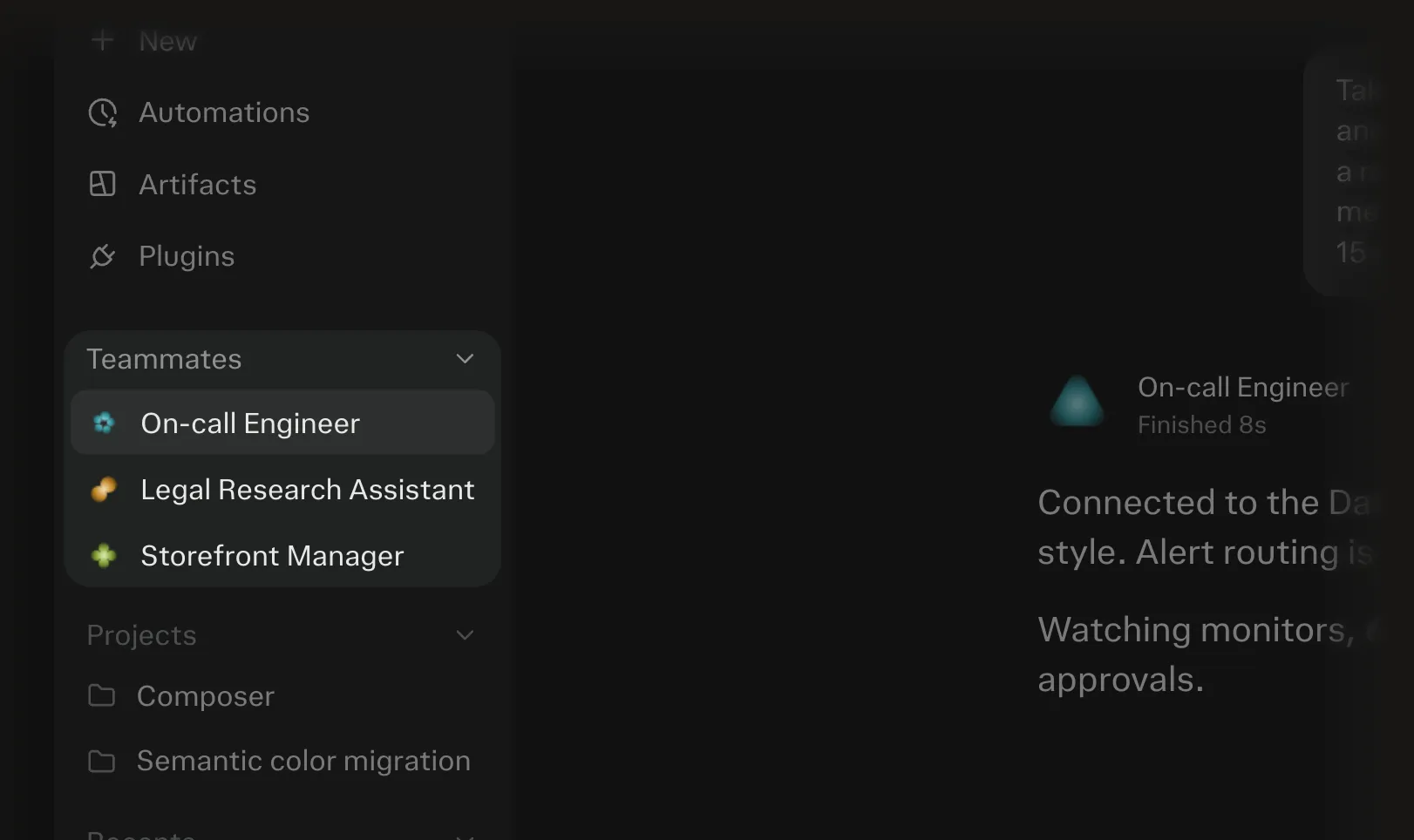
What did Perplexity actually ship?
Conclusion first: Teammates are persistent agents built on top of Computer, the company's multi-model agent system. Computer already executes concrete tasks on a user's device; Teammates extends that from one-shot task handling to running long, large-scale work projects, coordinating several agents in parallel.
The practical differences from a chat assistant are structural:
- You assign a goal or a responsibility, not a prompt. The agent plans the work, tracks it and acts when conditions change.
- Each Teammate keeps its own continuous thread, so status, completed steps and next actions stay visible and re-directable at any moment.
- Memory persists across runs: project objectives, execution history and shared files, so context does not have to be re-explained.
- Agents hand off to each other. In Perplexity's example, one agent that finds a website vulnerability passes the findings to another that drafts the fix.
- Slack integration lets staff assign tasks, ask for progress and receive results inside the channels they already use.
Perplexity's own product page frames the same design: give a Teammate a goal, and it orchestrates agents across parallel tracks using the user's existing Computer projects, skills, memory and tools. That inheritance detail matters more than the demo — see the risk section below.
Who can buy it, and what does it cost?
Conclusion first: the gate is a consumer-tier subscription. Perplexity's help centre states that the initial research preview requires an individual Perplexity Max subscription and that Enterprise Pro and Enterprise Max do not include it by default. Rollout began on the web, with iOS and Android announced as next.
| Perplexity plan | List price | Teammates access |
|---|---|---|
| Pro | $20 per month | Not included |
| Perplexity Max | $200 per month, or $2,000 per year | Research preview, web first |
| Enterprise Pro | $40 per seat per month ($400 per seat per year) | Not included by default |
| Enterprise Max | $325 per seat per month ($3,250 per seat per year) | Not included by default |
Source: Perplexity help centre pricing and Teammates articles. The commercial read, stated as analysis rather than company guidance: an "enterprise-grade" product sold through a personal plan is a deliberate ARPU play. Perplexity has been pushing up-market on both axes — the independent tracker Sacra estimates annualised revenue of roughly $750 million in August 2026, up from about $232 million at the end of 2025, growth it attributes to enterprise and agent products. Teammates is priced as a productivity platform add-on, not as a search subscription perk.
Why credits matter more than the sticker price
Conclusion first: $200 per month is an entry ticket, not a budget. Max includes a monthly allowance of Computer credits — commonly reported at 10,000 credits per month — and Teammates consume that allowance.
- Parallel agents, large files and frequent autonomous runs drain credits faster than single interactive tasks.
- Perplexity has not published a per-task credit conversion table, so cost per completed job has to be measured from your own usage history before rollout.
- When credits run out, running tasks pause and keep progress rather than failing outright — useful for continuity, but it means a project can stall silently mid-week.
- Max accounts carry a separate monthly spending cap on purchased extra credits, set by default at $200 and adjustable by the account holder. That cap is a different number from the $200 subscription price; conflating them is the single most common misreading in launch coverage.
Where does it fit, and where should a human stay in the loop?
Perplexity positions Teammates across marketing, sales, customer support, operations and finance, with role assignments per agent. Its flagship illustration is a sales one: an agent notices a long-standing customer stopped ordering, reads order history and after-sales records, investigates why, then drafts an offer or escalates to the team.
Suitable first assignments:
- Recurring monitoring jobs with a defined trigger (pricing pages, competitor releases, inactive accounts, failed builds).
- Triage queues: support tickets, code-review requests, lead enrichment.
- Research digests that feed an existing decision meeting on a fixed cadence.
Assignments to keep human-supervised: anything that spends money, signs or alters contracts, deletes data, changes production systems, or replies to a customer without a review step.
How does it stack up against OpenAI Dots and Anthropic's Claude Duet?
Conclusion first: same category, different gate. Teammates, OpenAI's Dots and Anthropic's Claude Duet all use multi-agent collaboration and always-on execution, and all let users split responsibilities across agents that work in parallel. Perplexity's differentiator is continuity — memory, stored skills and existing Computer projects feeding into each new run.
On cost, the honest observation is narrow: at $200 per month, Teammates sits on the most expensive individual entry ticket among the three, and none of the three currently sells the capability as a standardised enterprise seat. Buyers should verify each vendor's bundle terms at the moment of purchase rather than relying on launch-week comparisons.
What Perplexity's chief executive says, and how far to read it
Chief executive Aravind Srinivas restated the company's long-term vision at launch: every person in every organisation could eventually have hundreds of dedicated agents assisting with daily work, freeing humans from repetitive coordination. Launch-week reporting added an internal datapoint — roughly 10,000 agents active in Perplexity's own workspace over the preceding 30 days, about 20 times its headcount, with around 1,000 still active on a given day.
Read as a founder's roadmap claim, not as a procurement forecast. What is verifiable today is the shipping surface: web, individual Max, research preview.
Five misconceptions that distort the buy decision
- "Teammates is an enterprise product, so my IT department can provision it." It is a research preview on a personal Max subscription; enterprise plans do not include it by default.
- "$200 per month buys unlimited agent labour." Usage is credit-metered, and there is no published per-task rate card.
- "Two $200 numbers, one charge." The subscription price and the default credit spending cap are separate controls.
- "The vendor owns the agent's behaviour." Each Teammate inherits the user's projects, skills, memory and permissions, so its reach into Slack, files and connected tools is your account's reach — with your credentials.
- "Persistent memory means accountability." Memory is continuity of context, not an audit trail of who authorised what.
CompanyWatch decision path: buy, pilot or wait
Buy now if one named operator in your team already lives in Slack and the company's Comet browser, has a repeatable weekly research or triage workload, and can absorb a $200 per month seat with discretionary spend.
Pilot for 30 days if you want evidence before an enterprise conversation. Run it on a single workflow and measure cost per completed task, not tasks attempted.
Wait if you need central provisioning, admin policy control, per-agent audit logs or procurement-grade data terms. Perplexity added role-based access controls and API credential management to Enterprise in its July 2026 changelog, so the governance primitives exist — the open question is when agent permissions inherit from the workspace rather than from one person's account.
Minimum controls for any pilot:
- One human owner per named Teammate, recorded in a register.
- Write down the goal, the trigger and the success metric before the first run.
- Set the monthly credit cap and an alert well below it.
- Require approval before any outbound message, offer or code merge.
- Export the thread history weekly; it is the only evidence trail you will have.
- Review at day 30 against cost per completed task, then decide on seats.
What to watch next
- Whether iOS and Android rollout arrives on schedule, and whether it stays Max-only.
- Any move bundling Teammates into Enterprise Pro or Enterprise Max seats — that is the signal that Perplexity is monetising organisations rather than individuals.
- Publication of per-task credit rates, the difference between a pilot budget and a line item.
- Admin-side agent permissions, approval gates and audit logging.
- How OpenAI Dots and Anthropic's Claude Duet respond on price and enterprise packaging.
Questions buyers ask us most
Is Teammates included in a company licence?
Not by default. Perplexity's help centre states the research preview requires an individual Perplexity Max subscription; Enterprise Pro and Enterprise Max do not include it.
Is $200 per month charged per agent or per person?
Per person, as a Max subscription. The number of Teammates is not the billing unit — credit consumption is.
What happens if credits run out mid-project?
Active tasks pause and retain progress, then resume once credits are available or purchased, subject to the account's monthly spending cap.
Can it message colleagues and push work without me?
Yes. Slack integration lets Teammates receive tasks, post results and coordinate with other agents inside shared channels, which is exactly why an approval step belongs in the pilot design.
Does it replace OpenAI Dots or Anthropic's Claude Duet?
No. They are parallel entries in the same always-on agent category. Pick on memory continuity, tool reach and the price of the gate you have to buy to get in.
Where this comes from
- Perplexity Help Centre, "Get started with Perplexity teammates" — perplexity.ai/help-center/en/articles/2026102601-perplexity-teammates
- Perplexity Help Centre, "Enterprise Pricing and Billing FAQ" — perplexity.ai/help-center/en/articles/10352986-enterprise-pricing-and-billing-frequently-asked-questions
- Perplexity product page, "Perplexity Teammates" — perplexity.ai/hub/products/teammate
- Perplexity changelog, July 2026: role-based access controls and API credentials for Enterprise
- CloudZero, "Perplexity pricing in 2026: Free vs. Pro vs. Max" — cloudzero.com/blog/perplexity-pricing/
- Sacra, Perplexity revenue, valuation and funding estimates — sacra.com/c/perplexity/
Written by Marc Hale for the CompanyWatch desk at GlobalBizSight. We track single-company developments — product gating, pricing structure and governance readiness — rather than vendor announcements as such. Corrections and confidential tips: info@globalbizsight.com.