
CompanyWatch: Raspberry Pi's 16GB Repricing — What a $385 Raspberry Pi 5 Now Costs Buyers, Rivals and the Stock
One bill of materials moved this week, yet the read-through is corporate rather than hobbyist. The company behind the world's most widely used single-board computer has lifted prices again on its memory-heaviest boards, while pointedly refusing to touch the cheap entry tiers or its own 16GB desktop. That asymmetry is the story: it shows how a listed hardware business distributes a commodity shock across a catalogue, and where the resulting pressure spills into channel risk, product positioning and margin.
Event snapshot: two increases, one deliberate exception
From today, the pricing changes announced by Raspberry Pi reduce to three lines:
- the 16GB variant of Raspberry Pi 5 rises by $80, landing at $385;
- 16GB Raspberry Pi Compute Module 5 variants increase by $40, with revised figures published in the product brief on the Compute Module 5 product page;
- Raspberry Pi 500+ — the premium all-in-one desktop built into a mechanical keyboard, itself equipped with 16GB of RAM — keeps its existing price.
Two contextual details matter for anyone modelling the company. First, as in earlier rounds there is no uniform uplift across the range: exposure is allocated SKU by SKU. Second, the declared driver is input cost rather than demand or pricing ambition — memory price escalation running over two years, compounded by a shortage of alternative 16GB DRAM supply that leaves the firm unable to re-source the part without redesign.
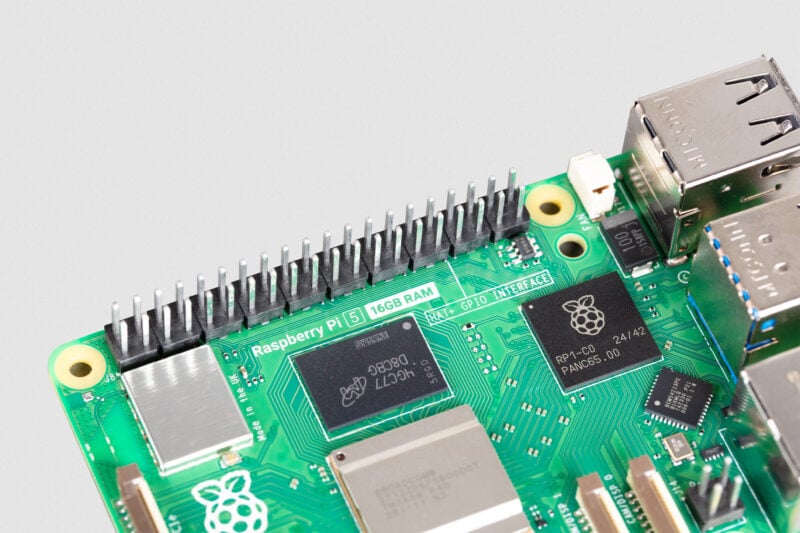
Where the increase landed across the line-up
| Product / tier | 16GB memory exposure | Price action | What it reveals |
|---|---|---|---|
| Raspberry Pi 5 (16GB) | Highest in the catalogue | +$80, now $385 | Top-density board absorbs most of the DRAM shock |
| Raspberry Pi Compute Module 5 (16GB) | High, but spec'd by OEM customers | +$40 | Smaller step, reflecting contracted/industrial demand |
| Raspberry Pi 500+ (16GB) | Identical DRAM content | Unchanged | Premium desktop shielded, likely on hedged or already-costed stock |
| 1GB tiers | Minimal | Protected at $35 (Raspberry Pi 4) and $45 (Raspberry Pi 5) in the February 2026 round | Entry funnel deliberately defended |
| LPDDR2-era models (Zero, Pi 1/3, CM1/CM3+) | Legacy memory, ample stock | Excluded from the April 2026 round | Old silicon designs become the cost hedge |
Read as a whole, the table is a map of who the company will and will not repricing-test: enthusiasts buying a $45 board, and designers who committed to a 16GB Compute Module 5 footprint, are treated very differently from the buyer of a top-spec desktop board today.
Why the densest SKUs are the ones bleeding
Memory is the single largest cost line on a high-density board, and the 16GB configuration multiplies that exposure. The mechanism is familiar from the wider market: capacity in LPDDR4/LPDDR5 and DDR5 has been pulled toward AI server builds, squeezing what small-volume consumer and industrial customers can buy. TrendForce's own forecasts through 2026 kept contract prices climbing — conventional DRAM up 10–15% quarter-on-quarter for 4Q26, and 13–18% for server DRAM in 3Q26 — so the input Raspberry Pi buys was still trending up when this adjustment was made, not stabilising.
The company has been mitigating rather than simply passing costs through: qualifying alternative parts to widen sourcing, and rebuilding the middle of its catalogue. In April 2026 it launched a 3GB Raspberry Pi 4 at $83.75 as a deliberately lower-density answer to LPDDR4 exposure, and it stated then that LPDDR4 costs for Raspberry Pi 4 and Raspberry Pi 5 had risen roughly sevenfold over the preceding year. This November move is best read as the sequel to that strategy: the alternative 16GB DRAM it hoped to qualify is the one part it cannot obtain in volume.
Company read-through: pricing power cushioned by industrial demand
What separates this from a 2021-style supply scare is the balance sheet underneath it. Raspberry Pi Holdings (LSE: RPI) reported first-half 2026 revenue of $256.9m on 24 September 2026 — up 90% from $135.5m in the equivalent period a year earlier — and closed FY2025 with revenue of $323.2m and pre-tax profit of $26.5m, an increase of 63%. In June 2026 the company told investors it expected full-year 2026 core profit to be "significantly ahead" of current market expectations, on the back of industrial demand.
That mix explains the selectivity. Industrial and OEM customers — who buy Compute Module 5, value long-term Linux userspace consistency and multi-year supply — tolerate a repriced module far better than a school or hobbyist tolerates a repriced $35 board. Protecting the low-capacity tiers therefore protects the funnel and the brand's founding proposition, while the 16GB boards, where buyers are professionals running out of 8GB, carry the margin repair that a ~8% pre-tax margin on FY2025 revenue can ill afford to lose on its most memory-heavy units.
Comparative verdict: is $385 still the value choice?
This is where the event stops being a footnote and becomes a purchasing decision. At $385, a 16GB Raspberry Pi 5 now sits at parity with a 16GB Orange Pi 5 Plus, which the Orange Pi store lists at $390 — an RK3588 board with a 6 TOPS NPU, dual 2.5GbE ports, an eMMC socket and M.2 NVMe storage. The historical heuristic "buy the Pi, it is cheaper" no longer holds at the top of the memory ladder; the Pi's remaining advantages there are software support, documentation depth, and supply through vetted channels, not price.
Against that, the value logic inside the Raspberry Pi family itself has shifted. The launch price of the 16GB Raspberry Pi 5 was $120 in January 2025; it reached $145 by December 2025, $205 after the February 2026 increase, and $305 before today's step to $385 — roughly 3.2 times its original ticket. Meanwhile the 1GB Raspberry Pi 5 has stayed at $45. The gap between "enough memory" and "maximum memory" is now nearly nine times in absolute price terms, so over-provisioning RAM is the most expensive mistake a buyer can make this quarter.
- Still buy the 16GB board if: you are running in-memory datasets, containerised workloads, local small-model inference or compile-time jobs where 8GB genuinely swaps, and where switching cost to RK3588 or x86 would mean re-validating software.
- Downsize instead if: the application peaks below 8GB. A lower-density Raspberry Pi 5, an earlier Raspberry Pi model, or the $83.75 3GB Raspberry Pi 4 delivers the same job at a fraction of the exposure.
- Look off-platform if: the requirement is NPU throughput or 2.5GbE/NVMe I/O rather than ARM Linux ecosystem continuity — at today's pricing those features cost extra on the Pi, but not on an RK3588 rival.
- Delay if: procurement is not on a project critical path, and you can tolerate re-quoting later, since the company's stated position is that the current memory landscape is difficult but ultimately temporary.
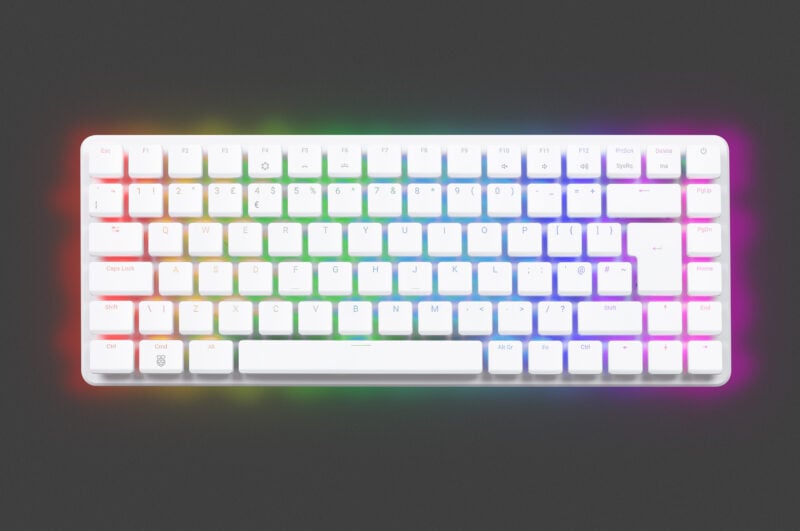 The 16GB-equipped Raspberry Pi 500+ desktop is the one high-density product held at its existing price.
Common misconceptions about this adjustment
- "This is a margin grab." The announced figures are cost-linked and selective; the company is simultaneously shielding Raspberry Pi 500+ and the low-capacity tiers, which is not the behaviour of a firm exploiting pricing power.
- "If the 500+ is unchanged, costs have eased." The hold on that SKU reads as inventory or pre-costing cover, not relief in the DRAM market — third-party forecasts still show quarter-on-quarter increases through 4Q26.
- "More RAM is always the safer specification." At $385 versus $45, unused density is now pure stranded capital in a product design.
- "Compute Module 5 and Raspberry Pi 5 16GB are equivalent buys." The module increased by $40 and the board by $80, and module pricing is governed by the product brief rather than the headline board price list.
- "Any supplier with stock is a real supplier." The company has flagged that bad actors are exploiting current memory conditions to sell at inflated prices or ship items that are not what they appear.
Channel risk: the hidden premium
For procurement teams the bigger exposure may be secondary rather than primary pricing. Where a genuine price increase is publicly documented, grey-market mark-ups and mislabelled listings follow within days, and buyers pay a premium the manufacturer never set. Raspberry Pi's counter-measure is its vetted distribution network: all products remain available at official prices through Raspberry Pi Approved Resellers, and doubtful buyers can locate the nearest vetted supplier via the Approved Reseller page. Practically, that means keeping the reseller confirmation and invoice as the warranty trail, and treating "immediate stock, no documentation" listings on general marketplaces as a defect-risk line item rather than a bargain.
Action list for the next 90 days
- Audit every design for actual peak memory use; move anything under 8GB to a lower-density variant or an earlier model.
- Re-baseline the bill of materials against today's prices before locking a product design, and price the 3GB and 1GB tiers as alternatives.
- Check the product brief on the Compute Module 5 product page for revised module pricing rather than assuming the board-level delta applies.
- Reduce software memory demand before buying silicon: Raspberry Pi Official Magazine carries techniques for squeezing more from a given capacity, and Raspberry Pi forums are where the company's engineers also answer optimisation queries. Business customers with volume exposure can raise memory optimisation directly with the company.
- Re-quote only through Raspberry Pi Approved Resellers and record the Approved Reseller page link used, for warranty and audit purposes.
- Track reversal triggers: LPDDR4/LPDDR5 contract prints, news of a qualified alternative 16GB DRAM part, and the company's next results commentary.
The verdict, and what to watch next
GlobalBizSight's read is that this is a well-targeted cost pass-through by a company with enough momentum to absorb criticism of its top-end pricing while defending its entry tiers — but the move has permanently altered the value argument for the 16GB configuration, which now competes on ecosystem rather than price. The three indicators worth following are whether Raspberry Pi 500+ eventually reprices, whether alternative 16GB DRAM qualification is announced, and whether the promised reversal arrives with the next leg down in memory costs. If the first two stay quiet and only the third materialises, the practical conclusion for buyers is unchanged: the cheapest memory is the memory a design never needs.