
CompanyWatch Playbook: Sourcing Authorized Semiconductors Through Rochester Electronics' Six New Language Stores
By Felix Campbell · GlobalBizSight CompanyWatch
Short answer: purchasing teams in Brazil, Mexico and much of continental Europe can now finish an authorized semiconductor transaction — search, availability check, order, invoice — on Rochester Electronics' regional websites in their own language, instead of only reading translated product pages there. The company extended complete buying journeys to six additional languages. That compresses cycle time on the buyer's side and channel risk on both sides. Everything below is about how to use the change, and where it does not help you.
The upgraded platforms went live in Portuguese (Brazil), Spanish (Mexico), French, German, Italian and Polish, per the announcement datelined Newburyport, Massachusetts, 6 October 2026. They join the English, Chinese, Japanese and Korean (South Korea) stores that were already transactional, so every regional site Rochester publishes now carries an end-to-end purchase path (Business Wire).
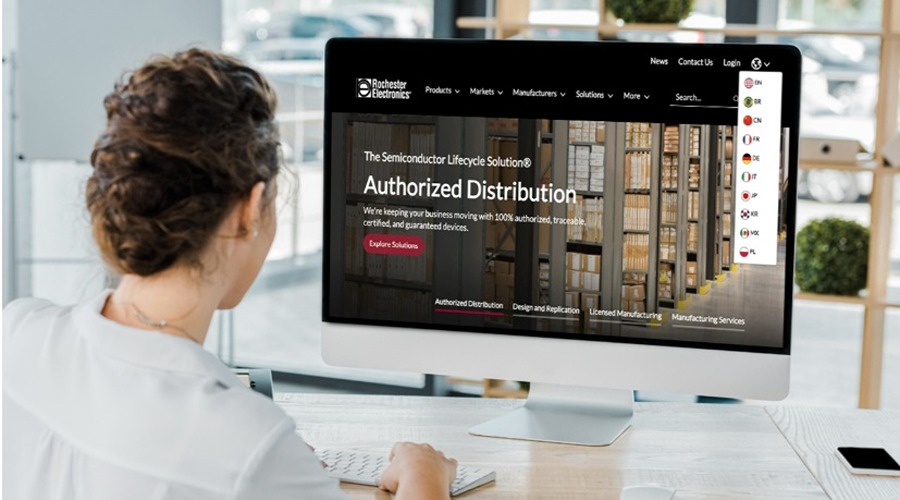
Useful definition: a localized storefront is a regional site that carries language, local-currency pricing, account terms and logistics data inside one checkout. It is not a translated brochure with a sales inbox attached. The difference between those two states is the entire event being reported here.
Why a language store is a lifecycle question, not a translation project
Conclusion first: for long-life programmes the binding constraint has been access to a clean transaction, not access to information. Engineering teams already had datasheets and lifecycle status pages; what they lacked was a way to place a compliant order without routing through a third party.
The arithmetic of that gap is well documented. Z2Data's obsolescence reporting put nearly 750,000 part numbers at end-of-life in 2022, then 473,910 in 2023 — a 37% decline from the prior year, but still six-figure attrition running every single year. The Semiconductor Industry Association's anti-counterfeiting task force has cited expert estimates that as many as 15 percent of spare and replacement semiconductors purchased by the U.S. Department of Defense were counterfeit. Every point of friction removed from an authorized channel is a point of pull removed from brokers, franchise overstock and unlabeled lots.
Rochester's position in that channel is unusual and explains why this event matters beyond one vendor: it is 100% authorized by more than 70 semiconductor manufacturers, states AS6496 compliance for its distribution operations, holds reported die inventory above 12 billion units, and describes itself as the largest continuous source of semiconductors. The company has kept the same posture since 1981 — dependable access to semiconductor solutions and support worldwide — and now the access layer is a checkout rather than a phone tree.
Rollout sequence: what a sourcing team should switch on first
Do not try to migrate BOMs the day the site launches. Work the functions in order of risk removed.
- Rebuild search habits. Start with product search and attribute filtering, plus the substitute-part suggestions. Verify that parametric filters return the same datasheet revision your design record holds.
- Load lists, not parts. Use the list-management tools, including Bill of Materials (BOM) support, to run one mature product's full BOM through the store. That single exercise shows you coverage gaps in an afternoon instead of over a quarter.
- Read inventory as two numbers. The stores expose both current and future stock. Treat current stock as today's executable quantity and future stock as a planning signal that still needs commitment language from the channel.
- Sort parts by lifecycle status. Availability information and TLS360 lifecycle management should decide who owns each line item — commodity buyers for unmanaged parts, programme managers for parts under a defined lifecycle horizon.
- Clean up the back office. Consolidate order status and shipment tracking into your ERP feed, and pull downloadable invoices and documentation into a single audit folder rather than per-site folders.
- Set accounts before spend. Configure billing, shipping and payment terms once, per legal entity, before anyone uses One-click reorder. Reorder convenience is a control problem first.
- Card checkout has a ceiling. Secure checkout with major credit cards suits prototypes, spares and low-value rework. Production allocations and long-term supply commitments still belong in a signed agreement.
Two supporting assets are easy to under-use: the expanded catalog, white paper and webinar library, which is the fastest route to substitution rationale when a part number disappears; and the regional support teams, which remain the only channel that can convert a visible quantity into a reserved one.
Site map of the newly enabled stores
The company publishes each regional domain separately, which is where local-currency pricing and account terms live. Confirm the domain you transact against, not a global landing page.
| Language / site | Primary market | Regional domain | Check first |
|---|---|---|---|
| Portuguese | Brazil | www.rocelec.com.br | Import tax handling and lead time to the plant |
| Spanish | Mexico | www.rocelec.mx | Payment terms for maquiladora entities |
| German | Germany / DACH | www.rocelec.de | Invoice format and VAT fields |
| French | France | www.rocelec.fr | Account setup for public-sector customers |
| Italian | Italy | www.rocelec.it | Currency display and shipping destination |
| Polish | Poland | www.rocelec.pl | Contract-manufacturer ordering rights |
What the local store settles — and what it does not
| Buyer question | Answered inside the store | Still needs human confirmation |
|---|---|---|
| What does this part cost in my currency? | Yes — visible localized pricing | Volume tiers and price-hold periods |
| Is the quantity real today? | Yes — current and future inventory visibility | Date codes, lot traceability, allocation reservation |
| Will this part still exist in five years? | Partly — availability status and TLS360 lifecycle management | Programme-level horizon commitments and last-time-buy terms |
| Is this an authorized source? | Yes — the storefront is the manufacturer-authorized channel | Whether a specific part number is under authorization |
| Can my contract factory order directly? | Yes, once account settings are granted | Payment terms, export screening, order approval limits |
Four misconceptions this launch invites
- "Localized checkout means localized stock." The announcement describes inventory visibility and localized pricing presentation, not a separate regional warehouse. Assume one pool with many doors.
- "Future inventory is a promise." A forward quantity is a forecast of availability. Convert it into a commitment only in writing.
- "A suggested substitute is an approved substitute." Alternative-part recommendations shorten the search; qualification of parametric, software, package and reliability deltas stays with your engineering change board.
- "One consistent global experience means one set of terms." The sites maintain a consistent experience while meeting regional requirements. Consistency is in workflow, not in tax, freight or credit rules.
What to watch next at Rochester
Treat the storefront as the visible layer of a supply-position strategy. Three indicators tell you whether the digital investment matches the stated ambition.
- Lifecycle coverage inside the cart. The most instructive precedent is how Rochester extended NXP QorIQ P-Series availability under TLS360: authorized inventory bought back a part family's planning horizon rather than a stock position. Watch for more families listed with horizons in local currency.
- Mature-node supply signal. Long-life analog and power parts depend on capacity that is being retired; our read of Samsung's 8-inch lines ending by 2030 frames which replacement routes actually work. A regional store is worth more when the wafers behind it are safe.
- Whether the company publishes order-cycle metrics. The claimed benefits are simpler sourcing, higher efficiency and shorter processing time. If no processing-time figure is disclosed, the benefits remain an assertion. For the mechanism behind licensed production, Rochester's vice president of design technology, Dan Deisz, has argued in Electronics Sourcing that licensed manufacturing is a lever for managing end-of-life risk; on TLS360 specifically, the company's coverage describes a defined horizon that "can be built directly into a program's planning cycle" (Electronics Sourcing).
FAQ: what buyers ask after a language expansion
Do the six new sites carry different prices from the English store?
The regional sites display localized pricing, so currency, taxes and payment presentation differ. Compare landed cost, not the displayed unit price, when deciding where to buy.
Does the store remove brokers from my long-life parts?
Only for part numbers that are authorized and stocked there. Run the BOM through the store first; anything missing tells you where gray-channel exposure still lives.
Is One-click reorder safe for production?
It is efficient for repeatable, already-qualified lines. Keep approval limits and change-control gates on the account, and never let a reorder shortcut bypass an engineering change review.
Which teams gain most in year one?
Programme managers in industrial, medical, transport and defense electronics, plus contract manufacturers in Brazil, Mexico and Poland who previously transacted in a second language. Their saving is handling time, not unit price.
Action plan for the next 90 days
- Pick one end-of-life-sensitive product and push its full BOM through the nearest newly enabled site; log coverage rate by part number.
- Split your part list into lifecycle-managed and non-managed, using availability status and TLS360 coverage as the dividing line.
- Freeze account governance: named orderers, spend ceilings, card usage limited to spares and prototypes.
- Report to procurement leadership in two numbers only — percentage of BOM lines transacted in-store, and days saved from request to shipment.
For the decision layer, the sentence is short: a translated catalogue wins a search; a translated checkout wins the channel. Use the six-language launch to pull long-life purchasing out of the gray market, and do not confuse the smoother interface with a safer supply chain.
Corrections or sourcing tips for the GlobalBizSight CompanyWatch desk: info@globalbizsight.com.
Reference sources
- Business Wire, "Rochester Electronics Launches Localized E-Commerce Experiences Across Key Global Markets" (6 October 2026) — https://www.businesswire.com/news/home/20261006914131/en/Rochester-Electronics-Launches-Localized-E-Commerce-Experiences-Across-Key-Global-Markets
- Rochester Electronics, manufacturers and authorization overview — https://www.rocelec.com/manufacturers
- Rochester Electronics, authorized distribution and AS6496 compliance — http://www.rocelec.com/solutions/authorized-distribution
- Rochester Electronics, TLS360 (Through Life Support 360) program page — https://www.rocelec.com/products/tls360
- Z2Data, obsolescence trends reporting on annual end-of-life part counts — https://www.z2data.com/guides/obsolescence-trends-2024/
- Semiconductor Industry Association, ACTF counterfeit-parts white paper — https://www.semiconductors.org/wp-content/uploads/2018/06/ACTF-Whitepaper-Counterfeit-One-Pager-Final.pdf
- Electronics Sourcing, "Lifecycle assurance, without compromise" and licensed-manufacturing analysis by Dan Deisz — https://electronics-sourcing.com/2026/09/10/lifecycle-assurance-without-compromise/