
CompanyWatch Case File: Samsung's Galaxy Studio and the SM-U700 Filing — What a More-Than-Decade Hiatus in Over-Ear Audio Signals for Early 2027
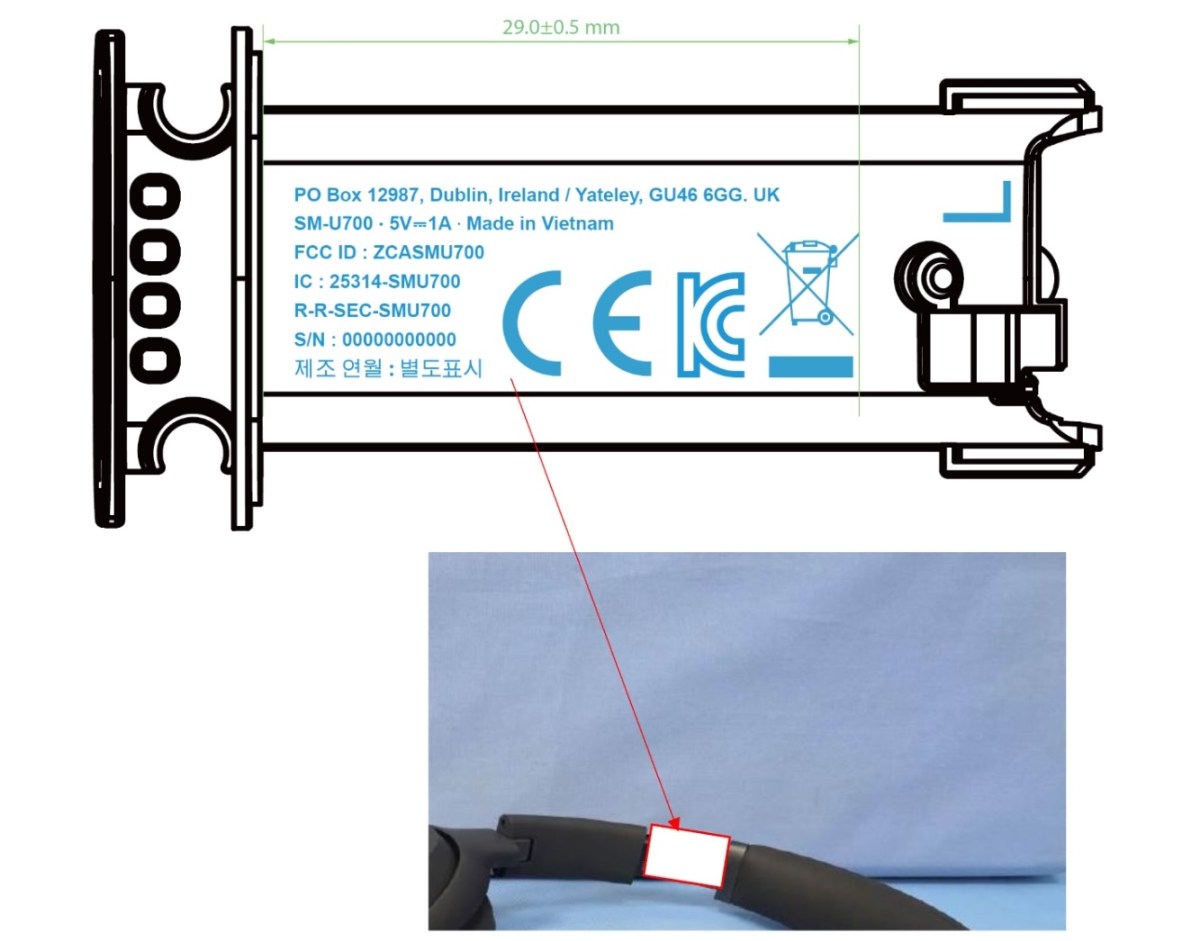
Direct answer: Samsung is returning to premium over-ear headphones. Recently, a Bluetooth headphone carrying the model number SM-U700 appeared in the U.S. Federal Communications Commission (FCC) equipment-authorization database, putting a hard regulatory footprint behind the rumoured name Galaxy Studio. GlobalBizSight CompanyWatch reads this as a corporate strategy reversal rather than a gadget leak: the device is expected in early 2027 alongside the Galaxy S27 series, after Samsung has stayed away from the category for more than a decade.
Reported by Marc Hale, GlobalBizSight CompanyWatch. Corrections and source tips: info@globalbizsight.com.
Case file at a glance
- Subject: Samsung Electronics, mobile experience (MX) hardware line — audio category re-entry.
- Trigger event: Recently, the model number SM-U700 surfaced in the U.S. Federal Communications Commission (FCC) certification database, alongside a regulatory-label image that reveals partial industrial design.
- Product identity: Leaked as Galaxy Studio, a premium in-ear-free, over-ear (circumaural) wireless headphone positioned above the Galaxy Buds series true-wireless line.
- Competitive target: Apple AirPods Max and other high-end over-ear models, filling a hole in the Galaxy ecosystem that Samsung has not served itself for more than a decade.
- Projected window: early 2027, co-announced with the Galaxy S27 series, matching Samsung's established February Unpacked cadence.
- Capability base: Acoustic know-how drawn from Harman International, the subsidiary that owns AKG, JBL and Harman Kardon.
How did this leak move from app code to a federal database?
Conclusion first: the SM-U700 trail is now sequenced, dated and cross-checked across two regulators, which is why CompanyWatch treats the product as real even though Samsung has confirmed nothing publicly. The evidence base before the FCC entry was speculative — strings in software, icons inside an app, naming rumours on social media. A filing in the United States regulatory system changes the character of the signal, because equipment authorization is generated by the manufacturer itself, not by an observer.
| Date | What surfaced | Why it matters for tracking the company |
|---|---|---|
| August 2026 | Code strings, an internal project name and interface graphics discovered in Samsung's wearable software | First hard trace of an over-ear project; suggested the product would sit inside the Galaxy brand rather than revive Level |
| October 8, 2026 | Developer account evowizz publicly named the product Galaxy Studio and framed it against Apple AirPods Max | The same account had earlier called the Galaxy Buds On naming correctly, so the leak carried credibility without carrying confirmation (per CNMO Technology) |
| October 23, 2026 | SM-U700 cleared Korea's National Radio Research Agency (RRA) certification | Home-market radio approval usually precedes export filings — the first indication of a near-term launch plan |
| November 4, 2026 | SM-U700 appeared in the U.S. Federal Communications Commission (FCC) database, with a label-placement graphic showing partial design; reporting citing SamMobile described swivelling ear cups and two finishes, black and beige | Confirms a U.S. go-to-market intention; design detail shifts the story from existence to ergonomics and portability |
| Early 2027 (projected) | Expected debut with the Galaxy S27 series | Samsung unveiled the Galaxy S26 series and the Galaxy Buds4 line at Unpacked on February 25, 2026 in San Francisco, with retail availability from March 11 — the calendar pattern behind the early 2027 expectation |
What is proven, and what is still inference?
Conclusion first: readers should separate the regulatory record from the speculation built on it. Several recurring misreadings circulate in the coverage of this case, and each one weakens the analytical value of the filing.
- Misconception: an FCC listing equals an announced launch date. FCC equipment authorization only confirms that a radio-equipped device cleared U.S. rules; the product may be delayed, repositioned or shelved. Samsung has not published any date, so early 2027 with the Galaxy S27 series remains an inference from the leak trail and the Unpacked calendar.
- Misconception: the leaked design photo is a marketing render. What the database shows is a partial view and the placement of a regulatory label — enough for a first read on the over-ear form factor, not enough to judge build quality or final colour options.
- Misconception: Samsung has no headphone capability left. It has not updated a Samsung-branded over-ear line for more than a decade, but the group has owned Harman International since 2017, and AKG, JBL and Harman Kardon over-ear products have continued to ship in that period. Manufacturing and acoustic competence were never lost; the Samsung badge was withdrawn from the segment.
- Misconception: Galaxy Studio is simply a bigger pair of earbuds. Positioning above the Galaxy Buds series implies a different bill of materials, a different price ladder and a different retail role — margin per unit versus volume.
- Misconception: features are confirmed. Active noise cancellation, wireless Bluetooth connectivity and deep Samsung ecosystem integration are industry expectations drawn from earlier leaks, not specifications published by Samsung. Some outlets also expect a newer Bluetooth revision, on the logic that the Galaxy Buds4 generation already moved ahead on the wireless stack.
Why did Samsung walk away from over-ear audio more than a decade ago?
Conclusion first: the Level series did not fail because Samsung could not build headphones; it failed because the company redirected scarce engineering and shelf space toward categories where it could win volume. Samsung launched the Level line around 2014 with over-ear and on-ear models, then stopped refreshing it; product databases now list the Level range as discontinued, and the Samsung-branded accessory gap was partly filled by AKG-badged earphones after the Harman acquisition closed in 2017. The precise wind-down year is not documented in an official Samsung record, so CompanyWatch treats the 2017-2018 transition as an analyst reconstruction rather than a company statement.
Strategically, the timing was rational at the moment it was made. The category Samsung exited was premium wired and early wireless headband audio, while the growth it chased was true wireless stereo — where Apple's AirPods had just created a brand-new accessory economy. Exiting cost little in those years. Re-entering now costs far less, because the premium over-ear segment has returned to growth on the back of active noise cancellation and, increasingly, on-device AI features such as live translation.
What are the economics behind the return?
Conclusion first: Galaxy Studio looks like an ecosystem-defence move with a margin upside, not a volume bet. Two datasets frame the case.
- Samsung is losing share in the category it chose to fight in. Research house Omdia put global true-wireless shipments down 0.7% year on year in the second quarter of 2026, with Samsung third at roughly 5.5 million units and a 6.7% share, down 2.9% year on year, behind Apple's approximately 16.8 million units and 20.5%. A maturing earbud market gives Samsung a reason to open a second audio front.
- Premium audio is where the money concentrates. Strategy Analytics' forecast cited in industry coverage expects global TWS shipments of 344 million units in 2026 and 349 million in 2027, while Apple alone captured about 44% of total TWS market value in the first quarter of 2026 — a signal that revenue, not units, follows premium positioning. Market-research firm Coherent Market Insights sizes the premium headphone market at about USD 25.1 billion in 2025, rising to roughly USD 72.7 billion by 2032 at a 16.4% compound annual growth rate.
Read against the price ladder Galaxy Studio must attack, the room is narrow but real:
| Product | Reference price | Position in the ladder |
|---|---|---|
| Sony WH-1000XM6 | USD 459.99 list (Sony Electronics store; frequently discounted below USD 380) | Volume-premium ANC benchmark |
| Apple AirPods Max 2 | From USD 549 (Apple Newsroom, March 16, 2026; orders opened March 25 with the H2 chip) | Ecosystem-locked top of the market; direct rival for Galaxy Studio |
| Samsung Galaxy Studio (SM-U700) | Unannounced; a USD 449-549 band would sit at parity or slightly under Apple | Analysis, not a Samsung figure |
Does Harman International help or complicate the launch?
Conclusion first: the subsidiary supplies the acoustic credibility that lets Samsung re-enter a segment it abandoned years later, and it simultaneously creates the hardest internal question of this case — brand cannibalisation. Samsung agreed in November 2016 to acquire Harman for USD 112 per share in cash, roughly USD 8 billion, closing in 2017; Oh-Hyun Kwon, then Vice Chairman and Chief Executive Officer of Samsung Electronics, described the deal as one where HARMAN perfectly complements Samsung in terms of technologies, products and solutions, a natural extension of the strategy the company had been pursuing for some time.
Practically, that heritage is why observers expect high performance from SM-U700: AKG tuning know-how, JBL's component scale and Harman Kardon's premium positioning are all inside the group. The risk is that JBL and AKG already sell ANC over-ear headphones, so Galaxy Studio could take share from its own sister brands before it takes any from Apple. CompanyWatch's read: Samsung is most likely accepting deliberate overlap, because a Galaxy-badged flagship headphone sells the Samsung ecosystem — pairing, audio hand-off, wearables continuity — in a way that a JBL product structurally cannot.
What to watch next: five trackable indicators
- Additional filings: further entries in the FCC system for the same model number, plus regional approvals, in the coming months — these are the earliest reliable proxies for a confirmed retail window.
- Brand architecture: whether Samsung commits to Galaxy Studio and retires Level permanently, or introduces a sub-brand umbrella.
- Announcement format: an Unpacked slot alongside the Galaxy S27 series versus a standalone audio event; the former signals ecosystem bundling, the latter signals a serious standalone audio business.
- Price and the sister-brand ladder: any JBL or AKG repricing at the same time is direct evidence of internal cannibalisation management.
- Feature proof: published active noise cancellation depth, battery life with ANC on, lossless or high-resolution wireless support, and real-time translation on Android devices — the four claims most likely to determine whether the product competes against AirPods Max on more than price.
Four reusable lessons from this case file
- Category exit is rarely wrong in the moment and rarely free in hindsight. Samsung's withdrawal from the Level series was defensible in a TWS gold rush; the cost is now paying in the form of a decade-long absence from a segment its premium phone customers keep buying.
- Buy capability, then redeploy it under your own badge. Acoustic depth came from Harman International, not from a ten-year in-house rebuild. This is the template for re-entry into a category you exited.
- Regulatory filings beat leaks as evidence. The step change in confidence happened when SM-U700 reached the U.S. Federal Communications Commission database, not when a name appeared on social media.
- Ecosystem gaps are a competitive liability that shows up in the accessory aisle. The Galaxy ecosystem lacked exactly one thing that Apple's did not: a flagship over-ear headphone.
Action recommendations by reader type
- Investors and equity analysts: do not model unit volume. Model accessory attach rate and gross margin on premium audio, and watch whether Samsung discloses audio content in MX earnings commentary rather than product launches.
- Industry analysts: benchmark Galaxy Studio on ANC depth, battery with ANC enabled, multipoint hand-off and translation latency against AirPods Max 2 and the Sony WH-1000XM6 — not on driver specs.
- Corporate strategy and business development teams: treat the timeline as a template — app-code trace, home-market radio approval, export-market approval, flagship-event debut. Any rival's silent category re-entry is visible in roughly that order if you are tracking filings.
- Retail and distribution partners: plan for a February-or-March window rather than a holiday launch, consistent with Samsung's Unpacked cadence, and expect bundle mechanics with the Galaxy S27 series.
- Component suppliers: a Samsung flagship over-ear program implies volume demand for ANC DSP, MEMS microphone arrays and hinge or swivel mechanisms; qualification cycles should be assessed against an early 2027 debut.
Frequently asked questions
Is Galaxy Studio officially announced?
No. Samsung has published no specifications, price or release date. Galaxy Studio is a leaked name; SM-U700 is a model number recorded in regulatory filings, and the design cues — swivelling ear cups, black and beige finishes — come from documents visible in the FCC database and reporting that cited them.
When will it launch?
The most-supported estimate is early 2027, together with the Galaxy S27 series. That estimate rests on Samsung's own pattern: the Galaxy S26 series and Galaxy Buds4 line were unveiled at Unpacked on February 25, 2026 and reached shelves on March 11. More filings and leaks are expected to sharpen the picture in the coming months.
What is it competing against?
Directly, Apple AirPods Max — now in a second generation at USD 549 with the H2 chip — and indirectly the Sony WH-1000XM6, which anchors the ANC benchmark a couple of price steps lower. For Samsung, the strategic function is to close the last premium gap in the Galaxy ecosystem years later, not to win a unit war.
Why does an FCC record matter commercially?
Because authorization filings are created by the manufacturer, they are verifiable, dated and public. A U.S. filing signals a planned American launch and lets analysts build a rollout calendar; the FCC's own equipment-authorization framework sets out the process behind such records.
What could still derail the program?
Component cost inflation, an internal brand clash with JBL and AKG, or a certification issue that pushes the filing-to-launch interval beyond a single Unpacked cycle. None of these is evidenced today; they are the standard failure modes for a first-in-category product from a returning incumbent.
Sources and further reading
- U.S. Federal Communications Commission — Equipment Authorization framework: https://www.fcc.gov/engineering-technology/laboratory-division/general/equipment-authorization
- Apple Newsroom — AirPods Max 2 introduction, USD 549, H2 chip, March 16, 2026: https://www.apple.com/newsroom/2026/03/apple-introduces-airpods-max-2-powered-by-h2/
- Samsung Global Newsroom — Unpacked February 25, 2026 (Galaxy S26 series and Galaxy Buds4): https://news.samsung.com/us/samsung-galaxy-unpacked-february-2026-next-ai-phone-makes-life-easier
- Samsung Global Newsroom — Harman acquisition terms and Oh-Hyun Kwon statement: https://news.samsung.com/global/samsung-electronics-to-acquire-harman-accelerating-growth-in-automotive-and-connected-technologies
- Sony Electronics — WH-1000XM6 list price: https://electronics.sony.com/audio/headphones/headband/p/wh1000xm6-b
- Coherent Market Insights — Premium Headphones Market outlook: https://www.coherentmarketinsights.com/market-insight/premium-headphones-market-2829
- IT Home / SamMobile — SM-U700 FCC filing details, November 6, 2026: https://mparticle.uc.cn/article_org.html?wm_cid=784076285161779200
- China, IT Era Net / Sohu — SM-U700 RRA certification, October 23, 2026: https://m.sohu.com/a/1091890047_121423427/
- CNMO Technology via Sohu — Galaxy Studio naming and the August 2026 code trail: https://m.sohu.com/a/1085509856_115831
- Omdia Q2 2026 TWS shipment data as reported by Sina Finance: https://finance.sina.cn/2026-09-27/detail-inithqpy3281415.d.html
- Strategy Analytics forecast on 2026-2027 TWS volumes and Apple value share, as reported in Gadgets Now: https://gadgetsnow.indiatimes.com/tech-news/apple-retains-global-tws-lead-but-open-ear-earbuds-are-emerging-as-the-industrys-biggest-growth-driver/articleshow/131641990.cms
Editorial note: GlobalBizSight CompanyWatch tracks single-company operating dynamics. Where Samsung, Apple or a research house has not published a figure directly, the article states that the estimate is analysis rather than a company disclosure. Ratings, dates and names of the parties cited are reported as filed or as published by the sources listed above; corrections go to info@globalbizsight.com. Written by Marc Hale.