
CompanyWatch: Seequent Buys Eliis — Reading Bentley's Seismic Play Against the Incumbents
This is a watchlist entry on one company, not an industry essay. On 2 November 2026, Bentley Systems, Incorporated disclosed that Seequent, The Bentley Subsurface Company, had acquired Eliis, a developer of seismic interpretation software. Most public coverage stops at that sentence. The useful questions are narrower: which specific hole in a Nasdaq-listed vendor's catalogue was just filled, how the acquired product compares with the platforms exploration teams already run, which buyers feel the consequences first, and which parts of the deal narrative should be treated as unproven.
The event, isolated
| Item | What the company disclosed |
|---|---|
| Announced | 2 November 2026, via Bentley's investor news channel |
| Acquirer | Seequent, The Bentley Subsurface Company, a subsidiary of Bentley Systems, Incorporated (Nasdaq: BSY) |
| Target | Eliis, seismic interpretation software developer, founded in 2007, operating from Montpellier, France |
| People moving | more than 100 geoscientists, technical specialists and researchers joining Seequent |
| Software assets | PaleoScan (seismic interpretation platform) and PaleoModel (co-innovation project for downstream reservoir simulation) |
| Stated strategic purpose | Add seismic data interpretation to Seequent's geophysics capabilities and broaden the subsurface software Bentley can offer |
| Outside legal counsel | Dechert LLP and Simmons & Simmons LLP advised Bentley and Seequent on the transaction |
| Price | Not stated in the material reviewed — treat any valuation figure circulating elsewhere as unverified |
The gap was in the front of the workflow, not the back
Seequent's commercial centre of gravity has been modelling and interrogating ground that is already reasonably well known: implicit geological modelling with Leapfrog, geotechnical stability analysis, geohazard and hydrogeology work, and geological data management for mine and site teams. That stack typically starts from boreholes, drill results, mappings and point data, then builds a model upward.
Seismic interpretation is the opposite direction of travel. It begins with reflected acoustic images of the deep subsurface and turns them into stratigraphy, structure and hazard screens before any well exists. High-resolution geophysical data for analysis at depth is obtained through seismic methods, and the interpretation layer is exactly where Seequent had been a bystander rather than a participant. Eliis supplies that layer: software used to process and analyze seismic imaging data and construct subsurface models from them.
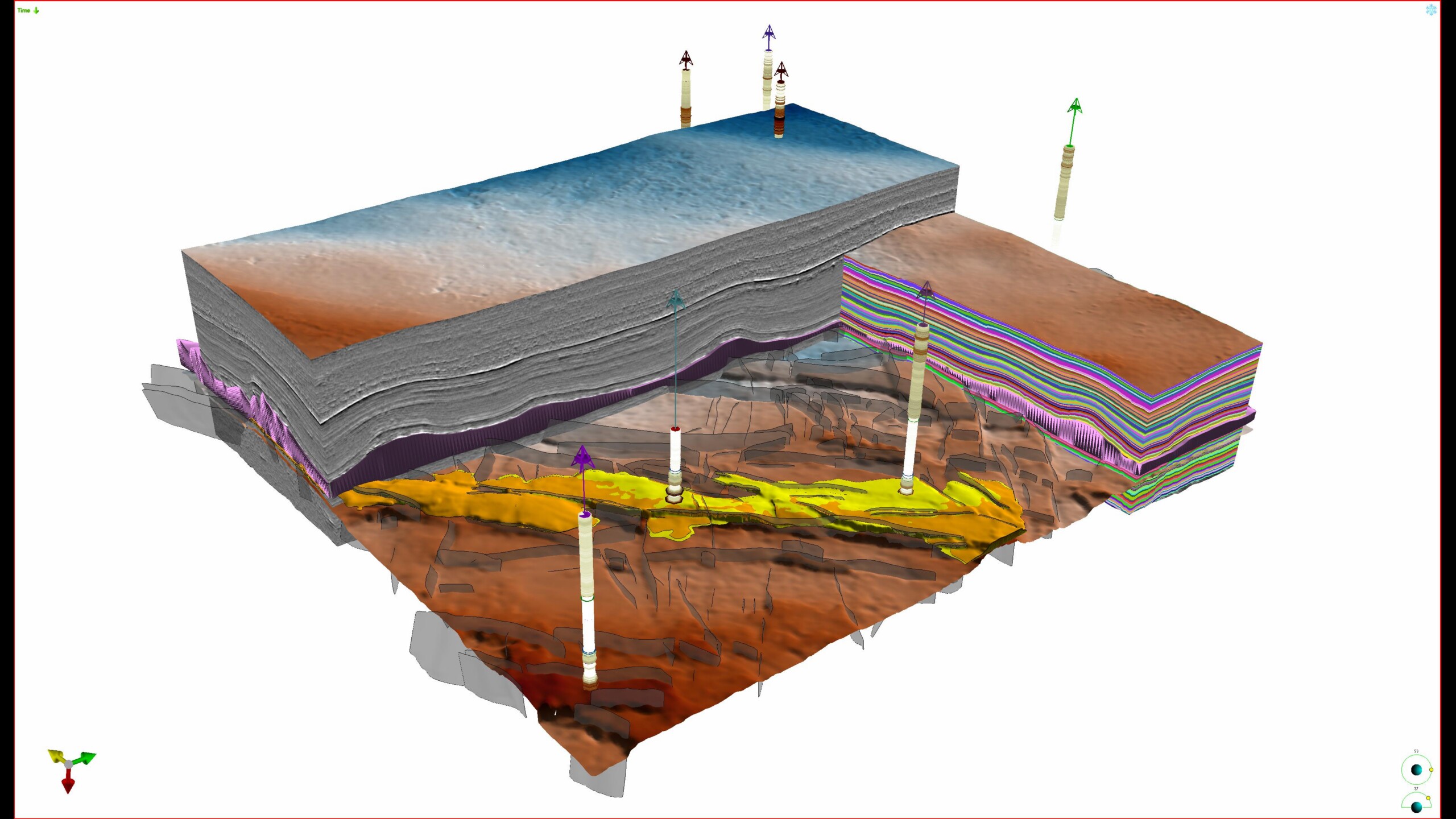 The image presents a 3D view from PaleoScan, positioned in the announcement around prospect evaluation and exploration decision-making — a workflow Seequent's installed base has historically bought from someone else.
How PaleoScan stacks up against the platforms buyers already run
Independent 2026 buyer round-ups group the seismic interpretation field along a rough division of labour, and it is worth holding the acquired product against that grid rather than against a strawman.
| Platform | Positioning in the market | Where it wins | Trade-off a buyer accepts |
|---|---|---|---|
| PaleoScan (now Seequent) | Patented Relative Geological Time (RGT) modelling combined with AI-assisted, semi-automatic global interpretation | Regional screening, surveys with inconsistent or legacy interpretation history, fast second opinions on mature acreage | A smaller installed exploration base than the majors; most often deployed alongside an existing platform, not instead of it |
| Petrel | Broad integrated subsurface environment spanning interpretation through reservoir engineering and field development | Deep entrenchment in major operator workflows and vendor ecosystems | Round-ups repeatedly note cost and learning-curve weight rather than gaps in capability |
| Kingdom | Seismic interpretation tied to well, geology and mapping workflows | Basin-scale studies and mapped interpretation programmes with strong well control | Less integrated downstream than a full field-development environment |
| OpendTect | 2D, 3D and 4D visualisation and interpretation, interoperable with other platforms and Python | Open workflows, algorithm-driven teams, research settings, aggressive pricing | Rated by round-ups as a value and flexibility pick rather than an end-to-end corporate environment |
One concrete signal supports a coexistence thesis over a replacement thesis: Eliis publishes migration guidance for moving projects into a rival platform through a dedicated From PaleoScan To Petrel workflow, where imported horizons are converted automatically into interpretations in the target system. Buyers should expect the combined Seequent catalogue to compete for incremental budget lines, not to displace incumbent interpretation stacks at short notice.
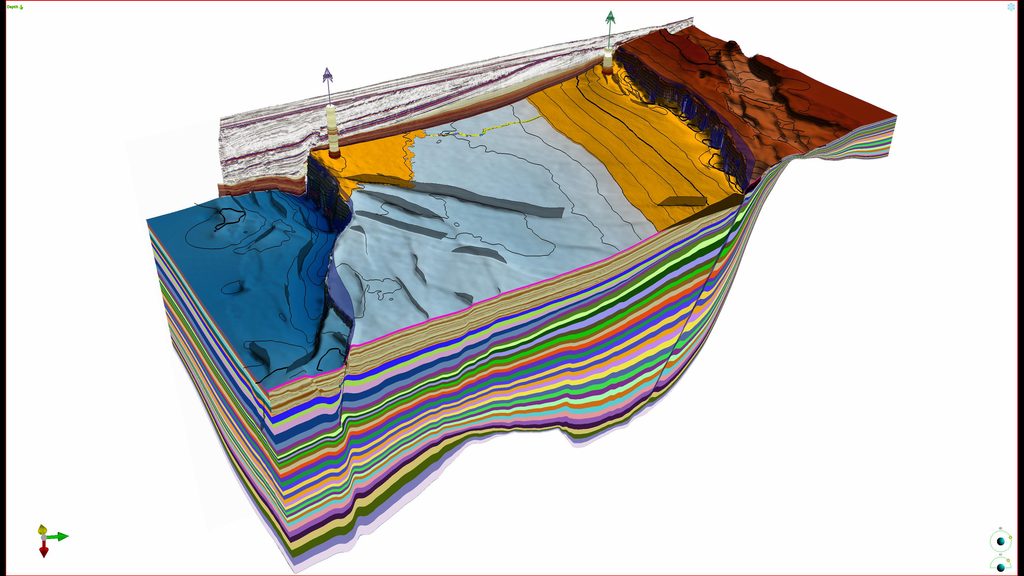 The image shows 3D seismic interpretation in PaleoScan using RGT to enhance subsurface understanding and stratigraphic analysis. The technique itself is not a marketing coinage: RGT modelling is discussed in geoscience conference abstracts as a reinterpretation of core stratigraphic principles, which is part of why it travels well across old and new surveys.
The financial frame: why this is capability, not inflection
Bentley's own reporting gives the sanity check that deal announcements deliberately omit.
- Total revenues of $410.7 million in the second quarter of 2026, up 12.8% year over year; subscriptions revenues of $378.6 million, up 13.6%.
- Annualized Recurring Revenues of $1,536.0 million as of 30 June 2026, against $1,379.2 million a year earlier; constant currency ARR growth of 12%; dollar-based net retention of 109%.
- Operating income margin of 21.6%, down from 23.2% in the same quarter a year earlier — a reminder that acquisitions carry integration and go-to-market cost before they carry yield.
The reference case is the parent deal itself. When Bentley agreed to buy Seequent in March 2021 for roughly $1.05 billion, it told the market the transaction should initially add about 10% to each of its key financial metrics: ARR, annual revenue and EBITDA. A private French software business whose team is described as more than 100 geoscientists, technical specialists and researchers is a fraction of that scale. Shareholders should therefore read Eliis as a catalogue and cross-sell move, not as a near-term growth inflection.
What has historically justified Bentley's subsurface M&A is the distribution effect. On its first-quarter 2026 earnings call, management said that since the acquisition of Seequent the company had grown its subsurface ARR in civil infrastructure by a factor of four, partly by cross-selling into the parent's installed base. The comparable prize here is pushing seismic interpretation into mining, geotechnical and energy-transition customers who previously bought that capability from specialists — and, symmetrically, selling modelling and geotechnical tools into Eliis' interpretation accounts.
Who the combined portfolio actually suits
- Exploration teams sitting on large legacy inventories. Evidence from before the deal: in November 2025 Eliis and Searcher announced a strategic partnership to analyse more than 20,000 square kilometres of 3D seismic data from the Orange Basin offshore south-western Africa with PaleoScan, aimed at rapid screening rather than full reprocessing. That is the archetype of the workload RGT is chosen for.
- Mining and critical-minerals operators. Grand View Research's seismic services analysis lists growing mineral exploration and the need to characterise complex subsurface geology among the demand drivers now shaping the market, alongside conventional hydrocarbon work — precisely the crossover where a modelling-first vendor adds an imaging-first product.
- Energy-transition operators. Time-lapse seismic monitoring of CO2 plume behaviour in carbon storage projects, and geothermal exploration, are recurring application areas in current geophysics literature and vendor roadmaps; Eliis has positioned PaleoScan in carbon sequestration work, and Seequent already owns the geotechnical and groundwater relationships in those sectors.
- Civil infrastructure and geohazard teams. Where seismic or near-surface imaging informs route selection, tunnelling or ground-risk assessment, the acquired interpretation layer now sits under the same commercial umbrella as Leapfrog and the geotechnical products.
- Not an obvious fit. Operator-owned environments with a locked, contractually entrenched integrated platform may find the RGT layer useful but hard to license in — expect adoption to start in screening, brownfield re-evaluation and non-core acreage, not in sanction-stage field development.
Three misreadings to avoid
- Bentley is now an E&P software company. It has acquired a seismic interpretation capability into a subsurface business built around civil infrastructure, mining and geotechnical customers. The centre of the transaction is capability, not a change of end-market.
- more than 100 heads means more than 100 incremental licences. A large share of that team is research and development capacity. Headcount adds product velocity and scarce interpretive expertise; revenue depends on whether the software gets attached to channels Bentley already owns.
- Incumbent interpretation platforms are now displaced. The migration tooling, the entrenched nature of operator workflows and the absence of disclosed contract economics all argue for coexistence first. Watch for pricing and bundling changes, not for replacement announcements.
Action recommendations
- Investors in Bentley Systems, Incorporated: do not mark up ARR for Eliis yet. Track whether management starts reporting a subsurface ARR line that separates mining, civil and energy-transition contributions — the cross-sell multiple, not the acquisition itself, is the value driver.
- Geoscience and exploration managers: before your next software review, ask the vendor what happens to RGT-based interpretation once it is inside a modelling platform — roadmap, licensing and support continuity in Montpellier, France are the three points where value leaks in carve-out integrations.
- Channel partners and resellers: a combined catalogue spanning interpretation, implicit modelling with Leapfrog and geotechnical analysis is easier to sell as one subsurface programme, but only where a single owner exists inside the customer. Map your accounts for that owner first.
- Competitive analysts: treat deal value as undisclosed and build a bottom-up estimate from headcount, the 2007 founding vintage of the product line and Bentley's prior stated accretion patterns rather than repeating unverified figures.
What we will watch next
Four signposts decide whether this watchlist entry upgrades to a strategy shift. First, product architecture: whether PaleoScan is kept as a standalone platform or absorbed into a common subsurface data layer. Second, commercial packaging: any sign that seismic interpretation is bundled into enterprise subscriptions rather than sold as a niche tool. Third, retention of the research team that built the RGT and AI-assisted interpretation work, since the entire thesis rests on absorbing more than 100 specialists rather than only the code. Fourth, whether Seequent extends interpretation into geothermal and carbon storage bids, where imaging and monitoring requirements converge and where a combined subsurface offering has the clearest commercial logic.
Governance detail is worth noting for its own sake: legal advice to Bentley and Seequent during the transaction came from Dechert LLP and Simmons & Simmons LLP, a counsel pair typical of a cross-border, technology-asset deal involving French IP. The absence of disclosed terms alongside that structure suggests a measured, capability-led purchase.
Bottom line for CompanyWatch readers: Bentley Systems, Incorporated has moved its subsurface arm one step further up the data chain, and Seequent now sells an interpretation product where it previously sold models. The near-term effect is a broader catalogue and a credible seat at exploration and energy-transition tables. The durable effect depends entirely on whether interpretation, modelling and geotechnical workflows are made to share one data story — and on whether customers with mature incumbent platforms find that worth switching for.