
CompanyWatch | Singapore Airlines' Cabin Bet: Better Hardware, a Contested Palette, No Payback Test Until 2027
By Felix Campbell · GlobalBizSight CompanyWatch
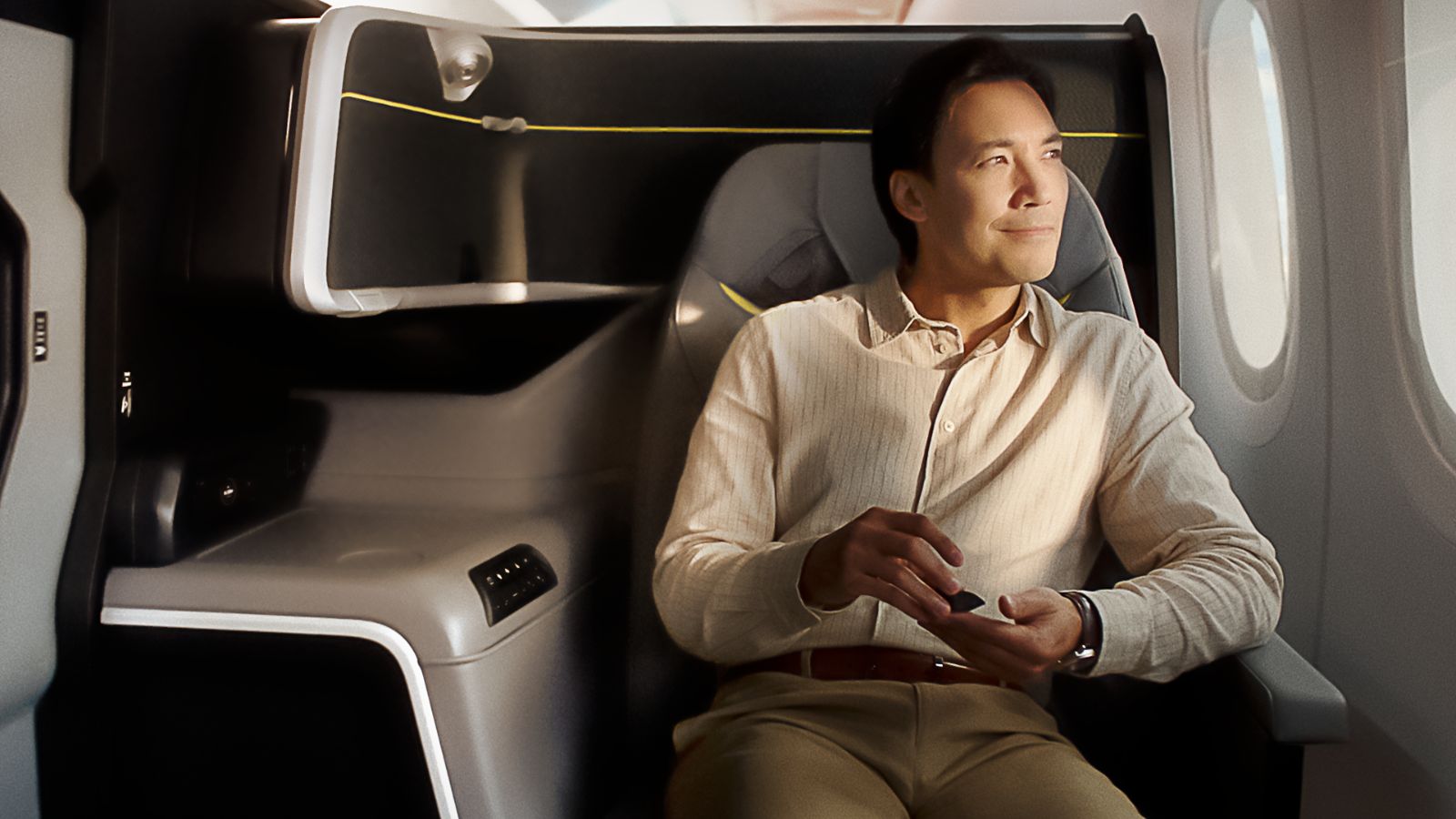
Long-haul premium travel has moved off service gestures and onto measurable privacy: doors that close, beds that lie flat, light the passenger controls. Judged against that decade-long shift, Singapore Airlines' next-generation cabins are a stronger product welded to a weaker brand signal. The hardware — sliding doors, new seats and more space across all four classes — won almost no arguments. The Business Class colour palette is what converted a launch into a public audit of a national carrier's identity, and the commercial verdict belongs not to reveal week but to the retrofitted aircraft that begin earning their fare premium from the second half of 2027.
Why an investment of more than SG$2 billion turned into a brand problem
Singapore Airlines unveiled the products on 6 November 2026, and Instagram did the distribution. Creators Munah Bagharib and Bellywellyjelly shared first looks at the seats, interiors and in-flight dining after the launch event, and the coverage also touched the airline's KrisFlyer overhaul. The refresh spans First Class, Business Class, Premium Economy and Economy, with design work split among PriestmanGoode, Designworks and Factorydesign; the cabins are expected to enter service from the second half of 2027.
Two operational details size the bet better than any render. First, this is a fleet-wide hardware change, not a soft-product polish: 41 retrofitted Airbus A350-900 and A350-900ULR aircraft receive the new Business Class seat, the ULRs gaining First Class for the first time, while incoming Boeing 777-9s carry all four new products — some 72 airframes in total. Second, the supply chain is split: Collins Aerospace builds the First Class, Premium Economy and Economy seats, and RECARO Aircraft Seating builds Business, which means the most contested cabin depends on one supplier's upholstery, tooling and certification path.
Timetable risk is already established. The Business Times reported the debut has slipped more than once — from mid-2026, then to the first quarter of 2027, now to the second half of 2027, with certification among the causes. On the money side, the narrower S$1.1 billion A350-900 retrofit programme disclosed in 2024 sits inside today's wider spend, and group capital-expenditure guidance compiled by The Smart Investor pointed from S$2.9 billion in FY2025 to S$4.6 billion and then S$4.8 billion in the two years after. A cabin launch here is also a balance-sheet event.
What the critics actually objected to
Three separate complaints were flattened into one headline. The first was tonal. DJ Jade Rasif posted an Instagram reel of SIA's existing First Class cabin carrying the line "Last chance to fly Singapore Airlines before they make it ugly", and her caption added, "Goodbye warm colour palette, goodbye expensive looking things." It is unclear whether she was among the creators invited to the launch event.
The second was about form language. Darshen, a former Singapore Airlines cabin crew member, welcomed the sliding doors for Business Class passengers yet compared the new seats to dental chairs, which he said "usually is not a good experience," and pushed for a palette rethink. "As a PPS Club member, I'm very loyal to you guys, but after seeing the new business class seats, it's very hard to be loyal," he wrote, then: "Please change the business class colour palette. It's not too late," and, "We are the world's best airline, we must look classy. We can't look like a dental chair."
The third was about process, not paint. US-based travel influencer Maxmilespoints, who has worked in visual design for 10 years, also read the seat as a doctor's examination or dentist's chair and drew parallels with the dark grey and neon yellow detailing on Spirit Airlines' seats. "When you have that many cooks in the kitchen working on one project, you kind of lose that visual cohesiveness," he argued — a governance critique aimed at three design studios working under one brand roof.
How large is the reaction, and how should an analyst read it?
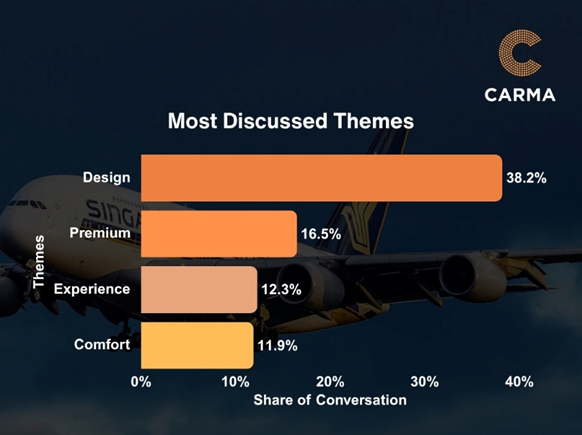
CARMA's social listening put the mood in numbers, with the Business Class palette drawing most of the attention. The table below adds a reading column, because these shares measure emotional arousal, not purchase intent.
| Measure | Result | What the number does not say |
|---|---|---|
| Negative sentiment | 49.4% | Nothing about willingness to pay for a ticket |
| Positive sentiment | 14.46% | Understates quiet approval of space and doors |
| Neutral sentiment | 36.14% | Includes news recitation with no opinion |
| Design share of conversations | 38.2% | Design is also the one variable still editable |
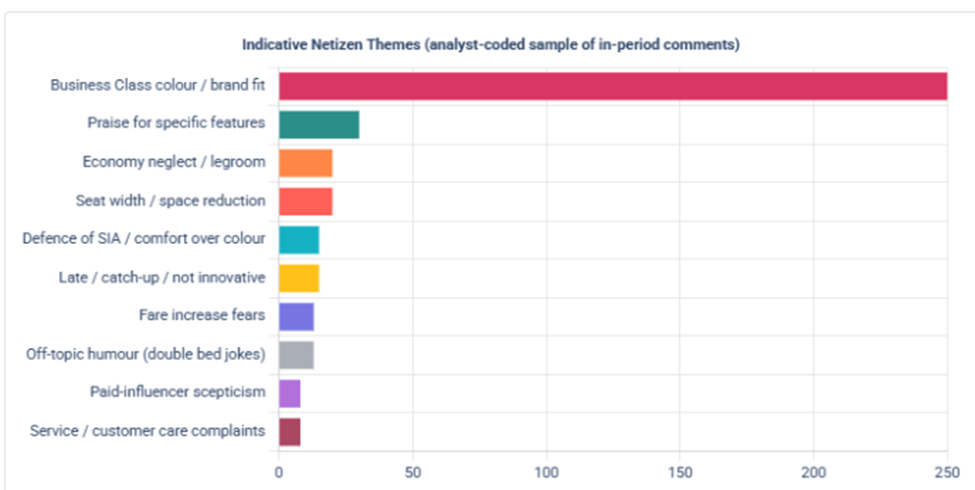
Truescope separately recorded 113,392 engagements and approximately 3.47 million views around the cabin refresh. Business Class generated 40,506 engagements, or 35.7% of the total, while First Class accounted for 32,649 engagements, or 28.8% — a useful tell, because the cabin carrying the brand's commercial weight is also the one carrying the argument. The debate travelled well past aesthetics into seat width, Economy Class comfort, the rollout timeline and whether the spend could eventually affect fares, and some reviewers accepted the practical improvements while remaining unconvinced by the visual direction.
Platform shape mattered, Truescope found:
- TikTok generated the highest engagement and accounted for 92% of shares — top-of-funnel reach, thin booking intent.
- Instagram recorded approximately two million views and the highest number of comments, where design opinions cluster.
- Facebook discussions leaned more towards Economy Class comfort and perceived fairness.
Kelvin Koh, managing director of Truescope Singapore, warned against reading the split as demand risk: "The social response is not a rejection of Singapore Airlines' investment. It is a debate about what people expect from a premium national carrier, and even many of the critics recognised the practical improvements in the new cabins," he said.
Singapore Airlines' answer: research beats stylistic consensus
In a video shared by Australian travel creator The Points Wanderer, vice president of product experience Ong Wah Li said customers had asked for a more contemporary aesthetic: "We spoke to our customers, and they said they wanted a more modern refreshed look. We worked with Designworks and Julia de Bono to come up with the colour palette that is modern and refreshed, yet elegant and refined that's suited to business travel," she said. The evidence base is unusually specific for an interior programme: the company describes research involving more than 5,000 frequent flyers worldwide through focus groups, interviews, surveys and concept tests, which reads as a deliberate positioning choice rather than a styling accident.
Chief commercial officer Lee Lik Hsin rejected the idea that differing cabin colours erode consistency, pointing to the wider journey: "The cohesive customer experience for Singapore Airlines goes far beyond colour. It even goes far beyond a cabin. It is the end-to-end experience that we provide."
Julia de Bono, chief executive of Designworks, explained the Business Class palette as a wardrobe — grey like a business suit, white accents like linen and sneakers, yellow as energy, a word she described as zestiness. "I think it works very well for Business Class. You have the silver accents that pop in front of the yellow, so I think it works very well," De Bono said, positioning silver against yellow as the reason the grey reads deliberate rather than clinical.
Where the brand specialists split
Industry professionals quoted by MARKETING-INTERACTIVE saw logic in distinct cabin identities but worried about the distance between them.
Simon Lee, managing and creative director of Vantage Branding, said three design studios can give each class its own character and give passengers reasons to trade up, and noted the automotive influence in Business Class given Designworks' association with BMW. His objection was recognisability: "Business Class is a better product, with more space and more privacy, but if you showed it to me on its own, I'm not sure I'd guess the airline. And that matters, because Business Class is where most premium customers actually experience the brand," Lee said. "Being different is fine. Being disconnected is the risk." For Lee, shared cues — batik motifs, warmth and attention to craft — are what keep separate cabins inside one identity.
Jonathan Bonsey, chief creative officer and CEO of Bonsey Design, sees an imbalance instead: First Class keeps its luxury language, Economy reads as its accessible expression, and Business steps outside the family. "I understand the choice of BMW DesignWorks. The association with precision and premium engineering is obvious, perhaps too obvious. But the result is so different that Business Class feels like another airline altogether," he said. His verdict was architectural rather than cosmetic: "If the goal was to elevate the brand through a more advanced experience, the outcome has done something else: it has fragmented it."
Nafe Tong, founder and chief creative officer of ABrandADay, argued the opposite side of the ledger. "It's also a smart commercial move. Each cabin becomes a proposition in its own right, with its own appeal and reasons for people to trade up," Tong said, pointing to amenity collaborations with Sisley, Byredo and Ink & Water as brand surface beyond the seat: "A good brand experience should have a life beyond the point of purchase, or in this case, beyond the flight," he added. He also noted that flat beds and greater privacy have been available from competitors for some time, which converts a later-mover position into an advantage if the delivered product is measurably more polished.
Cabin by cabin: a side-by-side read
| Cabin | Design partner | Seat builder | What it buys | Where the risk sits |
|---|---|---|---|---|
| First Class | PriestmanGoode | Collins Aerospace | Suites and doors; the luxury reference point | Low volume, so limited influence on overall brand perception |
| Business Class | Designworks | RECARO Aircraft Seating | Sliding doors, flat beds, more privacy | The palette, and the fact that most premium customers meet the brand here |
| Premium Economy | Factorydesign | Collins Aerospace | A clearer value step between cabins | Judged on width and recline, not on styling |
| Economy | Factorydesign | Collins Aerospace | Comfort gains for the largest audience | Conversation drifts to fairness and fares |
Rival benchmark: late, or merely different?
On privacy, SIA is closing a gap rather than opening one. Qatar Airways has marketed Qsuite with closing doors and double beds for years, and Cathay Pacific's Aria Suite has made enclosed business class the reference point of its own retrofit cycle — comparisons catalogued by Point Hacks and flight-rating outlet APEX. That context reframes the criticism: reviewers are not protesting the absence of doors, they are protesting a look that no longer matches the price the doors command. What SIA still owns is everything around the seat — Changi connections, service training, ground product and a loyalty programme mid-overhaul of its own. Keep those intact and the palette becomes a design footnote; let them slip and the cabin becomes the visible symbol of a wider drift.
What each reader should do now
- Premium flyers and PPS Club members: hold judgement until the first retrofitted aircraft flies your lanes; material and trim decisions can still be revised before delivery, and the airline has a track record of tweaking soft elements under customer pressure.
- Corporate travel managers: re-price cabin policy against product, not reputation. Compare door privacy, bed length and lounge access across SIA, Qatar and Cathay on the specific city pairs you buy, and expect the new cabins on A350-900 and 777-9 routes only from the second half of 2027.
- Investors and analysts: treat the spend as capex with a long payback tail and watch whether deferred refresh costs on the legacy cabins show up in product scores and premium fare elasticity.
Three ways this story gets misread
- Reading 49.4% negative sentiment as lost demand. It is a preference argument about appearance, not a switching signal.
- Reading creator posts as an orchestrated campaign. Several of the loudest critics, including a former cabin crew member, posted independently of the launch event.
- Reading the delays as design failures. The reported causes are certification and supply-chain, which is an engineering schedule problem sitting underneath the styling debate.
Five indicators to watch before launch
- Certification and delivery milestones for the first retrofitted A350-900 — any further slip past the second half of 2027.
- Whether any Business Class fabric, trim or colour change is announced before entry into service.
- Route allocation: which long-haul city pairs receive the new cabins first, and whether premium corridors are protected.
- Changes to KrisFlyer earning, redemption capacity and fare structure as the spend is amortised.
- Competitor cabin resets — successor suites at Qatar, Cathay and Emirates — that could date SIA's product before it flies.
Frequently asked questions
Is the criticism about the seat or the colour?
Mostly the colour. Sliding doors, flat beds and additional space were broadly welcomed; the grey, white and neon yellow palette in Business Class drove the design share of 38.2% of conversations recorded by CARMA.
When can customers actually fly the new cabins?
Progressively from the second half of 2027, beginning with retrofitted A350-900 and A350-900ULR aircraft, with Boeing 777-9s carrying all four new products.
Did Singapore Airlines signal any change of direction?
No. Ong Wah Li and Lee Lik Hsin defended the palette as customer-led, and Julia de Bono described it as modern yet elegant. The pressure test comes before delivery, not at the reveal.
Will this affect ticket prices?
An investment of more than SG$2 billion across the fleet is one of the themes audiences raised alongside seat width and Economy Class comfort, but there is no fare guidance in the public record, so any price claim is speculation rather than fact.
Sources behind this read
- Singapore Airlines newsroom — next-generation cabin press releases
- Channel NewsAsia — SIA unveils S$2 billion cabin upgrade
- The Business Times — new planes and seats delayed again over certification
- APEX — new First Class suites and Business Class seats, seat manufacturers
- The Smart Investor — SIA capital expenditure guidance and A350 retrofit programme
- Point Hacks — business class privacy benchmark comparison
For decision-makers the read is simple: the product gap SIA has been accused of closing too late is now closed, and what remains exposed is a brand cue — the look of the cabin where most of its premium revenue is earned — which is still cheap to adjust before 2027 and expensive to defend after.