
Siemens' two Memorandums of Understanding (MoUs) and Signalling Contracts at SUMW 2026: How to Read the Deals with SBS Transit and ST Engineering
GlobalBizSight · CompanyWatch · By Marc Hale · Corporate story tips: info@globalbizsight.com
Siemens left the three-day Singapore Urban Mobility Week 2026 (SUMW 2026) with two Memorandums of Understanding (MoUs) — one with SBS Transit Ltd. (SBST), one with SBS Transit Mobility Ltd. (SBST-M) — plus signalling contracts awarded by ST Engineering's Urban Solutions business for metro projects in Taoyuan, Taiwan. The practical reading: the memoranda are optionality with no revenue line today, while the Taiwan awards are booked orders carrying engineering workload and a multi-decade service tail.
Context sharpens that reading. SUMW 2026 ran from 4 to 6 November 2026 at Suntec Singapore Convention & Exhibition Centre as a biennial land-transport event co-organised by the Land Transport Authority of Singapore, MSI Global Pte Ltd and MP Singapore (sgurbanmobility.com). Siemens Mobility used that stage to press three claims it repeats across Asia-Pacific: rail innovation, deeper local technical capability, and sustainable mobility. This CompanyWatch note turns the ceremony into a working checklist: what each instrument is worth, where the numbers come from, which misreadings to avoid, and what to track next.
What exactly did Siemens sign at SUMW 2026?
Answer first: three deliverables of two very different commercial classes. The two MoUs with the SBS Transit group are framework documents; the Taiwan signalling packages are executed contracts. Mixing them in one headline is the most common way analysts overrate this kind of announcement.
| Instrument | Counterparty | What is actually committed | Commercial weight | Verification step |
|---|---|---|---|---|
| MoU No. 1 | Siemens Mobility and SBS Transit Ltd. (SBST) | Technology transfer, diagnostics and repair solutions to deepen local engineering competencies and sustain rail reliability in Singapore | No revenue today; a capability and workforce pipeline | Look for a named training facility, headcount or qualification programme in the next 12 months |
| second MoU | Siemens Mobility and SBS Transit Mobility Ltd. (SBST-M) | A framework to identify industry challenges jointly, develop innovative solutions and explore rail digitalisation, safety enhancement, sustainability and cross-border rail initiatives, plus knowledge sharing and exchange of best practices | Pre-competitive; innovation pipeline, not order intake | Watch for a first named pilot, funded project or demonstration site |
| Signalling contracts | ST Engineering's Urban Solutions business awarding Siemens Mobility GmbH Taiwan Branch | Signaling X signalling systems for the Brown Line and the Green Line extension for Taoyuan Metro in Taoyuan, Taiwan | Booked orders, engineering manning, spares and lifecycle services | Check scope boundaries against the turnkey contract and line opening targets |
On the Singapore side, the SBST memorandum was framed by the operator as a competency play rather than a procurement. Reporting on the earlier Downtown Line package, SBS Transit Group CEO Mr. Jeffrey Sim described the arrangement as "a strategic partnership with Siemens Mobility which will further strengthen our engineering competency" (sbstransit.com.sg) — the same logic now written into a broader framework that covers the operator's engineering base, not only one line.
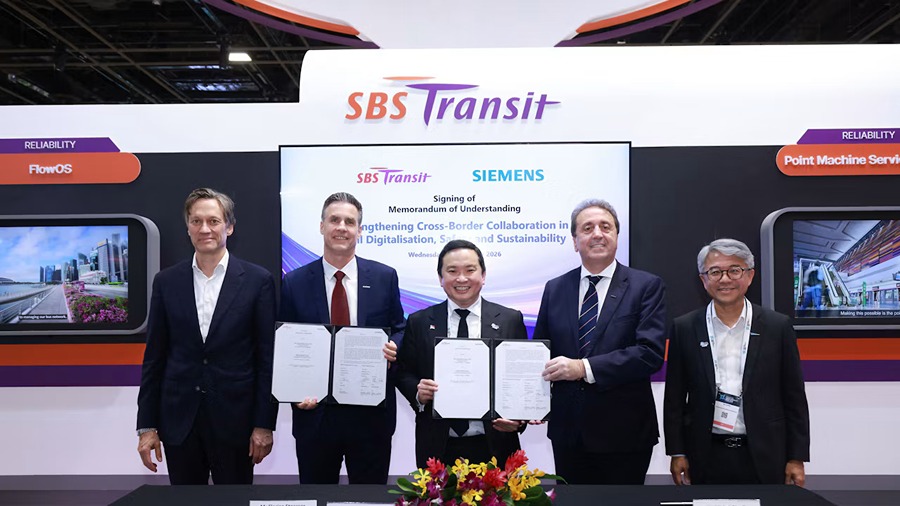 Signing ceremony at SUMW 2026 in Singapore, left to right: Mr. Michael Peter of Siemens Mobility; Mr. Florian Stoesser, Siemens Mobility Asia-Pacific Finance Director; Mr. Jeffrey Sim, Group CEO of SBS Transit Ltd; Mr. Michel Obadia, Siemens Mobility Asia-Pacific Managing Director; and Mr. Cheng Siak Kian, Managing Director and Group Chief Executive Officer of ComfortDelGro Corporation.
How should you read a signing photograph before calling it a win?
CompanyWatch treats ceremony announcements as raw data, not conclusions. Run these six steps on any rail or infrastructure signing — including this one — before it enters a model, a pitch or a competitor brief.
- Classify the instrument. A memorandum of understanding has no delivery obligation; a contract award does. Here that splits the news 2:1 — two MoUs, one set of signalling contracts.
- Name the payer. Siemens did not contract with a transit agency in Taiwan; it was awarded by ST Engineering's Urban Solutions business acting as turnkey contractor. Public reporting on the August 2026 turnkey awards put the Brown Line package at roughly $840 million and the Green Line extension package at roughly $750 million (stengg.com), so signalling is only one slice of a much bigger scope — never book the headline contract value against one subcontractor.
- Draw the scope boundary. Interlocking, ATO, ATS, platform interfaces, depot systems and power feed can sit with different suppliers. Siemens' own release on the two Taoyuan projects stresses "advanced digital signaling technologies, including GoA4 fully automated train operation and ATS" (press.siemens.com) — useful, but silent on who owns the rest.
- Anchor the calendar. Trade coverage of the turnkey awards places the start of works in the fourth quarter of 2026, while Taoyuan's wider rail plan points to the Green Line extension reaching Zhongli around 2031 and the Brown Line opening in 2032 — dates that slip routinely in metro programmes.
- Price the service tail. Signalling is the entry wedge into 15-20 year lifecycle economics. Singapore shows the pattern: Cross Island Line's Trainguard CBTC signalling and electrification contracts were awarded in 2023, and Downtown Line's Long-Tern Service Support running through 2047 was awarded in 2025. The award is the wedge; the annuity is the prize.
- Test the local-capability claim. MoUs promising technology transfer only become observable through hiring, certification schemes and supplier qualification. If no headcount or facility appears within a year, downgrade the partnership to a marketing artefact.
What is Signaling X and why did the two Taoyuan lines select it?
Definition sentence: Signaling X is Siemens' software-defined signalling platform, which centralises safety-critical functions such as interlocking and train control (including ATO and ATS) on a common computing platform instead of dedicated hardware per function. Siemens markets the urban-rail variant with claimed benefits of roughly 20% efficiency gains and 15% cost savings (mobility.siemens.com) — vendor metrics that should be treated as targets, not verified project outcomes.
The published project geometry explains why Taoyuan is an interesting reference. Siemens will deliver signalling for an approximately 11-kilometre Brown Line with eight stations in both underground and elevated configurations, and for the 7.2-kilometre, five-station Green Line extension running west from Bade toward Zhongli (press.siemens.com; stengg.com). Two lines, one platform, GoA4 automation — that is a repeatable software deployment rather than two bespoke hardware builds, which is exactly what a supplier wants for reference selling.
Why the Taiwan awards matter more than the MoUs
At company level, this is a pipeline-quality story rather than a headline-size story. Siemens reported a record order backlog of €132 billion at the end of the third quarter of fiscal 2026 (press.siemens.com), and its CFO told investors in November 2025 that Mobility entered fiscal 2026 with an order backlog of about €52 billion. Against that base, two metro signalling packages are immaterial to group earnings but material to one specific question: whether the software-defined platform can win outside its home markets.
The sequencing also tells a disciplined BD story. The contract signings follow an earlier MoU signed in Berlin during InnoTrans 2026 — a memorandum-to-contract conversion in roughly one trade-fair cycle, achieved because ST Engineering needed a signalling partner that could align with its own turnkey delivery model and local expertise. For competitors, the read-across is uncomfortable: the integrator, not the agency, is now the customer to persuade.
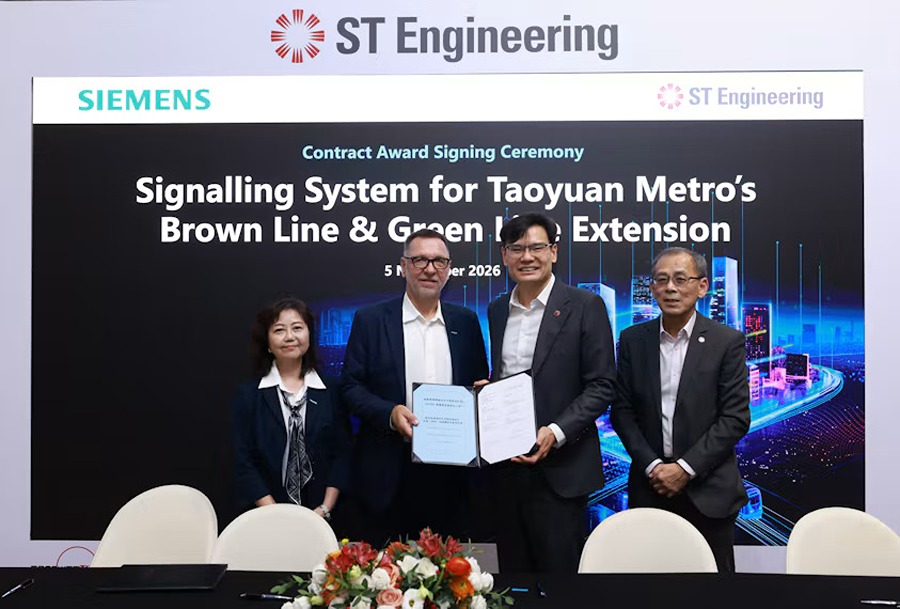 The Taoyuan contract signature: Ms. Georgia Shih, Finance Director of Siemens Mobility GmbH Taiwan Branch, and former Managing Director Mr. Thomas Stein, with Mr. Gareth Tang, President of Urban Solutions at ST Engineering, and Mr. Koh Chan Tia, Head of Global Sales, Urban Solutions — for Signaling X deployment on the Brown Line and Green Line extension.
How does this fit the wider Asia-Pacific delivery map?
Siemens positioned the SUMW 2026 signings as evidence of an established regional presence. Recast as a positioning table rather than a press list, the portfolio reads as a set of beachheads by technology type.
| Market and city | Project and instrument | Signal year | Practical read | |
|---|---|---|---|---|
| Hanoi, Vietnam | High-speed rail lines development contract in Vietnam covering rolling stock, electrification, communications and signalling solutions | 2026 | Widest scope in the set; an entry ticket to a national high-speed programme | |
| Sydney, Australia | First metro train delivered to Australia since 2006 for Sydney Metro – Western Sydney Airport, plus the first deployment of Railigent X in 2026 | 2026 | Hardware plus data-analytics attach: the reference sale is the software, not the vehicle | |
| Kuala Lumpur, Malaysia | Trainguard MT enabling GoA4 driverless operations on the LRT3 Shah Alam Line in 2026 | 2026 | GoA4 on a suburban LRT in Malaysia proves the platform outside heavy metro | |
| Singapore | Cross Island Line Trainguard CBTC signalling and electrification awarded in 2023; Downtown Line Long-Tern Service Support through 2047 awarded in 2025 | 2023 / 2025 | The clearest annuity model in the region: new build, then decades of lifecycle support | |
| Bangkok, Thailand | MRT Orange Line with 32 new metro trains, signalling solutions, systems integration and long-term maintenance; Northern Thailand Double-Track railway signalling contracts awarded in 2024 | 2024 | Thailand pairs metro rolling stock with conventional mainline signalling exposure in the north of Thailand | |
| Jakarta, Indonesia | Signalling supporting safe and reliable automated operations on Jakarta's Jabodebek LRT network, in revenue service since 2023 | 2023 | Indonesia offers in-service proof rather than a promise — the strongest sales asset of the six |
Which misreadings inflate announcements like this?
- "MoU equals signed revenue." The two Memorandums of Understanding (MoUs) create no delivery obligation and no order intake; only the signalling contracts do.
- "The award value is the supplier's value." ST Engineering's turnkey packages cover project management, integration and multiple systems; a signalling subcontract is a fraction of that figure.
- "GoA4 means driverless today." Grade of Automation is a capability of the signalling system; it goes live when the line opens, not when the contract is signed.
- "The operator is the buyer." In Singapore the infrastructure owner is the Land Transport Authority; operators such as SBS Transit contract service and capability frameworks, which changes how you forecast margins.
- "One more market entry means share gain." Competitors are quoting against the same turnkey integrators in Taiwan and Southeast Asia, so local capability clauses and lifecycle pricing decide wins more than technology claims.
What should CompanyWatch track next — action recommendations
Five concrete actions, each with a trigger you can verify without proprietary data:
- File the conversion clock. Record Berlin's InnoTrans 2026 MoU as t-zero and the SUMW 2026 signing as conversion; use that 12-to-18-month cadence to forecast when a current memorandum in another market becomes an order.
- Separate order intake from annuity value. When Siemens reports Asia-Pacific infrastructure wins, split new-build signalling from Long-Tern Service Support-type agreements; the 2047 Downtown Line horizon is the template for judging quality.
- Mine the operator's disclosures. SBS Transit runs the North East Line, Downtown Line and the Sengkang-Punggol LRT; ComfortDelGro's FY2025 reporting put group rail ridership at 448.7 million passenger-trips, up 1.7%, with the Downtown Line alone at 2.79 million train-km. Asset intensity is what makes a diagnostics-and-repair MoU valuable — the LTA network context is a 240 km system with more than three million daily rides (lta.gov.sg).
- Watch the delivery trigger. Works starting in Q4 2026 on the Taoyuan packages are the first hard signal; slippage there will show up in supplier guidance before it shows up in Taoyuan's opening dates.
- Benchmark before you quote. Treat the Signaling X efficiency and cost-savings figures as vendor targets until an operator publishes post-opening performance — a useful caution for anyone bidding against the platform or buying into it.
Frequently asked questions
Are the two MoUs legally binding contracts?
No. A memorandum of understanding records intent. The enforceable commercial items in this news set are the signalling contracts awarded by ST Engineering's Urban Solutions business to Siemens Mobility GmbH Taiwan Branch for the Brown Line and the Green Line extension.
Why did Siemens sign with both SBS Transit Ltd. (SBST) and SBS Transit Mobility Ltd. (SBST-M)?
The entities separate asset engineering from innovation work. The first memorandum concentrates on technology transfer, diagnostics and repair for local engineering capability; the second MoU is a framework for digitalisation, safety, sustainability and cross-border rail initiatives.
What is the near-term financial effect of the Taoyuan awards?
Modest at group level against Siemens' €132 billion order backlog at the end of Q3 fiscal 2026, but positive for the Mobility infrastructure business in Asia-Pacific and for the reference value of Signaling X in Taiwan and neighbouring metro markets.
What single indicator best tests whether these partnerships are real?
Local hiring and qualification output under the SBST capability framework within the next twelve months, and a named pilot emerging from the SBST-M innovation framework. Absent either, the MoUs remain announcements.
CompanyWatch verdict: the durable signal in this news is not the volume of paper signed in Singapore, but who pays. Siemens is increasingly selling to the turnkey integrators who assemble metro systems for others, which makes local engineering capacity and lifecycle economics the decisive purchase criteria. That is the axis to watch as Asia-Pacific's next wave of metro programmes moves from memorandum to contract.
Reference sources
- Siemens press release on the Taoyuan Signaling X awards — press.siemens.com/global/en/pressrelease/siemens-upgrade-taiwans-taoyuan-metro-signaling-x-technology
- Siemens Mobility, Signaling X product and urban-mobility reference pages — mobility.siemens.com
- ST Engineering newsroom, Taoyuan Brown Line and Green Line Extension turnkey contracts — stengg.com
- SBS Transit, Downtown Line collaboration announcement with Siemens Mobility — sbstransit.com.sg
- Siemens AG quarterly results, order backlog — press.siemens.com
- Singapore Land Transport Authority, MRT/LRT network overview — lta.gov.sg
- Singapore Urban Mobility Week 2026 event information — sgurbanmobility.com