
GlobalBizSight CompanyWatch Playbook: Six Checks for Reading Sociolla's Singapore Debut at Funan and Bugis Junction
The counter-intuitive number behind this launch is not a beauty statistic. In August 2026 online transactions were only 15.7% of Singapore's estimated S$4.5 billion monthly retail sales, which means roughly 84% of consumer money still changed hands across physical counters. Over the same month cosmetics, toiletries and medical goods grew 11.2% year-on-year while total retail crept up 0.7%. An online-born retailer adding shelves is chasing conversion, not fleeing the internet.
This CompanyWatch note is written as a working guide rather than a news recap: what has actually been placed on the shelf, what the headline arithmetic conceals, and the checks and traps that tell you within two quarters whether the Singapore experiment is a beachhead or a billboard.
What has actually changed, and what a third party can verify
Conclusion first: the event is a channel insertion, not market building. Demand in this category was already expanding before the doors opened; what changed is who owns the shelf space.
| Claim | What was disclosed | Where to check it |
|---|---|---|
| Store count | first two Singapore stores, at Funan and Bugis Junction | Mall tenant directories; company statements |
| Assortment | more than 130 beauty brands, across skincare, makeup, personal care, fragrance and wellness | Store visit plus the retailer's own site |
| New to market | more than 40 brands reaching Singapore consumers for the first time | Health Sciences Authority cosmetic notifications |
| Installed base | more than 200 stores across Indonesia, plus a presence in Vietnam | Company disclosures; regional trade press |
| Category tailwind | 11.2% year-on-year and 8.4% month-on-month in August 2026 | Singapore Department of Statistics monthly retail series |
The assortment splits into two tiers: established international names — JUNG SAEM MOOL, LANEIGE, COSRX, Laka and Round Lab — sitting beside Indonesian labels Rose All Day, HMNS and SAFF & Co, plus Australian skincare brand Sukin.
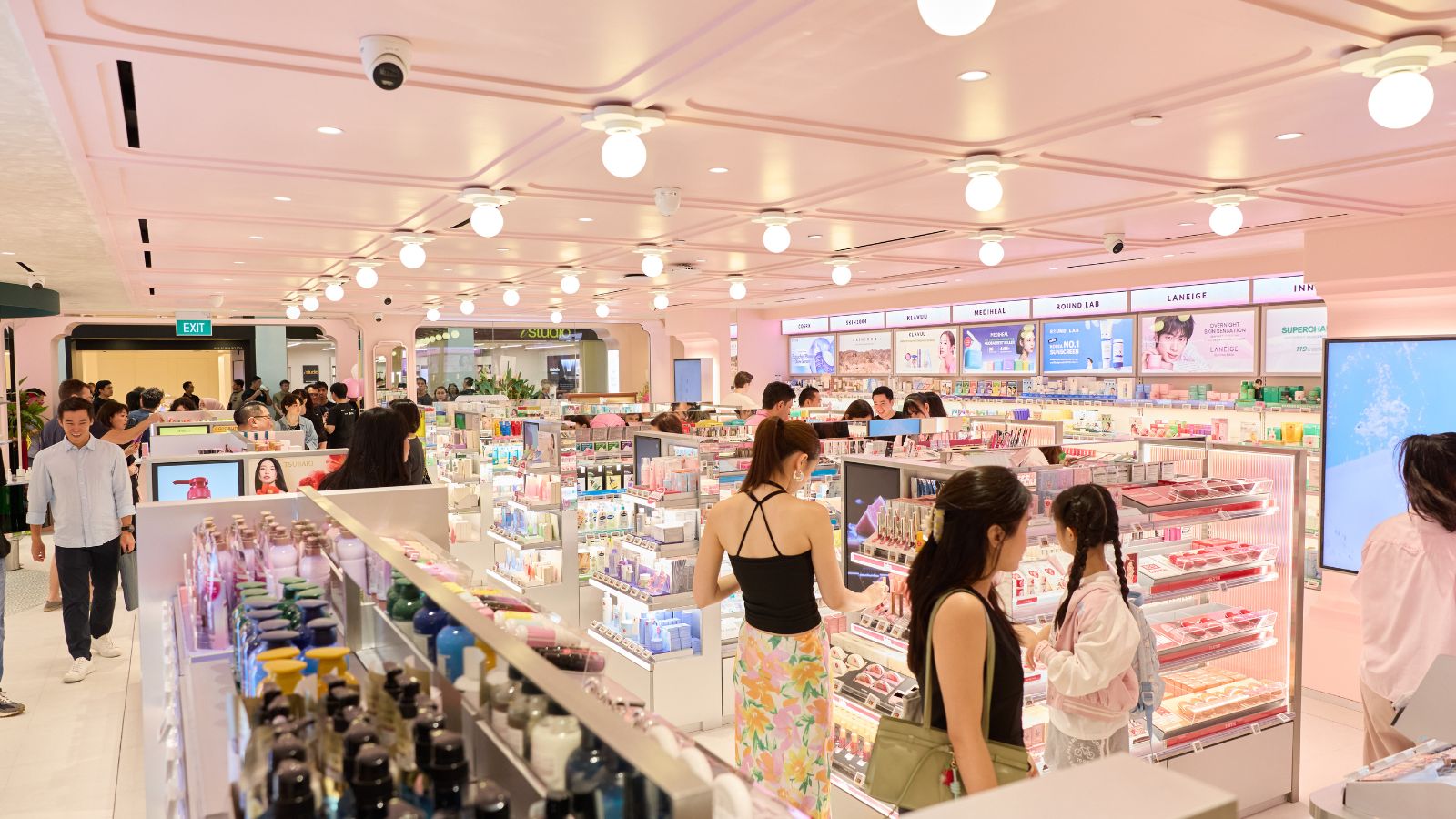
The corporate spine matters for tracking purposes. Social Bella was founded in 2015 and has built an integrated beauty and personal care ecosystem in Indonesia spanning the platform SOCO, the lifestyle publication Beauty Journal, the omnichannel retailer Sociolla and the mother-focused ecosystem Lilla. Its step into Vietnam in October 2020 was its first international market entry; Singapore is the second one, six years later.
Why physical counters, and why this market?
Because the pressure point in beauty retail is acquisition cost, not appetite. Customer acquisition cost (the cash burned to land one buyer) has compressed online margins for vertical e-commerce everywhere; sales per square foot (revenue divided by retail floor area) is the offline equivalent that decides whether a lease is accretive. Two stores in central Singapore are cheap enough to test that math and visible enough to work as branding.
For Christopher Madiam, co-founder and CEO of Social Bella Indonesia, the pitch is curation arbitrage: spot a brand before it goes mainstream, then sell it where shoppers already pay for discovery. “Singapore is where Asia’s beauty trends get tested. Consumers here are well travelled, well informed and always looking for what’s next. Over the past decade in Indonesia, we’ve learned to spot the brands people will love before they go mainstream. We’re bringing that curation to Singapore, including more than 40 brands that have never been available here before,” he said.
Cost is the discipline here. Knight Frank's Q3 2026 retail bulletin put the island-wide average gross rent for prime retail space at S$29.20 per square foot per month, up 0.7% quarter on quarter — firm, but not the Orchard Road peak figures that kill small-format beauty pilots. Read as analysis rather than company guidance: at that benchmark, a two-store footprint is a controllable experiment, and the marketing value of being photographed in a mall probably offsets part of the rent line.
The stated omnichannel design is browse online, experience in store, then repurchase through the app — the model the CEO credited for the group's rise in a February 2026 Nikkei Asia interview on its ambition to reach 500 stores across ASEAN.
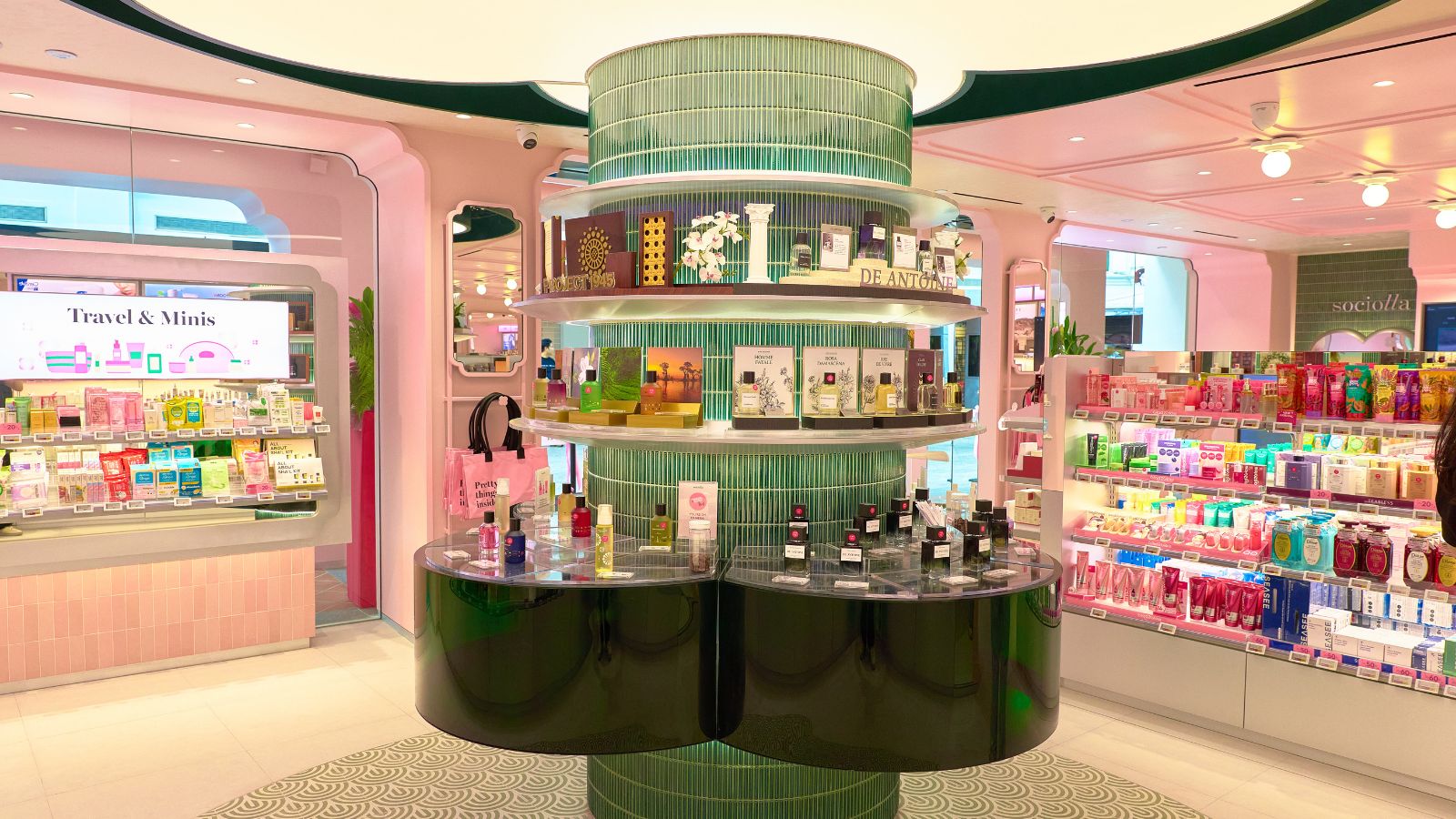
Madiam framed the two outlets as a starting position: “Funan and Bugis Junction are just our first steps in Singapore. We’ll keep bringing in new brands, especially from Indonesia and Southeast Asia’s fast-growing beauty scene, so there’s always something new to discover every time customers walk into a Sociolla store.”
Who is behind the counters: the capital and governance read
The Singapore push did not arrive out of nowhere. DealStreetAsia and MarketsGroup reported in December 2025 that growth investor General Atlantic took a controlling stake in Social Bella (reported at 53.3% in Nikkei Asia's coverage), in a transaction that Global Cosmetics News said valued the business at around US$595.5 million; L Catterton had already made a strategic investment in the group in May 2021. A majority private-equity owner with an exit clock is the most economical explanation for the pace of this rollout — a foreign flagship is a credibility asset for a holding company that eventually needs a story about regional scale, not only about Jakarta density.
Supply-side pressure reinforces it. Indonesian cosmetics exports rose 13.7% to US$473.8 million in 2025, according to industry reporting on government export data, which is exactly the kind of push that turns a domestic retailer into a distribution gateway for homegrown brands.
Six checks to run before you accept the expansion story
- Compare the category with the base. Pull the Singapore Department of Statistics monthly retail series and read the 11.2% year-on-year cosmetics print against total retail growth of 0.7%. A category leader growing off a flat base is a share story, not a spending story.
- Find the local entity. Under Singapore's Health Sciences Authority rules, the Responsible Person — a company locally registered with ACRA, which can be the importer, manufacturer, distributor or retailer — must notify every cosmetic product online before it is supplied, and that notification is valid for one year and must be renewed (official guidance on the control of cosmetic products). No local registrant, no compliance pipeline.
- Count notifications, not press-release brands. more than 40 brands said to be new to Singapore should each resolve to product-level filings. A retailer that cannot show notification coverage is quietly selling parallel imports.
- Test authenticity claims. The company says every product is sourced through official brand or distributor channels; verify by checking which of the names on shelf were already distributed by incumbent Singapore players.
- Price the floor. Benchmark rent per square foot against the sales per square foot you would need to break even, using published prime-retail averages rather than negotiated rates you cannot see.
- Use the company's own history as the discount rate. Its prior overseas market, Vietnam, was entered in October 2020 and still sits at a small footprint relative to more than 200 Indonesian stores. Six years to a second country is the realistic tempo to underwrite.
The same evidentiary bar applies here as to any distribution story we cover: a channel partnership read is only as strong as its restock cadence, not its launch photograph.
Four traps in reading the launch
- Confusing breadth with exclusivity. more than 130 brands on a shelf is assortment, not rights. The defensible number is how many the retailer controls, and the company's own strongest position is at home: as of June 2026, local products accounted for 55% of its assortment, spanning more than 180 local brands and 6,000 active SKUs, with local brands making up almost 99% of its fragrance offering.
- Treating a two-store pilot as a rollout. The plan and the proof are different line items until the third and fourth outlets appear.
- Reading campaign volume as market share. The annual “Love local” programme, first run in 2021, reached its 2026 edition under the theme “100% cantik Indonesia” from 16 July to 19 September; it strengthens supplier relationships in Indonesia but does not itself move Singapore sales.
- Ignoring the cannibalisation line. If app users now buy in store, blended contribution may not improve at all — the offline counter simply captures demand the platform already owned. Makeup, fragrance and skincare are the three highest-demand categories on the platform, so overlap is likely.
What to watch next: indicators and triggers
| Indicator | Trigger to watch | What a good read looks like |
|---|---|---|
| Store count outside Indonesia | A third or fourth Singapore opening, or a named third country | Repeatable format, not a one-off flagship |
| Singapore category growth | Monthly retail releases for the last quarter of 2026 | Cosmetics holding above total retail, as in August 2026 |
| Portfolio refresh | Indonesian and regional brand additions in Singapore | Local-brand mix rising outside fragrance |
| Ownership and funding | Capital disclosures or IPO preparation by the majority shareholder | Store growth funded by equity, not by supplier credit |
Questions analysts ask first
Is this a demand signal or a supply signal?
Predominantly supply. Demand was already running ahead of the market at 11.2% year-on-year in August 2026 and 8.4% month-on-month; what Singapore adds is a high-trust price point for Indonesian brands that need proof before they can export at scale.
How many stores are enough to matter?
Two is a research budget, not a business. Watch for a fourth outlet and for disclosed Singapore revenue within two quarters; anything else is brand theatre.
Does omnichannel mean anything operationally here?
It should mean one inventory pool, one price and one loyalty record shared between the site and the counters. If those diverge, the store is a discount channel dressed as an experience.
What would change our mind downward?
Assortment churn without new local brands, rent rising faster than footfall, or a majority owner pushing growth funded by trade credit rather than equity.
One reminder for investors
Two well-photographed stores in Funan and Bugis Junction prove that Sociolla can ship its curation model; they do not yet prove that the model earns its rent outside Indonesia — underwrite the second country by its sales per square foot, not by its brand count.
References and verifiable sources
- Singapore Department of Statistics, Monthly Retail Sales Index and Food & Beverage Services Index, August 2026 — https://www.singstat.gov.sg/news/monthly-retail-sales-index-and-food-beverage-services-index-aug2026
- The Straits Times, "Singapore's retail sales up 0.7% in August 2026" (S$4.5 billion total, 15.7% online share) — https://www.straitstimes.com/business/singapores-retail-sales-growth-rose-0-7-per-cent-in-august-2026
- Health Sciences Authority, Guidelines on the Control of Cosmetic Products — https://file.go.gov.sg/guidelines-on-the-control-of-cosmetic-products.pdf
- Knight Frank Singapore, Q3 2026 Retail Report (prime retail S$29.20 psf per month) — https://www.knightfrank.com.sg/research/reports/singapore-retail-market-update-531/contentassets/q3-2026-retail-bulletin_final.pdf
- Nikkei Asia, "Indonesian beauty retailer Sociolla eyes 500 stores and ASEAN expansion" (February 2026) — https://asia.nikkei.com/spotlight/asean-money/indonesian-beauty-retailer-sociolla-eyes-500-stores-and-asean-expansion
- DealStreetAsia, "General Atlantic acquires majority stake in Indonesia's Sociolla" — https://www.dealstreetasia.com/stories/general-atlantic-sociolla-467334
- Global Cosmetics News, "Indonesia Targets Cosmetics Export Growth as Local Industry Expands" (exports +13.7% to US$473.8 million in 2025) — https://www.globalcosmeticsnews.com/indonesia-targets-cosmetics-export-growth-as-local-industry-expands/
Written by Felix Allen, Enterprise Technology Advisor, GlobalBizSight. For questions about this CompanyWatch note, contact info@globalbizsight.com.