
CompanyWatch: STMicroelectronics' Unified STM32 Platform — How STM32A, STM32G5 and STM32H7P Stack Up for Buyers
By Marc Hale · GlobalBizSight CompanyWatch — one company tracked closely: what changed, what it costs, and what to watch next.
Short answer: STMicroelectronics is no longer asking engineers to buy a part; it is asking them to commit to a platform. Read functionally, the STM32 expansion splits by constraint — STM32G5 where digital power and motor control dominate, STM32H7P where on-device inference decides the architecture, and STM32A where automotive and certified safety rules apply. For investors, the same move recasts ST's embedded franchise as an ecosystem and tooling business competing for cloud AI and physical AI budgets.
The reset was presented at STM32 Summit 2026, a free online keynote staged on 3 November 2026 and listed on ST's own events calendar (st.com).
What actually changed at STMicroelectronics?
The change is strategic before it is electrical: ST has declared a unified STM32 microcontroller platform spanning industrial, automotive, and robotics applications, and is asking customers to judge continuity rather than peak specifications.
“There are two rapidly growing markets today, cloud AI and physical AI, and it is our duty at ST to make sure that the STM32 platform will be the king of the microcontroller market in cloud AI and physical AI,” said Remi El-Ouazzane, president, microcontrollers, digital ICs, and RF products group at STMicroelectronics, answering a query posed by EE Times at ST's global press briefing.
Maria Erez, executive VP of STMicroelectronics' embedded processing subgroup, describes the same decision in reuse terms: the platform is meant to let customers carry existing software, development expertise, and manufacturing investments across product generations and application domains. The announced building blocks are:
- STM32A — automotive and high-safety MCU portfolio;
- STM32G5 — new mixed-signal MCU series aimed at digital power and motor control;
- STM32H7P — high-performance MCU combining a Cortex-M7 core with ST's proprietary NPU;
- redesigned edge AI development tools;
- STM32Cube for agentic AI — tooling that puts AI agents inside the firmware workflow.
Convergence, in El-Ouazzane's reading, is already running across automotive, industrial and other domains in AI, security, safety, connectivity, sensing, and control, which opens the chance to reuse common technologies and expertise.
“Across many applications, the challenge for customers and developers is shifting from selecting a single device to finding ways to reuse software, tools, architectures, and engineering expertise across multiple products and evolving requirements,” El-Ouazzane said.
His summary is blunt: “In other words, the value is shifting from the individual MCU to the broader platform surrounding it.”
ST extends that logic to systems able to perceive, make decisions, and act autonomously in the physical world — industrial equipment, automotive systems, robots. The requirements they share (connectivity, real-time control, safety, security, software lifecycle management) are the reason one platform can serve them; the certification regimes they do not share are the reason the families stay distinct.
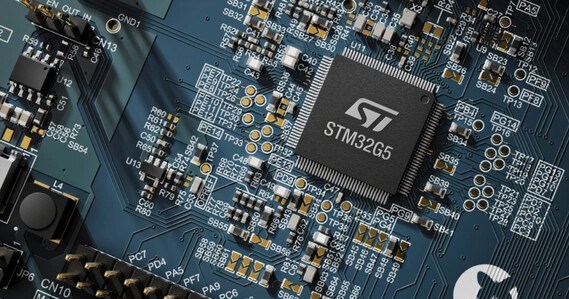
Source: STMicroelectronics
STM32A vs. STM32G5 vs. STM32H7P — which family fits which build?
Conclusion: pick by the binding constraint of the system, not by the family name. Power density points to STM32G5, model execution points to STM32H7P, and a safety case points to STM32A.
| Dimension | STM32A (A4 / A5 / A9) | STM32G5 | STM32H7P |
|---|---|---|---|
| Engine | Cortex-M cores shared with the wider STM32 platform | Arm Cortex-M33 at 280 MHz | Cortex-M7 plus ST's proprietary NPU |
| Design centre | A4: entry-level automotive local control nodes and safety systems; A5: mid-range safety-critical work in industrial automation, robotics, energy systems and automotive; A9: safety-critical multi-domain control needing real-time control, low latency, Ethernet and deterministic communication | Digital power and motor control: data centers, robotics, photovoltaic installations, wind turbines, industrial drives, commercial drones | On-device inference inside a control loop, such as solar inverter protection |
| Headline claim | Continuity of the STM32 platform into automotive and high-safety markets | Twice the compute performance of the STM32G4 series, and the first MCU with ST's enhanced 12-channel high-resolution timer | One MCU replacing several, with AI acceleration |
| Status | First three devices sampling; broader availability planned by ST in 2027 | Now in production; dual-core products planned for 2027 | Volume production in early 2027 |
| Safety / security lever | Automotive assessed under ISO 26262 and its ASIL levels; industrial uses different standards | Arm TrustZone, immutable root of trust, post-quantum cryptography libraries, target of Platform Security Architecture (PSA) Level 3 certification | AI runtime inside a certified control path (details to be confirmed at production release) |
The automotive and safety line
STM32A extends the platform into automotive and high-safety systems, with its first three devices sampling to customers and broader availability planned by STMicroelectronics in 2027.
“This is about continuity,” Erez said. “STM32A is not a separate story. It is an extension of the STM32 platform strategy, which we plan to continue and expand.”
Both STM32 and STM32A are supported by the STM32Cube ecosystem. Process technologies and intellectual property — Cortex-M cores, timers, clock sources, analog components, and power management — can be reused across domains, but safety certification requirements still differ by market: industrial and automotive products must meet different functional safety standards and qualification requirements, with automotive applications commonly assessed under ISO 26262 and its Automotive Safety Integrity Levels (ASILs).
Manufacturing continuity is part of the pitch: future STM32 products will be built on ST's 40-nm flash technology and 18-nm fully depleted silicon-on-insulator (FD-SOI) technology with embedded phase-change memory, supplemented by TSMC's embedded non-volatile memory (eNVM) technologies. Customers choosing its Stellar automotive MCUs or STM32A have different application requirements, the company said, and ST sees more automotive companies moving into humanoid robotics because functional safety and architecture overlap — a trend it expects to continue in the coming quarters and years.
The power and motor-control line
STM32G5 is already shipping. The mixed-signal series runs an Arm Cortex-M33 core at 280 MHz and, per ST, delivers twice the compute performance of the STM32G4 series.
“This new generation of microcontrollers addresses the challenge to meet the growing energy needs of AI data centers efficiently, realize more sophisticated humanoid robots, and power more complex motor-control systems,” said Patrick Aidoune, general manager, general purpose and automotive microcontrollers division at STMicroelectronics.
The load numbers ST cites are the reason this line matters commercially: GPU clusters are driving rack power toward 1 MW, and the largest data centers could demand more than 2 GW of peak power by 2030. STM32G5 is the first MCU with the company's enhanced 12-channel high-resolution timer, letting equipment makers reconfigure power supply units dynamically as server workloads change and handle the higher switching frequencies of supplies built with silicon carbide (SiC) and gallium nitride (GaN).
Robotics is the second market. Robotics company Ruiyan Intelligent is using the STM32G5 in its next-generation robotic hands. “In humanoid robotics, dexterity depends on combining strength, precision, sensing, and real-time control in an extremely compact space,” said Paul Tian, CEO of Ruiyan Intelligent.
On the silicon itself, the series includes a programmable logic array, PLAy, for custom hardware functions on chip. Security covers Arm TrustZone, an immutable root of trust for secure boot and firmware updates, and support for ST's post-quantum cryptography (PQC) libraries, with the device targeting Platform Security Architecture (PSA) Level 3 certification. With 64 Kbytes to 512 Kbytes of on-chip flash and packages from QFN32 to LQFP128, STM32G5 devices start at $1.034 for orders of 10,000 pieces. ST plans to add dual-core products to the series in 2027.
The inference line
Combining a Cortex-M7 core with ST's proprietary NPU for AI processing, the STM32H7P will enter volume production in early 2027. Aidoune said one alpha customer working on solar inverters moved from managing arc-fault circuit breakers across four panels to 20 panels using a single MCU — the clearest evidence so far that accelerators change system cost, not just benchmark tables.
CompanyWatch verdict (our analysis, not ST guidance): choose STM32G5 when switching losses and control-loop timing set the bill of materials; choose STM32H7P when a model must run inside the control path today and you can wait for early 2027 volume; choose STM32A when an ASIL or industrial safety case has to be signed off, because in that workload the platform story does not shorten the certification path.
Is the platform argument stronger than rival silicon?
Conclusion: on raw accelerator numbers ST is not the outlier; on installed developer base it is.
Rivals are pushing compute harder. Renesas shipped its RA8P1 group — the company's first 32-bit AI-accelerated MCUs — around a 1 GHz Arm Cortex-M85 plus an Ethos-U55 NPU delivering up to 256 GOPS on a 22-nm process, announced in July 2025 (BusinessWire). NXP's MCX N54 pairs dual Cortex-M33 cores at 150 MHz with an eIQ Neutron NPU and an EdgeLock Secure Enclave (nxp.com). Neither is a safety-certified automotive part, which is exactly the gap STM32A is built to fill.
ST counters with the ecosystem. Nearly every claim at the summit was about reuse and community scale: some nearly 2 million unique developers use the STM32 ecosystem, Erez said, and the number of active users has grown by around 20% over the past three years; the company offers more than 400 pre-validated models and has supported more than 260,000 active projects with its AI tools over the past 12 months. ST said deploying AI models on MCUs depends far more on development tools than on computing power.
Through its longstanding partnership with Arm, ST says it will help define the future Cortex-M processor roadmap, aiming to set up a common foundation for embedded systems, with early access to Arm cores. STM32 has helped drive Cortex-M adoption, Erez said; ST said more than 100 billion devices use Arm Cortex-M cores, and it is working with more than 100 ecosystem companies through Arm's Total Design program for physical AI, announced in September. Arm said the program brings ecosystem partners together to accelerate development, with STMicroelectronics and Cadence as key partners. “Now, we want the entire industry to adopt it,” said a company spokesperson during the Q&A session, referring to the Cortex-M roadmap.
“The next major frontier for computing is bringing intelligence into the machines that move, manufacture, and operate in the physical world,” said Drew Henry, executive VP, physical AI at Arm.
Asked by EE Times China whether the industry is heading toward a computing power race, ST said its ecosystem will be its biggest differentiator, and it expects multicore architectures to become a trend within the cost constraints of the microcontroller category. Physical AI, the company defines, is a subset of edge AI: systems that perceive, decide, and act in the physical world, with actual movement through components such as joints and actuators — and it says this is where convergence between automotive and industrial applications is strongest.
“The industry needs less fragmentation and a stronger focus on helping MCU technologies converge around a common foundation, while maximizing software reuse,” El-Ouazzane said.
How does STM32Cube for agentic AI change the developer workflow?
Conclusion: this is the part of the announcement most likely to be felt before the new silicon is in volume.
ST began rolling out new and redesigned edge AI tools at the end of October: Model Zoo for finding models, Model Factory for customizing and optimizing models, Dataset Factory for organizing datasets, and tools for basic model testing on ST boards.
Through a model context protocol (MCP) server, STM32Cube for agentic AI gives AI agents access to STM32 knowledge, resources, and toolkits, while providing validated reference code plus STM32 code generation and review tools.
Aidoune framed the split against the company's assistant: “STM32 Sidekick helps answer developers’ technical questions, while STM32Cube for agentic AI integrates into the coding workflow itself,” he said.
El-Ouazzane was careful not to call it finished. ST needs to strengthen its MCU portfolio with single-core and multicore devices, different security levels, and different types of accelerators, peripherals, and memory, he said. “Today’s announcement of STM32Cube for agentic AI is a step in the right direction, but there is more we can do,” he said.
What does it cost — and does the strategy show up in ST's numbers?
Conclusion: unit pricing stays in commodity territory, so the economics depend on how many design wins the platform can lock in, especially in data centers.
On price, STM32G5 devices start at $1.034 for orders of 10,000 pieces, with 64 Kbytes to 512 Kbytes of flash and packages from QFN32 to LQFP128 — a bill-of-materials position that keeps the fight with rival MCUs close. Availability is staggered: STM32G5 now in production, STM32H7P in volume production in early 2027, and broader STM32A availability planned in 2027, with dual-core STM32G5 products also slated for 2027.
The financial backdrop was reported a few days before the summit. In its third-quarter 2026 results published on 29 October 2026, STMicroelectronics posted net revenues of $3.76 billion with a 37.3% gross margin and operating income of $367 million, and guided fourth-quarter revenue to a $4.15 billion midpoint; the company also raised its 2026 data-centre revenue outlook to about $1.3 billion from a July forecast of more than $1 billion (Reuters). Read against the 1 MW rack and 2 GW campus figures ST itself cites, STM32G5's data-centre targeting is a revenue-mix decision as much as a technical one.
Which regulatory tailwind did most coverage miss?
Conclusion: ST's security spec sheet lines up with European law, and that is a procurement filter, not a feature list.
The EU Cyber Resilience Act (Regulation (EU) 2024/2847) applies in full to products with digital elements placed on the European market from 11 December 2027, with earlier obligations already in force (European Commission). ST's own calendar shows the company briefing customers on it: a workshop on navigating the Act with STM32 security experts was scheduled for 29 October 2026, ahead of the summit (st.com events).
That timetable explains why STM32G5 leads with an immutable root of trust for secure boot and firmware updates, Arm TrustZone, post-quantum cryptography library support and a Platform Security Architecture (PSA) Level 3 certification target — the same artifacts a compliance officer will ask for, and the same ones a component swap rarely makes easy to re-create on another vendor's part.
Common misreadings of the STM32 reset
- “Unified platform means one chip everywhere.” Industrial and automotive products must still meet different functional safety standards and qualification requirements; automotive is commonly assessed under ISO 26262 and its ASIL levels.
- “Reuse removes migration cost.” What is reusable is software, tools, architectures and expertise; peripherals, memory size and package still have to be re-qualified in each end product.
- “NPU means ST wins the AI race.” ST itself said deploying AI models on MCUs depends far more on development tools than on computing power, and rival parts already post higher headline accelerator numbers.
- “The parts are not available yet, so nothing changes this year.” STM32G5 is in production now, and the tooling update began rolling out at the end of October — the near-term lock-in mechanism is software.
- “Automotive and robotics are separate stories.” ST reports automotive companies moving into humanoid robotics on shared functional-safety and architecture commonalities, and expects it to continue in the coming quarters and years.
CompanyWatch action list: what to track next
- Sampling-to-production conversion. Measure how many of the STM32A first three devices reach broader availability in 2027 on schedule; slippage would weaken the continuity claim.
- Dual-core arrival. STM32G5 dual-core products planned for 2027 will show whether ST answers the multicore challenge raised by EE Times China.
- Design-win evidence. The Ruiyan Intelligent robotic-hand program and the solar-inverter alpha customer are the only named proof points so far; more named wins are the real metric.
- Tooling adoption. Watch the trajectory of the more than 260,000 active projects figure and the roughly 20% growth in active users reported over the past three years.
- Data-centre mix. Track whether ST's about $1.3 billion 2026 data-centre revenue outlook keeps rising, since STM32G5's power-control pitch depends on it.
- Compliance clock. Map customer statements against the 11 December 2027 EU Cyber Resilience Act date; security certification may decide the shortlist before price does.
FAQ: quick answers for engineers and analysts
Is STM32A a replacement for Stellar?
No. ST says customers choosing its Stellar automotive MCUs or STM32A have different application requirements, and Erez positions STM32A as an extension of the same platform strategy.
Should a data-center power design specify STM32G5 today?
If your architecture needs dynamic PSU reconfiguration and high switching frequencies with SiC or GaN, yes: the series is in production, runs a Cortex-M33 at 280 MHz, and is the first MCU with ST's enhanced 12-channel high-resolution timer, with prices starting at $1.034 for orders of 10,000 pieces.
Does an NPU matter more than clock speed for embedded AI?
According to ST, deployment success depends far more on development tools than on raw compute — hence Model Zoo, Model Factory, Dataset Factory and STM32Cube for agentic AI. Renesas, for comparison, markets its RA8P1 on a 1 GHz Cortex-M85 plus 256 GOPS of NPU throughput.
What is the main risk in this strategy?
Execution timing. Two of the three headline families reach volume or broad availability only in 2027, and El-Ouazzane conceded there is more to do on portfolio breadth; competitors are not waiting.
参考来源之外的判断
This CompanyWatch piece is a comparative read, not company guidance. Product claims, quotes and figures attributed to STMicroelectronics, Arm, Ruiyan Intelligent and ST's executives come from ST's STM32 Summit disclosures and the master reporting by EE Times; market and financial context comes from Reuters, BusinessWire, the European Commission and vendor datasheets, and is used to test — not to overwrite — what the company said.
GlobalBizSight readers tracking this franchise should treat the STM32 platform as a switching-cost story: silicon decides today's design, the ecosystem decides the next one. Editorial queries and correction requests: info@globalbizsight.com.
Reference sources
- STMicroelectronics — STM32 Summit 2026 highlights
- Reuters — STMicro lifts data centre revenue forecast after Q3 profit beat (29 October 2026)
- BusinessWire — Renesas 1-GHz RA8P1 devices with AI acceleration (1 July 2025)
- European Commission — Cyber Resilience Act (Regulation (EU) 2024/2847)
- NXP Semiconductors — MCX N series with integrated NPU