
CompanyWatch Playbook: Six Steps to Read Apple's First Ternus Quarter — Price Hikes, a Memory Squeeze and a Margin Cliff
Corporate trackers rarely get a cleaner single-company test case than the document Apple put in front of the market on November 2 Pacific time. It covered fiscal Q4 2026, and it was the first earnings release signed off by John Ternus, who took the CEO chair from Tim Cook in September. The headline reads like a win; the arithmetic underneath reads like an invoice passed downstream. A few months ago, Tim Cook summed up the AI-datacentre-driven memory surge in one line: "This is a once-in-a-century flood." Ternus's debut quarter answers that line: the flood took the handset industry's volume, and Apple is standing above the waterline on a stack of price increases whose full effect has still not landed.
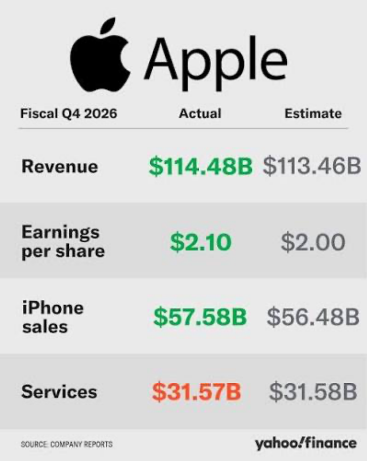
The scoreboard: what was actually reported
Fix the numbers first, interpret second. Revenue and profit come from Apple's own release for the quarter that closed on September 26; the unit and shipment lines come from IDC.
| Line | September quarter | Change | What it signals |
|---|---|---|---|
| Total revenue | $114.5 billion | up 12% year on year | above Wall Street expectations |
| Net profit | $30.7 billion | — | also above Wall Street expectations |
| iPhone revenue | $57.58 billion | up 17% year on year | a record for this quarter |
| iPhone shipments (IDC) | — | down 4% | growth did not come from volume |
| Total gross margin | 47.9% | against 47.2% last year | about 1 percentage point came from tariff refunds |
| Mac revenue | $10.79 billion | up 24% year on year | shipments down 11.3% |
| Greater China revenue | $17.54 billion | up 21% year on year | still about $1 billion short of consensus |
| December quarter revenue guide | growth of 7% to 10% | against 11.4% expected | softest guide in nearly five quarters |
| December quarter margin guide | 45% to 46% | against 48.2% a year earlier | two to three points lower |
Two of those rows explain most of the rest: revenue climbed while units fell, and management's own guidance points to a compressing margin. The market priced the second fact immediately — Apple shares dropped 3% in after-hours trading.
Step 1 — Decompose the revenue line into price and volume
Put Apple's revenue line next to IDC's shipment line and you get the single most useful ratio in the release. IDC counts devices shipped; Apple books sales into the channel, so the bases do not line up perfectly. Even allowing for that, iPhone revenue up 17% against shipments down 4% implies the average price had to move up roughly 22%. Independent work supports the inference: Counterpoint Research, which measures wholesale rather than retail prices, reported that iPhone's wholesale average selling price broke above $1,000 in a September quarter for the first time (counterpointresearch.com, 3 November).
Three mechanisms produced that. Before you judge how durable the growth is, name all three:
- the iPhone 17 Pro had already started $100 above its predecessor, and July and August this year were spent selling that dearer model;
- buyers kept migrating to Pro and to higher-capacity configurations, so the mix itself became more expensive;
- in early September, Apple raised prices across the entire iPhone range.
A discipline point belongs in the same breath: because Apple's fiscal quarter ends on September 26, the iPhone 18 Pro was on sale for only about 9 days inside it. Anyone extrapolating the full impact of the price ladder from a 9-day window is reading a partial quarter. The clean read of the increases arrives with the December print.
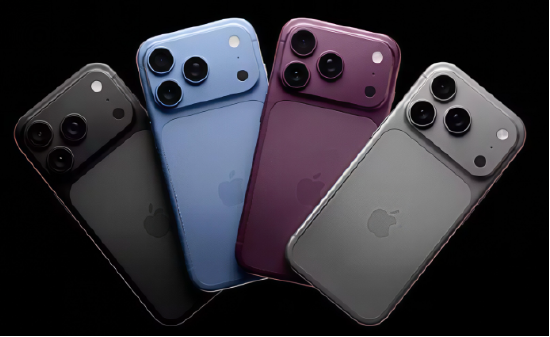
Step 2 — Map the new price ladder, then look for what is missing
At the September 9 event, nearly every iPhone in the lineup was repriced, and the pattern of the increases is as informative as their size.
- iPhone 18 Pro moved from $1,099 to $1,199; the Pro Max moved from $1,199 to $1,299.
- Capacity tiers were stretched hardest: the 1TB version rose $300, and the Pro Max 2TB version rose $500 to $2,499.
- Existing hardware followed: iPhone 17 went from $799 to $899, while iPhone Air, iPhone 17e and iPhone 16 each added $100.
- A foldable, iPhone Duo, arrived at $1,999, and the cheapest Plus model was deleted from the range.
Media tallies put the average increase for iPhones in the US at 13%. The omission matters more than the number: this autumn Apple shipped no affordable version at all — the iPhone 18 lineup came out as Pro and Pro Max only, with the standard iPhone 18 and the entry-level 18e deferred to spring next year. Analysts asked why on the call and Ternus did not answer it. From a company-watch standpoint that silence is the loudest strategic line in the document: Apple is choosing revenue per device over unit share.
Step 3 — Check who now holds pricing power upstream
Apple raised prices because it had limited room to do otherwise. Two years ago the company was the world's largest flash buyer, taking almost twice the volume of Microsoft, Amazon, Meta and Google combined — the four of them together. In negotiation it was domineering: it demanded "most-favoured-customer" terms so that nobody could obtain a lower price than Apple, and it reserved the right to audit supplier books. Suppliers accepted those "unequal terms" to keep the orders. More than a decade ago, Apple established that Micron had not been offering it the best price and collected damages worth tens of millions of dollars in arbitration. In 2023, flash fell to 5 cents per GB, the industry lost about $19 billion, and Apple still booked roughly $14 billion of gross profit from selling storage upgrades.
The leverage has flipped. Suppliers no longer have to accommodate Apple, because the AI build-out has created a buyer with deeper pockets: cloud groups now purchase flash at roughly twice Apple's volume, and Meta, Microsoft and Amazon have signed longer contracts at richer prices — deals Apple cannot match. TechInsights estimates flash prices rose about 4x in a single year. Apple will spend around $25 billion on flash this year against about $6 billion for the same volume last year. A Kioxia executive put it bluntly: he hopes the conditions of 2023 never come back.
Two external series are worth checking against that claim, and they are the reason this column treats memory as a quarterly indicator rather than background colour. Counterpoint, back in December 2025, expected memory prices to add roughly 40% through Q2 2026, lifting smartphone bill-of-materials cost by 8% to more than 15% (counterpointresearch.com). TrendForce's 30 September release then projected conventional DRAM contract prices up 10% to 15% quarter on quarter in 4Q26 and NAND flash up 15% to 20%, with enterprise SSDs up 23% to 28% (trendforce.com). Neither series is Apple-specific, but both move Apple's cost line with a one-quarter lag.
The industry ledger shows who absorbed the shock best. IDC data puts global smartphone shipments from July to September down 22% year on year, the largest fall on record, at 255.3 million units, and IDC now forecasts a record 16.7% full-year decline in 2026 with average selling prices up 27.6% to $581 (idc.com). Over the same period Apple only fell 4%, the smallest drop among the top five vendors, and its market share is once again closing in on Samsung. Less volume, higher price: the whole market is running the same experiment, and Apple is merely the best-capitalised laboratory.
Step 4 — See where the surcharge was placed, not only how large it was
The countermeasure was direct: move the bill to the customer. Ternus said in interviews that Apple raised prices "reluctantly", to offset rising component costs, and on the revenue line the objective was met. The distribution reveals intent. The steepest hikes hit the largest storage options — the quiet cash cow Apple has run for years, described in the industry as its "invisible money printer". According to media analysis, adding one storage step on the iPhone 17 Pro lifted Apple's cost from roughly $15 to roughly $66 while the customer was still charged $200 for it. Where input costs rose most violently, retail prices rose most violently too.

Step 5 — Strip the one-offs out of the margin bridge
This is where casual reads go wrong. Reported total gross margin of 47.9% looks better than 47.2% a year ago. CFO Kevan Parekh disclosed on the call that about 1 percentage point of that came from tariff refunds — and that the refunds have essentially finished running. Adjust for them and the quarter delivered about 46.9%, marginally below last year. Parekh added that, excluding the refunds, margin fell about 1 percentage point quarter on quarter, with memory pricing the main driver.
Mac makes the same point more sharply. Revenue of $10.79 billion, up 24%, was the strongest hardware line of the quarter, yet IDC put Mac shipments down 11.3%. A double-digit volume fall paired with a quarter-scale revenue jump can only come from price. Apple had already moved Mac and iPad prices in June, adding $300 to MacBook Pro; the first touchscreen MacBook Pro, unveiled last week, opens at $2,899.
China tells the identical story. Greater China revenue reached $17.54 billion, up 21%, and Ternus noted on the call that both the US and Greater China delivered strong double-digit growth and a record September quarter. Yet the figure was still about $1 billion below what Wall Street wanted. On units, IDC had China's smartphone market shrinking 15.4% in the third quarter while Apple shipments fell 4.3%. Apple's share moved from 15.8% to 17.8% because it declined less than everyone else, not because it sold more.
Step 6 — Test the demand side before extrapolating the price lever
Guidance is where the squeeze surfaces. Apple expects December quarter revenue growth of 7% to 10%, under Wall Street's 11.4%, the weakest outlook in nearly five quarters, with gross margin of 45% to 46% against 48.2% a year earlier — two to three percentage points lower, that is a margin path three percentage points away from last year's level — because memory costs keep climbing and Siri AI adds new cost lines. Shares were down nearly 3% after hours.
Price-led growth survives only while buyers accept it. So far iPhone customers have: Apple said replacement buyers in the September quarter hit a record, and active iPhone users reached an all-time high. iPad and wearables both missed expectations this quarter, which is the necessary counter-example — not every line can carry a higher sticker.
The new category is where demand outran supply. iPhone Duo preorders opened on October 16 and were gone within hours; delivery slots on Apple's own store still stretch to late January next year. Ternus said the company is pushing everything it can to put Duo units in customers' hands but could not say when supply will catch up with demand. Quality is the second wrinkle: users reported cracking on the inner foldable display, Apple acknowledged the issue is real but insisted that only "a very small number" of Duo devices came back over the screen, with direct replacements offered. For a $2,000 product in its first weeks, that is not a footnote. Duo went on sale on October 23 and therefore sits entirely outside this report. Its first full quarter is this year's holiday season.
Common mistakes when reading a price-led quarter
- Matching one tracker's units to Apple's revenue as if the bases agreed. Shipments, sell-in revenue and wholesale ASP are three different measurements. IDC counted global third-quarter shipments down 22%; Counterpoint counted down 20%. Pick one house and hold it across quarters.
- Confusing wholesale ASP with the shelf price. The $1,000-plus figure is what Apple books per unit into the channel, not what a consumer pays.
- Reading 47.9% as operating improvement. Remove the tariff-refund contribution and the honest number is about 46.9%.
- Extrapolating a 9-day product contribution. The iPhone 18 Pro barely appears in this quarter; the price ladder's full pass-through is still ahead.
- Assuming elasticity is uniform. The iPad and wearables misses show the portfolio is not one product.
- Treating memory as a one-quarter event. Contract-price forecasts still carry double-digit sequential increases into the holiday quarter, and Apple's own spend has gone from about $6 billion to about $25 billion.
- Assuming a unit recovery without a product. With no affordable version this autumn and the cheapest Plus removed, volume can only rebound if Apple re-enters a tier it has currently abandoned.
Action list: what to watch between now and the next print
- Track contract memory prices every quarter. TrendForce's DRAM and NAND ranges (trendforce.com) are the earliest public read on whether Apple's cost curve is still bending; a repeat of 15% to 20% sequential NAND gains would validate the 45% to 46% guide rather than beat it.
- Log iPhone Duo delivery lead times weekly. Shrinkage from late January next year toward a few days is the cleanest external proxy for the supply ramp; persistent six-to-eight-week waits mean the holiday story is capacity-capped, not demand-capped.
- Re-run the price-versus-volume ratio. If implied ASP premium keeps widening beyond roughly 22% while units stay negative, the company is harvesting pricing power rather than building installed base.
- Watch the entry-tier decision. Any sign the iPhone 18 and 18e stay on schedule for spring next year, and at what price, tells you whether Apple intends to recover share or defend margin.
- Separate the two Greater China signals. Share rising on a market shrinking 15.4% is resilience, not re-acceleration; measure it against the about $1 billion consensus gap.
- Price the new cost lines explicitly. Siri AI is now named alongside memory as a margin drag; ask each quarter whether that cost is one-off enablement or permanent operating expense.
- Treat foldable returns as a margin variable. Outright replacements on a $2,000 device land in cost of revenue, not marketing.
The call for GlobalBizSight CompanyWatch readers
Ternus's first quarter is not a verdict on his management; it is a snapshot of a company that still holds enough brand pricing power to convert an upstream cost shock into a revenue record. The exposure sits one layer down: the same quarter that delivered $114.5 billion of revenue also delivered guidance for a materially lower margin, a missing budget tier, and a flagship product whose supply Apple cannot describe catching up. Watch the memory contract series, the Duo lead times and the December margin print — if those three move the wrong way, the price lever that stood Apple above the waterline stops being a strategy and starts being the limit of one.