
Tesla's Cybercab Ghost-Ride Clip Is a Capacity Signal: A CompanyWatch Read on the Robotaxi Build-Out
Nineteen seconds of holiday footage rarely earns a company watch report. But when the vehicle in the frame has no steering wheel, no safety driver and a pair of plastic skeletons riding in the seats, a seasonal gag starts to behave like an operations disclosure. Read this way, Tesla's Halloween post tells investors, analysts and business-development teams where the company has been spending capital, regulatory goodwill and marketing effort across the past two quarters — and what still has to go right before that spending shows up in the accounts.
The underlying event is simple enough. Over the Halloween weekend, Tesla's official Robotaxi account published a short promotional film showing a yellow Cybercab cruising city streets after dark, its cabin washed in green ambient light with two skeletons sitting upright where passengers normally sit. The driving position looks vacant because the Cybercab has no steering wheel at all. The clip runs about 19 seconds, went live on a Friday evening, and was shot from a vehicle travelling alongside it.
The framing facts belong in the file before any interpretation. First, Tesla did not announce a Halloween mode, a software release or a new driving capability: the piece is seasonal marketing by the Robotaxi operating account. Second, earlier the same day that same account posted a message that amounts to a public-service pitch — "make a smart decision this weekend and take a Robotaxi home" — nudging party traffic toward driverless trips.
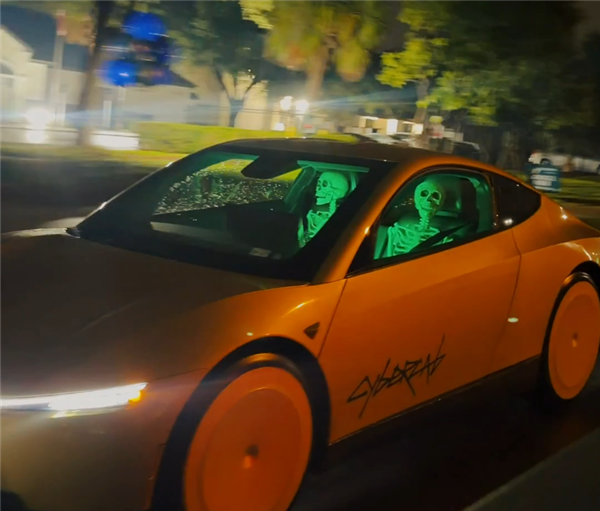
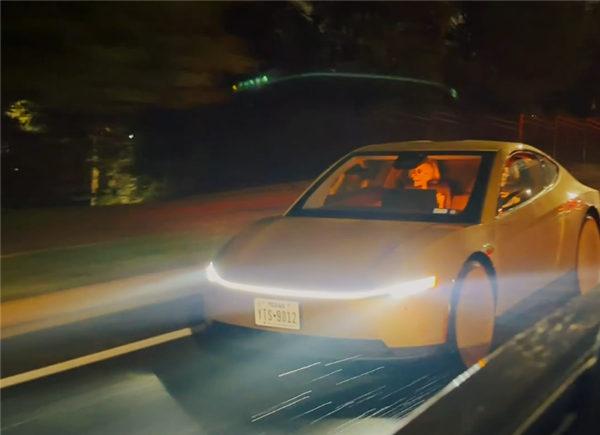
The commercial trail behind a seasonal joke
The clip matters because of everything arranged around it. A few days before the holiday, Tesla pushed its service cut-off from midnight out to 2 a.m., producing a daily operating window of 20 hours, from 6:00 a.m. until 2:00 a.m. the next day. Three product-level changes arrived in the same beat: a Share feature that lets riders share an in-progress trip; Calm Mode, which switches off the FSD visualisation display so the cabin feels closer to a lounge than to a machine; and a first ride for $0 promotion in Dallas and Houston.
Fleet counts point the same direction and move far faster. When Cybercab first appeared in Austin on June 22, only a handful of vehicles were on the road. By early October the fleet had passed 300 vehicles, an increase of 8 times within one month. By the end of October, Tesla's total Robotaxi fleet in Texas was approaching 1,000 vehicles, with Cybercab accounting for close to half of it. The industrial leg is the other half of the story: Dallas and Houston came online on April 18, and on April 25 Cybercab entered production at the Texas Gigafactory, where output is still ramping.
Why a night-time clip is a technical claim, not just a gag
The choice of darkness is substantive rather than cosmetic. Low-light perception, unpredictable road users around nightlife districts and the thinnest possible fallback coverage make night the hardest condition a driverless taxi can advertise. Tesla filmed exactly there instead of in daytime commuter traffic, and used a Halloween premise as the cheapest available wrapper for a difficult engineering claim: nobody asks a ghost story to file a validation white paper.
State-level law is what makes the claim possible in the first place. Texas formalised its commercial autonomous-vehicle regime in mid-2026: under the framework reported to have taken effect in late May, operators running driverless passenger services must hold authorisation from the Texas Department of Motor Vehicles (TxDMV), self-certify SAE Level 4 capability, satisfy accident-reporting and emergency-response information requirements, and can lose their permit if the state judges them a public threat. That framework also accommodates vehicles built without steering wheels or pedals — precisely the hardware the ghost-ride video showcases. The same agency now publishes an online registry of authorised AV vehicles by operator, which is why Texas fleet counts for Tesla and its rivals have become verifiable public data rather than company slides.
The constraint the video does not mention: federal vehicle rules
State permission is necessary but not sufficient. A car with no manual controls cannot satisfy Federal Motor Vehicle Safety Standards written around a human driving interface, so volume deployment of a steering-wheel-free Cybercab depends either on permissive state regimes such as Texas or on a federal exemption pathway. That pathway has now been precedented: in late July 2026 the National Highway Traffic Safety Administration (NHTSA) granted Amazon's Zoox the first commercial exemption from portions of eight FMVSS for a purpose-built robotaxi — a two-year temporary exemption covering up to 2,500 exempt vehicles per year — while also streamlining its Automated Vehicle Exemption Program and, together with the Department of Transportation, signalling work on a first federal robotaxi standard with SAE International.
Strategic reading: Tesla's Texas-centred growth is not accidental geography. It concentrates expansion where the law tolerates hardware that federal standards would otherwise block. The annual volume cap built into the exemption route, and the absence of any publicly granted FMVSS exemption for Cybercab in the materials reviewed here, are the items that decide whether this becomes a nationwide fleet or remains a Texas-plus-a-few-states fleet. Miami, where Robotaxi service is already listed, sits outside Texas and therefore depends on a different state rulebook.
What the money trail shows so far
Financial materiality is still thin, and models should keep it that way. Tesla's investor-relations calendar shows third-quarter 2026 results published after the market close on October 21, 2026. Third-party recaps of that report put quarterly revenue near $28 billion, non-GAAP earnings per share at $0.48 and free cash flow around $1.5 billion; recaps of the earnings call describe 2026 capital spending being trimmed from more than $25 billion to roughly $20 billion and redeployed toward the Robotaxi fleet, Optimus, solar manufacturing and AI compute. Those same recaps put the paid FSD base at about 1.74 million customers, describe attach rates above 75% for new North American deliveries, and quote the shareholder letter claiming nearly 2 million unsupervised miles for the Austin Cybercab fleet with zero injuries.
Set against that denominator, a 19-second holiday film costs almost nothing. The more useful signal is the disclosure mix itself: operating hours, trip-sharing, cabin ambience settings, $0 first rides and fleet tallies read like a company marketing a service in a pre-revenue phase, not a carmaker moving units. That is the honest description of Robotaxi in today's accounts — a strategic option being funded through capital expenditure and validated with engagement metrics rather than with a reported revenue line.
Company fact file
| Item | Detail on record |
|---|---|
| Founded | 2003 |
| Headquarters | Austin, Texas |
| Listing | Nasdaq, since 2020 |
| Vehicle lines | Model 3/Y/S/X passenger series plus the Cybercab driverless taxi |
| Robotaxi markets (United States) | Austin, Dallas, Houston, Miami |
| Current service window | 6:00 a.m. to 2:00 a.m. the next day — 20 hours daily |
| Manufacturing | Cybercab built at the Texas Gigafactory since April 25 |
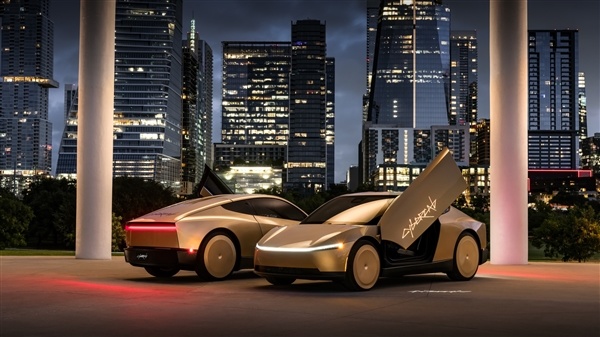
Competitive benchmark: the Texas scoreboard
| Metric | Tesla Robotaxi | Waymo (Alphabet) | Note |
|---|---|---|---|
| Weekly paid rides | Not disclosed in the record reviewed | Roughly 500,000 per week as of autumn 2026 | TechCrunch fleet-data report, September 24, 2026 |
| Authorised vehicles in Texas, late-May 2026 snapshot | 42 robotaxis registered | 577 robotaxis registered | TxDMV AV tracking tool, as reported by financial media on May 29, 2026 |
| Fleet trajectory | 300 Cybercab vehicles by early October, near 1,000 total Texas vehicles by the end of October | Thousands in service nationally through 2026 | Company disclosures versus state registry |
| Growth model | Single-state manufacturing base plus in-house vision software stack | Multi-city rollout built on supplier vehicles and Lidar sensing | Structural difference behind the pace of night-hours expansion |
The gap explains the marketing. Tesla is not trying to look like the incumbent on volume; it is trying to look normal on the nights that matter — which is why a Halloween clip, a $0 first ride and a 2 a.m. cut-off were released within days of each other rather than as separate announcements.
Common misconceptions about this story
- "The video is a feature launch." It is not. Tesla released no Halloween mode and no software capability; the clip is seasonal promotion on the Robotaxi operating account.
- "A fleet near 1,000 vehicles is a business." Fleet size is an input, not revenue. Nothing in the record reviewed shows Robotaxi earnings materialising against a quarterly revenue base near $28 billion.
- "State approval equals legal clearance." Texas authorisation covers operating a driverless service on state roads; it does not resolve federal safety standards for a vehicle with no steering wheel.
- "Miles driven prove safety." Company-reported unsupervised miles and independently compiled police or regulator incident filings count different events under different thresholds, so the two series cannot be placed side by side as a league table.
- "Free first rides are a price war." They are a trial-generation cost aimed at the specific objection that a car with no controls is unusable at night — closer to app-store onboarding than to ride-hailing discounting.
Monitoring checklist: what to watch next
- Monthly TxDMV authorised-vehicle counts for Tesla in Texas, which now give an independently checkable ramp curve instead of management statements.
- Any NHTSA docket showing Tesla seeking a commercial FMVSS exemption for a steering-wheel-free vehicle — the single item that unlocks expansion beyond permissive states.
- Operating hours and geographic fences in Austin, Dallas, Houston and Miami: whether the 2 a.m. window holds, and whether night incidents stay out of the headlines.
- Cybercab output at the Texas Gigafactory versus Austin fleet additions; a widening gap means vehicles are accumulating faster than they can be licensed and dispatched.
- Conversion economics after the first ride for $0: paid ride frequency, average fare and utilisation per vehicle per day, ideally disclosed by city.
- Capital-expenditure framing in coming quarterly reports, and whether Robotaxi and Optimus continue to absorb spend previously allocated to traditional manufacturing capacity.
- Competitive counter-moves on the nightside: rival operators extending hours, lobbying for local night curfews, or signing nightlife venue partnerships.
Action recommendations by reader role
- Investors: treat Robotaxi as an option, not a forecast. Anchor valuations on state registry fleet counts and disclosed paid volume, and cap the weight given to marketing-led milestones.
- Industry analysts: build a normalised comparison across operators using authorised vehicles, operating hours and miles or rides per vehicle, since raw fleet tallies and permissive-state exposure differ sharply.
- Corporate strategy and business development: the night-demand play is replicable. Bars, venues, event organisers and hotel operators in driverless-enabled cities can negotiate curated pick-up windows before pricing structures harden.
- Market researchers: track the language of the account itself. Ambience controls such as Calm Mode, trip-sharing and holiday storytelling show the competitive front moving from capability to passenger comfort and trust.
Bottom line
The ghost ride is memorable, but the disclosure around it is the story. Tesla has assembled a 20-hour service day, an expanding Cybercab build at the Texas Gigafactory, promotional onboarding in Dallas and Houston, and a near-1,000-vehicle Texas fleet — all inside a state rulebook that now tolerates a car with no steering wheel. What remains unproven is the part that decides scale: a federal pathway for the hardware, utilisation that converts free rides into paid trips, and revenue large enough to matter. For anyone tracking this single company, the practical takeaway is to ignore the spooky lighting and watch three boring series — registry fleet counts, exemption dockets and night-time incident reports.