
Volkswagen's Dual-Track SDV Playbook: A GlobalBizSight CompanyWatch Guide to NXP S32K5, VEGA and What to Track Next
A single corporate news cycle can carry two very different kinds of information. In Volkswagen's case, the semiconductor agreement and the China technology launch are most useful read not as product news but as a governance disclosure: a public admission about where engineering authority now sits inside the group. The passages below turn that disclosure into a working method for CompanyWatch readers — six ordered steps, a verification checklist, the traps that most coverage falls into, and the specific signals worth tracking over the next four quarters.
Step 1: Split the two announcements and draw the authority map
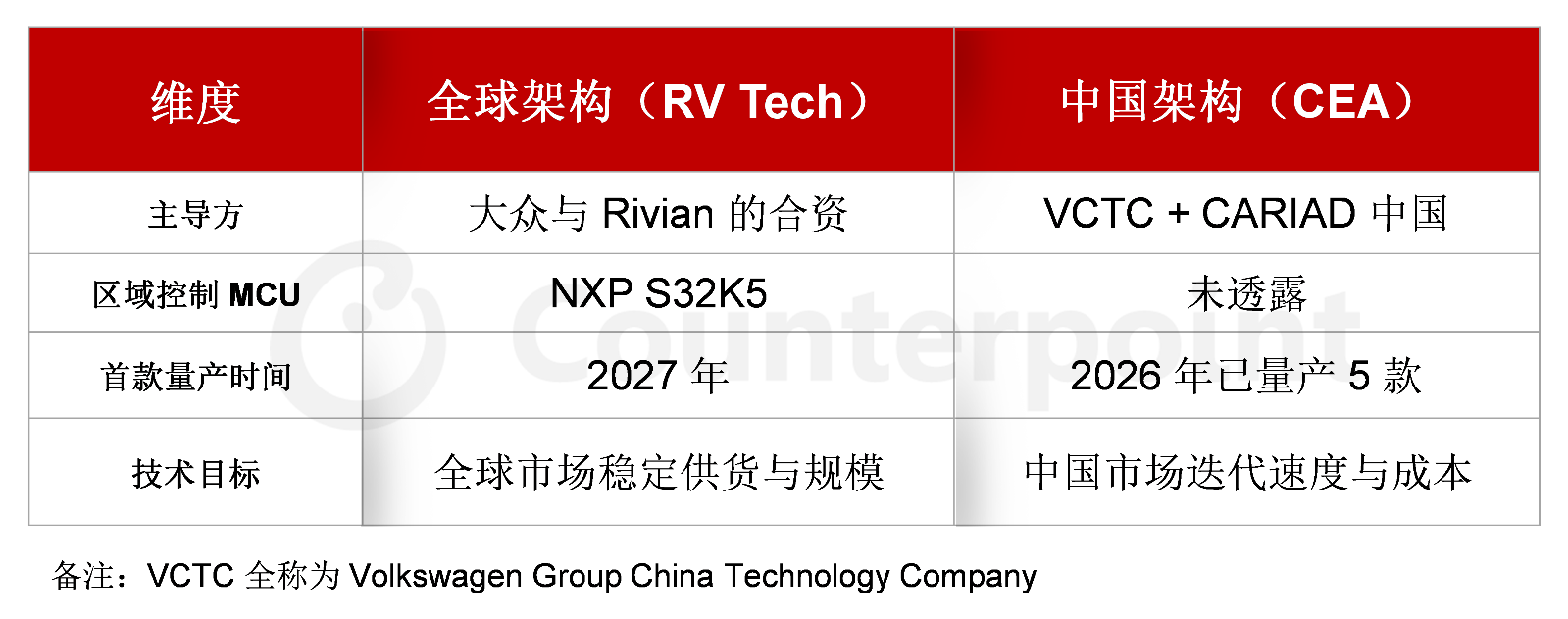
On October 26, NXP and Volkswagen announced a strategic partnership under which the S32K5 microcontroller family was selected as the zonal control module solution, to be applied across multiple brands and models of the group, with the first vehicle carrying the technology planned for 2027. Two days later, Volkswagen staged its first Tech Day in China and released VEGA, a locally developed technology matrix aimed at three domains: vehicle platforms, the electronic architecture and advanced driver assistance (ADAS). Counterpoint Research reads those two decisions as, on the surface, in tension, but in substance a redrawing of research leadership: the global architecture optimising for scale and stability, the China architecture optimising for development speed and market adaptation.
Before accepting the framing, put each programme on a named owner. The group-level track runs through Volkswagen's own zonal work — including RV Tech, the joint venture with Rivian, which said in March 2026 that it had completed winter testing of a production-intent zonal architecture (Volkswagen Group press releases, volkswagen-group.com). NXP, for its part, positions S32K5 as a common building block for zonal controllers across brands and segments, extending its CoreRide platform with pre-integrated zonal and electrification content (nxp.com/products/S32K5). The China track runs through CEA and VEGA, staffed and now largely steered from Hefei. Two architectures, two budget lines, two sets of gatekeepers — that is the disclosure, and it explains why running two parallel technology systems is costlier than any single-stack roadmap admits.
Step 2: Convert efficiency claims into verifiable metrics
At the Tech Day, Volkswagen highlighted C-Brain, an AI tool chain built on the China Electronic Architecture CEA. The disclosed figures are striking: the software functional test cycle fell from three days to two to three hours, and software problem diagnosis shrank from two weeks to 20 minutes. Counterpoint Research's caveat belongs in the same sentence as the numbers — these are not a proxy for overall research productivity, even though they show Volkswagen stepping away from a single global development process.
| Claimed metric | Reported change | What it genuinely measures | What it does not prove |
|---|---|---|---|
| Software functional test cycle | three days to two to three hours | Automation of repetitive test execution inside the CEA tool chain | Fewer validation gates, or faster type approval of a whole vehicle programme |
| Software fault diagnosis | two weeks to 20 minutes | Log aggregation and triage speed | Faster root-cause fixes, or lower warranty and recall exposure |
| Electronic control units on CEA | roughly 30% fewer than previous generations, per Volkswagen statements reported by Automotive News and Gasgoo | Hardware consolidation, wiring-harness length, assembly complexity | Lower electronics cost per function, because spend migrates into higher-value zone controllers |
| Programme milestones | first S32K5-based vehicle 2027, C7H production 2028, CMP localisation in South America around 2030 | Board-level commitments, revisable at any quarterly media round | A schedule that has survived supplier qualification and regulatory sign-off |
Operational rule for this step: log the claim, the owner, the date of first disclosure and the next date at which the owner must confirm it. A milestone that passes two consecutive reporting cycles without restatement is already slipping.
Step 3: Trace who actually defines the architecture
CEA is not a clean-room in-house build. In April 2024, Volkswagen and XPeng signed a strategic framework agreement on the electronic architecture, committing to joint development based on XPeng's latest-generation EEA 3.0. Volkswagen's own wording matters: CEA is jointly developed by Volkswagen Automotive (China) Technology Co., Ltd. (VCTC), CARIAD China and XPeng. Counterpoint Research describes the result as XPeng's architecture know-how fused with Volkswagen's functional-safety and validation regime, with the localisation engineering executed by Volkswagen China's own teams.
That creates a generational question. As XPeng's architecture evolves to EEA 4.0 in 2026, CEA 1.0 has to keep upgrading and narrowing a moving gap. The more durable signal, in Counterpoint Research's reading, is not which generation Volkswagen ships but the fact that architecture definition rights and technology choice rights have shifted to teams in China rather than staying with the headquarters in Germany. Ask four things of any ownership map: who writes the specification, who signs off the safety case, who owns the tool chain, and who can veto a supplier.
Step 4: Follow the silicon trail — three chip routes, one definition right
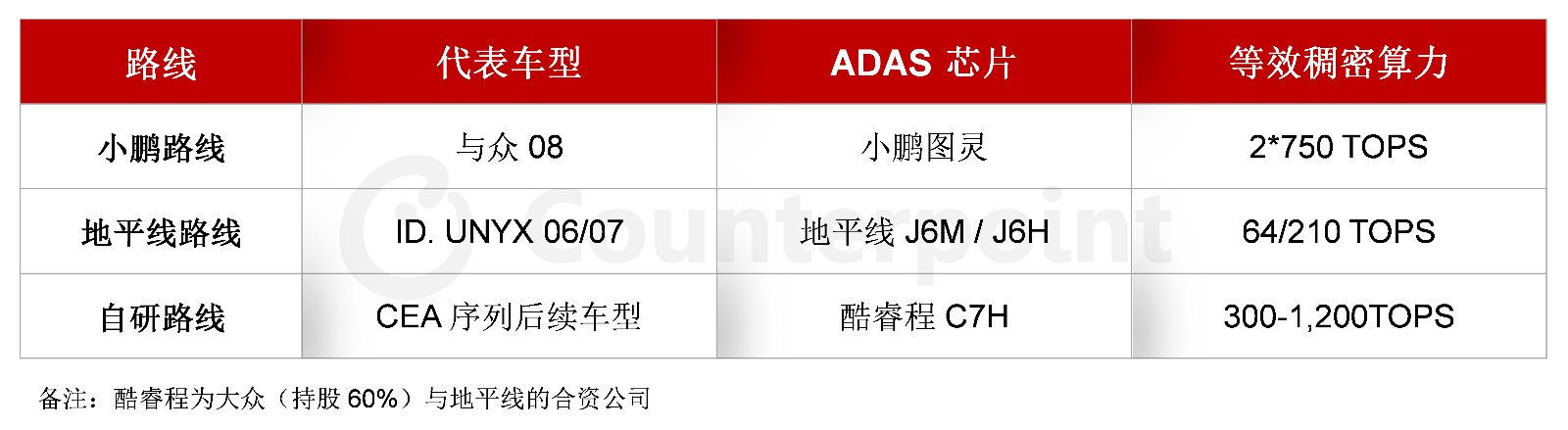
Counterpoint Research counts three ADAS chip routes that Volkswagen has laid out in China. One of them runs through CARIZON, the joint venture with Horizon Robotics, where a system-on-chip codenamed C7H is under development on an architecture internally known as Nash Architecture, with mass production planned for 2028. Reuters reported in November 2025 that CARIZON would build Volkswagen's first in-house chip for smart driving in China; the institution stresses that C7H is not a straightforward Horizon Robotics IP-licensing product, with the chipmaker acting as joint-venture shareholder, AI foundation model technology provider and chip supply-chain partner.
Read that structure as cost arithmetic, not prestige. Owning the chip definition lets Volkswagen push back on standard silicon bought off a supplier shelf and internalise margin in the highest-value layer of the stack — the same logic that made the NXP agreement a group-level decision rather than a purchasing note. Counterpoint Research frames it as a sector-wide shift: carmakers now want the right to define chips for performance, cost and product differentiation.
Step 5: Discount the L3 date into three separate gates
Volkswagen used the Tech Day to say it plans L3-level automated driving technology to be ready in 2027. Counterpoint Research's warning should be pasted next to that sentence wherever it is quoted: technical readiness is not commercialisation for Chinese consumers, and preparation, road-testing permits and market access for individual users are three distinct stages. On its reading of Chinese regulation and access timelines, consumer-facing L3 in China is unlikely before 2029.
The regulatory record supports the caution. China's first conditional L3 product entries, granted in December 2025, covered two models only — Changan's Deepal SL03 in Chongqing, capped at 50 km/h in specified scenarios, and BAIC's Arcfox Alpha S on designated Beijing expressway sections at up to 80 km/h — and both were run by corporate fleet operators. As of late October 2026, the second batch of market-entry pilots was still described by the industry ministry as merely under way, with no public list of models (CnEVPost, cnevpost.com, October 22, 2026). Ten months of approvals and zero deliveries to individual owners is the base rate to apply to any 2027 or 2028 L3 promise, Volkswagen's included.
Step 6: Track the export vector — CMP as the test of reverse leverage
Volkswagen also plans to push the China-developed stack outward, including the CMP platform with CEA integrated, to regions such as South America, Africa and Southeast Asia. Counterpoint Research sees the logic plainly: exploit the cost control and development efficiency of the China research base to serve emerging-market product needs. Reuters and China Daily report that South America is scheduled to be the first region to localise CMP and CEA, on a horizon around 2030, and Volkswagen has previously publicly targeted a cost advantage of roughly 40% for CMP-based vehicles against comparable platforms.
One variable remains unreported and it is the one that matters for suppliers: the zonal control microcontroller supplier for Volkswagen's CEA architecture has not been disclosed. Whether China-made silicon eventually enters that bill of materials will determine how deeply the country's automotive electronics supply chain participates in Volkswagen's global product system. Note too that the NXP agreement is a group-level understanding, so its flow-through to China-defined products is a separate question, not a given.
CompanyWatch verification checklist
- Confirm every milestone against the primary issuer, not an aggregator: Volkswagen Group press releases for RV Tech and CMP, the NXP newsroom for S32K5, ministry notices for automated-driving access.
- Record which legal entity owns each artefact: VCTC, CARIAD China, CARIZON, or the group research unit in Germany.
- For every efficiency claim, demand the denominator — which test scope, which vehicle programme, which software release train.
- Track tool chain and operating-system qualification partners as a switching-cost proxy; NXP pairs S32K5 with validated software from Vector and Green Hills, which is where lock-in actually accumulates.
- Watch component content rather than model count: how many zone controllers per vehicle, and how many suppliers per zone.
- Check whether the two parallel systems are being reconciled in budget documents or hiring data, both of which move before press releases do.
- Re-read the 2027, 2028 and 2030 dates at each reporting cycle; silent removal from a slide deck is the most reliable slip signal.
- Follow the China volume line — Volkswagen's deliveries there fell roughly 39% in the third quarter of 2026 and about 30% across the first nine months, to some 1.38 million vehicles (Automotive News, volkswagen-group.com) — because that pressure is what justified handing definition rights to Hefei in the first place.
Common pitfalls in covering this story
- Reading the NXP deal and VEGA as contradictory. They are one decision with two different optimisation targets: scale and speed.
- Converting test-cycle compression into a general productivity claim, which Counterpoint Research explicitly refuses to do.
- Describing CEA as pure Volkswagen in-house work, or as pure XPeng technology; it is a joint build with Volkswagen holding the safety case.
- Treating "technology ready in 2027" as "customers can buy it in 2027"; access, not engineering, sets that date.
- Assuming the group's NXP choice automatically becomes the supplier for China-defined architectures; that decision is still unannounced.
Action recommendations for the next four quarters
| Signal to watch | Where to verify | Threshold that changes the read |
|---|---|---|
| First S32K5-equipped Volkswagen Group model on the road | Group technology days, NXP investor updates | Any slip past 2027 implies qualification or supply friction and slows zonal consolidation |
| VEGA release cadence in China | Over-the-air notes published with each model-year refresh | Missed quarterly feature refreshes point to integration debt in the dual-track setup |
| C7H milestones before 2028 | CARIZON announcements, Horizon Robotics filings | A pre-silicon demo that never converts into production commitment means the route falls back to merchant SoCs |
| Next Chinese L3 access batches | Ministry industry notices, cnevpost.com | A named Volkswagen model cleared for individual owners pulls the 2029 estimate forward |
| CMP and CEA localisation contracts outside China | Plant investment announcements, volkswagen-group.com | A signed South America localisation confirms reverse leverage; the microcontroller list chosen there settles the supply-chain question |
| Cost of carrying two architectures | Group portfolio disclosures, CARIAD headcount data | An explicit provision for parallel development quantifies the price of the strategy for the first time |
Bottom line
Counterpoint Research's summary is the frame worth keeping: the shift is not about building a China research system, it is about redistributing technology decision rights inside the group, away from the long-standing model in which Germany decided and local teams adapted. Maintaining two technology stacks in parallel raises validation, supply-chain management and software maintenance costs, and whether they converge, and under whose leadership, is genuinely open. For CompanyWatch purposes, look past the product headlines and monitor three things: who signs the architecture specification, which controller sits inside the zone, and whether the stack developed in China starts shipping into other markets on its own terms. Answer those and the rest of Volkswagen's software-defined vehicle story becomes predictable.