
GlobalBizSight DataStories Field Guide: Five Steps to Read China's Record Two-Thirds EV Month
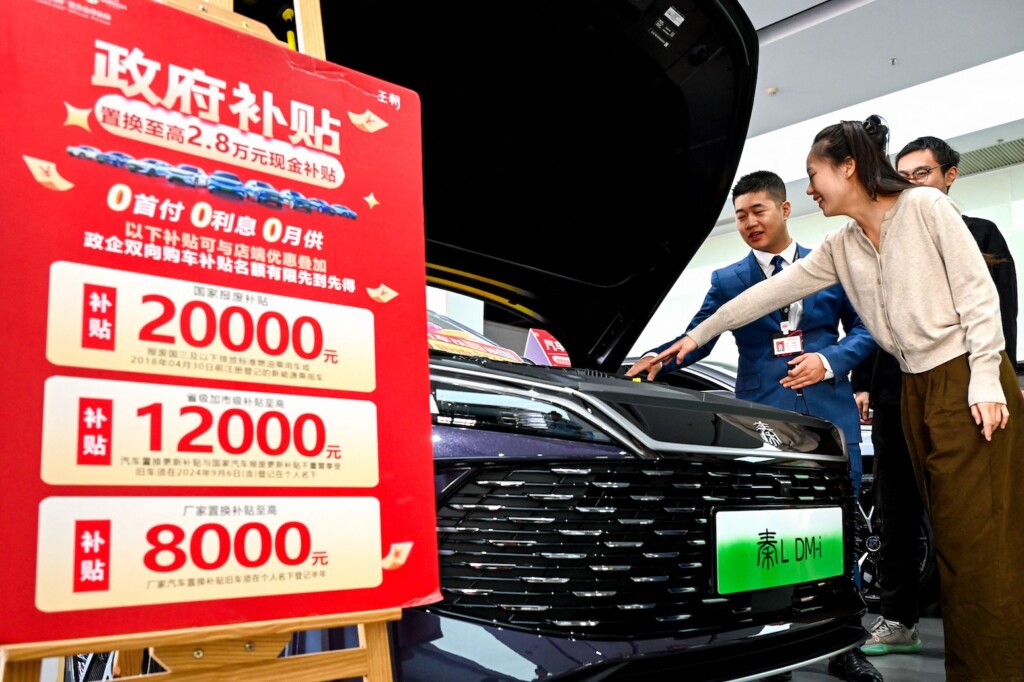 Photograph: shoppers negotiate a trade-in deal on a new-energy vehicle inside a BYD 4S dealership in Nanchang, Jiangxi province, China. Image credit: Cynthia Lee / Alamy Stock Photo.
One percentage figure can carry two opposite business messages. The China Passenger Car Association (CPCA) dataset for September delivers exactly that: new-energy vehicles (NEVs) reached 67% of new car sales in China, the first month in which two out of every three cars sold in the country were electric or plug-in. The same dataset also shows fewer NEVs leaving lots than last year, a passenger-car market in steep contraction, and a share line that rose only because the combustion engine fell faster than its substitutes. This field guide is written for readers who have to act on that ambiguity — sales and network planners, suppliers, strategists, analysts and investors. Work the five diagnostic steps below, borrow the checklists, and sidestep the traps that make most "China is going electric" commentary unusable in a board pack.
Step 1: Separate the share line from the volume line
A market share is a ratio, and ratios can improve while every component shrinks. That is precisely what happened this September. NEVs captured a record share even though fewer were sold than last year, because sales of fuel-only cars were down 31% year-on-year in the first nine months of 2026, with plug-in hybrid sales down 26% – whereas battery EV sales were only down 4%. The CPCA has attributed the collapse of the combustion side to rising petrol prices following the start of the Hormuz crisis.
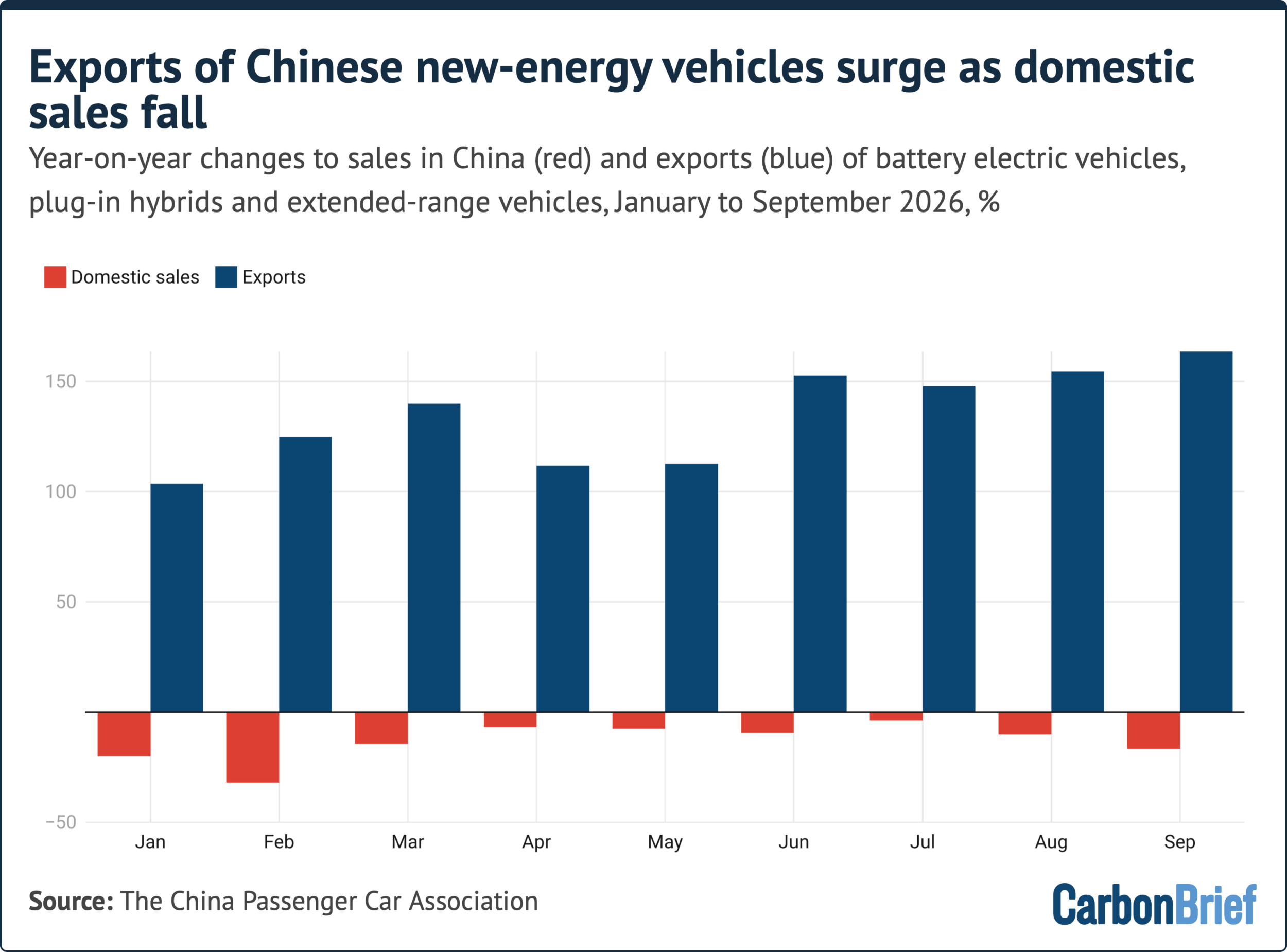
The energy signal travels in the same direction. Euan Graham, senior energy analyst at thinktank Ember, tells Carbon Brief that China's rapidly growing EV fleet has offset demand for 143m barrels of oil since the start of the Hormuz crisis. Erica Downs, senior research scholar at Columbia University's Center on Global Energy Policy, says the crisis is "reinforcing China's electrification of road transport". Meanwhile, amid slowing domestic sales, Chinese carmakers' exports of NEVs more than doubled in 2026 to date / in September from a year earlier.
- Before quoting any penetration statistic, state the numerator's unit growth rate next to it.
- If share rises while volume falls, the story is about the declining segment, not the winning one.
- Report the two curves separately in dashboards: an "adoption" curve and an "attrition" curve.
Step 2: Fix the statistical caliber before comparing anything
The single largest source of error in China auto commentary is mixing datasets. The CPCA series used above is a passenger-car retail penetration measure. China Association of Automobile Manufacturers (CAAM) data — the industry body's wholesale and total-vehicle series — put new-energy vehicles at a record 61.6% of new car sales in the same month, a lower number because the denominator includes commercial vehicles and the numerator counts wholesale dispatches. Export tallies diverge the same way: the CPCA recorded 1,084,000 NEVs sold domestically in China in September, alongside 558,000 NEVs exported, while CAAM reported 571,000 units of NEV exports in September, up about 1.6-fold year-on-year and 8.6% from August, with January-to-September NEV exports of 4.006 million units and total vehicle exports of 8.205 million for the same window (CAAM, via CnEVPost).
None of these pairs is a contradiction. Each is a definition. A professional read names the publisher, the channel (retail versus wholesale), the vehicle scope (passenger only versus all vehicles) and the month, or the numbers become meaningless.
Step 3: Decompose the mix, then zoom out to the decade trend
(NEVs predominantly include battery electric vehicles – BEVs – and plug-in hybrids – PHEVs. BEVs only run on electricity, whereas PHEVs also have a combustion engine.)
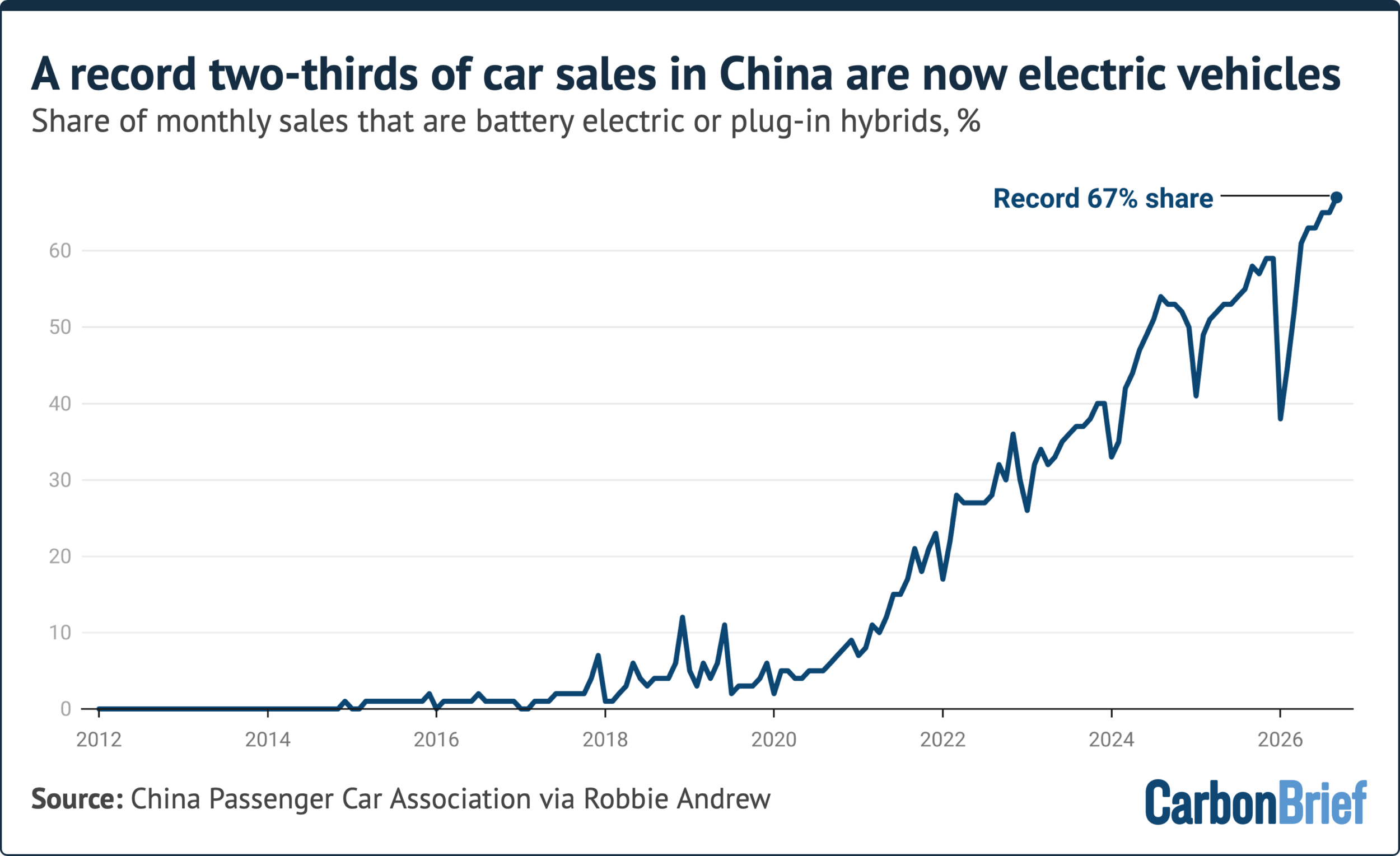
A record two out of every three cars sold in September in China were NEVs, as the first chart below shows. That marks a rapid rise from just 6% of new car sales in 2020 up to 58% in 2026 to date – and a record 67% in the month of September. This year, NEVs' share of sales has also bounced back from a low of 39% in January, after the full purchase tax exemption that had been in place for more than a decade came to an end in December 2025.
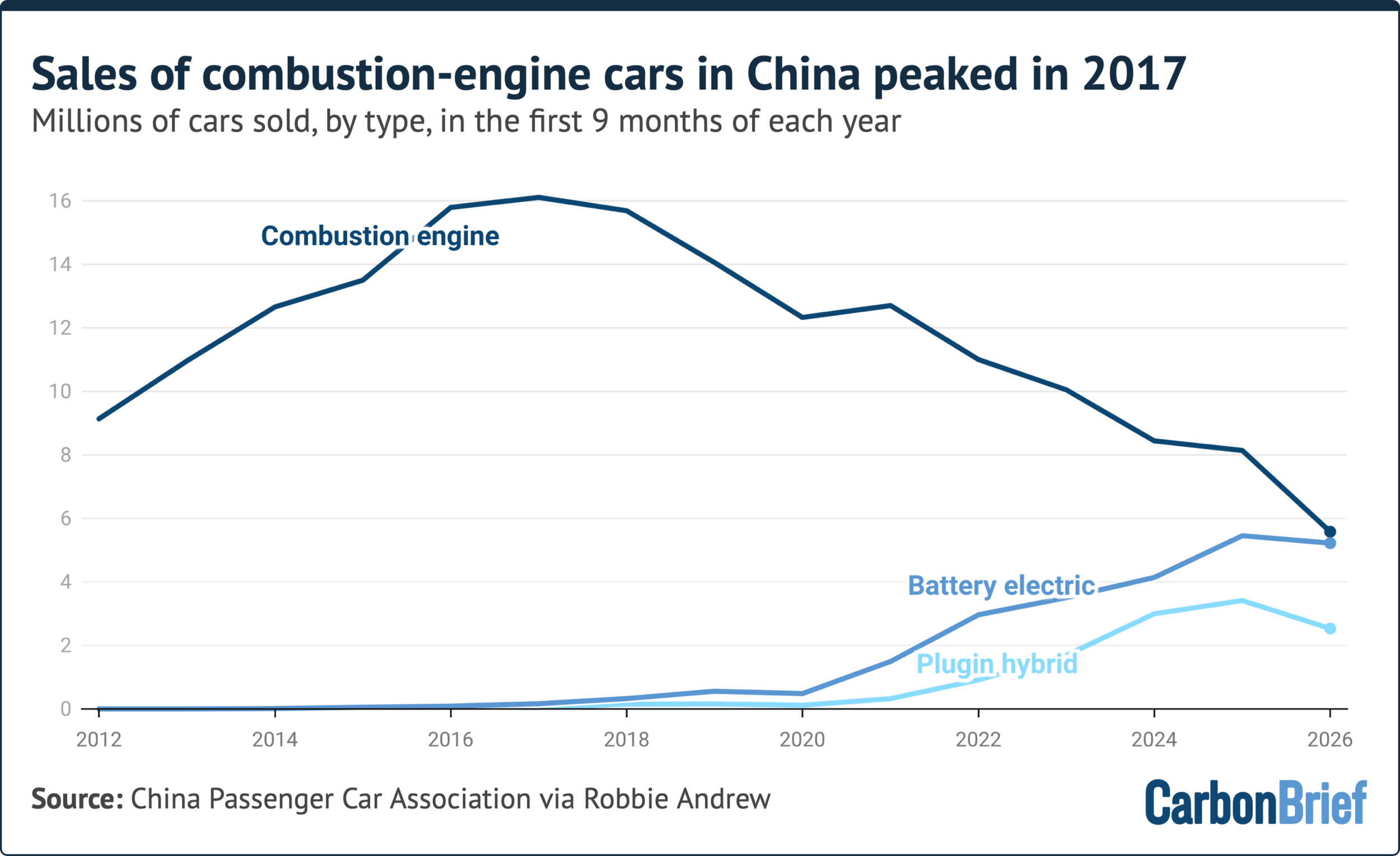
The 2026 gain arrived inside a shrinking market, which hit combustion-engine vehicles hardest. Passenger-car retail sales across all categories contracted, with overall sales volumes falling 28% year-on-year. Combustion-engine vehicles led the fall 43% year-on-year in September and 31% in 2026 to date. Sales of PHEVs also fell by 36% year-on-year in September and by 26% in 2026 to date. BEVs performed better, although sales still declined 8.5% from a year earlier in September and 4% in 2026 to date. As a result, NEV sales overall fell by 17% in September and 13% in 2026 to date.
| Powertrain segment | September, vs a year earlier | January–September, vs same period last year |
|---|---|---|
| All passenger-car retail | -28% | contracting |
| Combustion-engine only | -43% | -31% |
| Plug-in hybrids (PHEV) | -36% | -26% |
| Battery electric (BEV) | -8.5% | -4% |
| NEV total (BEV + PHEV) | -17% | -13% |
| NEV share of retail | 67% (record) | 58% |
While the market changes in 2026 to date were particularly dramatic, they reflect a broad continuation of trends seen over the past decade. Sales of combustion-engine cars in China peaked in 2017 and have been declining ever since, shown in the second chart below.
Step 4: Overlay the price and policy signals buyers actually feel
Chinese technology news outlet OFweek attributed part of NEVs' 2026 advance to petrol cars "giving up market share" as they were outperformed by electric alternatives. Cui Dongshu, secretary-general of the CPCA, cited higher petrol prices as the explanation for September's weak combustion-car sales, in comments to financial news outlet National Business Daily.
Those prices moved twice inside September. China's National Development and Reform Commission adjusts retail refined-oil prices on a rolling ten-working-day formula window and reported that the 24 September increase would have been 830 yuan per tonne for gasoline and 800 yuan per tonne for diesel under the formula, but was dampened by state price controls to 395 yuan and 385 yuan respectively (Reuters, 24 September 2026). Two capped adjustments in one month, on top of a supply-shock premium, is the cost signal that pushes a household from "wait and see" to a test drive.
On the purchase side, the incentive architecture changed materially in 2026. From 1 January 2026, NEV buyers moved from full vehicle-purchase-tax exemption to a halved levy — an effective 5% rate, with the tax reduction capped at 15,000 yuan per vehicle through 2027, per the policy China announced in June 2023 (Reuters; China vehicle-purchase-tax NEV schedule). The 2026 national scrappage and replacement scheme, issued by eight ministries, pays 12% of the new car's sale price — up to 20,000 yuan — for scrapping an old car and buying an eligible NEV, and 8%, up to 15,000 yuan, for a straight trade-in; scrapping a NEV to buy a petrol car earns nothing (2026 Automobile Trade-in Subsidy Implementation Rules).
Worked example (illustrative arithmetic, GlobalBizSight). Take a 150,000-yuan NEV bought on a scrappage-and-replace deal. Purchase tax at the halved rate adds roughly 6,600 yuan instead of the 13,300 yuan a comparable petrol car pays, and the trade-in subsidy returns about 18,000 yuan of the sticker price. A petrol equivalent carries the full tax and a 10% scrappage subsidy capped at 15,000 yuan. Net of both, the electric option starts roughly 18,000–20,000 yuan cheaper before a litre of fuel is burned — and that gap widened through September as pump prices climbed. Rebuild the arithmetic with your own price bands before using it in a business case.
On the macro side, imports of oil into China in January-September have fallen 15% compared to 2025, equivalent to 470m barrels, as ongoing conflict tightened supply and drove up prices. China's passenger-car NEV fleet has displaced 143m barrels of oil so far during the strait of Hormuz crisis, Graham of Ember says. EVs "accounted for 12% of the decrease in China's oil use post-Hormuz", according to an estimate provided to thinktank the Brookings Institute by an unnamed analyst. Downs argues that the "world's largest oil supply disruption" vindicates China's early bet on EVs, which was partly driven by concerns about oil-supply security.
Step 5: Pressure-test the ceiling and the export offset
NEV sales have fallen year-on-year, albeit at a slower rate than overall car sales, and the growth in NEV market share has been decelerating. Zhang Yichao, a partner at consulting firm AlixPartners, tells Carbon Brief that NEVs benefit from government trade-in policies and a "strong pipeline" of new models, particularly those involving innovation — factors that help explain why NEV volumes are shrinking more slowly than combustion volumes.
Cui told the state-run China National Radio that the fall for NEVs and for cars overall in September 2026 also reflects a high baseline of sales from the same month in 2025, changes to trade-in policies and disruptions from the holiday period. Consulting firm Wood Mackenzie adds weakened demand from "demand pull-forward" in 2025 caused by the end of subsidies, plus "tighter financing conditions". Zhang says he does not "see much more room ahead" for further share gains and views the NEV share in China as unlikely to exceed 80%, since some premium segments and specific use cases will continue to require combustion-engine vehicles.
Where domestic volume softened, the export channel absorbed it. Domestic NEV retail fell 17% in September 2026 while exports more than doubled, increasing 164% year-on-year, according to the CPCA. In September, 1,084,000 NEVs were sold domestically in China, while 558,000 NEVs were exported. Exports are becoming increasingly important to Chinese carmakers facing weaker domestic demand and cut-throat industrial competition; the CPCA says exports have become "a core priority" for some carmakers.
The offset is real but increasingly contested. The EU, which has placed tariffs of 7.8% to 35.3% on Chinese-built battery and range-extended EVs, moved in January 2026 to publish conditions under which exporters can substitute minimum-price undertakings for duties and accepted its first such undertaking in February 2026 (Reuters; European Commission trade portal). Brussels has also agreed plans to cap Chinese hybrid imports, and countries including Mexico and Turkey have placed tariffs on Chinese EV imports. At the same time, the Chinese government is putting policies in place that might be expected to disincentivise exports, such as cutting VAT export rebates. Analysts differ on the impact: some say it will be limited, others believe it could raise the price of exported cars.
Five traps that ruin the read
- Reading 67% as demand strength. It is a supply-side displacement statistic: NEV units still fell by 17% in September while the whole passenger-car basket contracted harder.
- Comparing CPCA retail penetration with CAAM totals. One is passenger-car retail, the other is all-vehicle wholesale; their September percentages and export counts legitimately differ.
- Calling PHEVs losers because BEVs fell less. PHEVs and range-extenders remain central to price-sensitive buyers and long-distance use; their decline is a mix effect inside a shrinking market, not an end-state verdict.
- Treating the January dip as proof of policy failure. The 39% share reflected the purchase-tax step-down; the rebound to 58% shows the halved levy plus trade-in rules absorbed the shock.
- Extrapolating share to saturation. With the credible ceiling put at 80% by AlixPartners' Zhang, the next phase is margin, churn and export share — not another vertical adoption curve.
What each role should do now
- OEM product planners: build the line-up around the BEV-versus-PHEV crossover of use cases, not around the headline penetration rate, and schedule launches against the ten-working-day fuel-price cadence.
- Dealers and network owners: model 2027 on subsidy-driven demand pull-forward, not on 2025 volumes. Watch the China Automobile Dealers Association inventory warning index, which has been running above its 50% boom-bust line through 2026, with new-car gross margins negative at many stores — share growth does not automatically mean channel profitability.
- Suppliers and battery makers: the fastest-growing demand curve is now the export order book, so locate content value where tariff and rebate risk is lowest.
- Investors: underwrite volume decline against margin repair; the pricing war, not adoption, is what decides 2027 earnings.
- Policy watchers outside China: track minimum-price undertakings, hybrid quotas and VAT rebate adjustments — they will re-shape landed cost faster than any adoption statistic.
FAQ
Does 67% mean China's car market is growing?
No. The share is a record, but total passenger-car retail sales contracted 28% year-on-year in September, and NEV sales themselves declined. The ratio improved because combustion sales fell faster.
Why did fuel prices matter so much?
Because pump price is the only operating cost consumers see monthly. Higher petrol prices after the strait of Hormuz crisis pushed buyers toward the cheapest per-kilometre option, which is why the CPCA links September's combustion weakness directly to fuel costs.
How much oil has the EV fleet actually displaced?
Ember's Graham estimates China's passenger-car NEV fleet has displaced 143m barrels so far during the crisis, while China's crude imports fell 15% in January-September versus 2025 — roughly 470m barrels. EVs were credited with 12% of that post-Hormuz demand decline in an estimate shared with the Brookings Institute.
Where is the growth now?
Exports. Domestic NEV retail fell 17% in September 2026, while overseas shipments increased 164% year-on-year, the CPCA says — which is also why EU minimum-price rules, hybrid quotas and Mexico and Turkey tariffs belong in every China automaker forecast.
Is this the end state?
Unlikely. AlixPartners' Zhang sees little room left and does not expect the share to exceed 80%, given premium niches and duty-cycle use cases that still need combustion power.
The September print is best filed as a structural marker rather than a boom signal: a decade-long adoption curve that moved from just 6% in 2020 to two-thirds in a single month, now running at full speed inside a market that is losing vehicles. For anyone making decisions off these numbers, the practical takeaway is narrow — track volumes and share on separate axes, name the dataset before comparing it, and price the policy and fuel shocks into every scenario. Adoption is no longer the interesting question in China's car market; profitability, churn and the export channel are.