
The AI Chip Depreciation Playbook: A Data-Driven Stress Test of Gartner's Math and the Jevons Paradox
Two clocks sit inside every AI infrastructure budget. One is the accounting clock — the useful-life assumption written into the depreciation schedule. The other is the roadmap clock, set by chip designers who never see your balance sheet. A capex plan holds only while the two tick at the same speed, and the whole public argument about AI overbuild is really a dispute over whether they still do. The encouraging part for operators, analysts and lenders is that the question is testable with data already in the open: an impairment forecast, benchmark price curves, rental-rate charts and resale indices. What follows is that test in the order a finance team would run it — the arithmetic, the demand counter-argument, the market signals, a workload framework, the misconceptions, an audit checklist and a FAQ.
Step 1: Lay out the arithmetic before anyone argues
A couple of weeks ago, Gartner published the most explicit version of the cautionary case. AI providers will spend close to $1 trillion on infrastructure in 2026 and another $6 trillion between 2027 and 2030. To fund that, cover the cost of borrowing and still earn a 12% return, AI data center owners would need about $8.5 trillion in revenue through 2030. Gartner expects the AI revenue that actually reaches those data centers to be $3.6 trillion at most. On that arithmetic, more than $3.5 trillion of this spending could be exposed to write-downs by 2030, and more than 80% of neoclouds will no longer exist as independent companies. Bloomberg's coverage of the release underlined the same distinction: this is exposure under stated assumptions, not a prediction that every dollar disappears.
A smaller figure in that release is the one most models should actually carry. Gartner expects spending on AI-optimized infrastructure-as-a-service to climb from $66 billion in 2027 to $174 billion in 2030, according to Network World's report on the forecast. That is the rental channel — the route by which most buyers of capacity, rather than owners of silicon, will meet this market. The usable move here is procedural: rebuild the distance between required revenue and expected revenue in your own spreadsheet, substituting contracted revenue for the industry aggregate, before adopting either the bull or the bear conclusion.
Step 2: Test whether Jevons can rescue the demand line
Gartner's math holds only if AI keeps being deployed roughly as it is today. The Jevons paradox argues the opposite: as a technology gets cheaper and more available, people find uses that were previously uneconomic, so revenue from aggregate usage can rise even as unit prices fall. Cars make it intuitive — when a car uses less fuel, each kilometre costs less, so people drive farther, take longer trips and may buy more petrol in total.
The paradox is older than the data center. In 1865, in The Coal Question, the economist William Stanley Jevons observed that more efficient steam engines did not cut Britain's coal consumption but raised it, because cheaper power found many more uses. His point held up: Britain's coal consumption kept growing as engines improved, even if efficiency was not the only reason.
Two datasets make the mechanism concrete for AI. Epoch AI estimates that the price of reaching a given benchmark score has fallen by roughly 13 times a year since 2023, measured on the benchmarks it tracks, with the usual caveats about how those benchmarks are chosen. Stanford's AI Index, published in its 2025 edition, tracked the cost of querying a model at GPT-3.5 level from $20 to $0.07 per million tokens — a fall of about 280x in roughly 18 months, as summarised in CloudZero's compilation of that report. What collapsed was the price of a fixed capability threshold, not a sticker price.
The caution belongs in the same breath. A widely cited reading of the Anthropic Economic Index, the public dataset on how people actually use conversational AI, suggests a response far weaker than Jevons would predict: roughly a 3% rise in usage for each 10% drop in task cost. Where elasticity sits below 1, cheaper tokens mean less revenue per unit of installed capacity, not more. Jevons is a direction of travel, not a guarantee.
Step 3: Read the rental market the way an underwriter would
So far, the market's evidence leans toward the "old chips" camp — they are keeping their value for longer than expected. a16z circulated a chart built on Ornn rental data as of Oct. 19, comparing what each major Nvidia generation rents for today with a projected price. The projection is deliberately naive: take the first rent observed for each chip and let it fall in a straight line to zero over six years, roughly the way hyperscalers write these servers off in their accounts. Because each line starts from that chip's own first observed rent, the series begin at different points in each chip's life. Every generation now rents above that line: the A100 by 9%, the H100 by 54%, the B200 by 111% and the H200 by 143%.
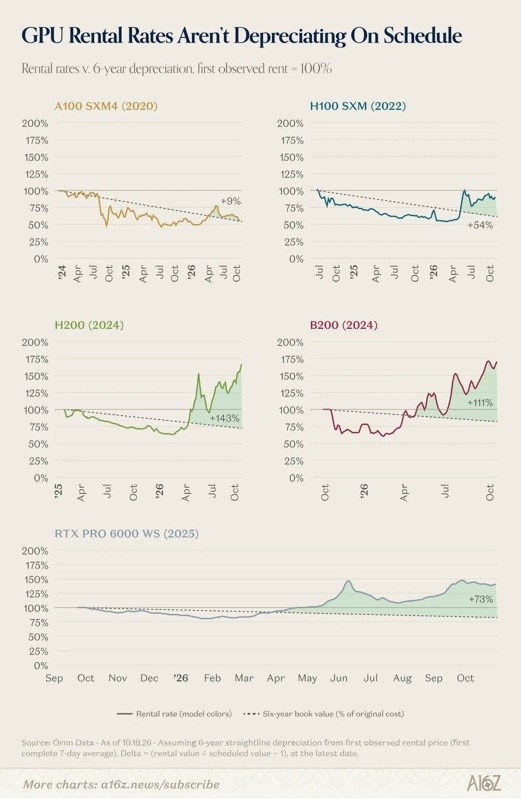
Two details matter for anyone modelling off this. First, a16z notes that most of the gap opened after April, when token demand took off — consistent with the Jevons paradox at work, although the chart alone cannot prove the cause. Second, for most of their lives these chips rented below that line, and rent is not profit: a chip can rent well and still lose money for its owner once power, cooling, networking, facilities and the cost of borrowing are paid.
Then cross-check the rental line against resale marks, which is where third-party data gets uncomfortable. Silicon Data's H100 index puts the median resale value of a three-year-old H100 at about 69% of a new unit's price, with refurbished cards at 80-90% of the contemporaneous new price and used cards at 65-75%. Hashrate Index's used-market tracking puts a three-year-old H100 system nearer 45% of new. Two reputable trackers, a spread of roughly 24 percentage points on the same asset — exactly why residual value belongs in a model as a range rather than a constant. The same dispersion explains how CoreWeave's chief executive could describe older A100s as holding most of their value while skeptics called the identical assets impaired: each was quoting a different slice of a thin market, as CNBC's roundup of the depreciation debate showed.
Step 4: Split the fleet into compute wells, not generations
The Economist recently described compute as the new oil, and the analogy earns its keep operationally. The token is the barrel — the "thing" the customer actually buys. Each GPU generation is an oil field: some wells are easy and cheap to pump and give better-quality oil, so their cost per barrel is low; others are harder to work and give lower-grade crude. For GPUs, the cost of producing a token is linked largely to how much energy each generation needs and to whether it can handle the work at all. When oil prices are high, every well pumps, including the expensive ones; when prices fall, the costliest wells are shut first. Chips behave the same way. With demand as high as it has been since April, even the A100 is needed. When a new generation arrives in volume it becomes the new cheap well, prices fall, and the oldest chips are the first to be switched off. Microsoft, for instance, plans to scale its own Maia accelerators to multi-gigawatt deployments from 2027, claiming 40% more tokens per megawatt — a figure not yet independently verified.
The comparison still treats every barrel as identical, and that is where most analysis oversimplifies. Tokens — and the chips that generate them — are not all alike. Interactive and agentic work needs low latency and the newest, fastest memory. Bulk work such as processing documents overnight, generating synthetic data or running evaluations cares mostly about cost and barely notices latency, so a fully paid-off chip whose remaining costs are power, cooling and upkeep can be the cheapest way to produce those tokens. There is not one oil market but several, one for each broad type of work.
| Workload class | What it optimises for | Silicon that fits | Depreciation read |
|---|---|---|---|
| Interactive chat, agentic loops | Latency, memory bandwidth | Newest rack-scale systems | Repriced by every roadmap step |
| Bulk and overnight batch | Cost per token | Paid-off or previous-generation GPUs | Earnings can outlive the accounting line |
| Structured machine decisions | Cost per decision | Small specialised models on older cards | Value case rests on price, not on novelty |
| Frontier sparse MoE serving | Memory capacity, chip-to-chip links | Newest generations only | Older GPUs are too small and isolated, not too slow |
| HPC and scientific | High-precision maths | Hardware that keeps FP64 capable | Longer life, smaller buyer pool |
The specialised row has a live example: Jev, from TypeSafe AI, returns structured decisions rather than text and its makers claim it is hundreds of times cheaper than a large language model. Models like this could move a lot of agentic decision-making off expensive LLMs, and they look well suited to older hardware — although TypeSafe does not say what it runs on. At the other extreme, frontier models keep getting bigger and many are increasingly sparse, activating only a small part of the model for each token as Mixture of Experts (MoE) designs do. For the largest of these, the bottleneck is less raw compute than memory capacity and fast connections between chips, which has made the rack, rather than the chip, the unit of frontier computing. Maybe new architectures will emerge that cope better with that sparsity.
Put the rows together and the shape is a barbell. Giant models pull toward the newest rack-scale systems, while small and specialised models live happily on older silicon. The squeeze falls on the middle: chips that are neither at the frontier nor already paid off, still carried on the books at a high value. If that reading holds, a lot of the 2024 and 2025 spending sits right there — which makes the middle rungs of the asset register the first place to look for impairment.
Step 5: Re-price a mixed-hardware data center
Variety adds another layer. A cloud data center a decade ago ran different types of CPU, memory, storage and networking, and the job was to match workloads to a fairly predictable menu. Those servers aged gracefully: each new CPU generation was only modestly better than the last, so an older server kept earning for years, a bit like a rental car where last year's model is nearly as good as this year's.
Today the menu is far richer. Next to the CPUs sit GPUs, TPUs and other AI accelerators, and inference is increasingly split into stages that run best on different chips. Nvidia announced Rubin CPX, a dedicated chip for the prefill stage, in 2025, then put it on the back burner, possibly until a later generation, in favour of decode-focused racks based on technology licensed from Groq. Add HPC, which often still needs high-precision maths that many AI chips deprioritise, and matching each workload to the right silicon becomes much harder — while each generation of that silicon ages much faster.
Two consequences for buyers. The largest operators can afford this variety: with enough scale they keep many kinds of hardware busy and route each job to the cheapest chip that can do it. Smaller data centers cannot, so the general-purpose GPU remains their safest bet, because it can step down from training to inference to batch work as it ages; specialised parts are cheaper per task but more fragile as assets, since they lose that ability to start a second and third career. Dedicated on-premises installations are a different case again: a company running its own well-understood workloads can choose a configuration that fits closely and does not need to chase every new generation, since state-of-the-art silicon matters there mainly for training custom models, and perhaps a few GPU-accelerated solvers.
Step 6: Identify who owns your clock
This is the core of the matter. Many of the big operators spread the cost of these servers over about six years in their accounts, but that is a bookkeeping convention, and it says little about how long a chip actually earns more than it costs to run. That economic life is decided upstream, by the people who design the next chip. Nvidia's annual cadence, the gains in tokens per watt each generation brings, new memory standards and number formats, and the software that keeps old chips useful together set how long any GPU stays competitive. The silicon roadmap dictates the real investment depreciation timeline — which is why the debate CNBC revisited over the autumn of 2025 was never really about six years as a number, but about whose clock the number follows.
Seen this way, owning your own silicon gives you more say over your own clock. Microsoft with Maia, Google with TPU and Amazon with Trainium can shape when their own fleets become obsolete, even if demand and competitors still have a vote. A neocloud renting out Nvidia GPUs lives on a clock set by its supplier and its customers.
And Nvidia sits on both sides of the table. It sets the pace that erodes the value of its customers' fleets and — at the same time — has, according to a recent piece in The Economist, agreed to cover up to $300 billion of its customers' debt used to buy its chips, should those customers be unable to repay. A faster cadence sells more new chips and weakens the chips that secure those loans. When Jensen Huang posted in August that an A100 remains useful until 2029, he was making a technical point, but he also has a stake in this trade-off, even as Nvidia keeps introducing new generations.
Step 7: Price the exit, because resale is where the thesis breaks
Which brings us to Gartner's real question: who will own the chips when the market turns? Rental car fleets are the closest working comparison. They buy fleets largely with borrowed money, pledge the cars against the loans, and make or lose money on what the cars fetch when sold. In early 2024, Hertz sold off about 20,000 electric vehicles and booked a loss of about $245 million. Hertz pointed mainly to high repair and collision costs, but weak resale values played a part too, and Tesla's price cuts on new cars had pushed down the value of used ones. A supplier's pricing decision eroded the value of its customer's fleet.
GPUs carry the same risk in a stronger form, since each new generation is a much bigger step than a new model year; the market for used chips is far thinner and more specialized than the market for used cars; and power, unlike parking space, is scarce. Secondary-market trackers add two refinements worth carrying. The dispersion between 45% and 69% for the same year-three H100 shows how little consensus pricing exists, and the mid-2025 corrections noted by used-hardware specialists hit the A100 harder than the H100 precisely because the older card is the more liquid one — meaning the most liquid silicon absorbs supply waves first.
What last week's earnings calls added to the dataset
The calls brought new signals, most of them in the bull's favour. Meta, which reported a week earlier, narrowed its 2026 capital spending to $135–$145 billion and cited growing infrastructure costs and payments to third parties for AI tokens. Then Microsoft, Alphabet and Amazon reported. All three said that demand for AI computing still runs ahead of the capacity they can bring online, and Microsoft and Google are even renting capacity from third parties to keep up. Between them, these three plan to spend close to $600 billion in 2026, and Alphabet and Amazon both said they will spend significantly more in 2027.
Four line items deserve a place in every model. Microsoft credited part of Azure's growth to "continued efficiency gains across our CPU and GPU fleet," a reminder that, as with a rental car company, getting more out of the fleet you already own is part of the business. Amazon said that short-term capacity on its previous-generation Trainium chips now rents at a premium compared with the first half of the year, which supports the a16z chart's insight, this time on Amazon's own silicon; it also said inference is now well over half of AWS's AI revenue, exactly the varied, price-sensitive work where older and specialized chips can compete. Google is now selling complete TPU systems for customers to run in their own data centers, with Amazon planning to sell Trainium outside AWS from late 2027. Owning your own silicon roadmap, it seems, is becoming something the hyperscalers can sell to others, and more of the market may end up living on their roadmaps rather than only on Nvidia's.
The counterweight arrived on the same calls. More usage does not automatically mean more revenue: Alphabet lost about $500 billion of market value in a day after admitting that answers from AI Mode in Google search earn less than traditional search ads, according to The Economist. People are using AI more, and Google is earning less on each search, at least for now — and since advertising is what pays for much of this buildout, that matters for everyone buying chips. More of that money now has to be borrowed: Meta, Alphabet and Amazon all reported negative free cash flow, and even Microsoft, which is still cash-positive, announced $25 billion of new bonds the day after its earnings call.
Common misconceptions to retire before the next capex meeting
- A six-year schedule is an engineering fact. It is a convention; the economic life is set by the next roadmap.
- Rent above the straight line means the asset is profitable. Rent is not profit once power, cooling, networking, facilities and interest are paid.
- Cheaper tokens automatically mean more revenue. That requires elastic demand, and the low-elasticity reading of usage data is the counter-case.
- Old chips are worthless. Batch and structured-decision work is where fully depreciated silicon competes best.
- Newest is always the right fit. For overnight bulk work, latency is invisible and cost per token is everything.
- Residual value is a constant you can hard-code. Year-three H100 marks run from about 45% to about 69% of new price depending on the index.
A seven-step depreciation audit for this quarter
- Tag every cohort (A100, H100, H200, B200 and their equivalents) with two dates: the book write-off and the roadmap step that could end its earning life.
- Map your portfolio onto the five workload classes above and note which cohorts can serve each class as they age.
- Rebuild the rental benchmark yourself — first observed rent, straight line to zero over six years — and track the premium or discount monthly rather than from one snapshot.
- Insert residual value as a range drawn from at least two independent secondary-market indices, then re-test loan covenants at the bottom of that range.
- Re-run the revenue-needed arithmetic against your contracted revenue, not the industry aggregate, and record the break-even utilisation.
- Stress the roadmap: reprice the cohort if the next generation delivers its claimed efficiency step — Microsoft's 40% more tokens per megawatt claim is the illustrative case.
- Match finance to life: stagger purchase waves so you are not carrying four or five years of depreciation on a single generation, keep debt tenor inside realistic economic life, and tie borrowing base to utilisation rather than list price.
FAQ: the five questions finance teams are asking
Should we simply shorten useful-life assumptions to three years?
Shortening the schedule changes reported earnings, not the cash. The useful move is to split the register into cohorts and re-test each one against its workload class: frontier serving, price-sensitive batch, or contracted on-premises use. A three-year life applied uniformly is as much a guess as a six-year one.
If Jevons is right, is the write-down risk overstated?
Not automatically. Britain's coal consumption kept growing while its mines were being consolidated, and the owners of the least efficient pits still went under as the industry grew. Aggregate demand can surprise on the upside while a specific generation of assets is still impaired.
Is a neocloud a different risk from a hyperscaler?
It is a different clock. A hyperscaler with its own accelerators can influence when its fleet becomes obsolete; a neocloud renting out Nvidia GPUs answers to both its supplier's cadence and its customers' contracts. Gartner's assessment that more than 80% of neoclouds will no longer exist as independent companies is a statement about that mismatch.
Do custom accelerators actually solve the problem?
They change who sets the cadence, not whether one exists. Demand and competitors still have a vote, and the resale market for non-standard parts is thinner still. Note also that the big clouds now want to sell those roadmaps to customers — Google with complete TPU systems, Amazon with Trainium outside AWS from late 2027 — which means more buyers inherit someone else's clock by choice.
What should we watch over the next two quarters?
Three series: rental premia versus the straight line for each generation; the spread between used and new quotes in the secondary market; and the gap between AI revenue growth and capital-spending growth. If the first two compress while the third widens, the middle of the fleet is repricing.
None of this settles whether AI is under-built or over-built. It settles where the risk sits: on the middle rungs of the fleet, on the balance sheets that financed one generation in bulk, and on a clock nobody in the buying room controls. The data that will decide it is already public — the rental gap, the resale spread and the revenue-versus-capex ratio — and the honest discipline is to update the model monthly rather than wait for the next forecast note. A demand curve that keeps bending upward and a write-down schedule that keeps tightening can both be true of the same roadmap, seen once from the buyer's side and once from the owner's.