
Magnetic sensor choices by the data: five principles, 4.6 billion shipments and the questions that decide them
DataStories desk · GlobalBizSight · By Marc Hale
Magnetic sensor selection is decided by the system constraint that is costliest to violate — standby current in a battery meter, insulation distance on a 2,000 V board, angular error inside a hollow robot joint — not by loyalty to a sensing principle. The evidence base is unusually concrete: NOVOSENSE covers five principles across current, angle, position, speed and switch functions and shipped more than one billion units in 2025.
For readers who track component economics instead of datasheets, that is the story in miniature. Magnetism has stopped being a single product line; it has become a portfolio question, and portfolios are where margin, qualification cost and design wins are decided.
What do the shipment and revenue numbers say?
Short answer: breadth is turning into the product. According to Yole Group, NOVOSENSE is fourth globally by magnetic sensor shipment volume and first among Chinese suppliers, with shipments of more than one billion units in 2025 and cumulative volume above 4.6 billion.
The market frame is narrower than the unit count implies. Yole Group's Magnetic Sensors 2026 report puts total global magnetic sensor revenue at roughly $3.2 billion in 2025, and Yole's Pierre-Marie Visse describes the trajectory as about $3.3 billion in 2025 rising to some $4.3 billion in 2031, a compound growth rate near 4.5% — with revenue growth (4.5%) slightly ahead of shipment growth (4.1%) because consumer designs buy cheaper, simpler sensors. That gap is the commercial lesson: unit leadership and revenue leadership are different races, which is why a supplier ranking list can look different depending on the metric chosen.
- Technology mix: Market Research Future estimates Hall effect at about 44% of magnetic sensor revenue in 2025, with TMR the fastest-growing principle at a 9.1% CAGR.
- Segment size: MarketsandMarkets forecasts the magnetic current sensor market at $4.20 billion by 2032, a 12.7% CAGR from 2026.
- Power benchmark inside a shipping part: a TMR switch drawing as little as 200 nA while sampling above 1 kHz.
- Accuracy benchmark: a fluxgate-based current system typically reaching the 0.5 percent class.
Which sensing principle fits which constraint?
Conclusion first, then the evidence: each principle owns one domain and becomes a compromise outside it. Hall effect is the base technology — the most mature and most flexible entry in the magnetic portfolio, covering switches, latches, current sensing, angle sensing and linear position sensing, with planar and vertical elements enabling 2D and 3D detection on a single die. Its wide linear range and resistance to saturation make it forgiving in strong fields and crowded electromagnetic environments, and where nanoamp-level power is unnecessary it is usually the better system choice on cost and maturity.
TMR is the answer when sensitivity or power headroom binds. Its strengths are high sensitivity, low noise and very low power consumption; NOVOSENSE's TMR switch solutions draw as little as 200 nA while sampling above 1 kHz, which suits battery-powered utility meters and industrial equipment that need long battery life and fast response together, and TMR handles weak fields and longer sensing distances better than Hall. AMR fills out the magnetoresistive side with low-power switching, high-resolution angle encoding and automotive wheel-speed sensing.
Inductive sensing removes the permanent magnet, and the company is quick to note that losing the magnet is rarely the point. "What matters more are the resulting system-level characteristics", NOVOSENSE says. Without a magnet the sensor is inherently insensitive to external fields, which suits compact designs near high currents, motors or power electronics, and inductive technology can reach higher angular accuracy than existing Hall or magnetoresistive approaches. The price is integration effort: a matching target rotor, coil or PCB structure, usually more space than a compact Hall solution, and rarely a drop-in replacement for an existing magnetic encoder.
Fluxgate covers the precision end of current sensing, with a twist in the business model: NOVOSENSE supplies the signal-conditioning ASIC and the customer designs the probe, windings and module, so final performance depends on the whole assembly. Well-executed systems typically reach the 0.5 percent accuracy class, with particular strength in offset stability and low-current detection — hence battery management, the grid side of photovoltaic inverters, energy storage and leakage-current detection.
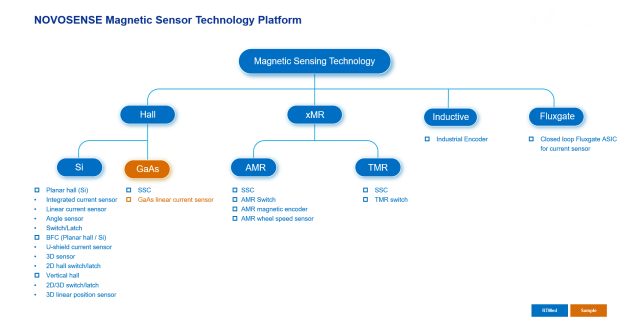
NOVOSENSE Magnetic Sensor Technology Lineup
| Principle | Buying argument | Watch-out | Where it lands |
|---|---|---|---|
| Hall effect | Mature, cost-effective, wide linear range, saturation resistance; element and conditioning circuitry on one die; differential designs reject stray fields. | Lower intrinsic sensitivity; not suited to nanoamp-level power budgets. | Switches and latches, integrated and linear current sensing, automotive angle, 3D and linear position. |
| AMR | Low-power switching, high-resolution angle encoding, wheel-speed sensing. | Results depend on element materials and process maturity; NOVOSENSE can also supply the conditioning ASIC for a customer element. | Automotive wheel speed, angle encoders, low-power switches. |
| TMR | Highest sensitivity and low noise; switch current as low as 200 nA with sampling above 1 kHz; detects weak fields at longer distances. | Hall is more cost-effective where nanoamp power is unnecessary and more tolerant of strong fields. | Battery-powered meters, low-power switches, industrial level sensing; angle and position are in development. |
| Inductive | No permanent magnet, inherently insensitive to external fields, highest angular accuracy (MT6901 typical INL ±0.02°). | Needs a matching target rotor, coil or PCB structure; larger than compact Hall; rarely a drop-in replacement. | Robot joints, high-end servo, precision machinery, inductive proximity switches. |
| Fluxgate (conditioning ASIC) | System accuracy in the 0.5 percent class, offset stability, low-current detection. | Customer designs the probe, windings and module; performance depends on the full assembly. | BMS, photovoltaic inverter grid side, energy storage, leakage-current detection. |
How is current sensing chosen from a few amperes to kiloamperes?
The decision has one number at its centre: the portfolio divides at roughly 200 A. Below that point, integrated sensors route current through a conductor inside a PCB-mountable package, with measurement ranges extending to ±400 A. Above it, linear sensors work with external magnetic structures, taking total coverage to about 2,000 A.
The boundary is set by package current-carrying capability and system architecture rather than silicon: conductor cross-section, power dissipation, temperature rise, PCB current capacity and safety requirements all cap an integrated part, and beyond roughly 200 to 300 A designers move the main current onto a busbar anyway. In EV traction systems running from several hundred to more than 1,000 A, a linear sensor with an external magnetic structure simply fits the architecture. The line is moving, though — the market is already asking for integrated solutions in the 300 to 400 A range, and at the same measurement range a package that carries more current brings lower on-resistance, lower loss and less temperature rise.
For integrated devices the package is an engineering variable, not a footprint preference. Compact QFN and SOP packages serve 12 V, 24 V and 48 V systems with moderate isolation needs, while wide-body and ultra-wide-body packages serve on-board chargers, DC-DC converters and 400 V to 800 V battery platforms, with bandwidths reaching 1 MHz and 2 MHz for fast overcurrent response.
The NSM2051 pushes that logic furthest, and it is the clearest example of silicon following a standards conversation. Aimed at emerging 2,000 V photovoltaic and storage platforms, its key change lies in the package rather than the die: an ultra-wide-body outline extends creepage and clearance to 15 mm and supports a basic-insulation working voltage of 2,800 VDC and 2,000 Vrms while remaining PCB mountable, so isolated current sensing moves onto the board in place of a larger conventional module, cutting system size, external module count and assembly steps. Designers sizing insulation per IEC 60664-1 and IEC 62477-1 have to balance working voltage, pollution degree, material group and altitude (TI's application literature on clearance and creepage sets out the method), which is precisely why a package that already delivers 15 mm shifts risk from the PCB layout into the component purchase.
Above the integrated range, the external magnetic structure sets the tradeoffs. A C-core is the mature option: it concentrates the field from the target current and shields against some external interference, generally giving the best stray-field immunity and accuracy; NOVOSENSE C-core solutions have been adopted by major Chinese automotive manufacturers, and the NSM203x linear sensor pairs with an external C-core and busbar for traction measurement. The U-shaped magnetic concentrator trades some of that margin for compactness — the NSM2025 redirects the horizontal field into the vertical plane so the sensor mounts directly on the PCB, with approximately 1.5 percent full-temperature accuracy, roughly 270 kHz bandwidth, a typical 2 µs response time and operation from −40°C to 150°C. That temperature span matters as a procurement signal: under the AEC-Q100 grading scheme published by the Automotive Electronics Council, −40°C to 150°C is the harshest Grade 0 band, while Grade 1 stops at +125°C.
Coreless designs, now sampling, go furthest on size, weight and system cost and avoid core saturation and hysteresis entirely; the honest tradeoff is greater sensitivity to ambient fields, crosstalk from adjacent conductors and installation tolerance. Coreless works when sensor and busbar are designed together, using busbar slotting, differential placement, tolerance control, crosstalk compensation and magnetic-field simulation — put simply, the busbar drawing matters as much as the sensor datasheet. GaAs Hall current sensors are also sampling, aimed at designs where drift is the limiting error: GaAs elements deliver lower sensitivity drift and better full-temperature accuracy than silicon Hall, but because element and conditioning ASIC are fabricated separately and joined through multi-chip packaging and wire bonding, cost is higher than for a single-die silicon device. Targets include high-accuracy industrial current sensing, battery management, and photovoltaic and energy-storage systems.
What resolution do motion and position designs really need?
Read the encoder lineup as a ladder of accuracy, and buy the rung that matches the control loop — not the marketing headline. NOVOSENSE combines conditioning ASICs with Hall, AMR and inductive encoders, supporting on-axis and off-axis installation in robot joints, servo systems and motors. The MT6835 offers up to 21-bit resolution and is a practical replacement for optical encoders at 19 bits and below, already used in general-purpose servo motors, battery and food-processing equipment, 3D printers and other automation systems, where customers weigh cost, environmental robustness, reliability and installation complexity alongside angular accuracy.
For 19- to 23-bit requirements, the MT6901 inductive encoder is the next rung: higher system-level accuracy than Hall-based solutions, typical INL of ±0.02° and angular error held below ±0.07° from −40°C to 125°C. Because it needs no permanent magnet and is insensitive to external fields, it keeps that accuracy next to motors and high-current conductors, and compared with high-accuracy optical encoders it offers lower system cost plus the robustness of a non-optical design. Optical encoders still lead above 23 bits of effective resolution — precision cutting and machining, high-end metrology, laboratory calibration — and remain the reference used to test other encoder technologies.
The NSM350x solves a mechanical problem as much as an electrical one. Robot joints use hollow shafts so power and communication cables can run through the center, simplifying cable management and shrinking the joint; an encoder on the axis blocks that path. The NSM350x moves the sensing elements off-axis and reads a dual-track magnetic ring, using a Vernier algorithm that compares the two tracks to recover single-turn absolute angle at up to 22-bit resolution. It supports 1.28 mm, 1.5 mm and 2.0 mm magnetic pitches and 16, 32 and 64 pole pairs. Typical INL is ±0.3° after simple self-calibration and ±0.1° after constant-speed self-calibration, and that second figure carries a process requirement: stable constant-speed rotation during assembly or production calibration, usually with a coaxial motor-to-motor fixture.
Buy-side relevance: the ladder is now being priced against robot bills of material. Schaeffler, cited in Meticulous Research's humanoid actuator study, counts 25 to 30 actuators per humanoid robot before the hand is included, and Interact Analysis estimates joint actuators at 30–50% of a humanoid's BOM, with most rotary joints carrying two encoders (motor-side and output-side) per Firgelli's engineering guide. A few tenths of a degree of error or a few dollars of calibration time therefore multiply 25-fold per unit — which is why off-axis magnetic designs are displacing optics below the 23-bit line rather than at the top of the resolution range.
In automotive angle sensing, Hall is the more widely used technology, and for good reason: integrating Hall elements and conditioning circuitry on one die produces compact, reliable packages, while differential architectures and Hall's lower intrinsic sensitivity give strong immunity to external fields — which counts for a lot in electrified vehicles where high-current conductors sit close together. The MT652x family uses 3D Hall sensing to detect field changes in the XY, XZ or YZ planes for valves and actuators, and the MT6511 employs a differential Hall architecture to improve immunity to stray magnetic fields. For ride-height sensing, the planar Hall NSM3219 uses a two-wire PSI5 current interface that provides strong interference immunity, supports PCB-less sensor designs and cuts wiring and overall system cost.
Further down the stack, Hall switches and latches span low-voltage consumer, 24 V industrial and automotive requirements up to 60 V, with speed-and-direction outputs, two- and three-wire interfaces, programmable options and 3D sensing, while xMR switches serve battery-powered equipment. The NSM903x shows how much now fits in one device: planar and vertical Hall elements for X, Y and Z detection, on-chip CORDIC processing for 360° angle calculation, 3D and angle-switch modes, low-power operation, an interrupt function and I2C, for joysticks, wearables, smart crowns and position switches.
Which four misconceptions cost the most engineering time?
- "Magnet-free is automatically better." Removing the magnet buys field immunity, not a shorter design cycle. As NOVOSENSE puts it, "What matters more are the resulting system-level characteristics" — and inductive designs need a matching target, coil or PCB structure.
- "The datasheet number is the system number." Fluxgate performance depends on the customer-designed probe, windings and module; high-precision current sensors only reach approximately 1 percent across the operating temperature range after three-temperature calibration; coreless accuracy is co-authored by the busbar drawing.
- "TMR is too new for safety-relevant positions." "Functional-safety capability is not determined directly by whether a product uses Hall, AMR or TMR technology", NOVOSENSE notes. TMR already has years of volume production in automotive angle sensing, industrial level sensing and low-power switches — comfortably more than two years of field history — and automotive TMR parts are qualified to standards such as AEC-Q100, evaluating element, ASIC, package and interconnects together.
- "The part we know is the part we need." Component makers' selection guidance published in Machine Design's 2026 sensor-selection feature warns that engineers frequently default to reed switches or basic Hall sensors out of familiarity rather than fit, even where newer magnetoresistive designs cut current draw and improve stability across temperature.
What does the calibration chain actually cost?
Five sensing principles only help if each one is backed by more than a sensing element. What an engineer receives — accuracy over temperature and over the life of the part — is a property of the whole chain: element, signal-conditioning ASIC, package, calibration and production test. Asked which link was hardest to build, NOVOSENSE pointed to the sensing elements: AMR and TMR elements demand long-term work on materials, physical mechanisms, manufacturing processes and reliability, and relatively few suppliers have real capability there. Calibration is the other link that separates products.
Three-temperature calibration shows what that means on the production floor. Each device is stabilized at low, room and high temperature, a known current or field is applied, offset and sensitivity errors are measured, and compensation coefficients are calculated, written to the part and verified. That is how high-precision NOVOSENSE current sensors reach approximately 1 percent accuracy across the operating temperature range. It is not free: cooling and thermal stabilization take longer than heating, so temperature cycling often consumes more test time than the electrical measurements. The company is also candid that calibration retention over the operating life cannot be reduced to one universal number — it depends on the product, element, package and stress conditions, and is confirmed through product-level reliability qualification and lifetime assessment.
The same chain lets NOVOSENSE supply only the conditioning ASIC when a customer brings its own AMR or TMR element, handling amplification, compensation, waveform conditioning and interface conversion, including SPI output. Around the silicon, the company supports customers with circuit design, magnetic-field simulation, mechanical assessment and system debugging.
How should an engineer run the selection decision?
When a customer arrives with a requirement rather than a technology preference, NOVOSENSE first asks what the measurement is for and whether a production-proven solution already exists in a comparable system or adjacent industry. For new applications, the team works through range, accuracy, response time, power, interface, installation space, environment, EMC, reliability, functional safety, cost and production constraints. "The technology is selected according to these system constraints rather than a predetermined preference for Hall, AMR or TMR", the company explains. The answer often surprises the customer: a solution proven in AGVs or robot vacuum cleaners, for example, might be adapted for a robotics program to reduce cost or implementation complexity.
Translated into a decision sequence for a design review, that becomes five questions, asked in order:
- What is being measured, and does someone already build it? Search adjacent industries for production-proven parts before opening a new technology debate.
- Which quantity caps the design? Standby current, isolation distance, angular error or busbar geometry — name the one that cannot be violated.
- Where does the boundary sit? Near 200 A, near the 300 to 400 A integrated request, or above 2,000 A on a busbar; below 23 bits of effective resolution, optics is usually replaceable.
- Who owns calibration? If constant-speed self-calibration or a motor-to-motor fixture enters the line, the sensor price is only part of the bill.
- What does qualification cost? ASIL targets, AEC-Q100 grades and reliability packages decide the shortlist before sensitivity does.
Where are these parts deployed today?
In vehicles, the portfolio reaches across body systems (windows, sunroofs, tailgates, seats, wipers and headlamp adjustment), thermal management valves, powertrain current measurement from BMS main circuits and traction inverters down to on-board chargers, DC-DC converters and PFC stages, and chassis functions such as steering angle, vehicle height, pedals, wheel speed and electric power steering. Industrial deployments center on current sensing in photovoltaic, energy-storage and charging systems and on closed-loop feedback in servo and stepper systems. Consumer uses range from appliance motors to earbuds, smart crowns and wearables, where low-power Hall and TMR parts protect battery life.
Functional safety follows the product architecture, not the sensing principle. Depending on the device, NOVOSENSE provides on-chip diagnostics, signal-plausibility checks, fault-status outputs and dual-channel or redundant outputs, backed by safety documentation and development support. Examples run from ASIL A for the MT72xx and NSM101x Hall switches and latches, through ASIL B(D) for the NSM41xx wheel-speed sensors and ASIL C for the NSM3219, to ASIL D for the MT6521 and MT6511 angle sensors.
What comes next?
According to NOVOSENSE, robotics is producing the most concentrated set of new problems: humanoid and collaborative robot joints must balance angular accuracy, compact design, hollow-shaft routing, field immunity, in-system calibration and cost at once. Two gaps stand out in that account, and the one the company describes in public is calibration: high-accuracy calibration still depends on a motor-to-motor fixture, an asset most production lines do not stock in quantity. With TMR angle and position products still in development, the near-term business question is not which principle wins, but who industrializes in-system calibration first.
FAQ: short answers to the highest-frequency selection questions
Can one supplier really cover all five magnetic sensing principles?
Yes, and it is now a measurable claim rather than a roadmap. NOVOSENSE covers Hall, AMR, TMR, inductive and fluxgate across current, angle, position, speed and switch functions, and Yole Group ranks it fourth globally by shipment volume and first among Chinese suppliers, having shipped more than one billion units in 2025 with cumulative volume above 4.6 billion.
Which principle wins on standby current?
TMR. NOVOSENSE's TMR switch solutions draw as little as 200 nA while sampling above 1 kHz, which is why they appear in battery-powered utility meters and industrial equipment needing long battery life and fast response together. Metering designers usually work to a decade-scale battery budget — Keysight documents a water meter manufacturer extending battery life beyond 10 years once its power model was quantified — so nanoamp sensing currents are a system requirement, not a spec-sheet flourish.
When must I stop using an integrated package?
At roughly 200 A, where package current-carrying capability, power dissipation, temperature rise and PCB capacity take over; integrated ranges reach ±400 A, external magnetic structures extend total coverage to about 2,000 A, and beyond 200 to 300 A most designs move the main current to a busbar. Demand is already shifting toward 300 to 400 A integrated solutions.
Is inductive sensing always the most accurate option?
Below the optical ceiling, effectively yes: the MT6901 reaches typical INL of ±0.02° with angular error below ±0.07° across −40°C to 125°C, and needs no magnet. Above 23 bits of effective resolution, optical encoders still lead and remain the test reference for other technologies.
Does fluxgate accuracy depend on the chip?
Partly. NOVOSENSE supplies the conditioning ASIC while the customer designs the probe, windings and module, so a well-executed assembly typically reaches the 0.5 percent class, and a poorly executed one does not.
Sources referenced
- Yole Group, Magnetic Sensors 2026 — 2025 revenue basis and supplier shipment ranking: https://www.yolegroup.com/product/report/tmr-based-current-sensors-comparison-2026/
- Yole Group market commentary by Pierre-Marie Visse, reported by Electronic China (ASPENCORE): https://www.esmchina.com/news/14468.html
- Market Research Future, Magnetic Sensor Market (technology shares and TMR growth): https://www.marketresearchfuture.com/reports/magnetic-sensor-market-22668
- MarketsandMarkets magnetic current sensor forecast (via PR Newswire): https://www.prnewswire.com/news-releases/magnetic-current-sensor-market-worth-4-20-billion-by-2032---exclusive-report-by-marketsandmarkets-302903353.html
- Texas Instruments, Demystifying Clearance and Creepage Distance: https://www.ti.com/lit/pdf/slup419
- Infineon developer community, AEC-Q100 temperature grades: https://community.infineon.com/t5/Knowledge-Base-Articles/What-is-AEC-Q100-and-it-s-Specifications/ta-p/248018
- Meticulous Research, Humanoid Robot Actuators Market (Schaeffler actuator count): https://www.meticulousresearch.com/product/humanoid-robot-actuators-market-6957
- Interact Analysis, joint actuators as a share of humanoid BOM: https://interactanalysis.com/insight/joint-actuators-the-fundamental-component-for-humanoid-robots-power-and-dexterity/
- Keysight case study, water meter battery life beyond 10 years: https://www.keysight.com/gb/en/assets/7018-06356/case-studies/5992-3399.pdf.html
- Machine Design, sensor selection guidance: https://www.machinedesign.com/automation-iiot/article/55344149/mastering-sensor-selection-key-considerations-as-design-constraints-tighten
This piece was written by Marc Hale for the GlobalBizSight DataStories desk. For datasets, corrections or a licensing query on the selection matrix above, contact the editorial team at info@globalbizsight.com. Market-value figures quoted from third-party research firms use different scopes and cannot be summed.