
GlobalBizSight DataStories Case Review: Newegg's RTX 5090 Restock Puts the Floor at $6,599.99 — What a 3.3x Gap Over the $1,999 MSRP Signals
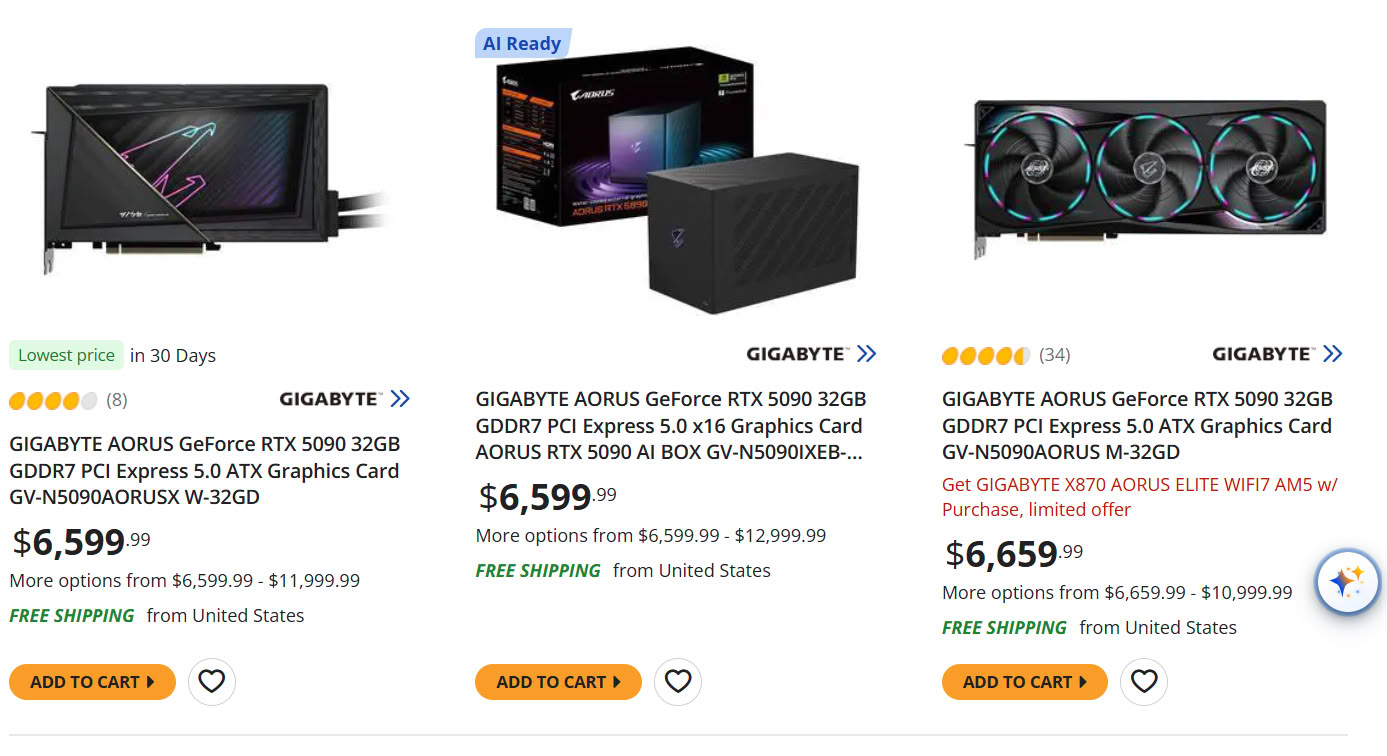
Restocks are supposed to push prices down. Newegg's latest RTX 5090 restock did not — and yet it delivered the clearest supply signal this market has produced in weeks. The cheapest self-operated card in the batch, the Gigabyte AORUS RTX 5090 Xtreme Waterforce, lists at $6,599.99, roughly 3.3 times NVIDIA's $1,999 MSRP. That is still an extreme premium, but it is down from an October street floor near $9,400. The pace of that decline, not the restock headline, is the number that matters.
What happened: a full shelf where nothing is cheap
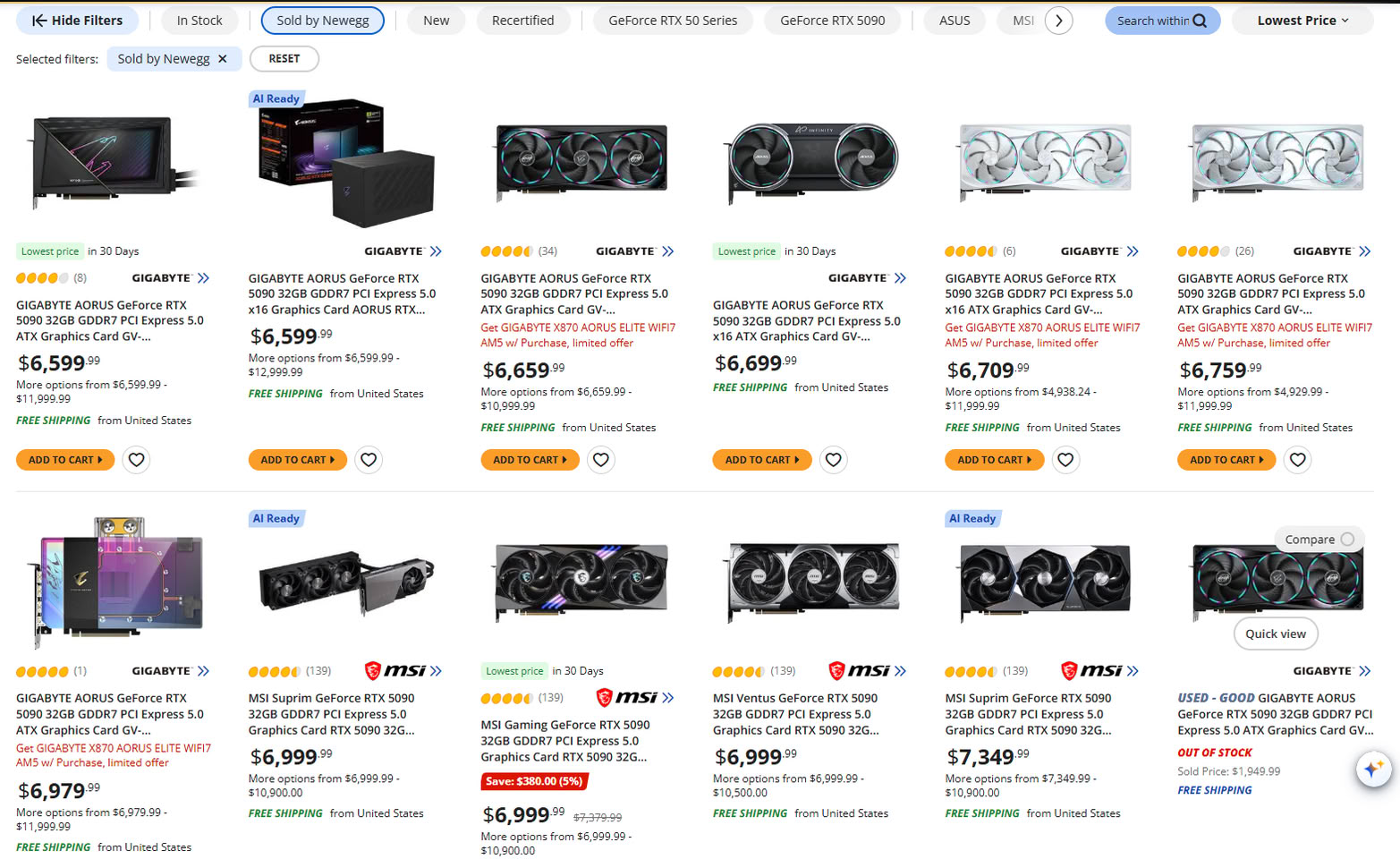
Conclusion first: this restock matters because of its structure, not its sticker prices. Every RTX 5090 in the batch is sold directly by Newegg as a first-party listing — no third-party marketplace sellers — which means these quotes reflect what the channel itself charges, with no scalper markup layered on top. That makes the lineup a rare, clean read on wholesale reality.
The batch spans ASUS, Gigabyte and MSI. The Gigabyte AORUS Master ICE sits at $6,759.99, while MSI's Gaming Trio OC, Ventus 3X OC and Suprim Liquid SOC are all priced at $6,999.99. Here is how far each card stands above the $1,999 MSRP:
| Model | Price at Newegg | Multiple of $1,999 MSRP* |
|---|---|---|
| Gigabyte AORUS RTX 5090 Xtreme Waterforce | $6,599.99 | ~3.3x |
| Gigabyte AORUS Master ICE | $6,759.99 | ~3.4x |
| MSI Gaming Trio OC / Ventus 3X OC / Suprim Liquid SOC | $6,999.99 | ~3.5x |
| ASUS ROG Astral RTX 5090 OC (current relist) | $9,490 | ~4.75x |
*Multiples calculated by GlobalBizSight from listed prices against the $1,999 MSRP.
The ASUS ROG Astral RTX 5090 OC is the case-within-the-case. It briefly appeared at $6,249.99 and sold out almost immediately; the same card is now visible again at $9,490. One SKU clearing fast at $6,249.99, then repricing to $9,490, is real-time price discovery — the market is telling you where demand actually clears, and it clears well above every currently listed card.
Why is a restock still landing 3.3x above MSRP?
Because the comparison baseline collapsed before the restock arrived. Back in October, TechSpot's survey of the US market found obtainable RTX 5090 stock was floored around $9,400, with many models held above $11,000. Against that baseline, a $6,599.99 floor is a fall of roughly 30% within a few weeks. Against the $1,999 MSRP, though, the gap has barely narrowed: 3.3 times is a structural dislocation, not a promotion.
Two details explain why the floor cannot fall much further yet. First, the ASUS Astral sellout at $6,249.99 shows that anything priced near the bottom of this range is absorbed instantly, so channels holding stock face no inventory pressure to cut. Second, Micro Center — one of the largest US retail chains — was found to have removed the RTX 5090 from its catalog entirely, which thins physical retail competition and concentrates pricing power in the few channels that still carry the card.
The root cause: GB202 allocation, not retail theater
The premium is a supply-ledger problem, and the ledger has three entries:
- Allocation shift. In early October, leakers claimed NVIDIA had cut or halted GB202 shipments to the RTX 5090 line in favor of the RTX PRO professional workstation cards. TechPowerUp quoted one leak bluntly: "No more GB202 for 5090, confirmed," followed by "all future GB202 supplies are RTX Pro exclusive."
- The official rebuttal. NVIDIA publicly denied that the RTX 5090 is being discontinued, while conceding supply is genuinely tight. By November 10, a company statement reported by Guru3D confirmed GB202 allocations and 32GB GDDR7 supply remain active — a denial that validates the demand story as much as it rebuts the discontinuation story.
- Partner-level scarcity. Unnamed partner manufacturers later said they can no longer order the GB202 core and GDDR7 memory combination the way they used to, which pushes the constraint upstream of retail and into the board partners' own procurement books.
There is also a cost-side entry the restock headlines skip: memory. Tom's Hardware reported that GDDR7 module prices had risen to around $20 per module and that fabrication and memory cost increases had lifted RTX 50-series prices by up to 30% in South Korea, pushing the RTX 5090 past $5,100 there. In other words, even partners who can secure chips are paying more for the same bill of materials. Silicon is being reallocated toward professional and data-center workloads — the same demand pull that made a $3.7 billion turbine write-down the AI power trade's first honest signal.
Buy or rent: what $6,599.99 looks like against the cloud meter
Conclusion first: at current Newegg pricing, only near-continuous users should buy; everyone else has a cheaper meter running in the cloud. RTX 5090 instances rent for roughly $0.50–$1.39 per GPU-hour — RunPod lists on-demand access from $0.89/hr varying by region up to $1.39/hr, and stock trackers caught cards as low as $0.50/hr on Vast as of November 13.
| Scenario | Rate | 24/7 hours to equal $6,599.99 | Calendar time |
|---|---|---|---|
| Own the Newegg floor card | $6,599.99 upfront | — | — |
| Rent, RunPod on-demand (upper regional rate) | $1.39/hr | ~4,750 hrs | ~198 days |
| Rent, RunPod listed floor | $0.89/hr | ~7,420 hrs | ~309 days |
| Rent, cheapest tracked stock | $0.50/hr | ~13,200 hrs | ~550 days |
Breakeven math by GlobalBizSight, based on listed rental rates. Read it as a decision rule: if your workload runs near 24/7 at a $1.39/hr rate, owning breaks even in about six and a half months and everything after is savings. If you train or render intermittently, renting wins at almost any utilization below roughly half-time. For gamers, the practical answer stays what channel observers have repeated all along — the RTX 5080, priced at a small fraction of the RTX 5090, is the only realistic tier for ordinary consumers.
What to do with this
- Analysts: track the street floor price weekly. A restock is an event; the floor is a trend.
- AI builders: run the rental breakeven above before committing capital to a card at 3x MSRP.
- Investors: treat GB202 and GDDR7 allocation statements as the leading indicator — restock headlines are lagging data.
What happens next: China's November hikes cap the downside
The near-term path is being set in China. Graphics partners there plan to raise RTX 50 series prices again this month, and wccftech reported on November 3 that high-end models were expected to climb by 1,000–2,000 yuan. When the world's largest single GPU retail market moves prices up, the global market gains little room to fall. NVIDIA's official line — RTX 5090 alive, GB202 allocations active, supply tight — describes exactly the conditions under which street prices stay detached from MSRP.
There is a quieter cost worth watching: the credibility of the list price itself. When a $1,999 MSRP coexists for months with $6,000-plus street pricing, the official number stops functioning as an anchor for buyers and starts functioning as a marketing floor — a failure mode we tracked in Singapore's 11.11 reset, where December decides who holds list price. The risk for NVIDIA is that an entire purchasing cycle gets made at 3x MSRP, resetting what consumers believe a flagship should cost.
One line for investors: in a supply-led market, the restock is the headline and the floor price is the signal — track the signal, not the headline.
FAQ
Is the RTX 5090 discontinued?
No. NVIDIA has publicly denied discontinuation, and a November 10 statement confirmed GB202 allocations and 32GB GDDR7 supply remain active. What is confirmed is tight supply — which is why Micro Center's catalog removal and partners' procurement complaints keep the speculation alive.
Why is the cheapest RTX 5090 at Newegg $6,599.99?
Three stacked factors: GB202 silicon prioritized toward RTX PRO workstation cards, GDDR7 memory cost inflation, and first-party-only stock with no third-party sellers competing the price down. The floor card, the Gigabyte AORUS RTX 5090 Xtreme Waterforce, sits at roughly 3.3x the $1,999 MSRP.
Should I buy an RTX 5090 or rent one in the cloud?
Buy only if your workload runs near 24/7. At a $1.39/hr rental rate, ownership breaks even after about 198 days of continuous use; below roughly half-time utilization, renting is cheaper at almost any rate.
Will RTX 5090 prices fall soon?
Not meaningfully in the short term. The street floor did fall about 30% in weeks — from roughly $9,400 to $6,599.99 — but the RTX 50 series hikes planned in China for this month, combined with tight GB202 and GDDR7 supply, cap any further decline toward MSRP.
Sources
- Guru3D — NVIDIA statement on GeForce RTX 5090 GB202 allocations and 32GB GDDR7 active supply (Nov 10, 2026): https://www.guru3d.com/story/nvidia-releases-statement-on-geforce-rtx-5090-gb202-allocations-32gb-gddr7-active-supply/
- TechPowerUp — NVIDIA Reportedly Ending the RTX 5090, Reserves GB202 Silicon for Workstation GPUs (Oct 10, 2026): https://www.techpowerup.com/353578/nvidia-reportedly-ending-the-rtx-5090-reserves-gb202-silicon-for-workstation-gpus
- Tom's Hardware — RTX 50 series prices jump up to 30% in South Korea; $20 GDDR7 modules push RTX 5090 past $5,100: https://www.tomshardware.com/pc-components/gpus/in-a-troubling-sign-nvidia-rtx-50-series-prices-jump-up-to-30-percent-in-south-korea-tsmc-wafer-hikes-and-usd20-gddr7-modules-push-rtx-5090-past-usd5-100
- Wccftech — NVIDIA RTX 50 GPUs Will See A Massive Price Increase In November (Nov 3, 2026): https://wccftech.com/nvidia-rtx-50-gpus-see-a-massive-price-increase-in-november/
- RunPod — RTX 5090 on-demand cloud pricing: https://www.runpod.io/gpu-models/rtx-5090
- GPUfinder — RTX 5090 rental stock tracker (from $0.50/hr on Vast, checked Nov 13): https://gpufinder.dev/gpu/rtx-5090
- MyDrivers — Newegg RTX 5090 restock coverage (Nov 12, 2026): https://news.mydrivers.com/1/1165/1165245.htm
DataStories is GlobalBizSight's column for turning market signals into decision-ready analysis. Questions or corrections: info@globalbizsight.com. Filed by Nina Roberts, APAC technology observer.