
GlobalBizSight DataStories: NVIDIA RTX 50 Price Shock — What a 370% RTX 5090 Premium Signals for Global Markets
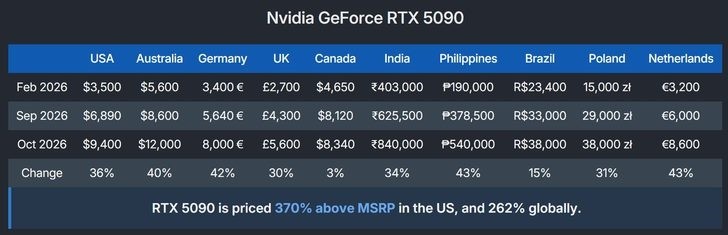
A graphics-card price table becomes a market signal when one model trades far above its launch benchmark. According to Tech Spot, the flagship NVIDIA GeForce RTX 5090 is 370% above MSRP in the United States and about 262% above MSRP globally, a gap that turns a gaming accessory into a visible stress gauge for memory supply, production allocation and demand pressure.
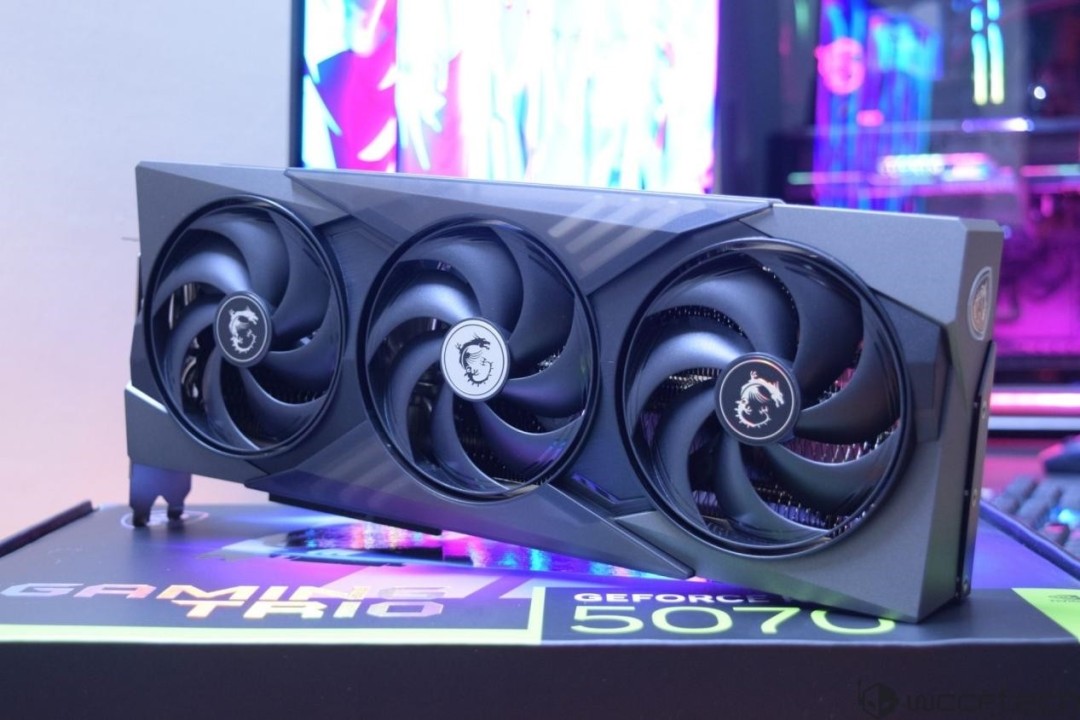
How the RTX 50 data series tells the story
The series matters because RTX 5090 has never been supplied steadily at MSRP. Tech Spot reports that US asking prices have broken US$9000, equivalent to about RMB 67834. Late last year, when the card reached US$3000 (about RMB 19944), many buyers paused; that earlier price once looked like a rational entry point, while the later price shows how quickly a premium can widen once scarcity expectations feed into resale and channel behavior.
Between February to October this year, the acceleration was concentrated. From September to October, the US average price rose 36%; Germany, Australia, Philippines and Netherlands rose by more than 40% in the same monthly window. Rumors that RTX 5090 will be gradually phased out have lifted prices further.
Model-by-model premium table
| Model | US premium vs MSRP | Global premium or price point | Commercial signal |
|---|---|---|---|
| RTX 5090 | 370% | 262%; above US$9000, about RMB 67834 | Flagship scarcity plus discontinuation talk creates the sharpest volatility. |
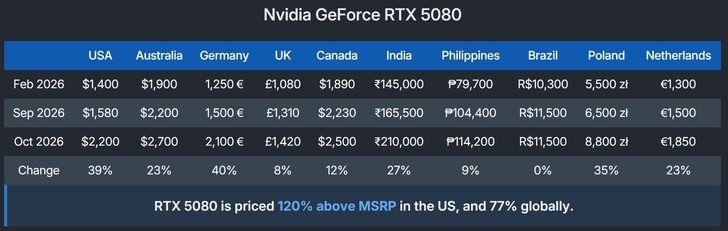
| RTX 5080 | 120% | 77%; US transaction price about US$2200, RMB 14626 | High-end buyers still absorb a large absolute premium. |
| 70 series: RTX 5070 Ti / RTX 5070 | 67% / 64% | October gain under 10% in most regions | Upper-mid range is pressured, but momentum has calmed. |
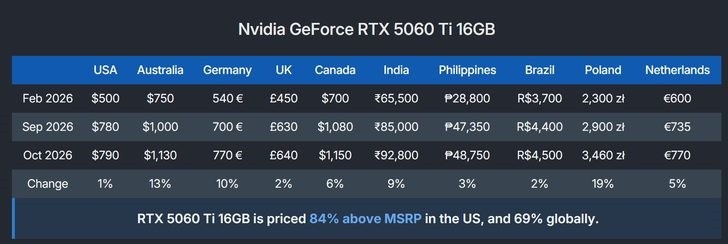
| RTX 5060 Ti 16GB | 84% | near or above US$800, RMB 5318 | 16GB configuration is most exposed to VRAM cost. |
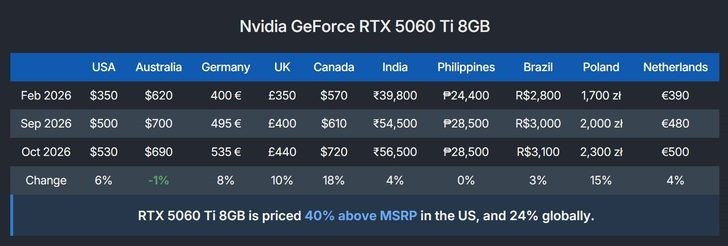
| RTX 5060 Ti 8GB | 40% | 24% global | Lower memory capacity reduces the cost shock. |
| RTX 5060 | 51% | 40% global | Mainstream demand keeps the price floor firm. |
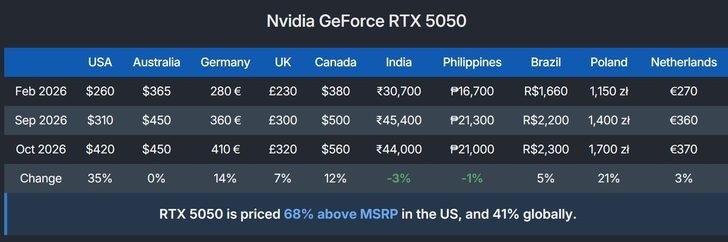
| RTX 5050 | 68% | 41% global; US$260 (RMB 1728) to US$420 (RMB 2792) | Entry tier can rise quickly from a low base. |
Overall, RTX 50 full lineup price increases in 2026 generally fall within 40% to 120%. RTX 5090 remains the outlier at 370%, and a near-term return to MSRP looks unlikely.
Official MSRP gives the premium a baseline
Public NVIDIA GeForce pages provide a useful launch anchor: RTX 5090 starts at US$1999, RTX 5080 at US$999 and RTX 5070 Ti at US$749. NVIDIA's RTX 5060 Ti announcement lists US$379 for the 8GB card and US$429 for the 16GB card. With those baselines visible, a US$9000 street price for RTX 5090 or a US$800 price for RTX 5060 Ti is not merely a retail adjustment; it is a multiple of an official price anchor, which is why the data reads as a supply-chain event rather than a product refresh.
Why memory supply changes the story
The asymmetry is the key clue. The 16GB version of RTX 5060 Ti shows an 84% US premium, while the 8GB version shows a 40% premium. That difference points to memory cost, not just brand demand. Industry coverage has described GDDR7 supply being diverted toward AI hardware, which raises the input-cost base for consumer GPUs and narrows the amount of memory available for board partners.
Three common misreadings
- Assuming every RTX 50 card carries the same story: RTX 5090 is a scarcity outlier, while the 70 series shows a more contained October move.
- Treating 370% as only a local scalping problem: the 262% global average premium shows a wider market mismatch across several regions.
- Believing lower models are insulated: RTX 5050 rose from US$260 to US$420, and RTX 5060 Ti 16GB moved toward US$800.
For RTX 5050, the entry-level path is especially telling. It is now difficult to buy within US$400, but it remains the lowest-priced 8GB card in the RTX 50 generation. The model had earlier been criticized for weak value; with memory and PCB costs staying high, the price is expected to climb further.
Action ideas for managers and investors
- Benchmark street prices against MSRP, not nominal price alone, because US$2200 for RTX 5080 and US$800 for RTX 5060 Ti carry different capital implications.
- Split procurement models by tier: RTX 5090 and RTX 5080 need scarcity contingency, while the 70 series may allow more scheduled buying.
- Track VRAM, PCB and logistics cost indicators, not only retail stock levels, since entry and midrange cards are now moving with input costs.
- Build regional scenarios: a 36% US monthly jump is disruptive, but more-than-40% moves in Germany, Australia, Philippines and Netherlands can hit channel margins faster.
FAQ: what the price data does and does not show
Is the RTX 5090 premium a short-term spike?
It may include short-term noise, but the evidence points to a trend. RTX 5090 has never stabilized at MSRP, and a 370% US premium plus a 262% global average premium are too broad to treat as one-country retail friction.
Should buyers simply wait?
Waiting is a price bet, not a guarantee. For RTX 5090, discontinuation rumors have already pushed prices higher. For RTX 5070 Ti and RTX 5070, the October move under 10% gives buyers more room to compare models and channels.
Does this only affect gamers?
No. Any workflow that needs GPU workstations — 3D, simulation, local inference, video editing or training — faces a higher capital base. The visible story starts with graphics cards, but the data points to AI-linked input costs moving through the wider hardware chain.
The GlobalBizSight DataStories takeaway is not that one GPU became expensive. The takeaway is that a product line has become a readable dataset: official price anchors, model-by-model volatility and regional divergence show how AI demand can transmit cost into consumer hardware markets.