
DataStories: Six Southeast Asian AI Markets Compared — Users Are Ready, Institutions Are the Cost Line
Judged market by market, Southeast Asia has no demand problem in AI. Google, Microsoft and IMDA data put weekly usage, agent deployment and worker skill above most global benchmarks. The spread that matters sits in institutional execution, and that spread behaves like a cost line: it decides which market converts 70% usage into margin and which one keeps paying for pilots it cannot retire.
Between the user-side statistics and the enterprise-side statistics of this region sits the most under-priced number in the current technology cycle: the cost of redesigning work. Read as a comparison of balance sheets rather than of enthusiasm, the dataset assembled between October 2025 and August 2026 tells a narrower story than “AI is booming here”.

Demand is measured at the user layer. Delivery is measured at the institutional layer. Those two layers are moving at different speeds in every market below.
Six markets, six different bottlenecks
The short answer: no market in the region leads on all four layers. The comparison below holds user adoption, firm redesign, policy instrument and physical constraint side by side, because a budget decision in Singapore fails on a different line than one in Ho Chi Minh City.
| Market | Strongest verifiable signal | Weak link | What a budget should fund |
|---|---|---|---|
| Singapore | 61% reported generative AI adoption; 37% agentic uptake | 13% frontier firms, against 31% in North America | Workflow redesign, not more licences |
| Malaysia | 24% Frontier Professionals; national adoption 21.8% in Q1 2026 | Only 32% see leadership consistently aligned on AI | Grant-funded commercialisation plus governance |
| Indonesia | 33% Frontier Professionals; 92% of knowledge workers use generative AI | Enterprise architecture and governance depth | Capability pipelines and assessment discipline |
| Thailand | 32% advanced users; 87% of Gemini prompts in-language | 60% prefer supporting old routines; one-third of leaders reward experimentation | Incentives that pay for redesigned processes |
| Philippines | 25% Frontier Professionals; 77% produce work they could not have made a year ago | Management layer, which carries more than twice the impact of individual mindset | Manager capability, not tool procurement |
| Vietnam | 89% of prompts in native language; proven in-production cases | Adoption speed depends on how deep the data foundation already is | Data lakehouse first, AI layer second |
What the usage data says — and what it cannot tell you
Usage is not marginal here; it is mass behavior. In its October 2025 note “Turning AI momentum in Southeast Asia into tremendous economic growth.”, Google reports that 70% of people in the region already use generative AI tools weekly, a pace it links to a potential US$270 billion contribution to the regional economy, provided adoption converts into output rather than novelty.
The enterprise side is equally strong on paper. Microsoft’s April 2025 APAC Work Trend Index said 53% of APAC leaders already use AI agents to fully automate workstreams or processes, the highest share of any region, while 52% of employees treat AI as a thought partner rather than a command box. Worker-level detail, published in the Work Trend Index updates, makes the point concrete: on June 30 Microsoft put 33% of Indonesian workers in the “Frontier Professionals” band, more than double the 16% global average; on August 4 it put Thailand at 32%; on August 10 the Philippines at 25%; and Malaysia at 24%.
Sentiment points the same way. Tech Wire Asia’s April 16 read of Stanford’s 2026 AI Index found that more than 80% of respondents in Malaysia, Thailand, Indonesia and Singapore expect AI to profoundly change their lives within three to five years, with Singapore’s reported generative AI adoption at 61% against 28.3% in the US. The July 11 brief on AI adoption in ASEAN trade finance still holds the same logic: AI moves fastest where people already see a concrete job to do and the surrounding system is dense enough to absorb it. Treating the region as still arguing about what “mature adoption” means reverses the evidence.
Where the usage figures start to mislead is depth. A cross-check from McKinsey, EDB and Tech in Asia found 46% of surveyed regional companies have moved beyond AI pilots against 35% globally, yet the same reporting noted most remain inside an experimentation trap — scaled tooling, limited P&L effect. That is the same distinction we drew when reading distribution numbers as distribution signals: reach proves willingness, never capability.
Why language fit is a performance metric, not a feature list
One reason the curve is steep is that AI stopped feeling imported. Google’s July 14 report “How Gemini is speaking the language of Southeast Asia.” says active Gemini users in the region more than doubled in a year, with Nearly 70% of prompts submitted in native languages — Vietnam at 89%, Thailand at 87%, Indonesia at 84%. Almost three in four requests arrive from mobile devices, more than 40% use voice, photos or video, and roughly 40% ask the model to generate something new instead of retrieving information.
For a decision-maker this converts into a test, not a talking point. If a vendor cannot hold Thai nuance, Bahasa structure and Vietnamese context across a multi-step task, the tool stays a curiosity regardless of benchmark scores; if it can, adoption deepens fast because the friction of working inside someone else’s interface disappears. Practical implication: in Vietnam, Thailand and Indonesia, language validation should precede licence volume. AWS and Strand Partners’ 2025 small-business survey in Vietnam reached a similar conclusion from the other direction — adoption was widespread but basic, breadth without depth.
The comparison that decides spend: 13% against 31%
The most important regional figures are not the growth ones. Microsoft Singapore made this unusually explicit in its April 29 essay “Fast AI adoption is not enough; Singapore must care about redesigning work.”: only 13% of organizations in Singapore and across Asia-Pacific qualify as frontier firms, against 31% in North America, even though enterprise uptake of agentic AI in Singapore was already 37%, in line with global peers. Adoption sat in a few functions rather than the operational core.
Malaysia shows the same split between workforce and management. Microsoft’s June 23 update, “Microsoft’s 2026 Work Trend Index: Malaysian workforce is ready for AI and organizations must keep pace.”, reported 24% of workers as Frontier Professionals and 69% producing work they could not have created a year ago — but only 32% said leadership is clearly and consistently aligned on AI.
Thailand sharpens it. The August 4 note “Microsoft Unveils Work Trend Index 2026, Guiding Thai Organizations Toward ‘Owned Intelligence’ For AI-Era Growth.” found 32% advanced users and 89% treating AI output as the starting point for their own work, yet one-third of leaders actively reward experimentation and 60% of employees feel safer using AI to support old routines than to rebuild them — what Microsoft calls the “Transformation Paradox”. The behavior is familiar: buy the new tool, protect the old process.
The Philippines is the cleanest warning for procurement-led programs. Microsoft’s August 10 release “Filipino Workers Outpace Global Peers in AI-Driven Reinvention, New Microsoft Work Trend Index Reveals.” recorded 25% Frontier Professionals, 77% producing work they could not have produced a year ago and 65% ranking critical thinking as the most important human skill in the AI era. The sharper finding sits in the management layer: organizational factors such as culture, manager support and talent practices account for more than twice the impact of individual mindset alone. Read alongside our earlier case for adoption managed as operational redesign, the conclusion is structural, not motivational.
Policy instruments compared: NAIIP, MDAG-AI and the Indonesia package
Singapore answered its own gap with machinery. IMDA’s March 2 factsheet “National AI Impact Programme: Empowering Enterprises and Workers to Transform with AI.” records SME adoption rising from 4.2% in 2023 to 14.5% in 2024 and non-SME adoption from 44% to 62.5% — and then refuses to stop there, targeting 10,000 enterprises supported over three years and 100,000 workers who are AI Bilingual. IMDA’s Singapore Digital Economy report published in October 2026 extended that series: SME adoption reached roughly 23.4% in 2025 with non-SMEs near 70.4%, according to Channel NewsAsia’s coverage. Direction is right; the SME-versus-enterprise spread is still the market to fix.
The AI for Enterprise Impact Playbook, released in May, is the more useful document for operators. Its Grain case shows product-build time cut by 80% and administrative workload down 20% — achieved only after leadership, workforce training, data governance and daily operating habits were treated as one transformation stack rather than four separate workstreams.
Malaysia’s instrument is capital-shaped. MDEC’s July 2025 release “RM2.9 Million in Strategic Grants to Advance AI and Industrial Digitalisation.” frames the goal as commercialising local AI products rather than importing them: under MDAG-AI, eligible companies can claim up to 70% of total project costs, capped at RM2 million, across foundation, enabling and application layers. Microsoft’s May 21 piece “From pilots to impact: Malaysia enters next phase of AI-driven transformation.” added the operational layer — the Malaysia West cloud region with more than 190 services generally available locally, and national AI adoption at 21.8% in Q1 2026 from 19.7% in H2 2025. The April 24 Elevate Malaysia partnership, “Malaysia deepens national AI partnership with Microsoft, expanding whole-of-nation skilling across educators, enterprises, and communities.”, supplies the workforce leg: 80,000 learners in the pilot phase plus 800,000 Malaysians previously trained through AIForMYFuture.
Indonesia’s package is scale-shaped. Microsoft’s March 12 note “Creating the Enablers for Indonesia’s AI Future.” tied 92% generative AI usage among knowledge workers to hard enablers: a US$1.7 billion cloud and AI investment commitment, an estimated US$2.5 billion of new economic value tied to the Indonesia Central region, 106,295 projected jobs, 704,342 people already skilled and elevAIte Indonesia’s target of one million AI-skilled people by 2025. One addition worth tracking: UNESCO’s Readiness Assessment process, which Indonesia was the first country in Southeast Asia to complete, gives buyers an externally audited governance signal rather than a vendor claim.
Singapore coordinates, Malaysia subsidises and Indonesia scales — three instruments aimed at the same missing middle. Google’s soft layer runs underneath all three: its October 2025 note said AI Ready ASEAN had equipped more than 800,000 young people, educators and parents with AI literacy while Gemini Academy had trained more than 290,000 teachers across Indonesia, Malaysia, Thailand, Vietnam and the Philippines, and its May 20 partnership “Accelerating AI impact in Singapore.” tied health, education, enterprise engineering and safety benchmarks together. A region does not become AI-capable by buying cloud credits.
Power and data foundations: the two hard speed limits
Infrastructure now belongs in an adoption analysis because production depends on it. Tech Wire Asia’s February 25 report “Singtel building Southeast Asia’s AI power grid through Johor.” described a physical race around Singapore, Johor and Batam: Nxera’s DC Tuas added 58MW of AI-ready capacity with more than 90% precommitted, while regional operational and pipeline capacity is expected to exceed 400MW in the mid-term. Johor’s own constraint is grid-side — roughly 825MW of operational data centre capacity against a pipeline measured in gigawatts — which turns time-to-power into the practical schedule risk for any 2026 build.
Vietnam provides the enterprise counterweight. FPT Digital’s April 7 retail summit write-up “Reshaping Vietnam’s Retai” argued that AI layered on a sufficiently deep data foundation can lift customer lifetime value by 20-30%, double conversion rates, halve the sales cycle and cut decision time by 40-60%. The instructive part is Long Chau Pharmacy: a Data Lakehouse built in 2023, AI applied to logistics and warehousing, and a 50% reduction in manual workload. That is what adoption looks like after it leaves the board slide.
Four misreadings this dataset invites
- Reading 61% against 28.3% as a capability verdict. It is a sentiment and usage comparison, not evidence of governed production systems.
- Treating Frontier Professionals as organisational maturity. Indonesia’s 33% individual band coexists with the same 13% frontier-firm ceiling that constrains Singapore and Asia-Pacific.
- Assuming grants create demand. MDAG-AI can fund up to 70% of a project; it cannot supply the data governance and workflow ownership that determine whether the project survives.
- Scoping language quality as localisation. Nearly 70% of regional prompts are already in native languages, which makes in-language reliability the entry requirement, not the differentiator.
Action guidance: how to allocate a regional AI budget
- Fund the weakest layer in each market before adding licences; adoption curves are already saturated at the user end.
- Run multi-step, in-language acceptance tests on your own workflows in Vietnam, Thailand and Indonesia before scaling seats.
- Convert public capital into governance and data work, where the payoff is durable: Grain’s 80% build-time reduction came from a single transformation stack.
- Sequence markets by constraint, not by hype — Singapore for governance-heavy deployments, Malaysia for subsidised commercialisation, Indonesia and the Philippines for workforce leverage, Thailand where redesign incentives are missing, Vietnam where data foundations already exist.
- Put an energy and capacity clause into any 2026–2027 infrastructure assumption; megawatts now gate production as much as budget does.
FAQ: the questions this comparison keeps generating
Is Southeast Asia ahead of the US on AI adoption?
On usage and sentiment, yes: Singapore’s reported 61% generative AI adoption sits above 28.3% in the US, and 70% of the regional population uses generative tools weekly. On firm-level redesign, no — 13% frontier firms across Singapore and Asia-Pacific against 31% in North America is a deficit, not a lead.
Is strong worker adoption enough to justify budget?
It is not. Thailand’s 60% who prefer supporting old routines, Malaysia’s 32% leadership alignment and the finding that organizational factors carry more than twice the impact of individual mindset all point to the same limit: the constraint sits above the user.
What do the public programmes actually change?
They change cost, not capability. MDAG-AI covers up to 70% of eligible project costs capped at RM2 million within a RM2.9 million grant pool, while NAIIP targets 10,000 enterprises over three years and 100,000 AI Bilingual workers. Both are instruments for buying time; the work still has to be done internally.
Why does a data centre story appear in an adoption analysis?
Because pilots that cannot secure capacity never reach production. With DC Tuas adding 58MW and more than 90% precommitted, and regional capacity expected to exceed 400MW mid-term, compute availability and grid timing are now adoption variables in Singapore, Johor and Batam.
What decides the next phase
The uncomfortable reading of this dataset is that the region’s enthusiasm has already done its job. Demand is proven, tools are legible in everyday language, and public money is on the table. What remains unproven is the part that shows up in cost: whether workflows, governance and accountability can be rebuilt at the pace users adopted a chat interface.
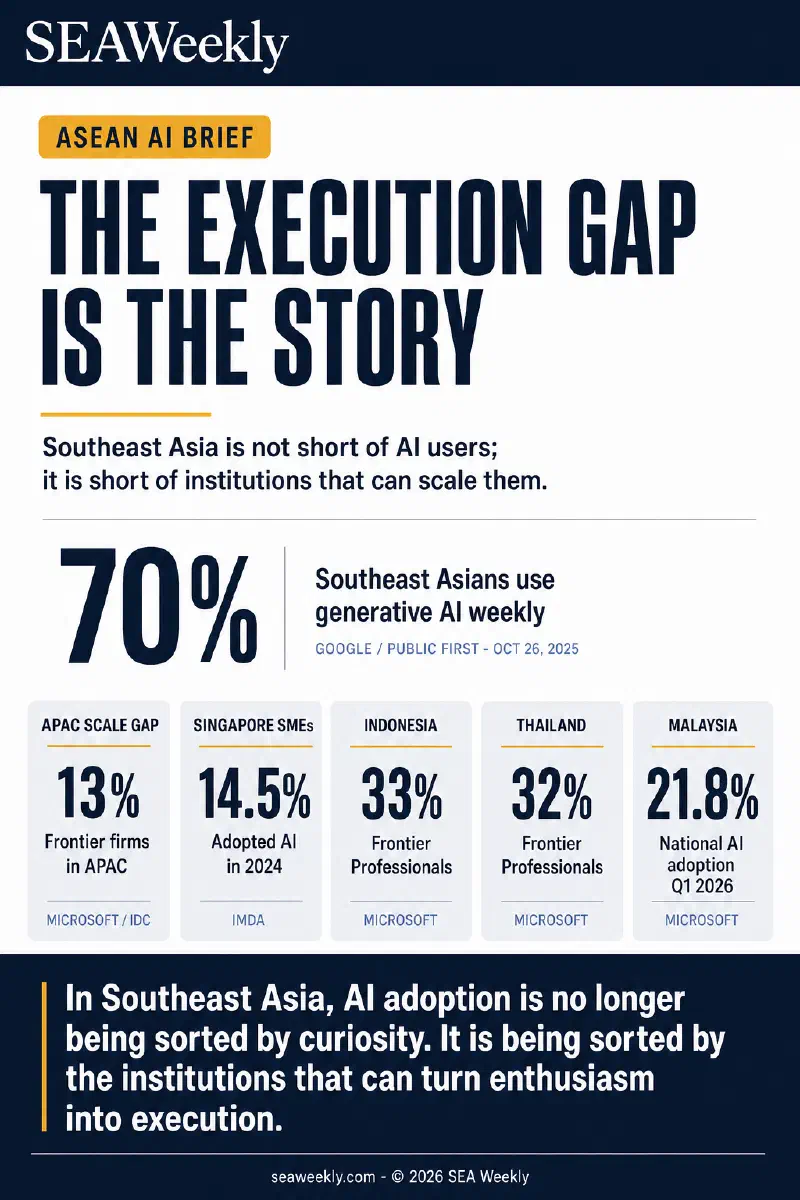
Singapore’s edge depends on converting trust and policy clarity into broad redesign rather than more pilots. Malaysia’s rests on whether grants, in-country data residency and national skilling turn a willing workforce into operational depth. Indonesia’s 92% readiness still has to be matched by enterprise architecture. Thailand and the Philippines have worker energy and unfinished management systems. Vietnam shows that where the data foundation is deep, execution moves fast. For anyone allocating capital here, one reminder: ask for the workflow map, not the licence count — usage is a marketing metric, and redesign is the only line that reaches a margin.
References
- Google (October 26, 2025). “Turning AI momentum in Southeast Asia into tremendous economic growth.” https://blog.google/company-news/inside-google/around-the-globe/google-asia/turning-ai-momentum-in-southeast-asia-into-tremendous-economic-growth/ (Accessed August 16, 2026)
- Google (July 14, 2026). “How Gemini is speaking the language of Southeast Asia.” https://blog.google/innovation-and-ai/products/gemini-app/gemini-southeast-asia-report-2026/ (Accessed August 16, 2026)
- Google (May 20, 2026). “Accelerating AI impact in Singapore.” https://blog.google/company-news/inside-google/around-the-globe/google-asia/singapore-government-partnership/ (Accessed August 16, 2026)
- Tech Wire Asia (February 25, 2026). “Singtel building Southeast Asia’s AI power grid through Johor.” https://techwireasia.com/2026/02/singtel-sovereign-ai-infrastructure-southeast-asia-johor/ (Accessed August 16, 2026)
- Tech Wire Asia (April 16, 2026). “Southeast Asia leads the world in AI optimism. Its governance frameworks are nowhere near ready.” https://techwireasia.com/2026/04/southeast-asia-leads-the-world-in-ai-optimism-its-governance-frameworks-are-nowhere-near-ready/ (Accessed August 16, 2026)
- IMDA (March 2, 2026). “National AI Impact Programme: Empowering Enterprises and Workers to Transform with AI.” https://www.imda.gov.sg/resources/press-releases-factsheets-and-speeches/factsheets/2026/national-ai-impact-programme (Accessed August 16, 2026)
- IMDA (May 21, 2026). “New Playbook Charts a Clear AI Transformation Path for Local Enterprises.” https://www.imda.gov.sg/resources/press-releases-factsheets-and-speeches/factsheets/2026/new-playbook-charts-a-clear-ai-transformation-path-for-local-enterprises (Accessed August 16, 2026)
- Microsoft Source Asia (April 30, 2025). “APAC emerges as global AI frontrunner: Region’s businesses lead worldwide intelligent agent adoption.” https://news.microsoft.com/source/asia/2025/04/30/apac-emerges-as-global-ai-frontrunner-regions-businesses-lead-worldwide-intelligent-agent-adoption/ (Accessed August 16, 2026)
- Microsoft Source Asia (March 12, 2025). “Creating the Enablers for Indonesia’s AI Future.” https://news.microsoft.com/source/asia/2025/03/12/creating-the-enablers-for-indonesias-ai-future/ (Accessed August 16, 2026)
- Microsoft Source Asia (April 29, 2026). “Fast AI adoption is not enough; Singapore must care about redesigning work.” https://news.microsoft.com/source/asia/2026/04/29/fast-ai-adoption-is-not-enough-singapore-must-care-about-redesigning-work/ (Accessed August 16, 2026)
- Microsoft Source Asia (April 24, 2026). “Malaysia deepens national AI partnership with Microsoft, expanding whole-of-nation skilling across educators, enterprises, and communities.” (Accessed August 16, 2026)
- Microsoft Source Asia (May 21, 2026). “From pilots to impact: Malaysia enters next phase of AI-driven transformation.” (Accessed August 16, 2026)
- Microsoft Source Asia (June 23, 2026). “Microsoft’s 2026 Work Trend Index: Malaysian workforce is ready for AI and organizations must keep pace.” (Accessed August 16, 2026)
- Microsoft Source Asia (June 30, 2026). “Microsoft’s Work Trend Index 2026: 33% of Indonesian Workers are at the Forefront of AI Adoption.” (Accessed August 16, 2026)
- Microsoft Source Asia (August 4, 2026). “Microsoft Unveils Work Trend Index 2026, Guiding Thai Organizations Toward ‘Owned Intelligence’ For AI-Era Growth.” (Accessed August 16, 2026)
- Microsoft Source Asia (August 10, 2026). “Filipino Workers Outpace Global Peers in AI-Driven Reinvention, New Microsoft Work Trend Index Reveals.” (Accessed August 16, 2026)
- MDEC (July 2025, release dated July 8, 2025). “RM2.9 Million in Strategic Grants to Advance AI and Industrial Digitalisation.” (Accessed August 16, 2026)
- FPT Digital (April 7, 2026). “Reshaping Vietnam’s Retai” (retail summit write-up). (Accessed August 16, 2026)
- McKinsey, EDB and Tech in Asia (February 2026). “AI in Southeast Asia: An era of opportunity.” https://www.edb.gov.sg/content/dam/edb-en/business-insights/market-and-industry-reports/ai-in-southeast-asia-an-era-of-opportunity/State_of_Ai_SEA_Digital.pdf
- Channel NewsAsia (October 5, 2026). “Singapore's digital economy grows as AI adoption rises.” https://www.channelnewsasia.com/singapore/digital-economy-ai-adoption-2025-singapore-imda-6432161
- UNESCO (2025). “UNESCO and KOMINFO Completed AI Readiness Assessment.” https://www.unesco.org/en/articles/unesco-and-kominfo-completed-ai-readiness-assessment-indonesia-ready-ai