
Case File: iPhone Duo's Two-Year Sprint to Nearly 30% of the Foldable Market | GlobalBizSight DataStories
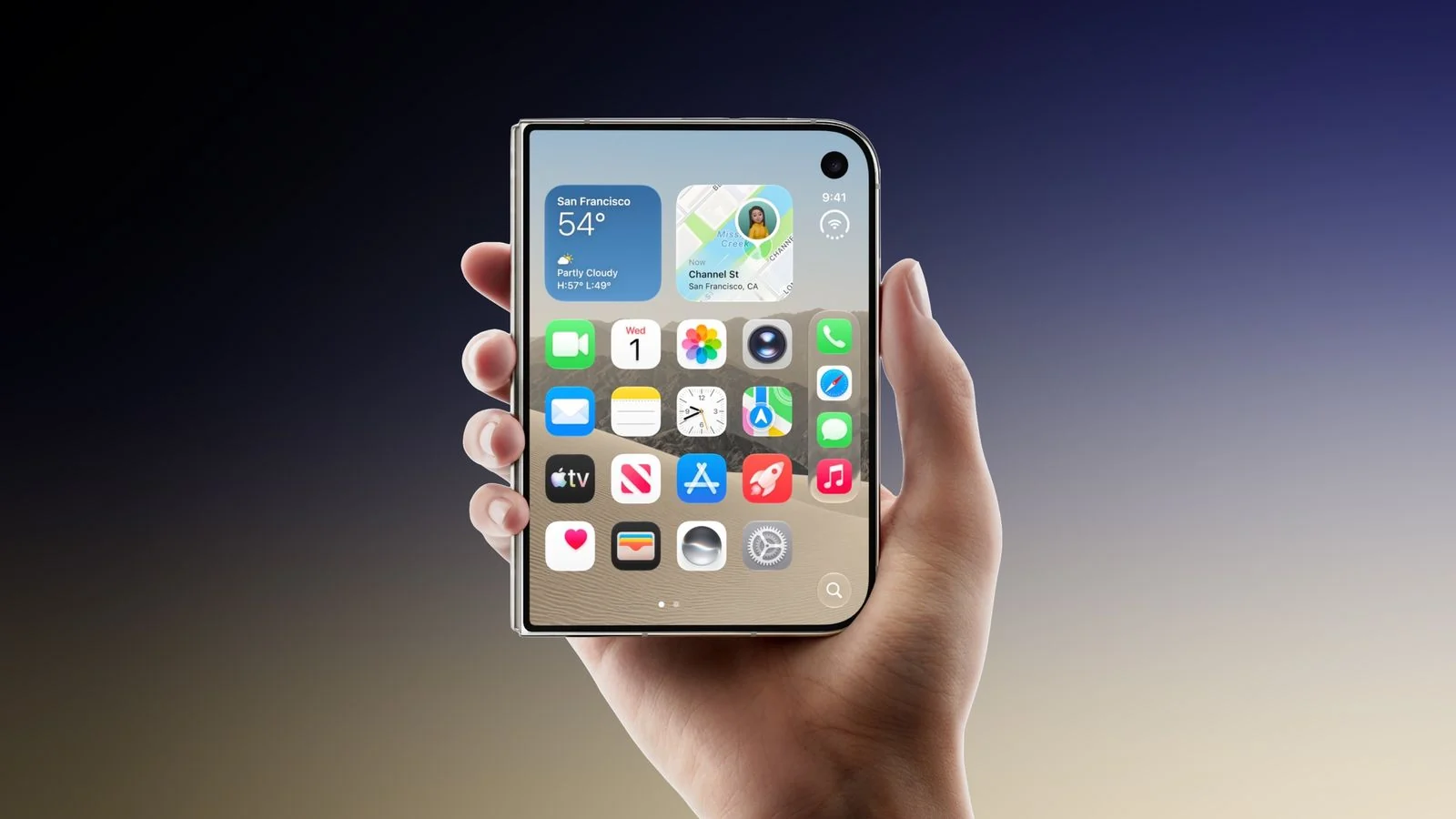
Two numbers from one research house are enough to reconstruct the whole story. TrendForce had the global foldable smartphone market growing just 0.5% in 2026 — a category that had stopped moving. In its latest update, the same firm has that market expanding 16.3% to 23.5 million units in 2027. Almost the entire delta carries one product name: iPhone Duo. This GlobalBizSight DataStories review treats Apple's entry as a case file — baseline, launch signals, forecast revision and the operating lessons a decision-maker can reuse in any category where a single incumbent walks in late.
Stage 1 — The baseline: a niche that had plateaued
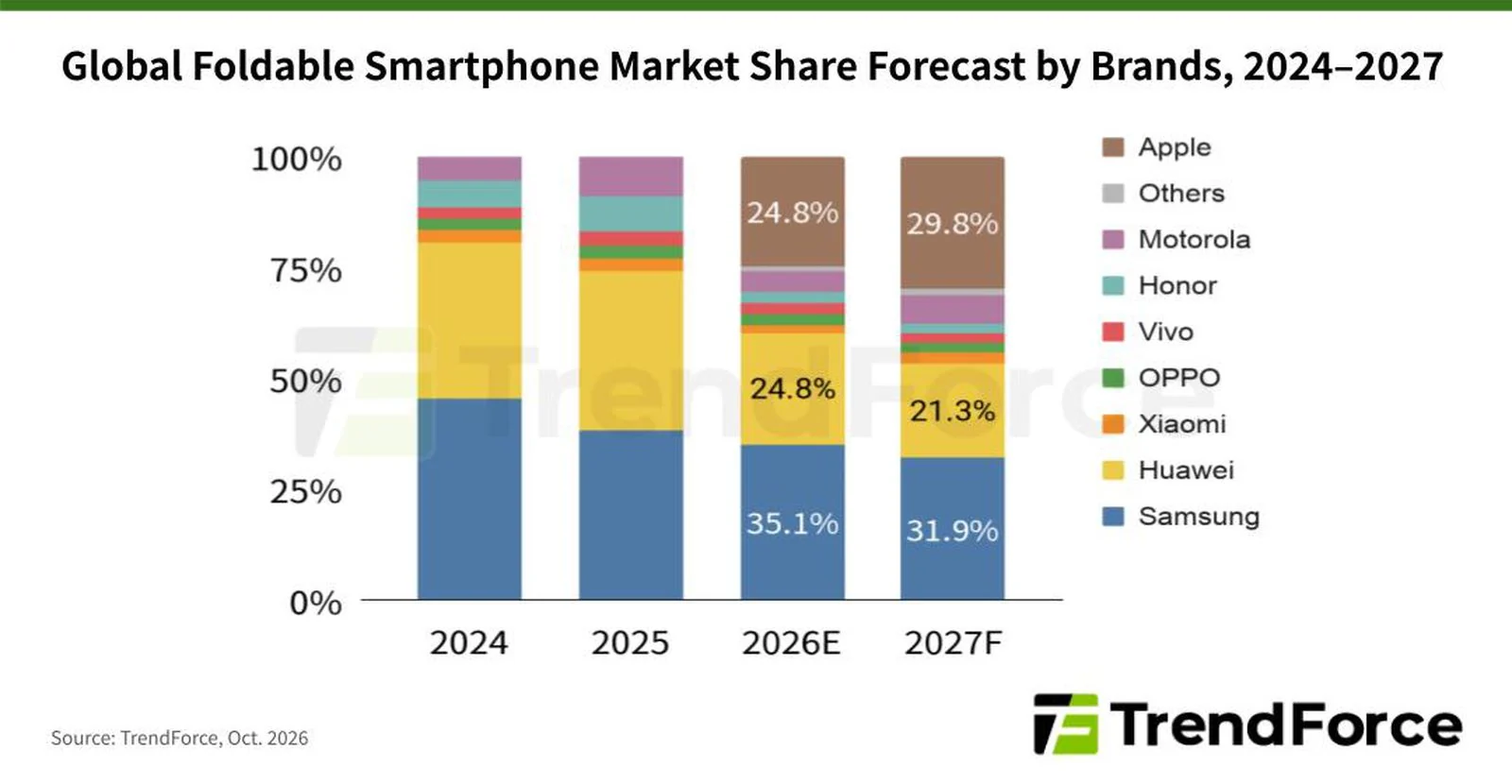
Read before the product existed, TrendForce's picture was sobering rather than exciting. The firm's pre-launch estimate had the iPhone Duo shipping around 5 million units by the end of 2026, good for a 24.8% slice of the foldable segment in its very first selling year — while several Android brands' foldable volumes were expected to contract by more than 20% year on year. Translation for a category owner: the pie was not growing, and one new entrant would still be handed a quarter of it.
The baseline itself is fragile, and that is instructive. Caixin Global's October 2026 report on smartphone pricing cited IDC's projection of 22.9 million foldable units shipped in 2026, up 12.6%, inside an overall handset market facing a record decline that year driven by memory-cost pressure. TrendForce says 0.5%; IDC says 12.6%. Both are serious houses measuring sell-in units with different channel definitions and different assumptions about Apple's ramp. The gap is a warning label for anyone modelling the foldable opportunity: treat single-source growth rates as scenario inputs, not facts.
Stage 2 — Launch: demand outran the supply plan
Apple has publicly described demand for the device as "unusually strong", and the order queues supported that language. Tom's Guide tracked Apple's own store after launch-day pre-orders sold out briskly, with estimated delivery windows slipping to as late as 25 January 2027 for buyers who missed the first wave. Caixin Global placed the device's list price at US$1,999 (¥15,999 in China), putting it in an ultra-premium band well above the typical foldable.
Three takeaways from the supply side:
- Lead time is the cleanest public demand signal when a manufacturer does not publish sell-through. A six-to-seven-week slide in delivery dates is a forecast input long before any earnings line exists.
- First-year volume is capped by yield, not by appetite. Hinge assembly and flexible-panel lamination ramp slower than conventional frames, which is why around 5 million units in 2026 coexists with sold-out pre-orders.
- A premium price narrows, rather than widens, the early funnel. The opening install base is disproportionately heavy-switching, high-income buyers — a cohort that flatters satisfaction scores but understates mainstream resistance.
Stage 3 — The revision: what the 2027 share table really says
| Vendor | 2026 foldable share | 2027 forecast share | 2027 position | Read |
|---|---|---|---|---|
| Samsung | 35.1% | 31.9% | First | Keeps the lead, but on a smaller relative base |
| Apple (iPhone Duo) | 24.8% (first selling year) | 29.8% | Second | Nearly 30% of the category from one product family |
| Huawei | 24.8% | 21.3% | Third | Loses roughly 3.5 points as the ladder re-shuffles |
The arithmetic hides a subtlety that most headline readings miss. Apple rises to second place while Samsung falls from 35.1% to 31.9% and Huawei falls from 24.8% to 21.3% — yet neither incumbent necessarily shrinks in absolute units, because the total moves to 23.5 million devices. Losing share in a market growing 16.3% is a different problem from losing share in a market stuck at 0.5%. TrendForce's forecast implies Apple would reach close to 30% of global foldable shipments within two years of shipping its first folding phone, a pace no previous entrant in this category has come near.
Stage 4 — The mechanism: integration, not the hinge
TrendForce's explanation for the re-rating is structural rather than styling: Apple's advantage lies in the joint control of silicon, operating system and developer ecosystem. In that framing, the decisive variable is not fold count or crease depth but whether applications behave sensibly when the display changes shape. Google's own engineering guidance for foldables shows how much work that is — developers are asked to handle continuous display mode across hinge angles, adaptive layouts, posture-dependent input and multi-window sessions. Android vendors have largely failed to monetise that checklist because the app surface they must persuade is enormous and fragmented. A single-vendor ecosystem can enforce the baseline far faster.
If that argument holds, the competitive axis moves from external form to multitasking productivity, software experience and — as TrendForce also notes — new AI use cases that benefit from a larger inner screen. That is the part of the forecast analysts should test hardest: it is an assumption about software, not about hardware demand.
Common misconceptions this case should retire
- Unit share equals value share. At a US$1,999 list price, a vendor taking 29.8% of units captures a materially larger share of category revenue and profit. Models built on units alone misprice the threat to Samsung and Huawei.
- One forecast is one forecast. IDC's publicly circulated outlook has Apple shipping more than 17 million foldable iPhones by 2027 and holding roughly 40% of the category, versus TrendForce's 29.8%. The honest range for Apple's 2027 foldable standing is "between a quarter and a third, with fat tails", not a single decimal.
- Hardware curiosity converts automatically into loyalty. After-sales economics decide the second purchase. Chinese media reporting on official repair price lists (Beijing Evening News) found flexible inner-display replacement priced at ¥5,499 on a Huawei tri-fold model, ¥4,500 on an OPPO Find N5 and ¥3,650 on a Xiaomi MIX Fold 3 — repair bills that many owners describe as "cheaper to replace than to fix". A foldable with weak service economics donates its second-year customers back to the slab market.
Reusable lessons by role
- Incumbent OEMs: defend the value pool, not the share chart. Differentiate on repair programmes, trade-in floors and multi-window software that does not require an app-by-app persuasion campaign.
- Component and materials suppliers: the swing factor is yield on hinges and ultra-thin flexible panels. A 0.5% category year followed by a 16.3% one is mostly a capacity-and-yield story — plan capex to the second number, but contract to the first.
- Retailers and carriers: premium foldables concentrate in high-income, high-trade-in cohorts. Bundle protection is margin insurance for the customer and for the reseller, given documented repair-price levels.
- App developers and SaaS vendors: adaptive layout work on the large inner screen is now a two-year lead-time item. The productivity use case — split views, drag-and-drop, external-canvas workflows — is where the differentiation narrative is moving.
- Analysts and investors: triangulate at least two houses, and monitor publicly visible order lead times as a proxy for sell-through, since first-party shipment disclosures will lag.
FAQ: the questions this case leaves open
Is 29.8% a demand estimate or a supply estimate?
Effectively both. It is TrendForce's view of where Apple's first-year volume lands once yield improves and a second product year ships; supply constraints, not desire, set the ceiling in 2026.
Why does the category forecast jump so sharply between 2026 and 2027?
Because 2027 prices in a full year of Apple shipments, wider app compatibility, better hinge and panel reliability, and the possibility of AI-driven use cases that make a folding screen genuinely useful.
Does Apple overtaking Huawei and closing on Samsung end the hardware race?
No. It relocates it. Samsung and Huawei still lead on thinness, hinge engineering and regional form-factor variety; what changes is that the scoring criteria shift toward software experience and multitasking throughput.
What would falsify this forecast?
A second-year Apple order book that normalises quickly after launch hype, a reliability incident cycle that pushes repair economics further into view, or an Android price-response that pulls sub-US$1,200 foldables into the consideration set. Track delivery windows, trade-in values and category average selling price rather than headline share.
The transferable finding is not "Apple wins". It is that a category can sit near flat for years — 0.5% growth in 2026 is close to stagnation — and be repriced overnight when a late entrant converts a hardware novelty into a software habit. For anyone planning products, inventory or capex around premium devices, the lesson is to watch who controls the app experience, not who folds the most times, and to model the next breakout as a scenario rather than a rounding error.