
GlobalBizSight DataStories: Inside the United States Enterprise AI Bill That Sends 89% to China Models
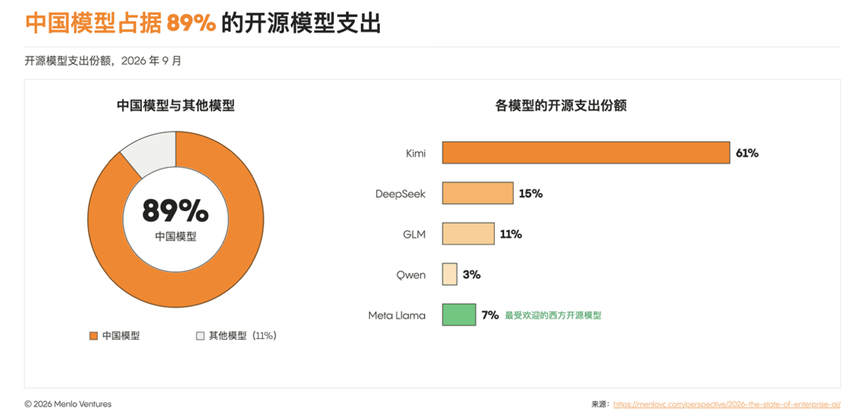
Recently, a Menlo Ventures survey of nearly 400 United States enterprise AI leaders estimates that 89% of spending on open-source large models goes to China models, with Moonshot AI's Kimi taking 61%. The Menlo Ventures 2026 State of Enterprise AI report places this shift inside a larger budget expansion: the surveyed respondents' AI spend totals over $4 billion, while enterprise AI deployment spending scaled sharply in 2026.
What does the 89% figure measure?
The number is narrower than it looks. The 89% share describes spending on open-source large models, not every dollar in the enterprise AI stack. The sample covers nearly 400 United States AI business owners who control over $4 billion in budgets. Menlo's wider market map says deployment spending reached $177 billion by September 2026, up from $33 billion. That contrast matters: the China-model result shows budget gravity inside open-weight infrastructure, not total dominance over all AI procurement.
Which models are capturing the open-source budget?
The distribution is concentrated. Moonshot AI's Kimi holds 61% of surveyed open-source model spending, and the top three models are China models. Cailian's report summary also places DeepSeek at 15% and Zhipu's GLM at 11%. The largest Western open-source model by share is Meta Llama at 7%. In other words, the question is no longer whether open models matter; it is which model family becomes the default substrate for United States enterprise workloads.
| Open-source model or group | Share | Decision signal |
|---|---|---|
| China models | 89% | Default open-weight spend in the survey |
| Kimi | 61% | Single-vendor gravity at the front |
| DeepSeek | 15% | Second China cluster beyond one product line |
| GLM | 11% | Broader China ecosystem, not only one firm |
| Meta Llama | 7% | Highest Western open-source share |
Menlo Ventures is a Silicon Valley firm with a 50-year investment history that has backed Anthropic and Uber, giving its survey weight beyond a single product claim.
Why did enterprises move toward these models?
Price is the obvious driver, but capability is the deeper reason. The report says: “As Chinese models define the open-source frontier, they account for 89% of open-source spending.” Enterprises can download open weights, adapt them to internal tasks, and avoid training every model from scratch. That approach saves time, compute and cash. It also gives a buyer leverage against a narrow set of closed vendors.
A useful case sits in common AI workloads. Menlo's broader application picture shows enterprise AI applications at $77.3 billion, coding tools at $34 billion, and enterprise chatbots at $25 billion. These are areas where volume, latency, and controlled data matter. An open model that can be fine-tuned on internal tickets, codebases or support scripts often becomes the cheaper operating choice once it performs close enough.
What changed in price and usage?
Over the past year, average open-source token pricing fell by two-thirds, from $0.45 per million to $0.13 per million. Usage rose 22.5 times in the same period, and monthly token calls reached 2,900 trillion. Open models now carry 19% of platform token volume but only 4% of enterprise model spending. That mismatch is the story: cheap models are no longer niche experiments; they are absorbing volume while staying small in total spend.
What are the common misunderstandings?
- The 89% claim is about all AI money. It is not. It is the share of open-source model spend among surveyed United States enterprises.
- Low token price means zero total cost. Evaluation, security review, fine-tuning, monitoring and integration still consume budget.
- Western open source has vanished. Meta Llama still captures 7%, showing competition exists but has not led the spend line.
- Open weights remove vendor risk. They reduce concentration on closed APIs, while creating new dependency on model maintenance and licensing practices.
What should decision-makers do now?
Treat the 89% result as a unit-economics warning, not a slogan. Map workloads that can run on open-weight models: high-volume retrieval, code assistance, ticket summarisation, document extraction and internal copilots. Keep managed or closed models for regulated workflows that require contractual assurance, audit trails or specialised safety controls. The cost sensitivity is already visible in markets: AI-related market turbulence has made budget owners more focused on whether each token creates enough business value.
For CIOs, the practical answer is layered governance: a small benchmark set for each candidate model, a data-residency review before deployment, and a quarterly spend model that separates token cost from total operating cost. A model's low price is only useful if it stays low after human oversight and integration are counted.
Frequently asked questions
Does 89% of United States enterprise AI spending go to China models?
No. The 89% figure is the share of spending on open-source large models, according to Menlo Ventures' survey of nearly 400 United States AI business owners whose budgets total over $4 billion.
Which China model leads the surveyed open-source spend?
Moonshot AI's Kimi leads with 61%. DeepSeek is reported at 15% and Zhipu's GLM at 11%, while the top three are China models.
Why did open-model usage grow so quickly?
Over the past year, average token prices fell by two-thirds, from $0.45 to $0.13 per million, while usage rose 22.5 times to 2,900 trillion monthly token calls. Cheaper calls made broader production use easier.
Does this mean closed-model vendors lose?
Not necessarily. Closed vendors still serve workloads where accountability, deep integration, or proprietary performance matter. The shift is strongest where enterprises need volume and control.
References
- Menlo Ventures, 2026: The State of Enterprise AI
- Cailian, enterprise AI spending and China model share summary
- Dealroom, Chinese models take 89% of United States enterprise open-source AI spend
By Isla Sanders, GlobalBizSight DataStories. Contact: info@globalbizsight.com