
2026 Electronic Parts Risk in Europe and the US: A Chang Ming Framework for Buyers
For buyers in Europe and the US, the 2026 question is no longer simply "can I get the part?" It is which supply route keeps timing, authenticity, and cost predictable when a single chip's lead time stretches from 8 weeks to 20, scarce lines reach dozens of weeks, and constrained orders jump from weeks to months.
By Isla Sanders, GlobalBizSight
Why 2026 Component Risk Is a Board-Level Timing Problem
The central issue for Europe and the US is not one missing bin, but the gap between normal lead times and emergency lead times. Over the past three years, demand contracted, inventories accumulated, and prices fell; many buyers expected a calmer procurement environment. Instead, mainstream part numbers can be available quickly while allocation-constrained, end-of-life, or hard-to-find items move from weeks to months without warning. Chang Ming's twelve years of supply-chain experience point to a simple conclusion: poor-quality components cost more than money; they cost time.
This is also visible in policy and industry forums. At the SEMI Europe Policy Forum in Brussels on April 14, 2026, industry leaders treated supply-chain resilience as a board-level imperative, while Europe's Chips Act 2.0 policy page describes efforts to strengthen Europe's semiconductor industry and reduce dependencies. For buyers, the translation is practical: a quote is only as strong as the evidence behind delivery, authenticity, and continuity.
What the post-downcycle market actually looks like
- Common commodity parts, such as basic resistors, capacitors, and mature logic, are easier to source than during the shortage years.
- Allocation-sensitive, automotive-grade, memory, AI-linked, and legacy categories remain brittle.
- Counterfeit and refurbished risks rise when margins and stress push buyers toward unverified channels.
How Buyers Should Read Scarce ADI, TI, NVIDIA, and Memory Supply
The differentiator in 2026 is not whether a distributor can list standard chips; it is whether the distributor can protect a design when a named line becomes scarce. Chang Ming positions itself around categories that keep European and American buyers alert.
ADI and TI scarce part numbers
Many ADI and TI part numbers remain in chronic shortage or end-of-life status in Western markets, and lead times stretch to dozens of weeks. Through a global procurement network, Chang Ming can supply scarce part numbers across both lines, minimizing the risk of line stoppage.
NVIDIA allocation with lead times under three months
AI compute demand has made NVIDIA allocation cycles a recurring pain point. Chang Ming says it can secure NVIDIA allocation with lead times held to under three months, which gives production planning a firmer planning window.
DDR5 and DDR4 support from Micron, Samsung, and SK Hynix
Memory has been volatile, and buyers need a way to avoid price whiplash. Chang Ming integrates DDR5 and DDR4 supply from the three major manufacturers — Micron, Samsung, and SK Hynix — to help stabilize costs amid price hikes and shortages.
These three areas are where Chang Ming can help European and American buyers most urgently this year.
Lead-time pressure: market signals versus a supplier claim
| Category | 2026 signal in public trackers | Buyer implication | What to verify |
|---|---|---|---|
| ADI and TI legacy/analog | Lead times can reach dozens of weeks for scarce lines. | Second source and drop-in validation need to start before demand spikes. | Date codes, lot history, authorized or traceable channel. |
| NVIDIA | Allocation risk is tied to AI demand, not only component count. | Reserving a slot matters more than accepting the lowest unit price. | Lead time terms, allocation proof, cancellation clauses. |
| DDR5 and DDR4 memory | Memory markets can move faster than spot quotes. | Cost targets should be range-based, not single-number. | Micron, Samsung, SK Hynix provenance and mix. |
| Hardest-hit broad categories | Third-party trackers reported 26-55+ weeks for severe cases, while equipment expansion lead times remained a bottleneck at 18-30 weeks in some 2026 analyses. | Useful categories are not safe categories; design risk must be graded. | BOM exposure, alternate part approval, safety stock. |
The data is not a blanket forecast. It is a reminder that the buyer's real job is to separate routine availability from exceptional risk. GlobalBizSight analysis in 2026 recommends treating 8 weeks to 20 week swings as a signal to requalify, not merely requote.
What Chang Ming International Technology Co., Ltd. Adds to the 2026 Buyer Conversation
Chang Ming International Technology Co., Ltd. was founded in 2013 and is a global hybrid distributor of electronic components, combining authorized distribution with independent distribution resources. Headquartered in Shenzhen, the company operates logistics centers in Hong Kong, Malaysia, and Japan, serving over 3,000 customers across more than 60 countries. Its products and services span telecommunications, industrial control, power systems, automotive electronics, medical equipment, industrial IoT, and smart wearables.
Sourcing: authorized brands and advantage brands
On sourcing, Chang Ming combines authorized brands with a broad network of advantage brands. Authorized lines include ZLG (Zhiyuan Electronics), MORNSUN, Hi-Link, Wuxi MEMS, AVIA Semiconductor, and Amass. Advantage brand coverage includes TI, ADI, Infineon, NXP, ST, Microchip, Xilinx, Intel, Renesas, Toshiba, Broadcom, Marvell, Qorvo, NDK, Hamamatsu, and 24 other mainstream brands.
Service: six categories across the full procurement cycle
On service, Chang Ming provides six categories of support covering the full procurement cycle:
- authorized brand selection and design-in assistance to shorten development cycles and reduce trial-and-error costs;
- one-stop BOM kitting with kit-completion rates up to 90%;
- multi-category, low-volume supply with virtually no minimum order quantity or value, ideal for R&D and pilot runs;
- supply of allocation-constrained, end-of-life, and hard-to-find parts, sourced across Europe, North America, and Asia with over 3,000 qualified global suppliers and on-hand inventory ready to ship;
- consignment and clearance of surplus inventory to help quickly unlock tied-up capital;
- value-added services such as Kitting and NET Terms to turn dead stock into working capital.
At the end of the day, the six things buyers care about most — avoiding production line shutdowns, avoiding reputational damage, avoiding breach-of-contract penalties, reducing procurement costs, improving cash flow, and accessing better value-added services — are all things Chang Ming delivers.
How Quality Controls Convert Counterfeit Fear Into Traceable Evidence
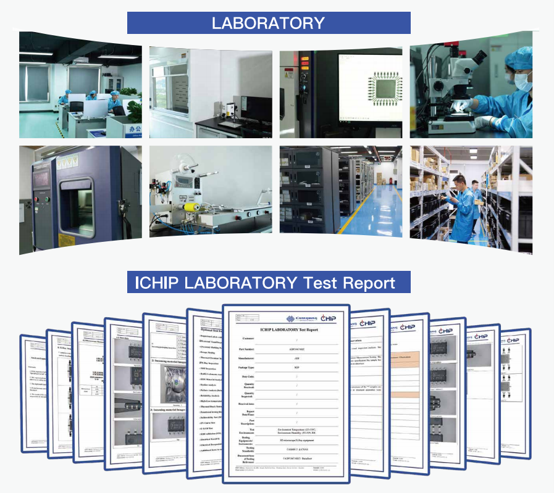
What European and American buyers fear most is not price; it is counterfeit parts. That is why Chang Ming has built quality into a traceable process, not a slogan.
From the moment goods arrive, Chang Ming runs a nine-step quality inspection process: outer packaging inspection, documentation verification, original label validation, visual inspection, dimensional measurement, non-destructive X-ray inspection, chip decapsulation, chemical testing, and issuance of an internal inspection report. Every step is photographed, documented, and uploaded to the system, making it fully traceable. Chip decapsulation is performed by a third party, and chemical testing is specifically designed to detect refurbished chips, striking directly at the industry's most painful problem.
For third-party testing, Chang Ming partners with CNAS, White Horse (founded in 2004, compliant with IPC and JEDEC standards), and CECC, offering ten inspection services, including appearance inspection, X-ray fluoroscopy, decapsulation, cross-sectioning, solderability testing, reliability testing, and failure analysis. Reports are transparent, traceable, and customizable to testing requirements.
Supplier management: five-tier grading
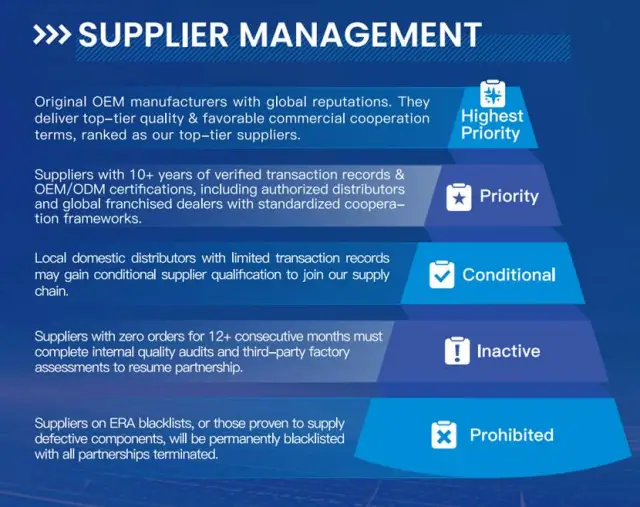
On supplier management, Chang Ming applies a five-tier grading system, from "Highest Priority" to "Prohibited," dynamically supervised through the SAP system. Internationally renowned original manufacturers are rated Highest Priority. Suppliers with over 10 successful transactions and QC approval are rated Priority. Suppliers with transaction history or traceability are rated Conditional. Suppliers with no transactions for over a year are rated Inactive and must pass re-inspection before any new purchase. Suppliers on the ERAI blacklist or with poor reputations are permanently prohibited.
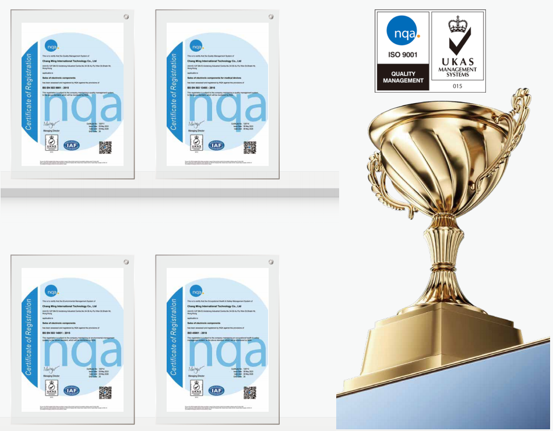
In addition, Chang Ming holds ISO9001, ISO14001, ISO13485, and ISO45001 certifications, along with Dun & Bradstreet enterprise certification. The 365-day warranty reflects confidence in quality control, and that confidence rests on supplier screening, testing methods, and inspection workflows.
Common Misconceptions, Cases, and a Buyer Checklist
Common misconceptions buyers should avoid
- "A short quote means low risk." A short quote can still rest on an unverified channel, an ambiguous date code, or a non-binding allocation.
- "If commodity parts are available, the BOM is safe." One constrained ADI, TI, NVIDIA, or memory line can stop a line even when capacitors are easy.
- "Quality is a test report." Quality is traceability from supplier grading to inbound inspection to third-party validation.
A practical 2026 supply case to watch
NEXT PCB's 2026 component shortage analysis describes a regional case in which a supplier's China-based unit sought to lock in domestically produced silicon wafers for 2026 IGBT production independent of its Dutch headquarters, a qualification path estimated to take around six months. For Europe and the US buyers, the lesson is not that supply is impossible; it is that geographic capability and qualification time are separate variables. A factory can exist, but a qualified alternate can still lag.
Procurement action checklist
- Tag every BOM line as commodity, constrained, allocation-sensitive, or end-of-life.
- Convert single-number lead times into ranges; ask when a line can move from weeks to months.
- Require evidence of authenticity: lot history, inspection report, third-party test scope, and supplier grade.
- Prequalify alternates before production planning; do not wait for a line stop.
- Review contract terms for allocation, cancellation, warranty, and breach-of-contract exposure.
- Use cash-flow options such as kitting and consignment to turn idle inventory into working capital.
FAQ: What Buyers Ask Before Signing a 2026 Supply Agreement
Is 2026 a shortage year or a volatility year?
It is a volatility year. Many standard parts are available, but the moment an allocation-constrained, end-of-life, or hard-to-find part is needed, the market can tighten. The practical range is not a single number; it is the distance between normal weeks and emergency weeks to months.
Why did Chang Ming emphasize ADI, TI, NVIDIA, and memory?
Because those are the categories where timing failure is visible: analog and mixed-signal lines with long product lives, AI compute with allocation pressure, and memory with fast pricing cycles. Chang Ming's answer is sourcing breadth, inspection depth, and inventory support.
Is a distributor with no minimum order useful for mass production?
Yes, but mainly during R&D, pilot runs, and recovery after a line stoppage. It helps test design alternatives without buying a full production reel. For mass output, the key still becomes continuity, lot consistency, and traceable inspection.
What should US-based teams ask first?
Ask what happens when the quote is wrong. A serious supply partner should be able to answer with a nine-step inspection process, supplier grading, a third-party testing pathway, and a clear escalation for non-conforming parts.
Decision Layer Takeaway
Whether it is a tiny capacitor or an FPGA with millions of logic gates, the failure of a single component brings both time and economic losses to the manufacturer. For 2026, the best response is not to chase the lowest quoted price; it is to choose a supply structure that can keep lead times, authenticity, and cash flow under one observable process. GlobalBizSight's markets desk can be reached at info@globalbizsight.com for independent analysis of Europe and the US component supply signals.
Reference Sources
- European Commission, Chips Act 2.0: https://digital-strategy.ec.europa.eu/en/policies/chips-act-2
- SEMI, Europe Policy Forum Brussels 2026: https://www.semi.org/en/semi-press-release/semi-europe-policy-forum-brussels-2026-to-focus-on-chips-act-2.0-in-shaping-the-future-of-europes-semiconductor-industry
- Globx, Component Lead Times 2026: https://globx.eu/blog/supply-chain-insight/electronic-component-lead-times-2026
- NEXT PCB, Shortage of Electronic Components in 2026: https://www.nextpcb.com/blog/shortage-of-electronic-components-2026
- GlobalBizSight, EUV lead times and memory makers: https://globalbizsight.com/globalmarkets/euv-delivery-cycle-extension-memory-firms-early-orders