
Sector Deep Dive | Optical Interconnects: Mapping the Value Chain, Control Points and Margin Pools Behind AI's Bandwidth Wall
The short answer: this sector has crossed from demonstrations to pricing, and price is the cleanest signal available. This week’s report of the $115 billion Marvell-Lumentum deal, a $125 million Series B for Salience Labs and Voyant Photonics’ chip-scale OCS engine all point the same way. The argument over whether photonics can relieve the power wall built by copper has effectively closed. What is genuinely open is a sector-structure question: which layer of the stack a company owns, what margin that layer can hold, and how long the entry window stays open before the board is dealt out.
What actually shifted since the last OFC cycle?
Conclusion: the binding constraint moved from physics to industrial capacity. Just two years ago, while chairing a workshop panel on the sidelines of the OFC conference in San Diego, the live question was whether AI would become the killer application for silicon photonics at all. At that time, the panel report stated: “It was clear from the presentations that we are at a potential turning point for silicon photonics. But there were still challenges in terms of scaling, energy efficiency, packaging, ecosystem, and tools like EDA and third-party IP, as well as materials.”
Read today, that list is a useful inventory of what has since been cleared away and what has not. Scaling and manufacturability were resolved by foundry economics: as Woodside Capital Partners’ sector work notes, foundry economics now favor high-volume manufacturability, and Over the past year the industry moved from treating integrated silicon photonics as an emerging alternative to copper to accepting optical interconnects as a viable physical backbone for scaling next-generation AI infrastructure. Packaging, test and materials, by contrast, were not solved so much as re-scoped — they became the acquisition targets.
How big is the optical interconnect market? Reconciling the forecasts
Conclusion: every credible forecast base implies double-digit growth; the disagreement is about scope, not direction. Public market models published between 2025 and 2026 differ by nearly a factor of two on the same nominal topic, which is why GlobalBizSight treats the spread itself as the finding. The table below converts each firm’s published endpoints into an implied compound rate so the bases are comparable.
| Research house | Base value | Endpoint | Stated or implied CAGR |
|---|---|---|---|
| Grand View Research | $17.8B (2025); $20.0B (2026) | $57.7B by 2033 | ~16.4% implied |
| Coherent Market Insights | $20.00B (2026) | $57.50B by 2033 | ~16.3% implied |
| DataM Intelligence | $18.58B (2024) | $50.09B by 2032 | 13.2% stated |
| Persistence Market Research | $17.1B (2026) | $38.5B by 2033 | 12.3% stated |
| Mordor Intelligence | $18.83B (2026) | $33.28B by 2031 | 12.06% stated |
| Credence Research | $15.92B (2024) | $45.26B by 2032 | ~12.3% implied |
Three scope variables explain most of the gap. First, whether pluggable transceivers are counted as optical interconnects or only the integrated layers above them. Second, whether co-packaged optics (CPO) revenue is booked at the switch-ASIC level or at the optical-engine level. Third, whether optical circuit switching (OCS) and optical I/O chiplets are included at all. A practical planning range for the decade is roughly $33B to $58B by the early 2030s at 12% to 16% annual growth, with the low end representing a narrower component definition. For a buyer, supplier or investor, the operative metric is therefore not the total but the share a given layer can defend. A parallel data point supports that framing: Yole Group’s Photonics Packaging 2026 report projects photonics packaging roughly tripling from about $4.5B to $14.4B by 2031, with transceivers alone accounting for some $8B of that requirement — growth concentrated in assembly and test, not in the photons themselves.
How is the stack layered, and where does value stick?
Conclusion: acquirer demand from systems, silicon and hyperscaler companies sits above a six-category supply stack, and the scarce categories are the ones with the longest qualification cycles. Woodside Capital Partners’ photonics market map places that acquirer demand above the supply stack of core interconnect and enabling technologies, while adjacent applications draw on the same technology base; the map assigns companies to a primary category, marks public companies or divisions with an asterisk, and is explicitly non-exhaustive.
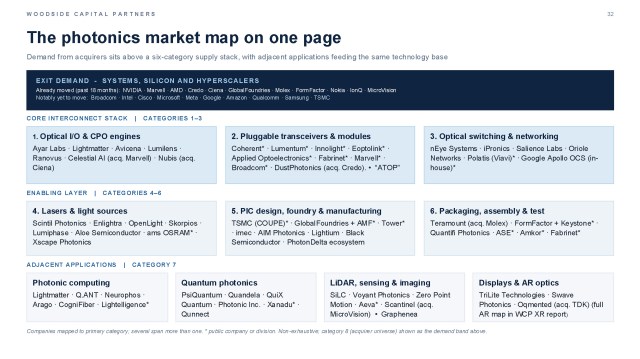
Image courtesy of Woodside Capital Partners.
Layering the map against the transaction record produces the following sector read, with GlobalBizSight’s margin and cycle assessment added in the final column.
| Control point | Function in the chain | Who has bought in | Competitive read |
|---|---|---|---|
| Lasers (InP light sources) | Generate the light; silicon cannot lase on its own | Nvidia stakes of $2 billion each into Coherent and Lumentum | Smallest supplier base, longest capacity lead time; strongest pricing leverage today |
| Optical engines | Convert and drive data between die and fiber | Marvell’s $3.54 billion purchase of Celestial AI | Bundles IP with packaging; winner determined by power per bit, not bandwidth alone |
| Optical I/O chiplets | Drop-in photonic die for accelerator vendors | Ayar Labs’ $650 million Series E at a $5.0 billion valuation | Highest optionality, highest dependence on third-party packaging capacity |
| Packaging | Align, attach and protect photonic and electronic die | GlobalFoundries, FormFactor, foundry CPO programs | Value is migrating here; qualification, not invention, sets the queue order |
| Test | Wafer-level opto-electrical screening before assembly | FormFactor and probe/interface suppliers | Least commoditized, fewest turnkey vendors; industry reporting describes it as the throughput constraint for volume ramps |
| Foundry capacity | Volume silicon photonics wafers | TSMC’s COUPE optical-engine program; GlobalFoundries | Route divergence is real: Tom’s Hardware’s August 2026 comparison of TSMC, Intel, Samsung and GlobalFoundries founds different answers to how close to compute the engine should sit |
| Switching and systems (above the stack) | CPO and OCS platforms, coherent and data-center networking | Ciena, Credo, Molex, AMD | Where revenue is recognized; where integration, not photonics, decides share |
The buyer-side validation point matters as much as the map. Nvidia said in March 2025 that its Spectrum-X Photonics family would ship co-packaged configurations delivering 100Tb/s-class switching across 128 ports of 800Gb/s or 512 ports of 200Gb/s, and StorageReview reported in August 2026 that the Spectrum-X Ethernet Photonics line had entered full production supported by a five-vendor CPO supply chain and roughly four times fewer lasers than earlier architectures. IDTechEx’s Co-Packaged Optics 2026-2036 work frames the same shift in energy terms: about 15 picojoules per bit for pluggable modules falling to roughly 5 picojoules per bit for co-packaged designs. That 3x step, not peak bandwidth, is what converts photonics from an option into a requirement once rack-level power is capped.
Why does the deal tape read as a land grab rather than consolidation?
Conclusion: prices are being set by how many layers remain unclaimed, not by discounted cash flow. A report published last month by Woodside Capital Partners, titled “The Interconnect Imperative—Why AI Is Forcing the Semiconductor Industry to Go Global”, stated: “In the space of fifteen months, Marvell paid $3.54 billion for Celestial AI; Nvidia put $2 billion each into Coherent and Lumentum—and then $3.2 billion more into Corning; Ayar Labs closed a $650 million Series E at a $5.0 billion valuation; and Credo, Molex, GlobalFoundries, Ciena, AMD, and FormFactor each bought their way into a different layer of the stack.”
The report added: “Our view is that this is a land grab for control points—lasers, optical engines, chiplets, packaging, test, and foundry capacity—and that it will not run forever. Each deal removes a control point from the board and raises the scarcity premium on what remains; but as the gaps fill, urgency will decline. For founders, the window for premium strategic exits is open now. For acquirers, the cost of waiting is compounding.”
That framing is the analytical bridge to the headline transaction: it is precisely why Marvell is interested in bringing Momentum into its already strong connectivity portfolio. Read through Woodside Capital’s lens, the $115 billion Marvell-Lumentum figure is not a bet on one product line. It is the price of removing two control points — laser source and optical engine — from the same board at once, and of closing a portfolio gap before a competitor does it asymmetrically. The corollary for valuation work is uncomfortable but practical: as scarcity premia compress, multiples earned during the scramble are not durable, and the next re-rating will be earned by volume yield and test throughput rather than by category ownership.
What do Salience Labs and Voyant Photonics show about switching?
Conclusion: the two startups demonstrate that OCS is now a manufacturing-and-interface contest, not a laboratory contest. The large Marvell-Lumentum deal is not the only signal; startups such as Salience Labs have also emerged. The company just raised $125 million in Series B funding to accelerate deployment of its optical circuit switching (OCS) technology. Its backers include Applied Ventures, AMD Ventures, and Intel Capital — a shareholder list that reads as a supply-chain map, because each corporate backer controls a layer Salience Labs must qualify through.
Vaysh Kewada, chief executive and co-founder of Salience Labs, explained in an interview why she believes this is the right moment for optical switching, how the company plans to reach volume manufacturing and commercial adoption, and why normal supply chain friction is lower for the company: its architecture is deliberately built on foundry processes able to support volume production, and it aligned with co-packaged optics manufacturing strategies early on. She also pointed to 2027 as a critical inflection year for volume production and deployment of its OCS technology.
In remarks to EE Times, Kewada said: “We’ve taken the approach of developing out an optical circuit switch that’s optical end-to-end so we’re never transforming the payload or the data into the electrical domain. The second differentiating standpoint is that we’ve chosen to take a fully integrated on-chip approach. And we’ve overcome the loss aspect of integrating optics onto the chip through the development of our own amplifiers that are also integrated on chip.”
In the same week, Salience Labs announced its funding round, and Voyant Photonics, another startup competing in the OCS space, said it is developing a chip-scale OCS engine for AI data center networks. It plans to offer customers a compact optical switching building block that can be integrated into next-generation data center switching platforms, delivered as an engine that optical networking companies can incorporate into their own platforms. Voyant is not starting from scratch: it has already developed a high-density silicon photonics switch matrix that routes light for its FMCW LiDAR systems, and instead of moving mirrors or continuous analog beam steering the architecture uses discrete, solid-state optical paths. The company said this technology is now being adapted because a data center OCS implementation uses the same fundamental architecture, which can be configured to route optical signals among communication ports.
Two commercial models therefore sit inside one category, and that difference should drive any diligence checklist: a vertically integrated switch for volume deployment (Salience Labs) versus an embedded engine sold to incumbent platform builders (Voyant). The precedent that both are chasing is hyperscaler-built. Google’s own write-up of the evolution of its Jupiter data center network describes how optical circuit switching and wavelength division multiplexing replaced the conventional Clos spine, delivering 40% less power consumption, 30% less cost and 50x less downtime than the best comparable network of its generation, with the underlying engineering published at SIGCOMM in 2022. That is the strongest available evidence that OCS economics clear at production scale — and the clearest warning that the largest buyers can build the layer themselves.
Where could this thesis break? Risks and common misreadings
Conclusion: the near-term failure modes are supply of light sources, throughput of test, and serviceability — not demand. Five risks deserve a place in any 2026-2027 plan.
- Light-source supply. Silicon photonics still requires indium phosphide lasers, and the material base is narrow. Nvidia’s $2 billion each into Coherent and Lumentum is best read as pre-purchase of source capacity; multiple industry analyses published in 2026 describe an InP capacity gap that would bind before wafers or packaging do.
- Test and assembly throughput. Photonic die must be screened optically as well as electrically, and trade reporting on silicon photonics ramps through 2026 identifies wafer-level opto-electrical test insertion as the step with the fewest turnkey vendors. If test capacity does not scale, 2027 volume dates slip for everyone in the stack.
- Serviceability resistance. Co-packaged architecture removes the swappable module. Buyers tolerate this when failure rates and field service models are proven; a single bad reliability quarter can push procurement back toward linear pluggable optics for a generation.
- Coexistence, not replacement. Copper remains superior inside the rack on cost, latency and reliability, which is why the near-term architecture is segmented: optics beyond the rack, copper within it. Anyone modeling a wholesale cutover is over-modeling the addressable share.
- Urgency decay. This is the counter-intuitive risk and it comes straight from the Woodside Capital Partners thesis: as the gaps fill, urgency will decline. Premium strategic exits are a function of unclaimed layers, so a portfolio built on the assumption of a permanent acquisition market is mispriced.
Four misreadings recur in sector commentary, and each is worth naming explicitly:
- “Optics kill copper.” The realistic picture is distance-segmented coexistence, with optical interconnects treated as the physical backbone for scale-out and longer runs.
- “Deal size proves technology.” Deal size proves scarcity; only qualification and yield prove technology.
- “Silicon photonics means silicon makes the light.” It does not, which is exactly why lasers are the most defensible control point on the map.
- “Total addressable market is the KPI.” With endpoints spanning $33B to $58B on definitional differences alone, layer share and margin defense are the usable metrics.
What should decision-makers do now?
Conclusion: buy time in the constrained layers, avoid owning the commoditized ones, and treat 2027 as the test date for every assumption. The actions below are organized by role rather than by technology.
- Infrastructure operators and cloud buyers: put a picojoule-per-bit ceiling in switch RFPs instead of a bandwidth floor, require field-replacement terms for optical engines, and dual-source laser supply now while incumbents are still competing for allocation.
- Component and module suppliers: decide whether to compete inside a layer or aggregate two adjacent layers; the aggregation route is what Marvell paid for, and the single-layer route is only survivable with a qualified foundry slot and reserved test capacity.
- Founders and executive teams: the window for premium strategic exits is open now, but acquirers are buying manufacturability, not novelty. Design to a high-volume foundry process and align to CPO manufacturing strategies early on, the same lever Kewada cites for Salience Labs.
- Investors and analysts: strip scarcity premia out of comps before extrapolating multiples, model the 2027 volume inflection as the first hard test of both Salience Labs and the broader OCS category, and monitor hyperscaler in-house programs as the principal share-risk to platform vendors.
- Everyone: track three leading indicators — CPO supply-chain vendor count, InP capacity announcements, and automated opto-electrical test solutions reaching production. Two of the three improving is the signal that the land grab is ending and the margin question begins.
Frequently asked questions
What is an optical interconnect, in one line?
A link that carries data as light rather than as an electrical signal over copper, used to break the power, reach and bandwidth-density limits that appear when AI clusters grow past what electrical traces can serve.
Why is 2027 the date the sector keeps citing?
Because volume production, not demonstration, is the gate. Salience Labs points to 2027 as a critical inflection year for volume production and deployment of its OCS technology, and foundry and CPO programs disclosed through 2026 are scheduled to reach qualification in the same window.
Is the $115 billion Marvell-Lumentum deal evidence of a bubble?
Not on its own. Under Woodside Capital’s land-grab framework, the number reflects the cost of removing several unclaimed control points before competitors do. The bubble test is what happens to multiples once the gaps fill and urgency declines.
What is the practical difference between CPO and OCS?
CPO moves the optical engine next to the switching or compute silicon to cut energy per bit. OCS reconfigures physical light paths so the network topology itself can change without electro-optical conversion. They are complementary: CPO reduces link cost, OCS reduces network rigidity.
Which layer of the stack holds margin longest?
On current evidence, light sources plus test. Both have the narrowest supplier base and the longest qualification cycle, while engines and chiplets face the most acquirer competition and the fastest commoditization.
Reference sources
- Grand View Research — Optical Interconnect Market Size, Industry Report, 2030: https://www.grandviewresearch.com/industry-analysis/optical-interconnect-market-report
- Coherent Market Insights — Optical Interconnect Market, 2026-2033: https://www.coherentmarketinsights.com/industry-reports/optical-interconnect-market
- Persistence Market Research — Optical Interconnects Market, to 2033: https://www.persistencemarketresearch.com/market-research/optical-interconnects-market.asp
- Mordor Intelligence — Optical Interconnect Market Outlook 2025-2030: https://www.mordorintelligence.com/industry-reports/optical-interconnect-market
- DataM Intelligence — Optical Interconnect Market Report 2032: https://www.datamintelligence.com/research-report/optical-interconnect-market
- Credence Research — Optical Interconnect Market Size, Growth and Forecast 2032: https://www.credenceresearch.com/report/optical-interconnect-market
- Yole Group — Photonics Packaging 2026 report: https://www.yolegroup.com/product/report/photonics-packaging-2026
- Optics.org — Photonics packaging market to triple in value by 2031: https://optics.org/news/photonics-packaging-market-to-triple-in-value-by-2031
- Google Cloud — The evolution of Google’s Jupiter data center network: https://cloud.google.com/blog/topics/systems/the-evolution-of-googles-jupiter-data-center-network
- Poutievski et al., “Jupiter Evolving”, ACM SIGCOMM 2022: https://research.google/pubs/jupiter-evolving-transforming-googles-datacenter-network-via-optical-circuit-switches-and-software-defined-networking/
- Nvidia newsroom — Spectrum-X Photonics co-packaged optics networking switches: https://nvidianews.nvidia.com/news/nvidia-spectrum-x-co-packaged-optics-networking-switches-ai-factories
- StorageReview — Spectrum-X Ethernet Photonics enters full production with a five-vendor CPO supply chain: https://www.storagereview.com/news/nvidia-spectrum-x-ethernet-photonics-enters-full-production-with-4x-fewer-lasers-and-a-five-vendor-cpo-supply-chain
- IDTechEx — Co-Packaged Optics (CPO) 2026-2036: https://www.idtechex.com/en/research-report/co-packaged-optics-cpo/1138
- Tom’s Hardware — Co-Packaged Optics foundry roadmaps: TSMC, Intel, Samsung, GlobalFoundries: https://www.tomshardware.com/tech-industry/artificial-intelligence/co-packaged-optics-cpo-foundry-roadmaps-breaking-down-tsmc-intel-samsung-and-globalfoundries-approach-to-next-generation-scale-up-connectivity
- Semiconductor Engineering — Copper’s Grip On AI Scaling Is Starting To Slip: https://semiengineering.com/coppers-grip-on-ai-scaling-is-starting-to-slip/
For sector owners inside GlobalBizSight’s SectorDeepDives desk, the takeaway is a framework rather than a forecast. Treat optical interconnects as a stack with six separately priced control points, benchmark any position against the layer it defends, and use 2027 volume dates plus laser and test capacity as the two checkpoints that will separate structural winners from scarcity-premium beneficiaries. The bandwidth wall has been answered; the allocation of profit across the stack has not, and that is where the next two years of deals will actually be judged.
Analysis by Marc Hale, GlobalBizSight. Methodology notes, the underlying control-point map and requests for a sector briefing: info@globalbizsight.com. Coverage from GlobalBizSight (https://globalbizsight.com) is provided for commercial decision-makers and does not constitute investment advice.