
How to Read Alibaba's T-Head Hong Kong Spin-off: Checklist, Signals and Pitfalls
Alibaba's November 10 disclosure signals a controlled spin-off, not a finished IPO: T-Head (Shanghai) Technology Co., Ltd. confidentially filed a Form A1 with the Hong Kong Stock Exchange on September 11, 2026, and may list H shares once the HKEX Listing Committee approves the application and China's securities regulator completes its filing review. The practical task is to track gates, evidence and value, not to celebrate a headline.
What did Alibaba disclose?
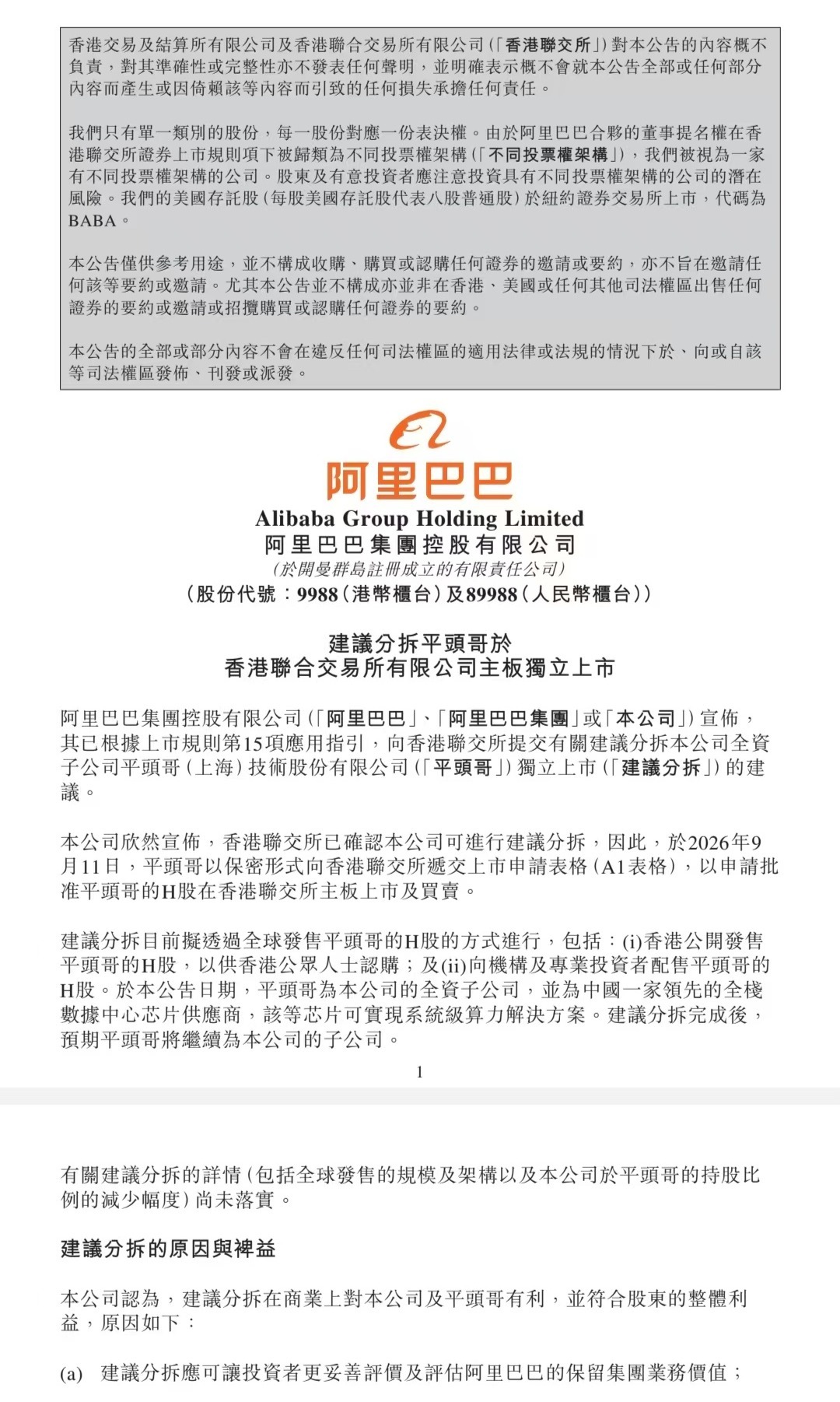
On November 10, Alibaba announced a proposed spin-off of wholly owned T-Head for Main Board listing in Hong Kong. The HKEX confirmed Alibaba may proceed. The company said T-Head submitted Form A1 confidentially on September 11, 2026. The transaction is planned as a global sale of H shares, including a Hong Kong public offering and placement to institutional and professional investors.
Alibaba states that sale size, structure and any adjustment to its stake are undetermined; approval by the HKEX Listing Committee and completion of China Securities Regulatory Commission filing remain required. After the split, T-Head is expected to remain an Alibaba subsidiary. Its current positioning is described by Alibaba as China's leading full-stack data-center chip supplier, with system-level compute solutions.
Why the company-level moment matters
The longer trend is that chip design moves from internal capability to external infrastructure only when capital, customers and governance can be separated into a trackable public business. T-Head was established in 2018 by integrating C-SKY Microsystems, acquired by Alibaba, with the chip team from DAMO Academy. It initially served Alibaba's own cloud, AI and device stack, reducing dependence on outside suppliers. The IPO path now asks a different question: can a supplier that grew inside one buyer become a credible supplier to many buyers?
The product clock reinforces the test. In September 2026, T-Head unveiled Zhenwu V900. Alibaba says it is 3x the performance of the previous-generation M890 and can support an ultra-large cluster of up to 500,000 chips for frontier model training. Production and launch are scheduled for Q1 2027. Tom's Hardware reported that Alibaba describes the chip as having 216 GB of memory and 1,200 GB/s inter-chip bandwidth. Those numbers make the roadmap legible; they do not yet prove margin, manufacturing yield, customer mix or cash generation.
How to track the spin-off as an operating checklist
Use a sequence, not a single date. Confidential applications are useful precisely because they are noisy; the signal comes from each later disclosure that narrows uncertainty.
- Confirm filing status. The Form A1 filing date is September 11, 2026; the November 10 announcement confirms the HKEX allowed the process to continue, but the full hearing package may remain private. Read Alibaba's announcement as the primary record.
- Watch the approval path. The HKEX Listing Committee must approve the listing, and the China Securities Regulatory Commission filing must be completed. The 2024 HKEX/SFC enhanced timeframe gives more clarity, but not certainty. Katherine Ng, HKEX's head of listing, said the enhanced timeframe would provide greater clarity and certainty for new listing applications, as reported by Xinhua.
- Separate scale from supply. A 500,000-chip cluster is an architectural target; check whether Q1 2027 production, packaging, power and customer deployment match the claim.
- Read revenue quality. Compare internal Alibaba demand with external customers. For a public unit, related-party sales can stabilize volume but compress bargaining power.
- Use fundraising reports as hypotheses. The Standard, citing IFR, reported a potential 2027 IPO raise of about US$2 billion to US$3 billion. Alibaba has not confirmed size or pricing; treat it as scenario input.
What each data point proves
| Signal | Verified meaning | Do not infer |
|---|---|---|
| September 11, 2026 Form A1 | An application has been made under HKEX rules; the HKEX has cleared Alibaba to proceed. | Listing approval or a price has been set. |
| November 10 announcement | Alibaba's board-level disclosure of the proposed spin-off and remaining conditions. | Alibaba ceases control after listing. |
| 3x performance versus M890 | Company-stated product step change from the previous-generation chip. | Customer adoption or gross margin. |
| 500,000 chips | A maximum support target for ultra-large cluster architecture. | A cluster already built or sold. |
| CSRC filing | PRC domestic companies seeking overseas listings need filing under the trial measures; it is a gate, not a formality. | Regulatory approval equals operational readiness. |
Common misreads
- Equating A1 filing with listing success: hearing packs, sponsor compliance and CSRC review can still delay or block the deal.
- Assuming T-Head must be sold to public shareholders soon: Alibaba's stake adjustment is not fixed, and the company expects the unit to remain an Alibaba subsidiary.
- Treating "full-stack data-center supplier" as proof of profitability: the term describes capability breadth, not standalone economics.
- Reading cluster capability as production capacity: packaging, supply chain qualification and power delivery remain separate constraints.
- Ignoring governance independence: public investors need to see how decisions, IP, procurement and pricing work when the parent remains the anchor customer.
Action advice for CompanyWatch readers
Build a company file around four measurable questions. First, when does the listing hearing package become public? Second, what share of revenue comes from outside Alibaba and how is related-party pricing governed? Third, can Zhenwu V900 reach Q1 2027 production with disclosed customers? Fourth, how much H-share liquidity will Alibaba retain? If you need a peer template for separating product narrative from capital discipline, compare this with AMD's data-center-first pivot.
A decision-maker's summary: the filing is credible because it turns a long-built internal chip unit into a disclosure regime, but it remains a gate-keeping exercise. The company watch point is not the announcement; it is the first prospectus paragraph that proves external demand, production discipline and governance independence.
FAQ: quick answers for investors and analysts
Has the IPO been approved?
No. T-Head filed a confidential Form A1 on September 11, 2026. HKEX Listing Committee approval and China Securities Regulatory Commission filing remain required.
Will T-Head stop being part of Alibaba?
Not according to the current disclosure. After the proposed spin-off, T-Head is expected to remain an Alibaba subsidiary.
What should I compare with the 3x and 500,000-chip claims?
Compare them with Q1 2027 production, named customers, cluster delivery and gross margin. A technical ceiling is useful only when converted into shipping units and recurring revenue.
Why does the Hong Kong route matter?
H-share listing gives access to international capital while keeping T-Head in the Alibaba group structure; it also makes governance, disclosure and valuation public over a longer horizon.
Reference sources
- Alibaba Group announcement: https://data.alibabagroup.com/ir_filings/HKEX/09988/en/202611102026111001061/2026111001061.pdf
- HKEX and SFC joint statement on new listing timeframes: https://www.sfc.hk/en/News-and-announcements/Policy-statements-and-announcements/Joint-Statement-on-Enhanced-Timeframe-for-New-Listing-Application-Process
- HKEX note on PRC overseas listing filing: https://en-rules.hkex.com.hk/sites/default/files/pdf_documents/faq-11.7_202405.pdf
- Xinhua coverage of the enhanced listing timeframe: http://www.xinhuanet.com/english/20241018/8356d61f0eeb4e84bda82657df3c9078/c.html
- Tom's Hardware on Zhenwu V900 specifications: https://www.tomshardware.com/tech-industry/artificial-intelligence/alibaba-unveils-zhenwu-v900-ai-accelerator-claims-its-the-most-powerful-ai-chip-in-china-accelerator-supports-500-000-chip-supercluster-with-a-10t-parameter-qwen-model-on-the-roadmap
- The Standard on the reported IPO size: https://www.thestandard.com.hk/finance/article/347954/Alibabas-chip-unit-T-Head-eyes-US3-billion-Hong-Kong-IPO-in-2027-IFR