
CompanyWatch: Ring's $250 Drone Cam and $1,000 Rover Cam — What Amazon Is Really Testing
Amazon's Ring on Tuesday unveiled the $250 Ring Drone Cam, an indoor camera that flies from one room to another and records in daylight or at night, and the $1,000 Ring Rover Cam, a patrol robot aimed at offices, warehouses and other workplaces. This is not a gadget story. It is Amazon testing whether mobile, alarm-triggered surveillance can carry Ring's next stage of subscription growth.
Read as a trend, it is the fourth step in a long sequence for home electronics: first the sensor, then the fixed camera, then software automation, and now mobility — hardware that travels to the event instead of watching one patch of wall. The GlobalBizSight CompanyWatch view is that Ring is borrowing a pattern already normal in enterprise facilities work, roving patrol, and trying to sell the household version first.
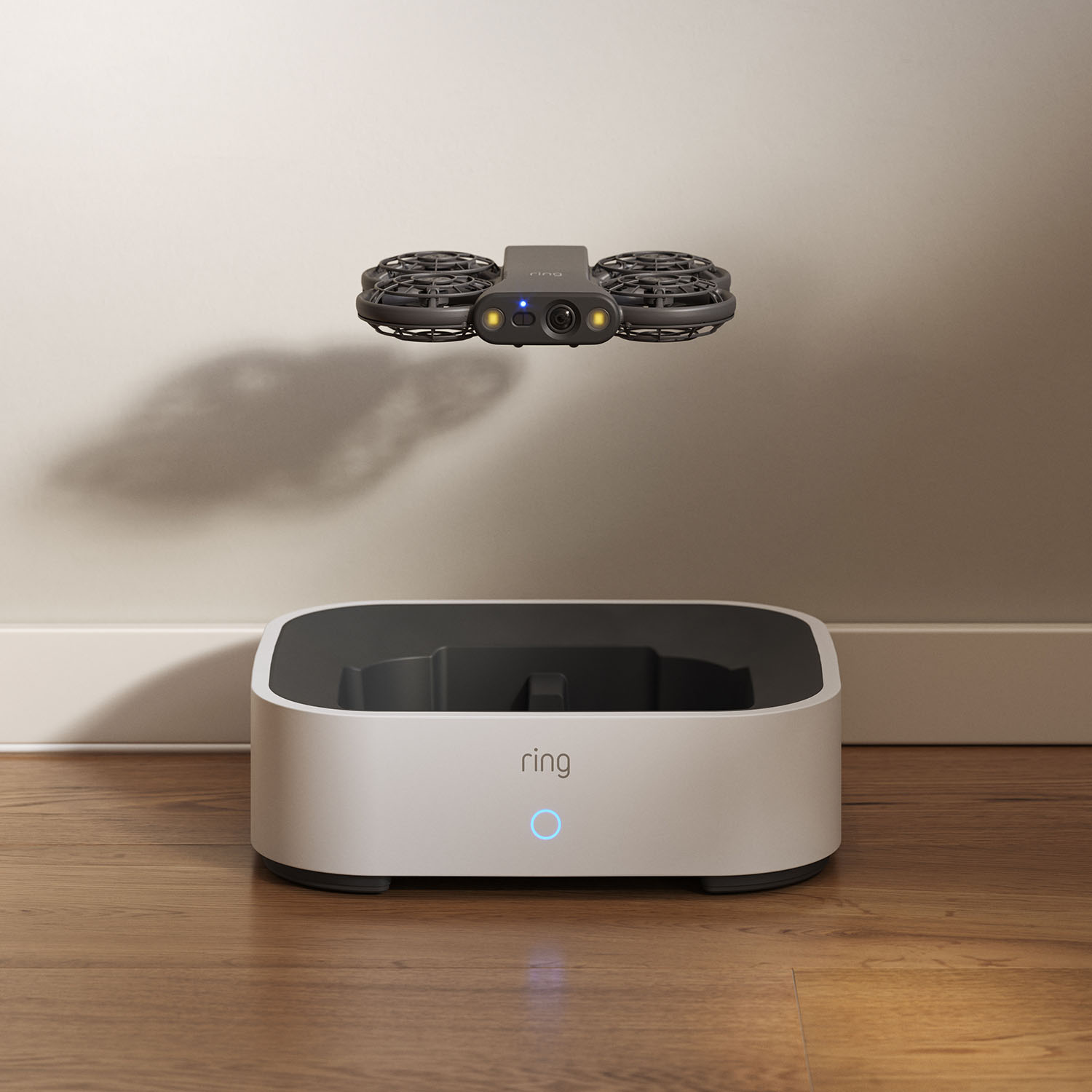
What exactly did Ring put on the table?
Two machines, one announcement cycle, and a long engineering backlog behind them. The drone was shown to press at a demonstration in New York on Monday, where Ring chief executive Jamie Siminoff positioned it as a home monitoring tool whose built-in LED lights can double as a crime deterrent.
- Ring Drone Cam, $250. A book-sized indoor drone that flies a preset route when an alarm or a sensor on a window, door or home-security device is triggered. Owners can also deploy it at any time they choose.
- Flight budget. It flies for a maximum of eight minutes each time, then returns automatically to its charging dock. Two plastic-wrapped propellers give it lift, and it emits a loud buzz going airborne.
- Ring Rover Cam, $1,000. Amazon's Astro home robot repurposed for commercial patrol of offices, warehouses and other workplaces: a display screen mounted on a two-wheel base with a retractable periscope camera, a built-in siren, two-way audio and a "light pillar" that shines at the ceiling so users can track its position.
- Shipping dates. Ring says the Ring Drone Cam ships in the United States on January 27, pending approval from the U.S. Federal Communications Commission, and that the Ring Rover Cam starts shipping to users on December 16.
Ring says it "borrowed the best parts of Astro" to build the Rover Cam, which it calls "a robot built for security". Astro itself had a short life as a commercial device and has seen few upgrades since it appeared in 2021.
One legal boundary frames the entire product: the drone cannot leave the building. Siminoff pointed to Federal Aviation Administration rules that restrict drone operation unless the aircraft stays within the operator's line of sight. "We have already told customers not to do that, because it is illegal," Siminoff said. "We have also built guardrails into it so it will not fly outside." The FAA's own guidance is written for airspace rather than living rooms, so Ring's answer was to make outdoor flight physically unavailable instead of chasing an exemption.
Why sell a camera that moves instead of cameras that stay?
Because coverage, not picture quality, is the scarce commodity. Siminoff said in an interview that the drone and the robot let users monitor multiple areas of a home or a business with one device, adding: "People like indoor cameras, but they don't necessarily want them all over the house."
The deterrence argument is the same logic in theatrical form. "If someone is walking around your house at night and your Ring doorbell motion detector goes off, imagine you see a spotlight and something fly past the window," Siminoff said. "You probably would not go into that house."
Ring devices give Amazon another route to expand influence in smart home beyond its Echo smart speakers and Eero routers. Grand View Research estimates the market's sales will exceed $200 billion this year; its published smart home report puts the 2026 base at $207.0 billion. That is fertile ground for Amazon's rivals Apple and Google as well. The narrower slice is what Ring must actually win: Grand View Research puts smart home security cameras at $13.9 billion in 2026, rising to $56.5 billion by 2033, a segment where fixed lenses already cost a fraction of this drone's price.
Two products, two very different buying cycles
| Dimension | Ring Drone Cam | Ring Rover Cam |
|---|---|---|
| Price | $250 | $1,000 |
| Buyer | Household | Facilities, warehousing, offices |
| Lineage | Previewed in 2020, then called Always Home Cam | Repurposed Astro home robot, debuted 2021 |
| Availability | January 27, pending U.S. Federal Communications Commission approval | Begins shipping December 16 |
| Competitive field | Fixed cameras from Apple, Google and Ring's own lineup | Patrol fleets such as Knightscope's |
| Binding constraint | No outdoor flight; eight minutes per sortie | Enterprise trust after the commercial Astro was wound down |
How a six-year delay shapes the credibility question
Ring previewed this drone as far back as 2020 under the name Always Home Cam, and Siminoff says he chose to hold it until Amazon could perfect the design, the sensors and the data processing. Reporting after the reveal adds detail the launch materials did not. The Verge's hands-on account describes a drone piloted by cloud-based AI, with custom flight routes and schedules, priced at $249.99 for January 27, 2027 shipment; Engadget records an aircraft weight of 165 grams. Those details matter commercially: if navigation intelligence runs in Amazon's cloud rather than on the device, every flight is a recurring cost and every household is extra load on infrastructure the company is already spending to expand.
Where the Rover Cam lands in an enterprise market smaller than the hype
Roving patrol robots are a genuine but modest business. Mordor Intelligence sized the commercial security robot market at $4.12 billion in 2026 and expects it to reach $9.33 billion by 2031 at a 17.75% annual pace. The clearest listed comparator, Knightscope, reported preliminary second-quarter 2026 revenue of roughly $9 million against about $3 million a year earlier, with its robots deployed across 42 U.S. states, and raised its full-year outlook to $32-34 million. In other words, the industry's economics run on monthly service contracts, not hardware sales.
Ring's $1,000 price tag cuts across that logic, and its ancestry is the offset. Amazon discontinued Astro for Business less than a year after that unit launched, refunding customers and retiring devices, as GeekWire reported at the time. Facility managers who watched a $2,350 robot taken out of service will ask about support horizons before they sign a patrol contract.
What Ring still has to prove: privacy, parts costs, airspace
Ring, acquired by Amazon in 2018, is known for its doorbell but has been dogged by privacy problems, chiefly its cooperation with police. It drew scrutiny again earlier this year over a controversial Super Bowl ad promoting an AI pet-finding tool called Search Party, and then cancelled its integration with Flock Safety, a police technology provider that has also faced wide pushback over automatic license-plate readers.
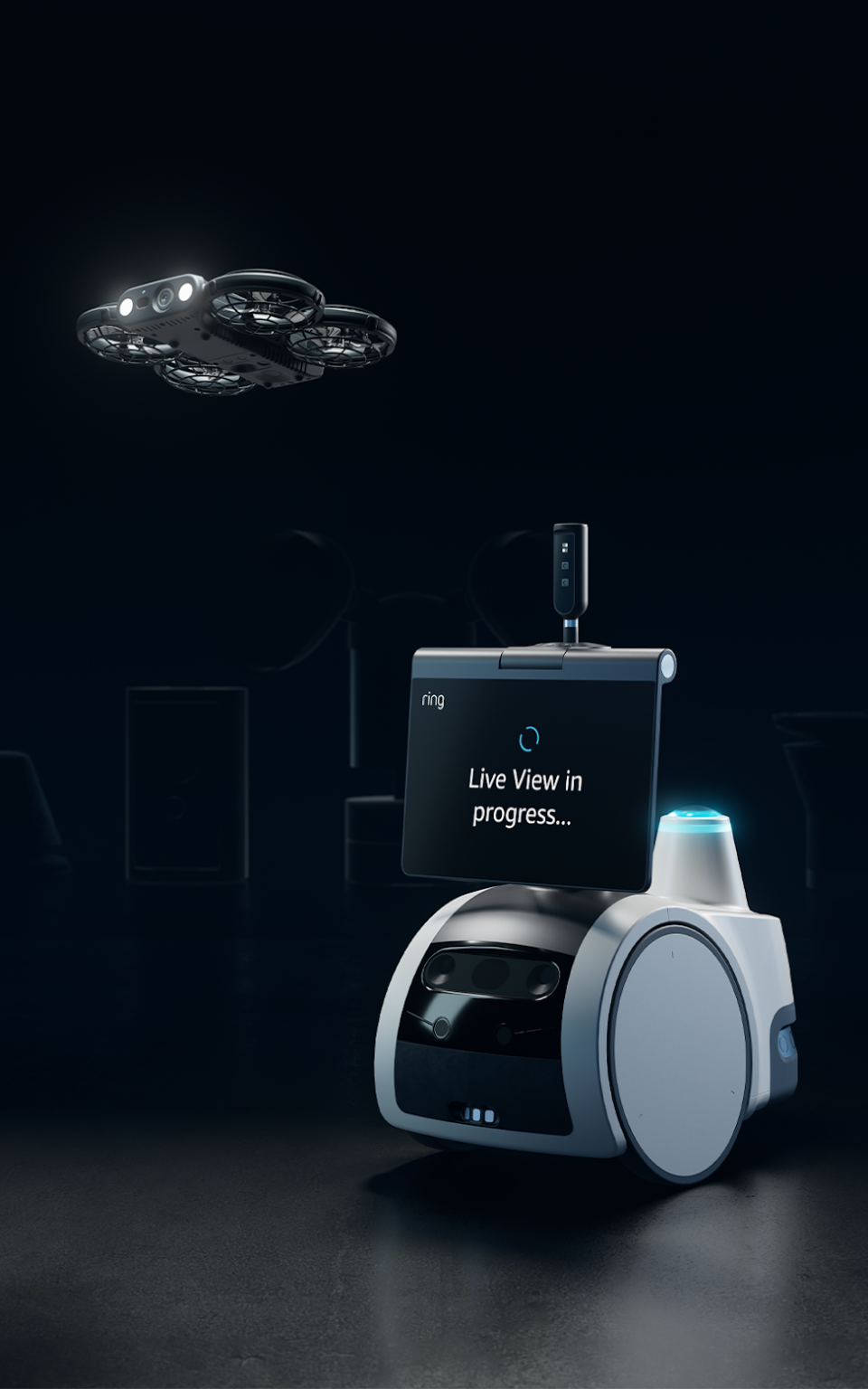
- Autonomy raises the stakes. Ring says privacy is the "default" mode for the drone and the robot, with LED lights flashing while recording. A device that roams every room on schedule creates a data trail a doorbell never could, which invites scrutiny from landlords, insurers and state privacy regulators.
- Component pressure. Business Insider reported in late October 2026, citing an internal Amazon planning document, that the company's first-party hardware business expected a $612 million gross loss this year against a $438 million target, as memory-chip inflation forced hard trade-offs between volume, selling price and margin.
- Regulatory ceiling. Indoor-only operation caps the use case: the eight-minute flight and the charging dock define the coverage envelope, not the property line.
- Execution history. Astro's short commercial run and the repeated redesigns behind this drone both argue for judging the launch on service uptake rather than on announcement-week orders.
Four misconceptions in the first wave of coverage
- "A $250 drone you can fly anywhere." The device is fenced inside the home, and the Federal Aviation Administration rule Siminoff cited is about line of sight, not indoor safety.
- "Astro is back." The Rover Cam reuses Astro hardware but not the old business plan, which Amazon abandoned within a year.
- "The sticker price is the total cost." Ring's revenue model has always leaned on subscriptions: U.S. Ring Protect plans list $4.99 a month for one device and $9.99 for all devices at a location, while Ring has not published a drone-specific tier. Treat the recurring fee as an open question (analysis).
- "This is a one-off gadget." It sits inside a longer Amazon bet: the company's new home-robot team is building a successor to Astro, so Ring's launch is the security slice of a wider robotics push.
What to watch next
- Whether U.S. Federal Communications Commission clearance lands before January 27, and whether the ship date slips.
- Whether Ring discloses Rover Cam shipment and retention data — Astro was never sold beyond a limited customer group.
- Whether Drone Cam recordings get folded into a higher subscription tier, which would confirm the monetisation thesis.
- Whether the Rover Cam is sold outright or bundled with monitoring contracts, and what support horizon Ring offers.
- Any privacy or neighbour-surveillance incident involving autonomous patrol footage, given how the Flock Safety episode played out.
- Next quarter's Amazon device margin commentary, where memory costs show up first.
FAQ: what investors and buyers are asking
Can the Ring Drone Cam follow an intruder outside?
No. Siminoff said the device is barred from outdoor flight under Federal Aviation Administration rules that restrict drone operation unless the pilot can see it, and Ring has added guardrails so it will not leave. "We have already told customers not to do that, because it is illegal," he said.
How much of a property can one drone actually cover?
The published limit is a maximum of eight minutes per flight before it returns to the charging dock, so coverage depends on floor plan and route length rather than square footage. Ring's pitch is that one device replaces several fixed cameras.
Is the Rover Cam just a rebadged Astro?
It reuses the Astro platform — the two-wheel base, retractable periscope camera, siren and audio are carried over — while Ring says it borrowed only the best parts and rebuilt the unit as a robot built for security.
Does this threaten Apple or Google first?
Both. Grand View Research estimates smart home sales will exceed $200 billion this year, a market all three are chasing, and neither Apple nor Google carries a comparable doorbell install base.
What single metric decides whether this launch worked?
Attach: how many owners pay a recurring fee to keep a robot flying, not how many units ship on January 27.
For decision-makers, the number worth tracking is neither $250 nor $1,000; it is the monthly fee a customer will accept to make a robot leave its dock, because whoever prices that honestly ends up owning the category.
Sources consulted
- CNBC: Amazon's Ring unveils flying drone, robot to patrol homes and businesses
- The Verge: hands-on with Ring's new AI drone camera
- Engadget: Ring Drone Cam and Rover Cam launch details
- Grand View Research: smart home market report
- Mordor Intelligence: commercial security robot market
- GeekWire: Amazon ends Astro for Business
- Federal Aviation Administration: recreational flyer rules
- Security.org: Ring Protect plan pricing