
CompanyWatch: Amazon Reloads Its Home-Robot Bet — How the "World-First" Team Stacks Up Against Apple, 1X and Tesla
Amazon has stood up a new home-robot team over the past few months to build what a since-deleted hiring post called a "world-first robot product". The CompanyWatch read in one line: this is not a rematch of hardware specifications. The contest is who can put a robot in an occupied house, keep it working there for five years, and monetise the services behind it. On that test Amazon brings the longest running robotics operating record of any consumer entrant — and the category's most public cautionary tale.
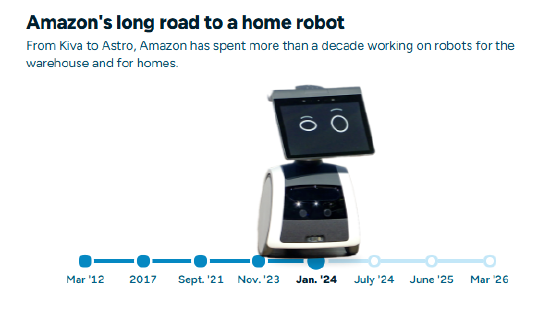
What did Amazon actually restart, and why now?
Conclusion first: Amazon restarted an ambition, not a product line. The removed job posting does not describe a successor gadget to Astro; it describes a machine class that current home hardware does not occupy.
The documentary record, in order:
- 2017 — Jeff Bezos, then CEO and an avowed science-fiction and robotics fan, tells a group of Amazon's top device executives to build a robot.
- Within a few years — the team delivers Astro, priced at $1,450.
- Fall 2021 — Astro appears in public for the first time: essentially a wheeled tablet carrying Alexa, able to navigate a home unaided, recognise faces and act as a mobile security camera.
- Never beyond invitation-only purchase — Amazon ships to only a few thousand customers, and some owners now believe the robot's days are numbered.
- 2023 — Astro for Business reaches small shops and commercial sites; Amazon stops the product less than a year later.
- Over the past few months — the new team forms around the world-first brief.
The deleted engineering posting was unusually candid about the ambition: "Robots are about to leave the movies and enter our homes." It described a product able to move through dynamic home environments and to operate autonomously alongside family members — two phrases that read as an explicit rejection of Astro's fixed, wheeled, camera-first role.
Andy Jassy, chief executive of Amazon, has framed the bet in the same long-horizon language he uses for Alexa and Kindle. In his latest annual shareholder letter he wrote that artificial intelligence and robotics are one of the biggest inflections of our lifetimes. "We work hard to anticipate what will make customers' lives easier and better every day, and invent the next inflection," Jassy wrote. The company's own precedent matters here: it is willing to be misunderstood for years if that buys an early position in a new market, exactly as it was with the Alexa voice assistant and the Kindle e-reader.
Why did Astro stall? Four failure points worth re-reading
Conclusion first: Astro did not stall because the technology was impossible. It stalled because Amazon never converted an invitation-only experiment into an installed base, and because the body it chose could not do chores.
- A distribution ceiling, not a demand ceiling. A few thousand shipped units cannot generate the household-scenario data that navigation and safety models need to improve. This is our analysis, not a disclosed Amazon metric, but the mechanism is visible in the record: the product stayed in preview while rival sensors and maps kept training.
- The wrong body for the job. A mobile Alexa with a camera adds monitoring value; it does not fold laundry, close a gate or fetch a pill. Astro's proposition was security plus companionship — two categories already crowded with static cameras and smart speakers.
- Trust friction was under-engineered. A roaming camera that learns faces raises the bar on consent and data handling far above a fixed doorbell. In September 2021 Ben Wood, chief analyst at CCS Insight, called Astro "a bold move" and a logical step for Amazon, while noting the company's willingness to push highly experimental hardware to market and watch how people react — a verdict on ambition, not on category readiness (BBC reporting).
- Organisation churn erased momentum. Amazon announced in July 2024 that it was winding down Astro for Business, refunding device purchases in full and giving business customers a $300 credit, with the robots disabled on 25 September 2024 (The Verge). Reporting based on LinkedIn profiles in November 2026 indicates that most Astro staff were moved to other programmes earlier this year, while a robotics specialist from the Massachusetts Institute of Technology joined the new home-robot effort. Talent is being reassembled around the next attempt.
How does the field line up? Amazon vs Apple vs 1X vs Tesla
Conclusion first: every credible entrant is buying a different prize. Amazon is buying the entry point to the home; Apple is buying continuity of an ecosystem it already owns; the humanoid startups are buying a general-purpose machine and accepting a price no consumer electronics category has ever survived at.
| Player | Form factor today | Public price signal | Route to market | Central trade-off |
|---|---|---|---|---|
| Amazon — new team | Undisclosed; brief says autonomous movement through dynamic home environments | None announced | Devices channel plus Alexa and Ring installed base | Deep operating experience against Astro's failed precedent |
| Amazon — Astro | Wheeled tablet with Alexa, face recognition, mobile security patrol | $1,450 | Invitation-only purchase; a few thousand customers; enterprise edition stopped less than a year after its 2023 debut | Never scaled beyond a preview |
| Apple — reported home robot (J595 / robotic-display line) | Robotic home display, pre-launch | Reported target around $1,000, with timing slipping from 2027 toward 2028 (The Verge, citing The Information and Bloomberg) | Privileged position inside HomeKit and iPhone | Careful secrecy versus a shrinking first-mover window |
| 1X Technologies — NEO | Humanoid | $20,000 outright or $499 a month, with a $200 deposit (1x.tech) | Direct pre-order, early units guided remotely by human operators | Category-defining form factor at a luxury-car price and a live privacy debate |
| Tesla — Optimus | Humanoid, factory-first deployment | No announced consumer home price | Own factories as the proving ground | Manufacturing muscle, but domestic safety and insurance are unproven |
For the inside of Apple's programme, our scorecard on Apple's J595 robot against OpenAI, Meta, Tesla and 1X on price and timing lays out the hardware-versus-software tug of war that is shaping both companies' launch calendars.
What does the market math actually support?
Conclusion first: the addressable prize is large enough to justify the bet, and small enough that it will not move Amazon's reported numbers for years.
Analysts expect the humanoid-robot market to surge over the next few years. In a January report, Barclays put the global market at $2 billion to $3 billion today, rising to roughly $40 billion by 2035 and, in the most optimistic scenario, as high as $200 billion. Two things follow for anyone underwriting this story:
- Base case and ceiling case are five times apart. A company planning capex around the $200 billion end is making a different bet from one planning around $40 billion. Treat the optimistic figure as a scenario, not a forecast.
- The unit-economics gap is the real story. At $20,000 per machine, 1X's NEO books roughly as much revenue per unit as a small car. If Amazon's world-first product lands near Astro's $1,450 price point, consumer margin will be thin and the strategic return will have to come from services attached to the device — the same logic that made Echo a distribution channel for Alexa, music and shopping rather than a profitable speaker.
Amazon's hidden asset is operational, not commercial. It has run more than one million robots across its fulfilment network and built DeepFleet, an AI foundation model that coordinates that fleet, as reported in mid-2025 (National CIO Review). That gives Amazon route-planning, failure-recovery and fleet-management experience no consumer rival can replicate from a lab. It does not solve the harder consumer problem: a warehouse has flat floors, no children and no liability for a machine that bumps into a stranger.
Four misconceptions worth discarding
- "Astro was a prototype that simply ran out of money." The record shows a deliberate product decision — stopping Astro for Business less than a year after its 2023 launch — plus a distribution model that never left invitation-only purchase.
- "The new team is building a humanoid." Nothing published confirms this. The brief is autonomous movement in dynamic home environments, which a legged, wheeled or hybrid machine could satisfy.
- "Bezos's 2017 order means the founder is running it again." Bezos issued the original instruction while still CEO; the sponsor in the current disclosures is Andy Jassy's shareholder-letter framing.
- "A market worth roughly $40 billion by 2035 means near-term earnings impact." Amazon's devices business monetises best through services; a robot that cannot do chores will not be a revenue line for several years. Treat 2026 and 2027 robot spending as option cost.
Decision guide: what to watch, and what to do, over the next four quarters
Conclusion first: judge this story on hiring, pricing and safety architecture — not on keynote language.
- Watch the requisitions, not the press releases. A shift from robotics-research roles toward production, battery, actuator and warranty engineering signals a product decision, not a science project. Verify that former Astro staff rehired into this group stay put for more than two quarters.
- Watch the price anchor. Anything under $1,000 — Apple's reported target — is a mass-market attempt; anything near $1,450, Astro's launch price, repeats a mistake; anything at $20,000 or $499 a month, like 1X's NEO, is an early-adopter financing play.
- Watch the autonomy promise. Remote human operators inside customers' homes is the most legally fragile pattern in consumer robotics. Any launch that depends on teleoperation should be read as a data-collection programme.
- Watch supply-side signals. Robot compute demand is already distorting Amazon's own buying; our analysis of Amazon's GPU order cancellations and account bans shows how tight AI hardware supply has turned even paying customers into review targets. A home robot is the downstream product of that same compute scramble.
- For BD and smart-home vendors: ask each platform which interface owns the robot — Alexa, HomeKit or a proprietary agent — because that determines whether you are a component supplier or a data counterparty.
- For investors: build the case on attachment economics (subscriptions, security monitoring, care services), not units shipped, until Amazon discloses an availability tier broader than invite-only.
Frequently asked questions
Is Amazon's new robot a replacement for Astro?
Not described as one. Amazon has not disclosed a product that replaces Astro; the new team's brief, drawn from a posting later deleted, is a world-first robot product that can operate in dynamic home environments.
How much did Astro cost, and how many people bought it?
Astro was priced at $1,450 and never moved beyond invitation-only purchase, shipping to a few thousand customers since its first public appearance in fall 2021.
How big is the robot market Amazon is chasing?
Barclays estimated in January that the global humanoid-robot market is worth $2 billion to $3 billion now, could reach roughly $40 billion by 2035, and might go as high as $200 billion in the most optimistic scenario.
Should I buy a home robot now?
No — unless a specific, recurring chore is the reason. Today's purchase options are a $20,000 or $499-a-month humanoid that still needs remote human guidance, or an ageing invitation-only robot with no committed successor. Waiting costs almost nothing here; the decision point arrives when a platform announces a mass-market price and an unassisted autonomy claim.
References
- BBC News, "Amazon announces Astro the home robot" (28 September 2021) — Ben Wood, CCS Insight: https://www.bbc.co.uk/news/technology-58727057
- The Verge, "Amazon is bricking its Astro business robots less than a year later" (3 July 2024): https://www.theverge.com/2024/7/3/24190410/amazon-astro-business-robot-discontinued-refunds
- The Verge, "Apple's 'Ultra' smart home robot might have to wait until 2028" (November 2026): https://www.theverge.com/tech/1024496/apple-homeview-ultra-robot-rumor-delay
- 1X Technologies, NEO home robot ordering and pricing: https://www.1x.tech/neo
- National CIO Review, "Amazon's Logistics Strategy Evolves With DeepFleet and One Million Robots" (July 2025): https://nationalcioreview.com/articles-insights/extra-bytes/amazons-logistics-strategy-evolves-with-deepfleet-and-one-million-robots/
This company watch is filed for GlobalBizSight's CompanyWatch desk; queries to the editorial team can be sent to info@globalbizsight.com.