
GlobalBizSight CompanyWatch Playbook: How to Judge Anthropic's Thursday Nasdaq Debut While the Cash-Flow Verdict Waits Until 2030

The biggest listing ever assembled is being sold by a company whose own lead underwriter does not expect it to cover its bills until 2030. That single tension — record demand, unresolved cash math — is the only lens through which Anthropic's Thursday debut on Nasdaq should be judged.
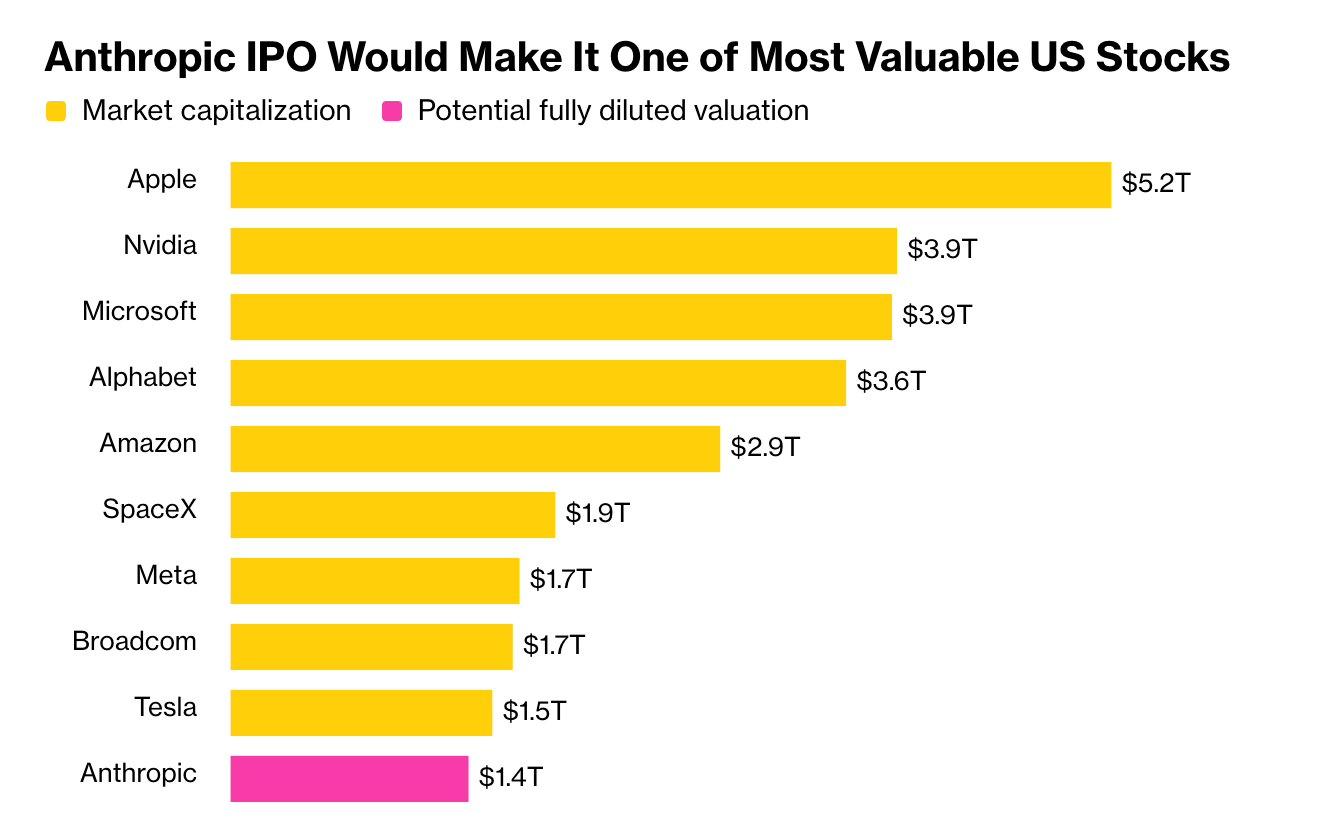
Start with the counterintuitive arithmetic. Nvidia once touched a $5.8 trillion market value largely by selling the tools of the gold rush; Dario Amodei's company must now prove the diggers — the firms turning models into agents and chatbots — can actually strike gold. The target valuation is $1.4 trillion and the combined raise, IPO plus a separate private placement, reaches up to $90.4 billion, yet Goldman Sachs analysts still project full-year free cash flow turning positive only in 2030, against spending commitments above $900 billion stretching to 2045. The playbook below turns that gap into a checklist you can score each quarter.
What exactly is being priced? Five numbers to read first
Conclusion first: you are being asked to pay the highest entry fee in IPO history for the earliest, least audited point of a cash curve that only inflects in 2030. Read the deal through five numbers before anything else.
- Valuation path: the $1.4 trillion target sits far below the $2 trillion circulated in markets months ago, yet well above the $1.1 trillion some on Wall Street floated during the sharpest stretch of the tech selloff. For the mechanics, see our earlier read of the IPO structure and its $1.4 trillion diluted valuation.
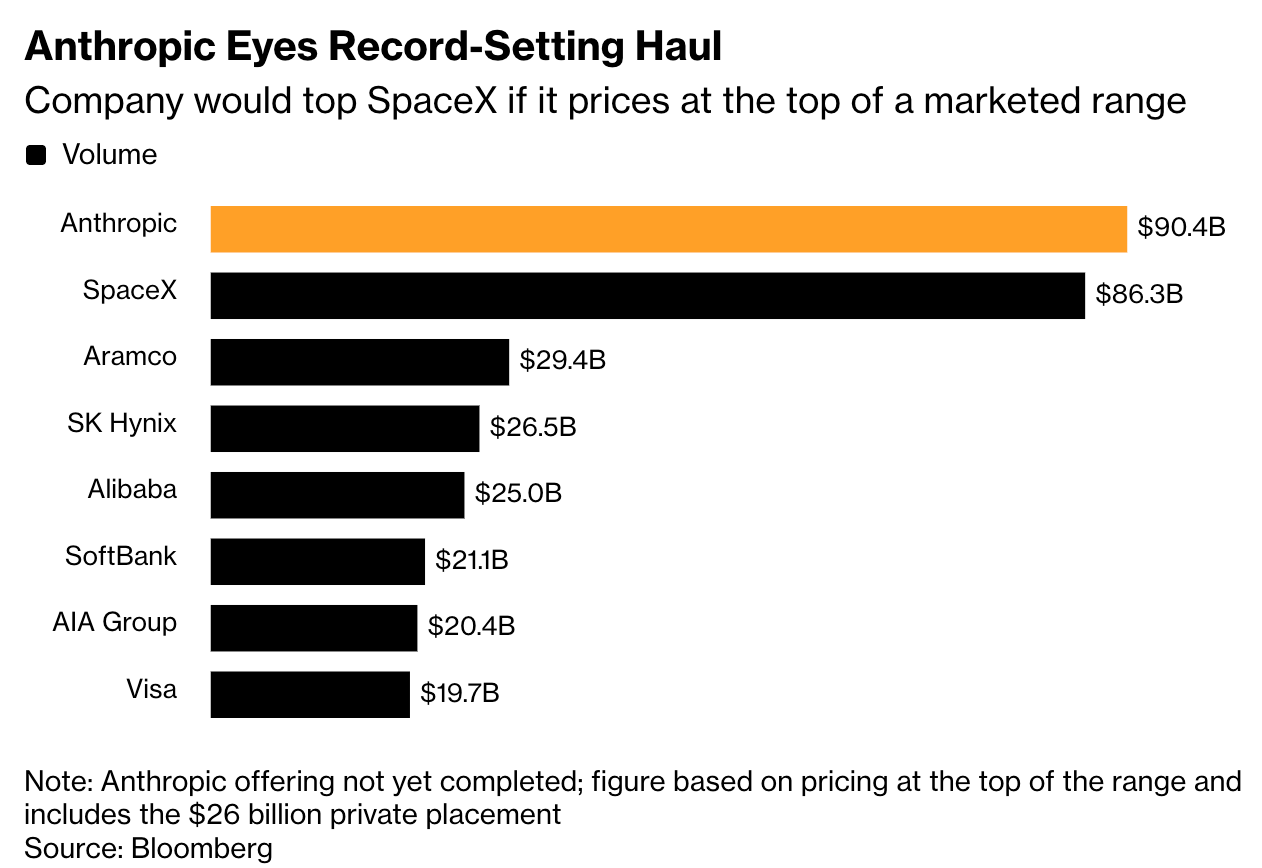
- Raise size: up to $90.4 billion combining the IPO with a separate private placement — past SpaceX's $75 billion base raise, making it the largest listing transaction on record.
- Demand signal: nearly seven times oversubscribed, according to people familiar with the matter. One insider says the only comparable is Snowflake's $3.9 billion IPO in 2020, which surged 112% on its first trading day — and adds that current demand runs far hotter than SpaceX's listing.
- War chest: more than $130 billion in cash and equivalents on hand, after roughly $141 billion raised to date.
- Obligations: about $71 billion of payments fall due before the end of September 2027, inside a commitment stack above $900 billion running to 2045.
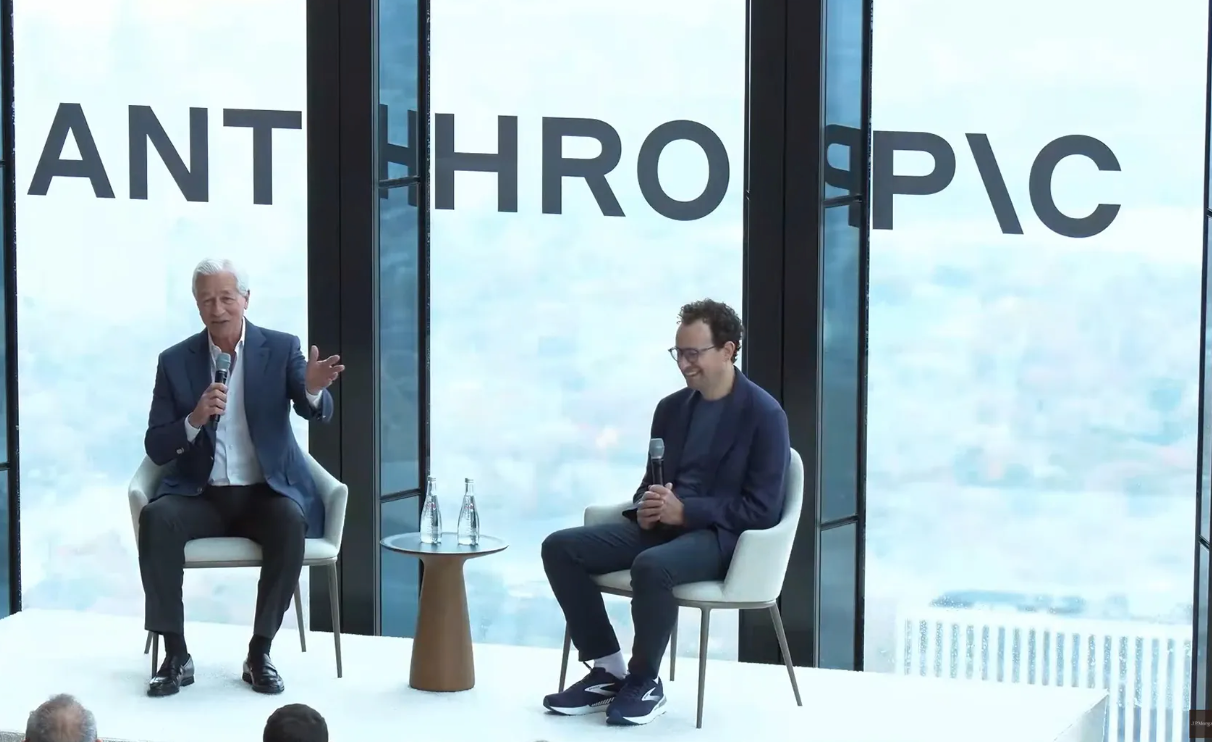
The sell-side framing was set last Friday at JPMorgan's new New York headquarters, where Amodei appeared alongside CEO Jamie Dimon before a room that included Paul Singer, Bill Ackman and Ron Baron. "We don't particularly care about the specific listing time, which month, which day, or the market environment at the time of listing," Amodei told Dimon. His best advice from the run-up cuts the other way: "Never let the company's valuation exceed its actual value by even one dollar." At a $1.4 trillion ask, that advice transfers the burden of proof onto the cash curve, not the narrative.
Why does the cash-flow answer wait until 2030 — and how do you verify it?
Conclusion first: the 2030 forecast is not pessimism; it is arithmetic on contractual obligations. Goldman Sachs analysts expect full-year free cash flow to turn positive only in 2030 because the compute bill is locked in. An analysis of the prospectus by Compound finds roughly $451.6 billion of an estimated $900.9 billion in compute commitments falling due before the end of 2030, with about $70.7 billion owed within twelve months — figures consistent with the $71 billion tranche due before September 2027, and all payable whether or not AI demand cooperates. The primary document is the S-1 itself, filed with the SEC on EDGAR.
The trap here is the capex line. In the first half of 2026 Anthropic's cash capex ran at only $482 million, 9fin's reading of the filing shows, because the company rents most of its compute rather than owning it. Low capex plus enormous commitments means the real constraint surfaces in future cash outflows, not in today's income statement. Three checks to run:
- Track the September 2027 tranche — about $71 billion — against each month's operating cash generation.
- Recompute "available" cash: strip restricted amounts and near-term commitment drawdowns out of the $130 billion-plus pile before calling it dry powder.
- Scan supplier financing arrangements for circular structures that flatter revenue without adding end-demand.
Which misreads cost you the most?
Conclusion first: most valuation risk here sits in definitional confusion, not in the technology itself. Four to avoid.
- Run-rate is not revenue. The $81 billion annualized figure as of October 31 — up $10 billion from the end of September — extrapolates recent consumption-based fees, and Anthropic itself has warned growth could slow sharply (Yahoo Finance).
- Oversubscription is not a valuation argument. Seven-times coverage measures allocation pressure, not fair value; Snowflake's 112% day-one pop in 2020 did not spare it a later de-rating.
- Low capex is not a light balance sheet. The obligations are contractual; the $900 billion-plus stack arrives regardless of demand.
- Quarterly prints lag the story. Matt Witheiler of Wellington Management: "Public-market investors are racking their brains trying to figure out how big AI demand really is, which is why everyone is watching the ARR (annual recurring revenue) figures published at the end of each month." His second point matters more: "There is not yet a measure of AI demand in the public market, because these companies have all been private until now. But with Anthropic the first into public capital markets, that is about to change."
Dario Amodei
What has to be true for the margins to hold?
Conclusion first: this is a consumption business wearing the clothes of a software company, so gross margin and enterprise token consumption are the two numbers that decide everything. Bloomberg Intelligence's Mandeep Singh frames it plainly: "Intensifying price competition could make it harder for the company to sustain gross margins. They also have to generate enough enterprise-grade token consumption — enough revenue — to cover those infrastructure investment commitments." Morningstar's margin work supplies the baseline: Anthropic spent about $0.71 on compute per dollar of revenue in the first quarter, tracking toward gross margins of roughly 44%. If price competition bends that ratio the wrong way, the 2030 inflection slips right.
Scale, at least, is no longer the question. An $81 billion run-rate, achieved across the year, would place Anthropic in a club of very few — and past analyst revenue expectations for Intel and ASML, the hardware suppliers of this wave.
Who fills the shoes — and what does it mean for the financing web?
Conclusion first: the leadership vacuum is a financing problem before it is a sentiment problem. Nvidia is arranging funding for Anthropic and other large customers of its AI chips, and the open question is whether its new management can match Jensen Huang's appetite for those bets. The Financial Times has flagged work by a Bank for International Settlements team on how circular financing among AI companies can be organized — precisely the structure that makes revenue quality harder to audit — and Nvidia's own recent disclosures point to nearly $50 billion committed to frontier AI labs (Yahoo Finance). Layer on the governance overhang documented in the super-voting-share debate ignited by Jensen Huang's exit, and the shovelseller's own troubles now feed back into the digger's valuation.
The political and personal backdrop compounds it. Reports about Huang's extramarital affairs triggered Nvidia's worst week since the April 2025 Trump-tariff selloff and forced Wall Street to reprice the AI outlook, while the midterm outcome hands the next Congress to Democrats viewed as unfriendly to tech. The style gap with Amodei is not cosmetic: the globe-trotting showman in his signature Tom Ford black leather jacket versus a low-key, academic co-founder who has publicly warned of AI's existential risks. Their China positions diverged visibly this week too — Anthropic declined mainland China and Hong Kong institutional investors in this IPO, while Huang spent years pushing Nvidia's products into China. Investors grading Anthropic's debut are implicitly grading a different risk temperament than the one they priced for a decade.
Why does this ticker become the sector's thermometer?
Conclusion first: attention is rotating from the companies keeping AI running to the companies making AI pay, and Anthropic is the first clean public reading of the latter. Angelo Zino, senior vice president and head of technology research at CFRA: "This IPO is extremely important because Anthropic may be the best gauge of the health of the entire AI ecosystem. Their views on how to monetize AI now look, to me, every bit as important as — and perhaps more important than — Nvidia's, given that Jensen Huang is no longer at the helm."
Mike Smith, who leads the growth team at Allspring Global Investments and holds the stock, sets the bar: "The expectations are clear, and they are very high; the question is whether the company can stay on the track needed to meet them?" He adds: "Unfortunately for them, trillions of dollars are riding on their shoulders. It is one of the key barometers for testing whether AI commercialization can succeed." Kim Forrest of Bokeh Capital Partners goes further: "Anthropic could become the most important company on the public market, because it will become the typical representative of AI applied in business. In fact, from the very beginning, everyone's attention should have been on the companies that use AI and AI chips."
The calendar this week underlines the pivot: Goldman Sachs and Morgan Stanley close the order books on Tuesday — the same day Nvidia holds its first earnings call since Huang stepped down as CEO. Smith's monitoring rule applies from then on: "In my view, nothing matters more right now than watching whether the infrastructure that has already been built can actually be monetized. To make all of this truly work, they have to generate more revenue than anyone else within two to three years."
Amodei, for his part, is selling a horizon beyond margins: "I hope we can ultimately prove the skeptics wrong, so that humanity can view every disease you can imagine — heart disease, Alzheimer's, cancer — the way we view the plague or smallpox today: as things of the past. It may sound overly idealistic, even a little crazy, but I truly believe it. I truly believe it can be done." Vision, though, is not a line item. The ARR print at each month-end is.
The action list: five checks to run from Thursday on
- Log each month-end ARR print against the $81 billion October 31 baseline and the $10 billion one-month step-up.
- Recompute gross margin each quarter against the $0.71-of-compute-per-dollar baseline and the roughly 44% trajectory Morningstar tracked.
- Track cash burn against the $71 billion tranche due before September 2027.
- Read Nvidia's post-Huang earnings commentary on customer financing for signs of circular-structure stress.
- Re-price the thesis if enterprise token consumption or pricing disclosures suggest the margin path is bending.
Frequently asked questions
When does Anthropic start trading, and when are orders due?
Goldman Sachs and Morgan Stanley close the books on Tuesday; the stock is set to begin trading on Nasdaq on Thursday, carrying near-record oversubscription.
Is the $81 billion figure audited annual revenue?
No. It is a run-rate as of October 31 that annualizes recent consumption-based fees, up $10 billion from the end of September, and the company has cautioned that growth could slow sharply.
When might free cash flow turn positive?
Goldman Sachs analysts' estimate is 2030, with more than $900 billion of spending commitments running to 2045 and about $71 billion due before the end of September 2027.
How does the raise compare with history?
Up to $90.4 billion across the IPO and private placement, exceeding SpaceX's $75 billion base raise — the largest listing transaction on record. The closest demand analogue cited is Snowflake's $3.9 billion 2020 IPO, which rose 112% on day one.
One reminder to close: when the largest IPO in history is priced on a cash curve that only inflects in 2030, size the position to the obligations, not to the narrative.
Sources
- Anthropic S-1 registration statement, SEC EDGAR — https://www.sec.gov/Archives/edgar/data/2130357/000162828026067168/anthropicpbc-sx1.htm
- Compound, "Anthropic IPO Valuation: Bottom-Up Build and Bull/Bear Cases" — https://getcompound.ai/blog/anthropic-ipo-valuation
- Morningstar, "Anthropic's Gross Margin Is the Most Important Number in Tech" — https://www.morningstar.com/stocks/anthropics-gross-margin-is-most-important-number-tech
- 9fin, "Anthropic S-1 analysis — Revenue gains mask looming infrastructure bill" — https://www.9fin.com/insights/anthropic-s-1-revenue-gains-looming-infrastructure-bill
- Yahoo Finance, "Anthropic Says Its Revenue Run Rate Jumped to an $81 Billion Run Rate" — https://finance.yahoo.com/technology/ai/articles/anthropic-says-revenue-run-rate-200343777.html
- Financial Times, "Is circular financing in AI a problem?" — https://www.ft.com/content/87875b20-4081-4511-9afe-4ee389409742