
DeepX DX-M2 Q&A: Is the LPDDR5x-PIM Edge AI Bet Worth Designing In?
Short answer: qualify it now, commit volume later. DeepX, a South Korean edge AI chip startup, has taped out DX-M2 and built it around Samsung's LPDDR5x-PIM, claiming generative inference inside a 5 W envelope. Below are the questions our CompanyWatch readers ask before they design such a part in — dates, supply concentration, cost mechanics and the metrics to track.
1. What exactly happened, and why should a product team care?
The event is narrow; the implication is a bill-of-materials question. DX-M2 is the second-generation accelerator from DeepX, and it reaches tape-out together with custom processor-in-memory (PIM) silicon rather than as a standalone NPU. The company's first-generation part, DX-M1, is already in mass production for vision work and has more than 100 purchase orders behind it, so this is an incumbent supplier extending its architecture, not a pitch deck seeking a first customer.
Two datapoints outside the launch note sharpen the read. First, Samsung validated its LPDDR5X-PIM design in silicon at Hot Chips 2026 in late August 2026: 16 compute blocks embedded in an LPDDR5X-class package, up to 8x the effective internal bandwidth and up to 3x the token throughput on Llama 3.1 8B inside Samsung's own Edge AI Accelerator reference system, as reported by Tom's Hardware. Second, DeepX's headline 6.7x is a supplier simulation for Llama3.1-8B, not a vendor-published measurement. The two numbers are not interchangeable, and a buyer comparison should always insist on the measurement base before it is repeated in a business case.
On the supply side, chief executive Kim told the 2026 K-AI Semiconductor Growth Forum on June 4, 2026 — in remarks carried by ZDNET Korea and reprinted by IT之家 — that Samsung is currently the only supplier of LPDDR5x-PIM, and that DX-M2 is priced to launch below US$50 per unit. Sub-$50 silicon would reprice humanoid robot and smart-camera budgets; single-source memory is the offsetting exposure, and it belongs in the same risk column.
2. Why is bandwidth, not compute, the story?
Conclusion first: generative inference at the edge is limited by data movement, so a bandwidth change is a bigger architectural change than another block of MACs. "The most important change [between M1 and M2] is the memory bandwidth," DeepX founder and CEO Lokwon Kim told EE Times, and the specification behind that sentence is a jump from 50 to 150 GB/s.
The gains compound rather than arrive at once. DeepX credits design work inside the NPU with doubling power efficiency, and the move to a 2-nm process node with doubling that again, which is how the chip lands at 80 TOPS while the device class stays power-constrained. "This is important because with 5 W power consumption we can go everywhere, drones or any other battery-powered device," Kim said. "Our goal is to enable deployment of sophisticated AI in all devices."
What that envelope buys, in DeepX's own framing, is a model class rather than a benchmark score: the M2 targets models of 20 billion to 100 billion parameters (approximately 3 billion to 20 billion active parameters) at 10 to 30 tokens per second depending on the model, all inside the same 5 W budget as the M1. Large mixture-of-experts LLMs are in scope, and the chip supports newer inference tricks such as speculative decoding and TurboQuant.
 Tim Park (left) and Lokwon Kim of DeepX, photographed by the company at the DX-M2 launch briefing (Source: DeepX)
3. How does PIM help — and what does it cost?
Short answer: it moves the multiply-accumulate into the DRAM, and it moves the power bill along with it. Weights shuttling between memory and compute constrain most inference work, GEMV (general matrix-vector multiplication) most of all, because scattered accesses stall the math. PIM schemes from memory makers let memory-bound operations such as GEMV be computed inside the memory chip; because the operation happens where the data lives, effective memory bandwidth rises and access latency drops.
"We have spent one and a half years on this technology, collaborating with Samsung Memory, as they already have their custom PIM for LPDDR5x," Kim said — a one and a half years co-design programme with Samsung Memory predating the current PIM hype cycle. "We already received LPDDR5x PIM samples and we are testing the operations and performance in-house."
Those LPDDR5x PIM samples underpin the headline number: according to DeepX's simulations, offloading GEMV operations from the DX-M2 into LPDDR5x-PIM will produce 6.7× the tokens per second for Llama3.1-8B compared with the DX-M2 alone. "DX-M2 with LPDDR5x-PIM is close to optimal," Kim said, immediately adding the roadmap qualifier: "But our next generation, the DX-M3, will support official LPDDR6 PIM technology; then we can get the full theoretical performance advancement, which is 5× to 8× higher performance."
Now the cost side, which is where most coverage stops. Kim acknowledged that extra compute does not come for free — 6.7× the performance requires 2.7× the power consumption overall — and DeepX's practical claim is a 2× performance uplift within the same power envelope as non-PIM operation. The second hidden cost is software. Kim said "Substantial manual effort" is required in the compiler to support this mode of operation, noting DeepX currently has a prototype compiler running, based on a simulation of the PIM-enabled LPDDR5x. "We are now making the hardware modules so that we can test that in the physical environment, so we couldn’t finish the compiler yet, but we are actively working on it."
Standards timing matters here. A JEDEC standard for LPDDR6 is set to cover PIM, and before that arrives DeepX has been working with Samsung to integrate the DX-M2 with Samsung's LPDDR5x-PIM. Publicly, JEDEC published the JESD209-6 LPDDR6 device standard in July 2025 and stated on April 22, 2026 that its LPDDR6 PIM specification was nearing completion — so the DX-M3 dependency rests on a spec that is still firming up. Treat the third-generation PIM performance claim as schedule-linked, not guaranteed.
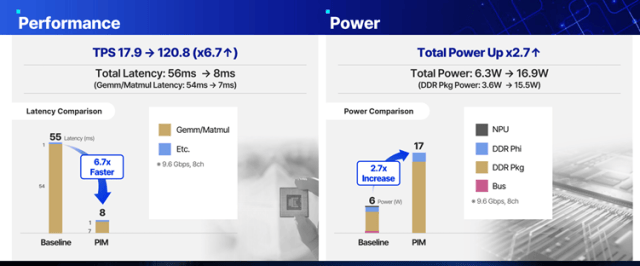 DeepX's own breakdown of the GEMV offload to memory: a 6.7× tokens-per-second gain on Llama3.1-8B against the DX-M2 alone, paid for in watts (Source: DeepX)
4. Which buyers fit DX-M2? Five scenarios, one at a time
According to Tim Park, director of strategic marketing at DeepX, the DX-M2 will target several key sectors, and the fit is not uniform. The company is working with Taiwanese OEMs to find the right sweet spot for AI PCs, including laptops and workstations. Robotics companies currently prototyping on GPUs such as Nvidia Thor want lower power and more compute on-device. Automotive companies are looking for a low-power chip that can run agents in-vehicle. For IoT devices, DeepX is already working with Samsung on a next-generation smart hub, and the company is also joining the AWS IoT ecosystem so it can use Greengrass to support remote model updates.
Robotics is the clearest displacement case. Park said robotics customers typically begin development on GPUs but must look for alternatives because of thermal and power consumption considerations, and DeepX is working hard to enable transitions from the Nvidia Isaac robotics platform to its in-house equivalent, Newton. "Robotics customers ask us about our hardware, but also about how they can migrate from Nvidia to DeepX," he said. "This is the answer—customers change their APIs to call Newton instead of Isaac and then they can run the exact same pipeline on the DeepX system."
That pitch has a measurable base. Park said DeepX has 17 compatible libraries up and running, and the company has demonstrated M1-based robots using the same source code as an Nvidia Jetson-based robot, but calling the DeepX libraries. "The actual outcome for the customer is they can enjoy 20 times longer battery life and [lower cost] when they switch from Nvidia to DeepX," Kim said. "At the same time, the switching time can be under a second. They just need to change the API name from Isaac to Newton. That’s it." The company is still developing a full robotics stack for its hardware, so the stack — not the silicon — is the piece to diligence.
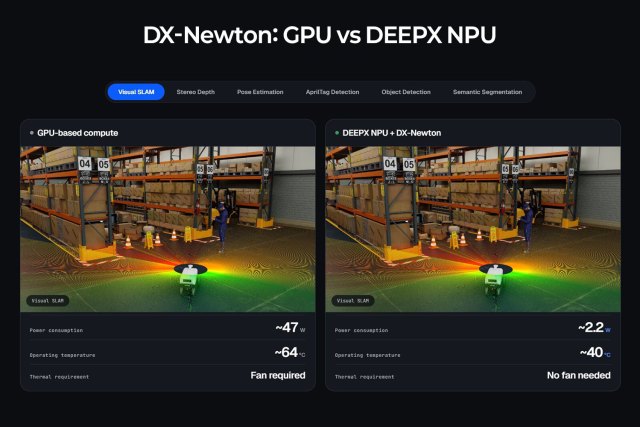 The DX-Newton software layer is DeepX's answer to vendor lock-in on robotics platforms (Source: DeepX)
5. Is DeepX a one-supplier ecosystem or a platform?
It is building the second, deliberately, and the partner list is the evidence. Robotics customers in the U.S., China, Vietnam and Korea are engaging with DeepX, and Hyundai Motor Group Robotics Lab already uses the DX-M1 in its robotics platform. The company is also expanding its ecosystem by adding Taiwanese OEMs, vertical champions in various markets and, lately, a collaboration with Intel.
To tap into Intel’s x86 customer base, DeepX is working with Intel to integrate OpenVINO with the DeepX SDK. The DX-M1 can complement integrated NPUs in Intel Core Ultra CPUs and enable AI for other Intel edge CPUs that don’t have an NPU by offloading some or all of the AI workload. Kim said the company recently met with AMD to discuss jointly developing a robotics platform based on DeepX accelerators combined with AMD’s Kria reference board, in particular for the Korean ecosystem. That work is part of DeepX's drive to collaborate with other heterogeneous ecosystems, including Raspberry Pi and Baidu’s PaddlePaddle ecosystem.
The strategic logic is that an edge accelerator sold only as a chip loses to incumbents, while one sold as a migration path can be dropped into existing code. For comparison, our field guide to STMicroelectronics' unified STM32 platform shows the same play from the microcontroller side, and our read on how Andes slowed its Cuzco RISC-V CPU roadmap to chase AI shows how quickly silicon IP vendors are reallocating engineering toward this exact demand pool.
6. What the three generations tell you about timing
| Dimension | DX-M1 (shipping) | DX-M2 (just taped out) | DX-M3 (2028) |
|---|---|---|---|
| Primary workload | Vision inference | Generative AI at the edge | Automotive and humanoid programs |
| Power posture | Same budget as M2 | 5 W | Chiplet-level, multi-package |
| Memory path | Conventional LPDDR | Samsung LPDDR5x-PIM | LPDDR6-PIM |
| Compute target | — | 80 TOPS | 1 ePOPS (INT8) |
| Status | Mass production, more than 100 purchase orders | Samples March 2027, mass production fall 2027 | Roadmap year 2028 |
DeepX's third-generation roadmap points to the DX-M3, coming in 2028. The M3 will be chiplet-based and will target 1 ePOPS (INT8) using LPDDR6-PIM. Its main target markets are automotive OEMs and humanoid robotics companies, whose demands will require multi-chiplet designs. In the meantime, samples of the M2 are expected in March 2027, with mass production targeted for fall 2027.
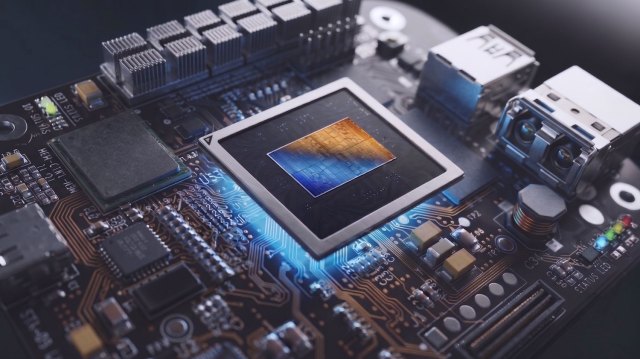 An artist's rendering of the final DX-M2 chip, which has just taped out (Source: DeepX)
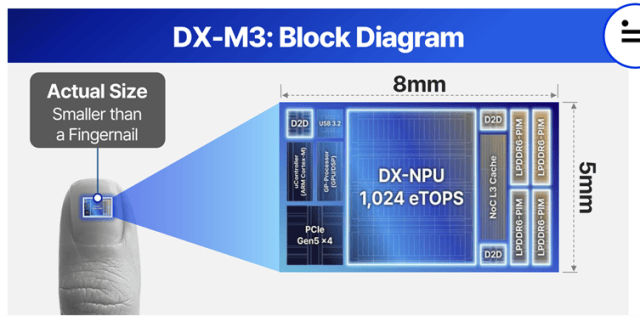 DeepX's third-generation will be chiplet-based. (Source: DeepX)
7. Is the demand real, or is this a roadmap looking for a market?
Pull the evidence forward, and the current order book sits on the M1. Kim said the most active market for physical AI was previously China, but Japan has emerged this year as a major market, with a strong willingness to pioneer humanoid robots. "All the large Japanese companies are evaluating our chips, more than 10 leading companies in Japan right now, and their feedback is very encouraging," he said. "At the same time, the U.S. market [is strong]; we have several big names there, and their feedback is really good." Smart city projects in South Korea, Vietnam and Singapore also involve DeepX.
The thesis attached to the chip is a compute-distribution argument. "Our long-term view is that AI compute will become more distributed as efficiency improves," Park said. "The PC and smartphone eras showed how computing can spread into many products. AI will follow its own path, but local inference has clear value when an application needs immediate access to sensor data or operation without continuous connectivity." Park said DeepX considers edge AI to be a substantial opportunity for its chips, especially at a time when the amount of power available for new data centers is limited.
Kim's quantification is deliberately provocative: only a quarter of the CPU market is in the data center today, and he expects the AI processor market to shift the same way over the next five to 10 years. He added that at a time when many AI data center projects are delayed, the AI capacity issue can’t be solved with investment alone, and that chips consuming just 5 W can pull inference onto the device. "If we deploy models up to 100 billion parameters in devices, we can reduce AI data center traffic by more than 80%," Kim said. "That means we could have five times larger infrastructure without adding any AI servers. This is our vision." Our own assessment: the traffic-reduction figure is a modelling assumption built on the 100 billion parameters claim, not an audited deployment metric — cite it as a vendor vision, never as a customer saving.
8. Four common misreadings of this announcement
- Reading 6.7× as a delivered product number. It is a DeepX simulation of GEMV offload on Llama3.1-8B, and it comes with 2.7× the power consumption; Samsung's separately validated Hot Chips figures use a different reference system and a different measurement base.
- Treating PIM as a free win. Bandwidth moves into the DRAM bank; energy per operation moves with it. The honest figure to design against is the 2× uplift inside the same power envelope.
- Assuming software is solved. A prototype compiler plus "Substantial manual effort" is not a production toolchain. Migration claims such as Isaac to Newton hinge on library coverage, currently 17 compatible libraries.
- Confusing DX-M1 traction with DX-M2 supply. The 100 purchase orders belong to the M1 generation, which is in mass production; the M2 only reaches samples in March 2027.
9. Buyer FAQ: short answers
Is DX-M2 available to design in today?
No. Tape-out is complete, samples of the M2 are expected in March 2027 and mass production is targeted for fall 2027. Programs needing silicon now should evaluate the DX-M1, which is already in mass production.
Should a robotics team start migrating off Nvidia?
Start the software audit, not the swap. The switching time can be under a second once APIs are renamed from Isaac to Newton, but that assumes your stack maps onto the 17 compatible libraries. Prototype one pipeline before a platform decision.
Does PIM replace the NPU?
No — it divides the work. GEMV-heavy, memory-bound stages move into LPDDR5x PIM while dense compute stays on the accelerator. Expect the split to be tuned per model.
How solid is the DX-M3 dependency?
It rests on LPDDR6 PIM reaching a published form. The M3 is a 2028 part targeting 1 ePOPS (INT8) with LPDDR6-PIM; standardization progress is the metric to watch, along with the 5× to 8× theoretical claim attached to it.
Who carries the supply risk?
Buyers do. With Samsung Memory as the only current source of LPDDR5x-PIM, allocation and second-source questions should appear in any contract review, alongside the 2-nm wafer capacity that DeepX shares with other AI silicon programs.
10. Action recommendations: what to track over the next 18 months
- Compiler maturity, not TOPS. Ask for a physical PIM module and a production compiler branch; until then the DX-M2 sits at 80 TOPS on paper only.
- Power-per-token at model level. Demand both non-PIM and PIM curves so the 2× within-envelope claim and the 2.7× power penalty can be netted against your battery budget.
- Sample and qualification dates. March 2027 samples and fall 2027 production are the gates; slip signals usually surface in the JEDEC LPDDR6 PIM schedule first.
- Design-win quality. More than 100 purchase orders is a strong M1 signal; watch whether Hyundai Motor Group Robotics Lab-class references convert into DX-M2 sockets.
- Price-to-BOM impact. A launch price below US$50 per unit, as stated by Kim in June 2026, would move edge AI from premium products into commodity cameras and small robots — verify against contractual pricing.
Sources and further reading
- EE Times interview with Lokwon Kim and Tim Park behind the DX-M2 tape-out reporting.
- Tom's Hardware: Hot Chips 2026, Samsung LPDDR5X-PIM measured in silicon
- JEDEC press release, April 22, 2026: LPDDR6 roadmap and LPDDR6 PIM status
- Samsung Semiconductor: OCP Global Summit 2026 LPDDR5X-PIM performance material
- IT之家, June 4, 2026, relaying ZDNET Korea on DX-M2 pricing and the single-supplier position
- Rambus blog, February 2026: DeepX, Rambus and Samsung Foundry edge-inference collaboration
CompanyWatch note: figures attributed to DeepX are company simulations unless stated otherwise. This report is analysis of public disclosures, not investment advice. Contact the GlobalBizSight editorial desk at info@globalbizsight.com with corrections or document requests. Author: Marc Hale.