
CompanyWatch Q&A: Is Dukosi's DK-NFLNK Worth Designing Into Your Next Battery Pack?
Short answer: design it in when harness assembly, connector yield or sparse cell data are already costing you money; pilot it when the module architecture is still open; wait only if your pack is frozen for a 2026 or early 2027 launch. Sampling status, not production supply, is what changed.
The longer trend is that battery building has stopped being a chemistry story and become an operations story: the constraint is moving from the electrode to the assembly cadence of the plant and to the quality of data each pack carries out of it. Against that backdrop, BUDAPEST, Hungary – speaking at the Pretzl Connect 2026 press event, Joseph Notaro, president of Dukosi in Budapest, confirmed that commercial sampling has started for DK-NFLNK, the contactless intra-battery communication system from the Edinburgh-based chipmaker intended to delete wiring harnesses rather than trim them.
What is DK-NFLNK, precisely?
It is a module-level communication layer, not a full chip-on-cell system. Instead of copper cabling, voltage and temperature data travel wirelessly over one bus antenna using near-field RF — a field coupled along the conductor inside the enclosure, so the link needs no line of sight and keeps its noise immunity. The hardware is a DK8503 Node chip on each module feeding a DK8203 System Hub, plus a Dukosi API, all running on C-SynQ, the company's time-synchronised communication protocol; the hub moves data between each analog front end (AFE) and the BMS host processor, alongside the control layer that host sits in.
Dukosi's own demonstrators set the scope: the unit shown at Embedded World 2026 in March 2026 used a standard 12-cell module configuration typical of the 400-800V packs used in electric vehicles and stationary storage, according to the company's press release. Read that as the addressable case: conventional modular packs, not exotic cell formats.
Why does a wire harness decide pack reliability?
Because the connector, not the cell, is where warranty money leaks. "Connector failure rates in a conventional wiring harness are around 10 parts per million," Notaro said, and "In the automotive and industrial arenas where you’re looking at parts-per-billion-level reliability, that failure rate is simply too high and an unacceptable risk of failure."
Wiring also ties high-voltage and low-voltage domains together, and adds manual labour and mass to every pack line. "With contactless technology, we decouple the high-voltage circuits and get rid of the physical connectors, which makes the system safer, higher quality, and more reliable over its entire operating life," Notaro said.
| Decision variable | Copper harness | Contactless DK-NFLNK |
|---|---|---|
| Failure surface | Connector defects measured in parts per million | Physical connectors removed |
| Voltage domains | Galvanic coupling between power and control circuits | High-voltage circuits decoupled |
| Line cost | Assembly labour and harness weight | Single bus antenna, no harness |
 Joseph Notaro (Source: Dukosi)
What does synchronised cell data buy in watts and dollars?
The payoff is headroom that is already inside the pack. "Smarter battery management starts with better data, and better data starts at the individual cell," Notaro said. "When you’re deciding available power or charge limits, you want every cell being measured at the same time under the same conditions. That’s the technical equivalent of taking a high-speed photo of every cell at the same time."
Without that simultaneity, margins do the work: "The weakest cell dictates the state of charge and the overall performance of the pack. If you don’t measure the cells in synchronization, then measurement errors creep in, and you’re forced to add in design margins, which in turn limit performance."
The measurement stack is the Dukosi Cell Monitoring System, known as DKCMS and built on the DK8102 Cell Monitor chip and DK8202 System Hub. "By providing consistent cell-level data, operators can reduce safety buffers and increase usable energy by 6% to 12%," Notaro said, adding: "You are not altering cell chemistry or adding weight; you are simply extracting energy previously locked away by measurement margins." In a 200-MW storage installation that is framed two ways: additional revenue of $8 million from the extra capacity, or $2 million less capex by needing fewer cells.
Editorial note, not a company claim: those two numbers are alternatives, not additive. Which one a project bankrolls is a financing question — revenue capture if the asset is merchant, capex reduction if it is contracted.
How much warning does a failing cell actually need?
Longer than old packs can provide. The objective in lithium-ion safety is preventing thermal runaway, where one shorted cell starts an exothermic reaction that walks to its neighbours. Legacy designs used only two or three temperature sensors across a whole module, so no cell was watched individually. "In the traditional layouts with very sparse temperature sensing, the heat from a failing cell can take 10 to 15 minutes to get to an external sensor," Notaro said. "With sensing capability on every cell, temperature excursions are detected almost immediately, well before the heat has a chance to propagate to the adjacent cells."
Latency is now a regulated variable, which sharpens the business case. China's GB 38031-2025 mandatory national standard, in force from 1 July 2026, requires that a traction battery pack not catch fire or explode after thermal runaway begins, a bar that pushes detection from the module to the cell. Once every cell reports, software can run outlier detection across thermal profiles and flag small deviations early.
"Some manufacturers try to cut costs by getting rid of the sensors and just assuming the cells are all the same," Notaro said, warning: "Every chemical manufacturing process has variation. You can’t have a battery pack that’s that uniform and then ignore the cell-level monitoring without increasing your operating risk."
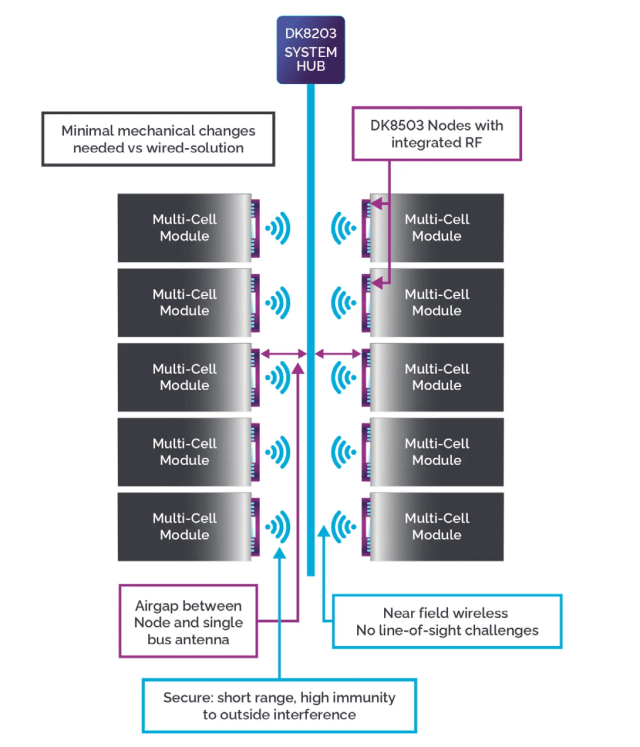 DK-NFLNK System Diagram (Source: Dukosi)
What does the 2027 passport rule change about hardware?
It turns traceability into a procurement requirement. Regulation (EU) 2023/1542 of the European Parliament and of the Council states: "From 18 February 2027 each LMT battery, each industrial battery with a capacity greater than 2 kWh, and each electric vehicle battery placed on the market or put into service shall have an electronic record (‘battery passport’)." The European Commission's digital product passport page for batteries repeats the same start date, and the duty sits in Article 77 of that regulation.
Dukosi positions DKCMS as a data source for that record: the chips carry onboard non-volatile memory and a unique silicon identifier per cell. "Every cell has its own digital passport on chip, which records the maximum temperature it’s ever seen, its voltage history, and total charge cycles," Notaro said. "When the battery has finished its life in the car, the recyclers and integrators simply read the chip to determine the health of the cell, which allows them to sort it efficiently for either grid use or recycling." From Feb. 18, 2027, packs covered by the EU Batteries Regulation must ship with an electronic record of identification, composition, performance and health, and the EU Battery Passport that buyers will ask for is only as credible as the silicon that logged it.
Near-field or far-field wireless: which link fits your architecture?
Both remove wire, but they move different risks. Far-field wireless battery management, the approach Analog Devices productised for automotive in 2020, claims elimination of the traditional harness with up to 90% less wiring and up to 15% less pack volume; Texas Instruments' application note on BMS communication architectures is blunt that a system-level ASIL D requirement from a wired design translates into an equally rigorous ASIL D-compliant wireless link. That means radio coexistence, pairing, spectrum and functional-safety partitioning land on your team.
Dukosi's near-field variant is deliberately narrower: the antenna is a bus wire inside the enclosure, the existing AFE hardware stays, and the module's mechanical architecture is not constrained by RF requirements. For a programme that wants connector and traceability benefits without re-qualifying a radio stack, that is the cheaper path to a first design-in.
Why does the buyer landscape split into two tiers?
During the briefing, EE Times asked whether battery manufacturers in China approach monitoring and safety differently from companies in other regions, particularly whether their strategies are mainly cost-driven. Notaro answered that China has two distinct tiers of customers:
- one that prioritises safety and total system value
- another strictly focused on short-term component costs
He stressed the split is not a China-only pattern — carmakers everywhere divide between safety-first and cost-first procurement — but added that the sheer volume of EVs in China hands domestic manufacturers operating data at a scale that speeds up battery quality refinement. That is the structural point: the tier that owns field data gets to price reliability.
Case check: where the monitoring stack is already running
Dukosi says its monitoring technologies are in commercial testing across several sectors, and the two named proofs are maritime — the harshest place for a connector. Nordic Marine Power received DNV maritime approval for its PowerStack system using Dukosi monitoring, and Yichuan Intelligent Technology incorporated the system into marine vessels in China.
The bridge to legacy designs matters for most readers: "DK-NFLNK and our full cell monitoring system are built on the same C-SynQ communication platform, giving battery manufacturers a real migration path," Notaro said. "The engineers can upgrade their architecture today and move to full chip-on-cell monitoring in future product cycles." The node chip connects to existing analog front ends through a serial interface, so wireless capability arrives without changing the module hardware structure.
Four misconceptions that misprice this decision
- Sampling equals supply. It is engineering access; volume availability is a later milestone, so treat the announcement as a qualification signal, not a sourcing plan.
- Contactless means redesign. The opposite is the pitch: existing modules keep their hardware, and the AFE link stays serial.
- Fewer sensors save money. Saved component cost is paid back through design margins and, after 2026 and 2027 rules, through risk you cannot argue about.
- The passport is a paperwork project. It is a data-source problem; if nothing measured the cell, there is nothing to publish.
Decision guide: design in, pilot, or wait
- Design in now if you build packs above 2 kWh destined for the EU market, or you already fight connector rework: start with the vendor's DK-NFLNK evaluation kit and GUI to prove the AFE-to-hub link in one module.
- Pilot first if your programme is safety-driven but architecture-frozen: run cell-level thermal correlation against existing warranty returns and measure how much margin the data removes.
- Compare architectures before committing: score near-field bus versus far-field wireless on wiring removed, requalification effort, and functional-safety burden.
- Wait only if your pack ships before the migration window; then buy the traceability outcome contractually and revisit the silicon at the next product cycle.
FAQ: the four questions procurement asks first
Does DK-NFLNK replace the BMS?
No. It replaces the wiring between modules and the BMS host processor; measurement still happens in the AFEs and in DKCMS silicon.
What does it cost my line?
It removes harness labour and connector inventory and adds node silicon per module. Dukosi does not publish a price, so treat the harness savings as the negotiating base.
Does it help before Feb. 18, 2027?
Yes, in the sense that a passport is only a record of what was measured — logging has to start earlier than the filing date.
Is this a chip-on-cell product?
Not yet. It is the upgrade path for traditional modular designs, with full chip-on-cell monitoring as the later step on the same C-SynQ platform.
References
- Dukosi press release, DK-NFLNK availability: https://www.dukosi.com/press-release/dukosi-dk-nflnk-brings-safety-reliability-and-scalability-to-traditional-modular-battery-architectures
- Dukosi, Embedded World 2026 demonstrator: https://www.dukosi.com/press-release/dukosi-to-debut-novel-module-level-communication-solution-using-near-field-wireless-at-embedded-world-2026
- European Commission, Digital Product Passport – Batteries: https://single-market-economy.ec.europa.eu/single-market/digital-product-passport/batteries_en
- CnEVPost on China's July 2026 battery safety standards: https://cnevpost.com/2026-06-30/china-toughest-battery-safety-rules-take-effect-july/
- Analog Devices wireless BMS announcement: https://investor.analog.com/news-releases/news-release-details/analog-devices-introduces-automotive-industrys-first-wireless
- Texas Instruments, BMS communication architectures: https://www.ti.com/lit/sluucf5
- EE Times reporting on the sampling announcement: https://www.eetimes.com/dukosi-samples-contactless-battery-communication-system-for-evs-grid-storage/
One line for the decision-makers reading this: the interesting question is not whether a radio link can carry cell data, but who ends up owning the measurement standard that every pack, recycler and grid operator has to depend on.