
GlobalBizSight CompanyWatch: Open vs. Closed AI Models After Jensen Huang's Nvidia Exit — A Side-by-Side Comparison and Tracking List
By Isla Sanders · CompanyWatch, GlobalBizSight · info@globalbizsight.com
Short answer: Jensen Huang's exit from Nvidia does not end open AI models, but it removes their best-funded advocate at exactly the moment capital is rotating toward closed frontier labs. Set side by side, the near-term financial advantage sits with Anthropic and OpenAI; the unresolved question marks are four unfinished Nvidia deals and the pace at which labs cut their chip dependence.
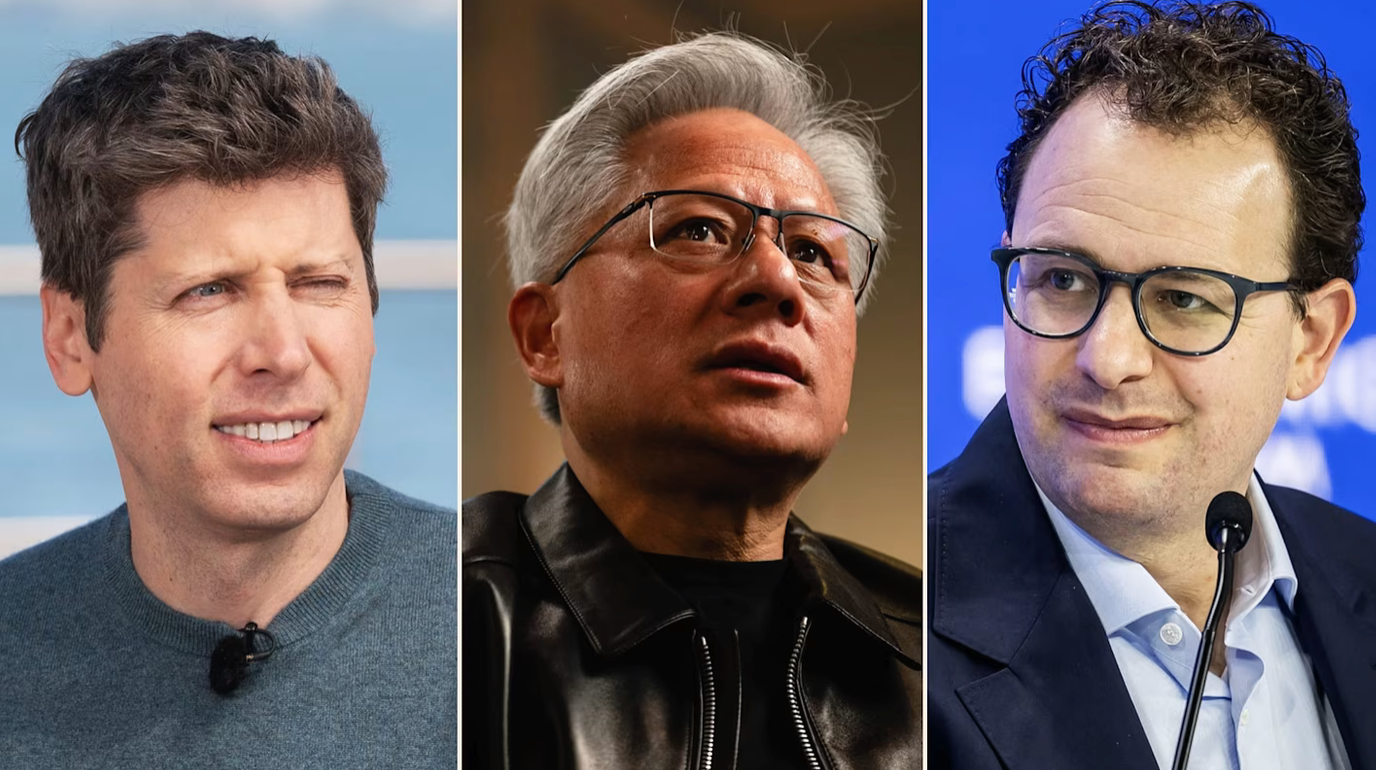
The decade-scale trend first: every computing platform eventually produces one executive who functions as load-bearing infrastructure for an ecosystem, and for AI that was Huang. Two frameworks frame what changes. The first is capital rotation — where the marginal dollar of AI funding lands next. The second is model-layer commoditization — whether frontier models become interchangeable inputs or stay scarce, differentiated assets. Huang spent his tenure betting on commoditization; the closed labs bet on scarcity. His departure shifts the odds on both bets at once.
Why did one executive matter so much to open models?
The short version: he was financier, lobbyist and symbol at the same time, and no successor inherits all three roles. Using Nvidia's balance sheet, Huang built a wide net of investments and acquisitions across startups building open-source and open-weight models — models users can customize and run on their own hardware. In Washington he lobbied against restricting open models built in China while pushing the US to develop its own alternatives.
This summer, in his first-ever post on X, he framed the doctrine: “The measure of American AI leadership should not be whether we have a single frontier AI model, but whether the US can build a strong open ecosystem and make it pervasive across industries.”
Continuity, however, is not purely personal. Nvidia's own Nemotron family ships as open-source models with open weights, training data and recipes, according to Nvidia's developer documentation — a product-embedded commitment that does not resign with any individual. That distinction is the analytical hinge for everything below: how much of the open agenda was the man, and how much was the machine?
The four pending Nvidia deals, compared
Conclusion first: the four transactions carry very different execution risk, and the binding constraint is contractual rather than doctrinal. Nvidia had been expected to participate in or lead all four of the startup deals currently in discussion:
| Deal | Type | What is exposed | Signal to watch |
|---|---|---|---|
| Thinking Machines Lab | Investment | An open-weight startup pipeline | Whether the term sheet is signed under interim leadership |
| Groq | Investment | An inference-chip counterweight | Formal paperwork replacing verbal commitments |
| Reflection AI | Potential partnership | An open frontier-model effort | Scope and exclusivity of the agreement |
| Hugging Face | $12.9 billion acquisition | The distribution hub of open models | Board process and regulatory filings |
It remains unclear whether the rapid deal tempo survives under new leadership. Elon Musk wrote on X last Saturday: “Jensen did an outstanding job driving supply-chain building at Nvidia, but many of those deals were verbal understandings he reached with counterparties, not formal written contracts. Without Jensen, at least some key deals may fall through.”
A venture capitalist who has co-invested with Nvidia on AI startups added the concentration angle: “I think Jensen (promoting open models) benefited the most economically, and he is personally committed to diversity at the model level. Without him — and if Nvidia is no longer so generous with its investments — we may end up with a world of highly concentrated model providers.”
The commercial logic cuts the other way too: those deals widened Nvidia's customer base and erected a counterweight to OpenAI and Anthropic. As an executive at a top Silicon Valley AI company put it: “In one sense, Jensen leaving Nvidia is a bad thing for the whole industry. But from another angle, Jensen was actually a competitor of the frontier labs, because he wanted models commoditized and ubiquitous so that Nvidia could keep its central position in the value chain.”
History supplies the baseline. Ten years ago, Huang delivered Nvidia's first “AI supercomputer” to OpenAI, setting a then-fledgling startup onto the road that ended at ChatGPT. OpenAI's leadership at the time included three people — Musk, Sam Altman and Dario Amodei — and Huang's relationships with all three underwrote the AI boom, supporting not only OpenAI's rise but also SpaceX and Anthropic. Earlier this year Nvidia invested $30 billion in OpenAI and committed more than $100 billion to support the lab's flagship data center. Relationships of that scale outlive a signature; deal tempo does not.
Labs vs. Nvidia: who gains leverage if compute concentrates?
Conclusion first: if compute concentrates, bargaining power migrates from the chipmaker to its largest buyers — and that migration was already underway. Friction long predates the exit: founders at frontier labs chafed at Nvidia dependence and answered it with new partnerships and in-house silicon. As an executive at an AI lab put it: “That is why you see every lab and frontier company investing in its own chip projects: it is all because Nvidia's margins are too high. There is reason to believe Jensen's departure will concentrate compute more in the hands of frontier labs and hyperscale clouds. That is good for the labs.”
Compared directly, the two flagship autonomy plays are built differently:
- OpenAI — build: its custom inference chip Jalapeño, co-developed with Broadcom, was unveiled on June 24, 2026 and went from design to production in roughly nine months, purpose-built for large-language-model inference. CFO Sarah Friar often says she wants to make sure the company avoids putting “all the eggs in one basket” with any single chip vendor.
- Anthropic — hedge: the longer diversification record, anchored by early backing from Google and Amazon whose chips it can use. Anthropic has disclosed plans to accept a $10 billion Nvidia investment alongside its IPO, yet executives stressed through the IPO roadshow that its models can switch to rival AMD's chips within days — a process that normally takes months.
The trade-off is asymmetry: building (Jalapeño) attacks inference economics but leaves training-scale compute exposed; hedging (Anthropic) buys switching speed at the price of parallel engineering. On a two-year view, neither play removes Nvidia from the stack. The accurate reading is insurance, not divorce — which is precisely why the concentration argument above deserves attention.
Open vs. closed: where does the money go?
Conclusion first: closed developers hold the near-term financial advantage, and this week is the stress test. Last month, while introducing OpenShell — Nvidia's in-house open-source safety platform for AI agents — Huang needled the two frontier labs over their secrecy: “An opaque agent system, wrapped in an opaque box, locked away by an opaque company — how can that possibly work? Clearly, that model is unsustainable.”
The market is answering differently this week. Anthropic is executing one of the largest IPOs in history, targeting total proceeds of about $100 billion; the range was set at $70–$78 per share, implying up to roughly $1.4 trillion on a fully diluted basis (Morningstar), and reporting indicates final pricing printed at $83, above the range. We mapped the structure, private placement included, in our earlier breakdown of Anthropic's IPO structure and valuation. Meanwhile OpenAI sits in the final stage of a $20 billion raise. Industry insiders expect investors reducing their chipmaker exposure to redeploy into these labs.
“I don't think open-weight models will disappear… but losing Jensen — the biggest financial backer and advocate they had — will slow their progress. And it will not hurt Anthropic's IPO,” one industry insider said.
The counterweight is developer gravity rather than balance sheets. Thomas Wolf, co-founder of open-source AI platform Hugging Face: “If open models had only one supporter, then this week would mean their era is over. In reality, open models have millions of developers, and many supporters sit inside Nvidia.”
Three common misreads
- “Open models are finished.” The ecosystem's unit of account is developers, not patrons: millions of them, a Hugging Face hub listing more than two million models, and Nvidia's own Nemotron line as proof of product-level commitment.
- “Nvidia will automatically abandon open.” The realistic variable is tempo, not doctrine: internal advocates remain, and products like Nemotron are already revenue-bearing. Watch contracts, not press language.
- “Chip autonomy means the labs leave.” Jalapeño is inference-specific; Anthropic's days-long AMD switch is a hedge it touts even while accepting Nvidia's $10 billion. Diversification and dependence coexist by design.
A tracking checklist for the next two quarters
- Deal by deal: whether the Thinking Machines Lab, Groq, Reflection AI and Hugging Face items are signed, rescoped or dropped, and whether written contracts replace verbal understandings. For a step-by-step method, see our stress-test checklist for Nvidia's commitments after the leadership change.
- Anthropic's first weeks of trading against the $70–$78 range and the reported $83 print — the cleanest read on closed-lab appetite.
- Closing of OpenAI's $20 billion round, which tests whether capital rotation into closed labs holds at scale.
- Jalapeño production ramp and any published inference-cost benchmarks against Nvidia parts.
- Governance mechanics: Reuters reporting on board filings notes that shareholders holding more than 3% of voting power for at least three years may nominate directors, and Huang himself can nominate two — whether he does is a signal in itself.
FAQ
Does Huang's exit end Nvidia's open-model strategy?
No. Part of the commitment is institutionalized in products such as Nemotron (open weights, training data, recipes). What weakens is the sponsorship of external open-model startups and the tempo behind the four pending transactions.
Who gains financially in the short term?
Closed developers. Anthropic targets about $100 billion in proceeds this week; OpenAI is finalizing $20 billion. Insiders expect capital leaving the chipmaker to be partly redeployed into those two raises.
Is the $12.9 billion Hugging Face acquisition at risk?
It is the most complex item among the four and, on Musk's account of Nvidia's verbal deal-making, among the most exposed to the leadership change. The tell to watch is a formal written agreement.
Can frontier labs cut Nvidia dependence quickly?
Only partially. Anthropic claims a days-long switch to AMD; OpenAI's Jalapeño covers inference. Training-scale compute remains Nvidia-weighted, so full decoupling is a multi-year project, not a quarter.
The bottom line
For ten years the market priced the podium; from this week it should price the infrastructure. Whichever side of the open-closed line you sit on, own the layers others cannot leave — compute commitments written into contracts, chips already in production, and developers who have already migrated.
About the author: Isla Sanders is a strategic observer at GlobalBizSight. She writes CompanyWatch's decade-scale industry structure reports; contact info@globalbizsight.com.
References
- Reuters — Former Nvidia CEO Jensen Huang can nominate two directors to the board, company filings show: reuters.com
- CNBC — OpenAI unveils its first custom chip, built by Broadcom (June 24, 2026): cnbc.com
- OpenAI — OpenAI and Broadcom unveil LLM-optimized inference chip: openai.com
- Morningstar — Anthropic: we see the stock as undervalued in the IPO pricing range: morningstar.com
- Investopedia — Anthropic has priced its IPO: what investors need to know: investopedia.com
- NVIDIA Developer — Nemotron family of open models: developer.nvidia.com
- Hugging Face — model and dataset hub: huggingface.co