
CompanyWatch Practical Guide: Reading Mercedes-Benz's Autonomy Reset — L3 Out, L2++ In, L4 Later
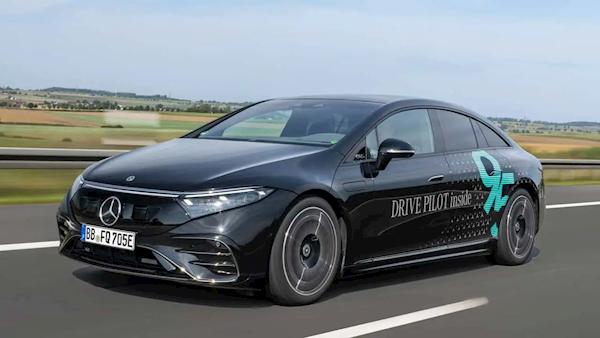
Mercedes-Benz has pulled its Level 3 system Drive Pilot off the new S-Class and the facelifted EQS, replaced it with the L2++ MB.DRIVE ASSIST PRO stack, and moved driver-free driving into a robotaxi programme with Momenta in Abu Dhabi. Read narrowly, this is a unit-economics and liability decision, not a loss of faith in software. Here is how CompanyWatch verifies a pivot like it: the record, the checks, the traps and the indicators.
What exactly changed at Mercedes-Benz?
Short answer: one automation tier has left the price list, the tier below it has been widened, and the top tier has moved out of the customer car and into a test fleet.
| Automation tier | System | Status on the new flagship | Who is responsible while it runs | Operating envelope |
|---|---|---|---|---|
| L3 | Drive Pilot | removed from the new S-Class and the facelifted EQS | Mercedes-Benz carries the liability in full | Top speed 64 km/h, congested motorway stretches, clear daytime weather, high-precision map coverage |
| L2++ | MB.DRIVE ASSIST PRO | the successor offer, first on the market in China, then the United States and Europe | the driver | point-to-point assist on motorways and in city traffic |
| L4 | S-Class prototypes co-developed with Momenta | public-road robotaxi testing in Abu Dhabi | not a customer product yet | fenced pilot operation, series production expected after 2030 |
The timeline anchors, in order: late 2021, the German Federal Motor Transport Authority approved Drive Pilot, making it the first production L3 system that could legally be used on public roads anywhere in the world; 2023, the system crossed into the American market with approvals in Nevada and California; January this year, the new S-Class appeared without it, and the facelifted EQS dropped the option as well.
Why did L3 stop paying for itself?
Because the price sat on the wrong side of the value. Drive Pilot let the driver take hands and eyes off the wheel, watch a video or play a game, with the liability resting on Mercedes-Benz — an impressive package that only worked while traffic crawled. Top speed capped at 64 km/h, motorway congestion required, daylight and good weather required, mapped roads required. The system was excellent at traffic creep and almost useless at the driving most buyers pay to automate.
The pricing made that trade explicit:
- Germany: an option priced between 5,000 and 9,000 euros.
- United States: a subscription of 2,500 US dollars per year.
- Usage: low demand and low frequency, according to the company's own reading, which is why the option quietly disappeared from the configurator.
Two external records explain why the envelope could not be widened cheaply. UN Regulation No. 157 on automated lane-keeping systems — the European type-approval gateway for L3 — originally confined activation to motorway-type roads at a maximum of 60 km/h; the later amendment series lifts the ceiling in principle to 130 km/h, but only if the system can execute a lane-change minimum risk manoeuvre above 60 km/h (UNECE text). In the United States, the California DMV permit covering Drive Pilot likewise limits it to highways, in daylight, at no more than 40 miles per hour — the same 64 km/h figure, in another unit. Regulatory permission, in other words, moved in centimetres while engineering cost moved in euros.
Arithmetic, flagged as our own: a 2,500-dollar annual subscription held for ten years costs 25,000 US dollars, roughly the price of a mid-range compact car, to buy a feature that switches on only in jams. Mercedes-Benz chief technology officer Joerg Burzer put the strategic version of this at a media roundtable: being first with a new technology does not mean it satisfies what customers actually need, and the Level 3 ambition was early rather than wrong (Road & Track).
What does MB.DRIVE ASSIST PRO actually deliver?
The replacement is not a lesser system, it is a wider one. It is an L2++ driving assistance package rated for the whole journey from start to destination: lane changes, crossing junctions, turning, and recognising and responding to traffic signals, on motorways and in urban roads alike.
| Hardware line (new S-Class, maximum fitment) | Quantity |
|---|---|
| Cameras | 10 |
| Millimetre-wave radars | 5 |
| Ultrasonic sensors | 12 |
| Total sensor set | 27 sensors |
| Compute platform | 254 TOPS |
The constraint travels with the label. Because this remains L2 partial automation, the driver keeps hands on the wheel and eyes on the road, and responsibility for the driving task stays with the driver. That is not a footnote; it is the commercial reason the package can be sold widely. Independent research into partial automation keeps returning to driver vigilance, which is why the Insurance Institute for Highway Safety runs a safeguard-rating programme that grades whether a system watches the driver's gaze and hand position and how it escalates warnings.
Sequence matters too: the system reached the Chinese market first, only then the United States and Europe. For an analyst, that ordering is evidence of a software-release strategy, not of regional preferences — validate the feature in the market where its co-development partner operates, then port it.
Is skipping L3 to reach L4 credible?
Yes on hardware, unproven on product — and that gap is the whole story. The new S-Class shown in January this year runs on the MB.OS architecture and, as NVIDIA described at launch, is built on the DRIVE Hyperion reference architecture with full-stack DRIVE AV software aimed at L4 (NVIDIA blog). The 254 TOPS compute figure sits inside that story: the car a customer buys today carries capability that no L2 tier legally uses yet.
The commercial first step is a fleet, not a driveway. Mercedes-Benz, Momenta and the local operator Lumo announced in December 2025 the start of an S-Class based L4 robotaxi programme, opening with public-road testing in Abu Dhabi, with Momenta separately reporting a Germany-wide L4 testing approval from the KBA (Momenta).
Joerg Burzer's own forecast keeps expectations honest: L4 vehicles are expected to reach series production after 2030 and then be rolled out in stages. A roadmap that needs an operator, a map, a regulation and a plant ramp-up cannot be pulled forward by a software update.
How should you verify a route pivot like this yourself?
Six steps, in order, using nothing but public sources:
- Diff the configurator, not the press release. Compare the S-Class and EQS order tools, in Germany and in the United States, month by month; option removal shows up there first.
- Pull the approval record. Type-approval status at the German Federal Motor Transport Authority, and permits in Nevada and California, outlive marketing claims by years.
- Read the tier language literally. L2++ is a capability label inside an L2 legal frame; only SAE L3 transfers responsibility to the manufacturer.
- Count the silicon. 27 sensors, 10 cameras, 5 millimetre-wave radars, 12 ultrasonic sensors and 254 TOPS tell you whether one stack is being reused across tiers or replaced.
- Map the partner structure. Momenta for L4 know-how, Lumo as the operating layer, NVIDIA for the architecture — each partnership is a dependency and a cost line.
- Price it against the financial backdrop. Group revenue in the first quarter of 2026 was 31.60 billion euros, down 4.9 percent year on year, with earnings before interest and taxes down 16.8 percent (Just Auto), which explains the appetite for a cheaper tier that reaches more cars.
CompanyWatch keeps a running file on comparable exit decisions: our playbook for a supplier walking away from a legacy line shows how to follow redirected investment rather than the announcement, and our review of a service shutdown shows what happens to paying users when a feature is retired.
Which readings of this pivot are wrong?
- Mistake one: "Mercedes-Benz has given up on automated driving." It removed one tier from two models; the testing budget went into L4 prototypes in Abu Dhabi.
- Mistake two: "L2++ means hands-off." The driver supervises continuously and carries the liability — that is the definition of L2.
- Mistake three: "the new S-Class was de-specced." A wider sensor-based assist system replaced a narrow, expensive, low-usage option.
- Mistake four: "L3 failed on safety." It was certified twice, in Germany and in the United States; it failed on usage, price and the cost of the approval envelope.
- Mistake five: "an L4-ready car is an L4 product." Architecture readiness is not regulatory approval, and the company's own timeline points to production after 2030.
- Mistake six: "subscribers keep what they bought." Anyone still paying 2,500 US dollars a year should check the continuity terms for existing vehicles rather than assume the feature set is permanent.
What should different readers do next?
| Reader | Recommended action | Why now |
|---|---|---|
| Equity analyst | Ask for attach rates and revenue per tier at the next results call; strip Drive Pilot out of any software-revenue forecast still carrying it | Configurator removal in January this year means this year's numbers are already clean |
| Competitor strategy team | Re-test your own L3 business case against the 64 km/h envelope and a 5,000 to 9,000 euro or 2,500 US dollar price point | Mercedes-Benz has just absorbed the reputational cost of proving that window too narrow |
| Fleet and leasing operators | Assist features that keep the driver liable are easier to deploy at fleet scale than responsibility-shifting L3 | Insurance and duty-of-care structures do not have to change |
| Prospective buyer | Check which market code the car carries, since the system arrived in China first, then the United States and Europe | Identical hardware, different feature availability |
Which indicators tell you the reset is working?
- Order-tool breadth: how many S-Class and EQS markets list MB.DRIVE ASSIST PRO, and how quickly the rollout moves from China to the United States and Europe.
- Cost-per-tier trend: whether the assist stack is bundled as standard equipment or sold as an option, which signals where the margin sits.
- Existing-owner handling: any technical-service bulletin or software update touching Drive Pilot cars already sold in Germany, Nevada and California.
- Regulatory unlock: national implementation of the UN Regulation No. 157 amendments above 60 km/h, the cheapest route to widening the L3 envelope without new hardware.
- Robotaxi milestones: the gap between testing and paid passenger operation in Abu Dhabi, and whether the Germany-wide L4 test approval converts into a second market.
- Language discipline: whether "L4-ready" survives in investor materials as production slips past 2030.
FAQ
Why did Mercedes-Benz remove Drive Pilot from the new S-Class?
Because the option's value did not match its price or its scope. It required congested motorway traffic, daylight, good weather and mapped roads, and capped speed at 64 km/h, while costing 5,000 to 9,000 euros in Germany or 2,500 US dollars a year in the United States. Demand stayed low, so the new S-Class launched in January this year without it, and the facelifted EQS followed.
Can the driver relax with MB.DRIVE ASSIST PRO?
No. It is L2++ in capability but L2 in law: hands on the wheel, eyes on the road, and the driver remains responsible for the driving task even though the system handles lane changes, junctions, turns and traffic signals from start to destination.
How many sensors does the new S-Class carry?
Up to 27 sensors: 10 cameras, 5 millimetre-wave radars and 12 ultrasonic sensors, running on a 254 TOPS compute platform — the same hardware base that supports the L4 software stack described by NVIDIA.
Is Level 3 finished for Mercedes-Benz?
Not formally, but it is off the current product path. The stated plan is to widen L2++ now and go directly to L4, which chief technology officer Joerg Burzer expects in series production only after 2030, introduced step by step.
Where is the L4 testing happening?
On public roads in Abu Dhabi, using S-Class prototypes developed with Momenta and operated together with Lumo, with a Germany-wide L4 testing approval reported separately.
Sources
- UNECE, UN Regulation No. 157 on automated lane-keeping systems — https://unece.org/sites/default/files/2023-12/R157e.pdf
- California DMV news release on the Mercedes-Benz automated driving system permit — https://www.dmv.ca.gov/portal/news-and-media/california-dmv-approves-mercedes-benz-automated-driving-system-for-certain-highways-and-conditions/
- NVIDIA blog on the new S-Class built on DRIVE AV, 29 January — https://blogs.nvidia.com/blog/mercedes-benz-l4-s-class-drive-av-platform/
- Momenta news item on the Abu Dhabi robotaxi programme with Mercedes-Benz and Lumo — https://www.momenta.cn/en/article/374.html
- Road & Track on the CTO's Level 3 remarks — https://www.roadandtrack.com/news/a74337420/mercedes-cto-level-3-autonomy-ambitions-were-early-focus-turns-to-level-2/
- WardsAuto on the 2026 S-Class technology shift — https://www.wardsauto.com/news/mercedes-benz-shifts-autonomous-driving-tech-in-2026-s-class/811431/
- Just Auto, Mercedes-Benz first-quarter 2026 results — https://www.just-auto.com/news/mercedes-benz-posts-lower-q1-profit/
- IIHS partial automation safeguard ratings — https://www.iihs.org/ratings/partial-automation-safeguards
GlobalBizSight CompanyWatch tracks single-company events and their business consequences. Corrections, documents or tips: info@globalbizsight.com. Written by Marc Hale.